Total Antioxidant Capacity Assay Kit (200 tests)
Total Antioxidant Capacity Assay Kit
Cat. No. FNK-AC01DE
Size 200 tests / 1 Kit
Storage 4°C
Description
Rapid (10 minutes) High Throughput Screening Assay Kit for Total Antioxidant Capacity (TAC) !
the underlying basis of oxidative stress, that is thought to be involved in the development of cancer, Parkinson’s disease, Alzheimer’s disease, atherosclerosis, heart failure etc.
Measurements of Total Antioxidant Capacity (TAC) were used as an integrated index rather than the simple sum of measurable antioxidants. It has been reported that patients of various disease and aged people exhibit low serum TAC levels.
Therefore, TAC is greatly expected as a marker of aging and diseases. Total Antioxidant Capacity Assay kit measures not only the TAC of biological fluid such as plasma, serum and urine etc. but also that of foods such as wine, beverage, tea etc. Antioxidants in the sample reduce Cu2+ to Cu+. Cu+ is chelated by bathocuproine and yields an orange colored complex. Since the intensity of the color formed is proportional to the TAC,TAC can be determined by measuring absorbance of the generated complex at wavelength 490 nm (430 nm to 510 nm).
Features and Benefits
- Copper Reduction Ability assay method
- Just 10 minutes assay
- Kit does not contain any hazardous components like cyanide or azide as preservative.
- Samples from any animal species can be measured.
- 2 points calibration - does not require multiple point measurement to make standard curve
- Samples : Serum, Plasma, Urine, foods such as wine, beverage and tea, etc.
- Simple Protocol
Protocol
Calculate TAC (copper reduction ability) of the samples by comparing the ΔOD of the samples to the ΔOD of standard
(1 mM ascorbic acid).
ΔODstandard = (OD2standard – OD1standard) – (OD2blank – OD1blank)
ΔODsample = (OD2sample – OD1sample) – (OD2blank – OD1blank)
Copper reduction ability
TAC (mM) = (ΔODstandard / ΔODsample) x 2
Kit Components
- R-A : Buffer solution (bathocuproine)
- R-B : Cupric ion (Cu2+) solution
- R-C : Stop solution
- Standard (STD) : Calibrator (Ascorbic acid 1.0mM)
Example
|
|
|
|
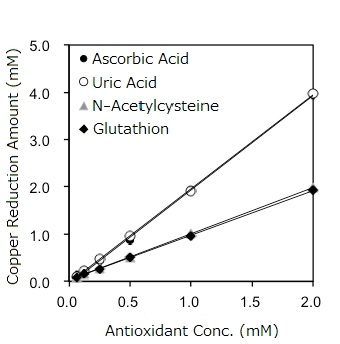
Fig.1 Total antioxidant capacities of various antioxidants |
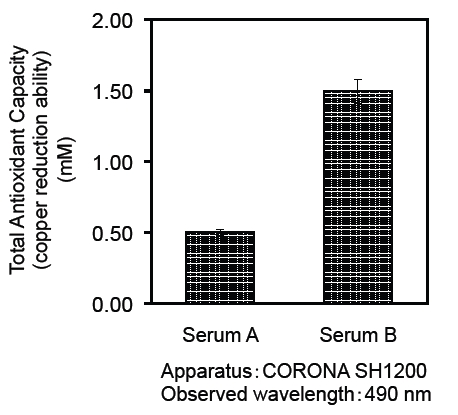
Fig.2 Total antioxidant capacities in bovine serum |
- Remove insoluble substances in serum and plasma samples by filtration or centrifugation.
- Hemolyzed sample cannot be used.
- Do not use EDTA for anticoagulant.
- Please use same type of blood collection tubes when TACs in plasma samples was compared.
(Some of anticoagulant has reduction ability.)
- Samples must be assayed fresh. If you want to store the samples, please keep in -20℃ and do not repeat freeze/ thawing cycle that causes damage to the samples
Note
- Reaction time has a significant impact on the accuracy and reproducibility of the measured values. Control the reaction time exactly. We recommend the use of multi-channel pipette.
- Use disposable test tube and glassware washed with 1 M HNO3 or 1 M HCl solution and distilled water.
- In the cell lysate or the tissue extract use as specimen, high concentration of proteins or lipid, may affect observed value. Please remove them by ultrafiltration or centrifugation.
- Accuracy in pipetting volume for samples and reagents may affect the quality of assay. Please note that samples, standards and Working Reagent must be poured accurately µL level.
- Temperature for chromogen reaction may affect optical density. Please try to extend or shorten chromogen reaction time depending on room temperature.
- Sample must be assayed fresh. If you stored the samples, please keep in -20 ℃.
- Repeated freeze/thawing causes damage to sample.
- Sample, which containing high concentration copper or copper chelating agent, may not be measured accurately.
- l Micro plate reader (Wavelength 430-510 nm)
- l 96 well
- l Pipette (5 µL)
- l Multi-cannel pipette (30µL, 70µL, 150µL) and reservoir.
- l Distilled water
Do not use a blood sampling tube with EDTA.
Hemolized sample cannot be used.
a biomedical tissue, extract it by the following method.
<Extracting method>
1.) Wash away blood from tissue with saline.
2.) Mince or homogenize the tissue.
3.) Add 10 mL of distilled water or lysis buffer to 10 g of the tissue.
4.) Centrifuge the mixture (10,000 rpm, 10 min, 4℃).
5.) Collect the supernatant and use it as a sample.
2. Assay preparation
Bring all reagents to under room temperature before use.
l Reconstitute of standards
Add distilled water to STD vial to dissolve ascorbic acid.
(The volume of distilled water to add is indicated on the label of the vial.)
3. Assay procedure
(255 µL per 1 assay sample)
OAssay
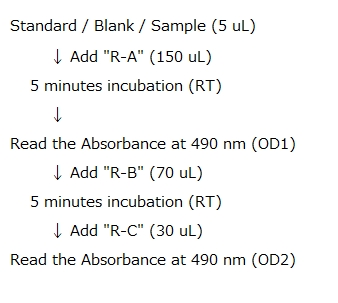
(1) Add 5 µL of distilled water (Blank) / STD / sample into each well.
(2) Add 150 µL of R-A to each well and incubate at room temperature for 5 min.
(3) Read the absorbance at 490 nm. →OD1
(4) Add 70 µL of R-B to each well and incubate at room temperature for 5 min.
(5) Add 30 µL of R-C to each well.
(6) Read the absorbance at 490 nm. →OD2
* Select the filter: 430 - 510 nm at 490 nm (main).
Imprecision Imprecision was evaluated using serum.
Within run
|
|
Mean mM |
S.D |
C.V % |
|
Level 1 |
0.33 |
0.01 |
6.10 |
|
Level 2 |
0.74 |
0.02 |
5.72 |
Run to run
|
|
Mean mM |
S.D |
C.V % |
|
Level 1 |
0.33 |
0.01 |
3.47 |
|
Level 2 |
0.74 |
0.03 |
2.71 |
- Campos C, Guzmán R, López-Fernández E, Casado A. Anal Biochem. “Evaluation of the copper(II) reduction assay using athocuproinedisulfonic acid disodium salt for the total antioxidant capacity assessment: the CUPRAC-BCS assay.” 2009 Sep 1;392(1):37-44. doi:10.1016/j.ab.2009.05.024. Epub 2009 May 21.
- Yuji Naito, Masaichi-Chang-il Lee, Yoji Kato, Ryoji Nagano, Yoshikazu Yonei “Oxidative Stress Markers.” Anti-Aging Medicine 7(5):36-44,2010