
Thermo T7 RNA polymerase, 7500U, 5 pack
Thermo T7 RNA polymerase, 7500U, 5 pack
Thermo T7 RNA polymeraseDescriptionThermo T7 RNA polymerase is a genetically modified T7 RNA polymerase exhibiting increased thermal stability. The optimum reaction temperature of this enzyme is around 50ºC. The half-life of the enzyme at…
Product Overview
Thermo T7 RNA polymerase
Description
Thermo T7 RNA polymerase is a genetically modified T7 RNA polymerase exhibiting increased thermal stability. The optimum reaction temperature of this enzyme is around 50ºC. The half-life of the enzyme at 50ºC is approximately 85 min.
Feature
- Exhibits greater specific activity than WT-enzyme at 37-50ºC.
Application
- RNA probe preparation
- RNA synthesis for in vitro translation
- RNA synthesis for RNA splicing studies
- Capped mRNA synthesis using a cap analogue
Products
| Product ID | Size | Order |
|---|---|---|
| TYB-TRL-201 | 7,500U, 50 U/uL | Order |
| TYB-TRL-201X5 | 7,500U x 5, 50 U/uL | current page |
| TYB-TRL-252 | 50,000U, 1000 U/uL | Order |
Source
E. coli strain that carries the cloned T7 RNA polymerase gene from T7 phage.
Unit Definition
One unit is defined as the amount of enzyme that will incorporate 1 nmole of [3H] rNTP into an acid insoluble material using T7 DNA as template in 60 min at 37ºC.
Storage Conditions
20 mM KPO4 (pH 7.5), 100 mM NaCl, 0.1 mM EDTA, 0.1 mM DTT, 0.01% Triton X-100, 50% Glycerol.
Store at -20ºC
Components
Thermo T7 RNA polymerase (50U/µL)
10×Buffer
Application Data
| Example 1. Comparison of heat stability | |
|---|---|
| The residual activities of WT and Thermo T7 RNA polymerases were measured after incubation for various periods at 48ºC and 50ºC, respectively. As a result, Thermo T7 RNA polymerase retained its activity after incubation for 15 min whereas the activity of WT-enzyme decreased to 1/10 after incubation for 5 min. | |
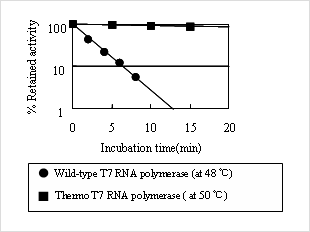 |
The half-lives of the enzymes have been estimated to be: WT T7 RNA polymerase: < 1.9 min. Thermo T7 RNA polymerase: 84.5 min. |
| Example 2. In vitro transcription at high temperature | |
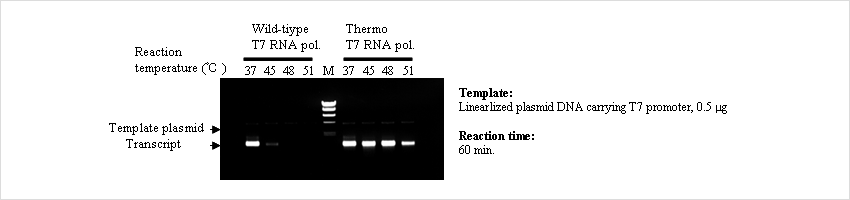
| In vitro transcription activities were compared between WT and Thermo T7 RNA polymerases. Distinct transcripts were detected on an agarose gel from 37 to 51ºC with Thermo T7 RNA polymerase. | |
 |
|
References
- K. Ishikawa, M. Watanabe, T. Kuroita, I. Uchiyama, J.M. Bujnicki, B. Kawakami, M. Tanokura, I. Kobayashi, Discovery of a novel restriction endonuclease by genome comparison and application of a wheat-germ-based cell-free translation assay: PabI (5'-GTA/C) from the hyperthermophilic archaeon Pyrococcus abyssi. Nucleic Acids Res. 3: e112 (2005).
- M. Itoh, I. Haga, Q.H. Li, J.Fujisawa, Identification of cellular mRNA targets for RNA-binding protein Sam68. Nucleic Acids Res. 30: 5452-64 (2002)
- M. Chamberlin and J. Ring. Characterization of T7-specific ribonucleic acid polymerase. 1. General properties of the enzymatic reaction and the template specificity of the enzyme. J Biol Chem. 248: 2235-44 (1973)
- M. Chamberlin and J. Ring. Characterization of T7-specific ribonucleic acid polymerase. II. Inhibitors of the enzyme and their application to the study of the enzymatic reaction. J Biol Chem. 248: 2245-50 (1973)

-diagnocine_600.jpg)