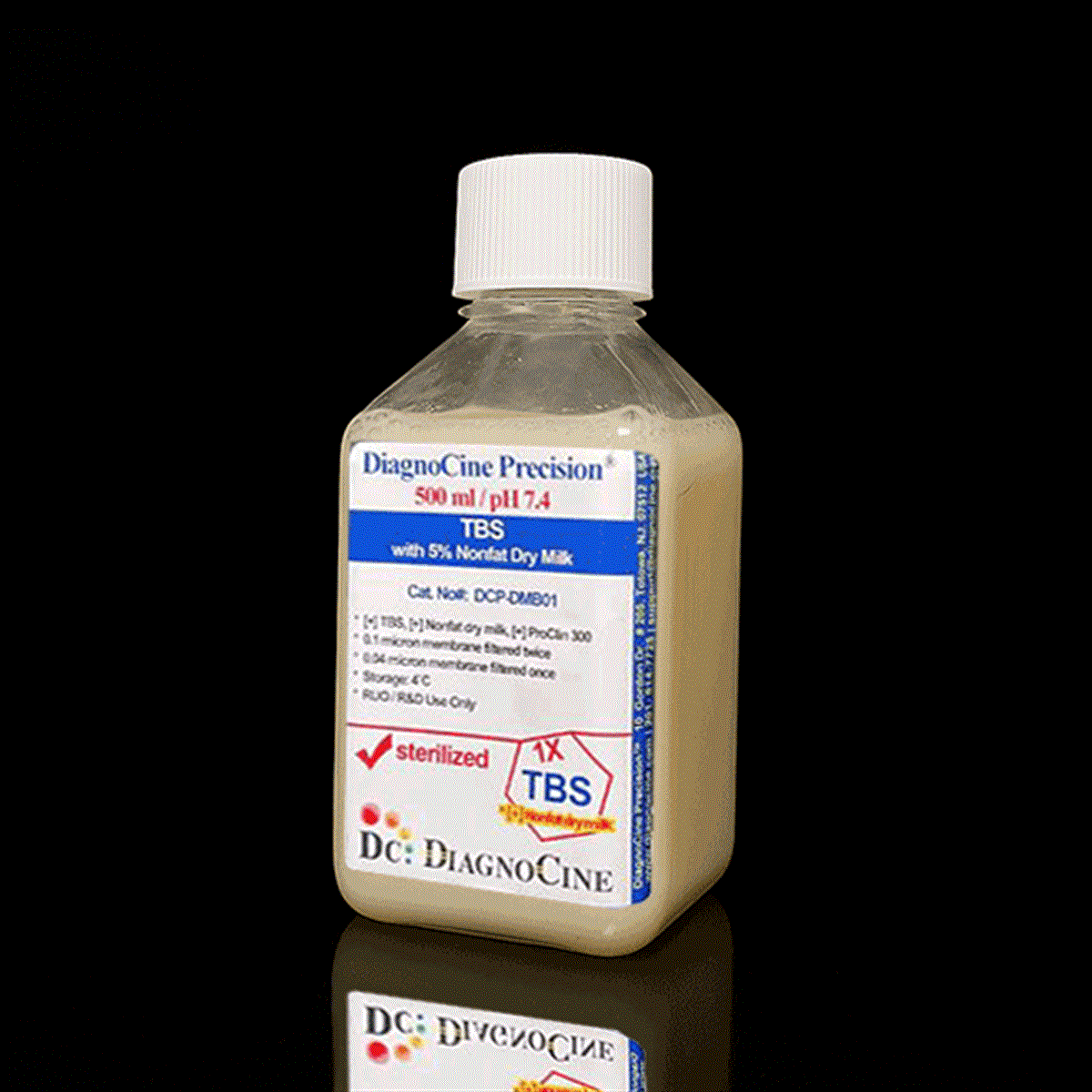
TBS with 5% Nonfat Dry Milk
TBS with 5% Nonfat Dry Milk
Research-grade Tris-buffered saline (TBS) formulated with 5% nonfat dry milk, a ready-to-use blocking and antibody dilution buffer for Western blotting, ELISA, and other protein-detection assays. Precise, stable pH and a defined 20 mM Tris-Base / 150 mM Sodium Chloride formulation support consistent antibody-antigen interactions. 0.1 µm filtration removes large particulates and aggregates, helping protect downstream applications.
- 0.1 µm membrane filtration for a clean, ready-to-use blocking buffer (nonsterile)
- pH 7.4 for optimal antibody-antigen interactions
- Defined 20 mM Tris-Base / 150 mM Sodium Chloride formulation
- 5% nonfat dry milk blocking protein with 0.05% ProClin 300 preservative
- DNase- and RNase-tested, non-detected under internal QC conditions
- Ready-to-use blocking and antibody dilution buffer for Western blot, ELISA, and immunoblotting
- Customizable concentration, pH, and additives available on request
- pH7.4
- Tris-Base20 mM
- Sodium Chloride150 mM
- Nonfat Dry Milk5%
- ProClin 3000.05%
- Filtration0.1 µm membrane filtration (single step)
- SterilityNonsterile
- Storage4°C
- Shelf Life1 year
- AppearanceClear, Colorless Liquid
Engineered where standard blocking buffers fail
Conventional milk-blocking buffers are often hand-mixed on the bench: inconsistent milk hydration, unfiltered particulates that clog and stain membranes, undefined pH, no nuclease testing, and no preservative to control microbial growth once opened. TBS with 5% Nonfat Dry Milk removes that variability with a defined, filtered, preserved, and quality-tested formulation.
0.1 µm filtered
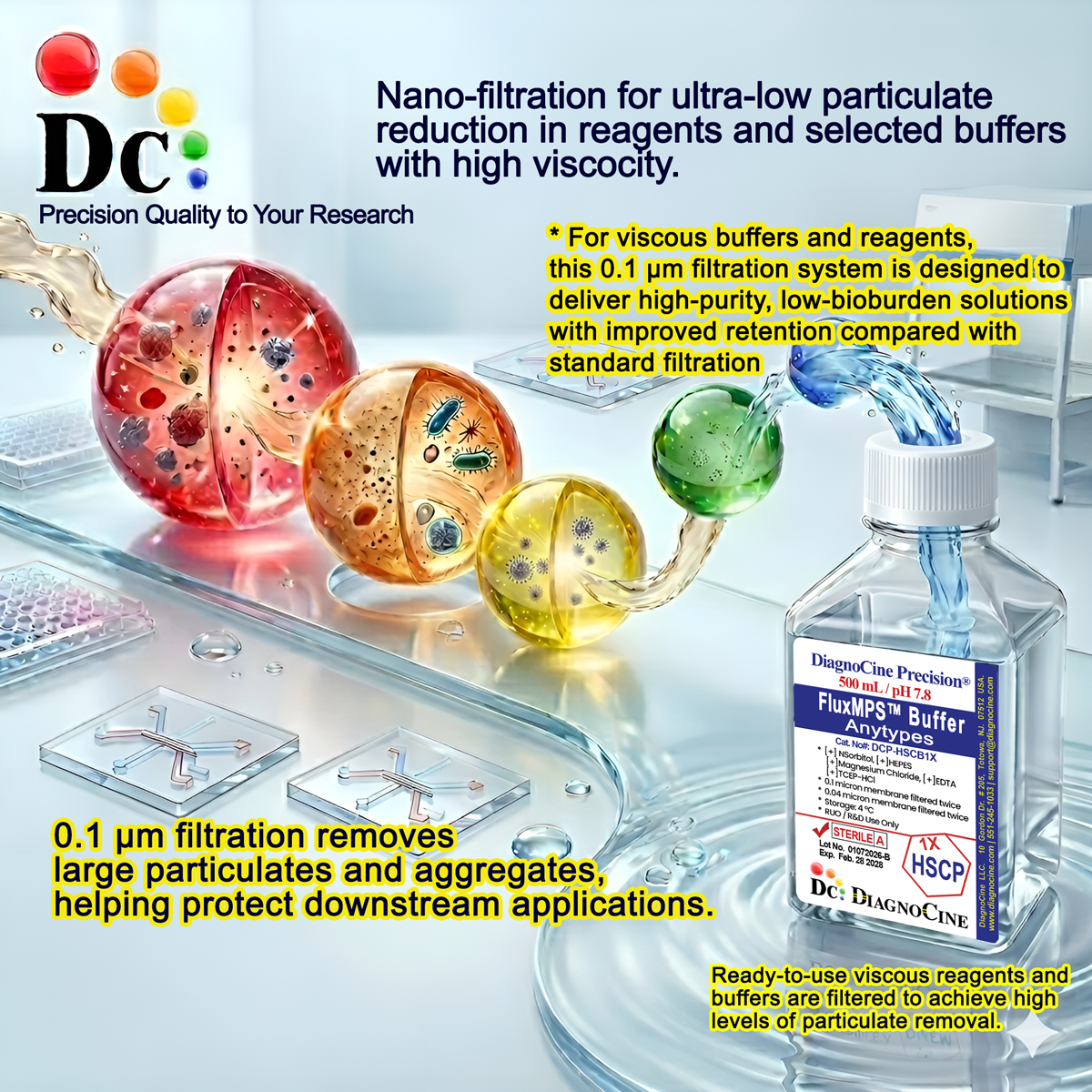
0.1 µm filtration removes large particulates and aggregates, helping protect downstream applications.
Precise, stable pH
Buffered to pH 7.4 with 20 mM Tris-Base, maintaining the stable pH environment needed for optimal antibody-antigen interactions and assay performance.
Ultrapure-grade water
Formulated with Ultrapure Type 1 water (18.2 MΩ·cm), consistent with USP <85> water-quality expectations for sensitive protein assays.
Low background for imaging & assays
5% nonfat dry milk provides a broad mixture of blocking proteins that reduces background banding and works with phospho-specific and total antibodies alike.
Defined, traceable composition
Every lot is formulated to a fixed 20 mM Tris-Base / 150 mM Sodium Chloride / 5% nonfat dry milk / 0.05% ProClin 300 recipe, with no undisclosed components.
Customization on demand
Alternate concentrations, added chemicals, compounds, proteins, supplements, and pH modifications are available — contact support@diagnocine.com.
0.1 µm membrane filtration
As a ready-to-use blocking buffer that carries functional Nonfat Dry Milk protein, DCP-DMB01 is passed through a 0.1 µm membrane. The product is supplied nonsterile for use as a bench blocking and antibody-dilution buffer.
-
1
0.1 µm Membrane Filtration
Removes large particulates and aggregates, helping protect downstream applications.
Filtration
0.1 µm filtration removes large particulates and aggregates, helping protect downstream applications.
© Diagnocine® — DCP-DMB01
Where TBS with 5% Nonfat Dry Milk is used
Formulated as a specialized blocking and antibody dilution solution, DCP-DMB01 supports Western blotting and related protein analysis techniques where a broad, multi-protein blocking matrix improves signal-to-noise performance.
Dot Blot & Protein Array Blocking
Blocks unoccupied binding sites on dot blot membranes and protein arrays to reduce non-specific antibody binding.
Antibody Dilution & Blot Washing
Serves as a dilution medium for primary and secondary antibodies and as a wash/dilution buffer in immunoblotting procedures.
iPSC-Derived Lysate Analysis
Blocking and antibody dilution support for Western blot validation of marker proteins in iPSC-derived cell lysates.
Endothelial Signaling Protein Detection
Reduces background in Western blot detection of endothelial and primary cell signaling proteins.
Western Blot Blocking & Detection
Nonfat dry milk proteins occupy vacant binding sites on the membrane, reducing background noise and improving signal-to-noise ratio.
Downstream Target Validation
Supports Western blot confirmation of protein targets identified in live-cell imaging and biosensor experiments.
Full specification sheet
Physical, chemical, storage, and regulatory parameters for DCP-DMB01.
| Parameter | Specification |
|---|---|
| Formulation / Composition | Tris-buffered saline (TBS) with 5% nonfat dry milk |
| Appearance | Clear, Colorless Liquid |
| pH USP <791> | 7.4 |
| Tris-Base concentration | 20 mM |
| Sodium Chloride concentration | 150 mM |
| Nonfat Dry Milk | 5% |
| ProClin 300 | 0.05% |
| Parameter | Specification |
|---|---|
| Sterility | Nonsterile |
| Filtration | 0.1 µm membrane filtration (single step) |
| DNase activity | None detected after incubation of plasmid DNA with this product for 18 hr at room temperature |
| RNase activity | None detected after incubation of ribosomal RNA with this product for 18 hr at room temperature |
| Parameter | Specification |
|---|---|
| Storage temperature | 4°C |
| Shelf life | 1 year |
| Parameter | Specification |
|---|---|
| Manufacturing QMS ISO 13485 | Manufactured under ISO 13485-certified facilities (Suppliers of DiagnoCine Precision) |
| Production method | Final packaging, quality assurance, and testing performed at the DiagnoCine R&D and Quality Testing Center |
| Customization location | Custom requests and assembly accomplished at DiagnoCine Precision, Totowa, New Jersey, USA |
| Intended use | Research Use Only (RUO) |
Full composition
DCP-DMB01 is formulated to a fixed blocking-buffer recipe; concentrations shown reflect the released formulation.
| Component | CAS Number | Concentration |
|---|---|---|
| Nonfat Dry Milk | 5% | |
| ProClin 300 | 0.05% | |
| Tris-Base | 77-86-1 | 20 mM |
| Sodium Chloride | 7647-14-5 | 150 mM |
Manufacturing & compliance
DCP-DMB01 is manufactured, filled, and tested under a documented quality system with full traceability from raw materials to final packaging.
ISO 13485:2016 QMS
Manufactured under ISO 13485-certified facilities (Suppliers of DiagnoCine Precision).
Ultrapure Type 1 Water
Formulated with Ultrapure Type 1 water (18.2 MΩ·cm) as the base for a stable, low-background buffer.
Dedicated QA & R&D Testing
Final packaging, quality assurance, and testing are completed at the DiagnoCine R&D and Quality Testing Center.
Micro-Batch Precision
All final packaging, quality assurance, and testing are completed at the DiagnoCine R&D and Quality Testing Center.
DNase / RNase Testing
No DNase activity detected after incubation of plasmid DNA with this product for 18 hr at room temperature; no RNase activity detected after incubation of ribosomal RNA with this product for 18 hr at room temperature.
pH Verification
Buffer is verified to pH 7.4 using 20 mM Tris-Base and 150 mM Sodium Chloride.
Custom Assembly Site
All specific customization requests and assembly were accomplished at DiagnoCine Precision in Totowa, New Jersey, USA.
Documentation / CoA
Certificate of Analysis available covering appearance, pH, DNase and RNase testing.
How DCP-DMB01 compares
A side-by-side look at purity practices and formulation control versus conventional blocking buffers.
| Parameter | DCP-DMB01 | Conventional buffer | Standard alternative |
|---|---|---|---|
| Blocking protein source | 5% nonfat dry milk (multi-protein blend) | Single-protein (e.g., BSA) | Single-protein (e.g., BSA) |
| DNase / RNase tested | check_circle | cancel | cancel |
| Manufactured under ISO 13485 | check_circle | cancel | cancel |
| Custom formulation available | check_circle | cancel | cancel |
Frequently asked questions
Common questions about DCP-DMB01, TBS with 5% Nonfat Dry Milk.
Supporting literature
Curated literature on blocking chemistry, Tris-buffered saline, and immunoblotting relevant to DCP-DMB01.
- Mahmood T, Yang PC. Western blot: technique, theory, and trouble shooting. N Am J Med Sci. 2012. doi:10.4103/1947-2714.100998
- Kurien BT, Scofield RH. Western blotting: an introduction. Methods Mol Biol. 2015. doi:10.1007/978-1-4939-2694-7_3
- Gao L, et al. Comparison of milk and BSA as blocking agents in Western blot analysis. Anal Biochem. 2012. doi:10.1016/j.ab.2012.03.007
- Zhukova E, et al. Comparative evaluation of blocking reagents in immunoblot assays for phospho-specific antibody detection. J Immunol Methods. 2013. doi:10.1016/j.jim.2013.01.005
- Bass JJ, et al. An overview of technical considerations for Western blotting applications to physiological research. Scand J Med Sci Sports. 2017. doi:10.1111/sms.12599
- Alegria-Schaffer A, et al. Performing and optimizing Western blots with an emphasis on chemiluminescent detection. Methods Enzymol. 2009. doi:10.1016/S0076-6879(08)03610-5