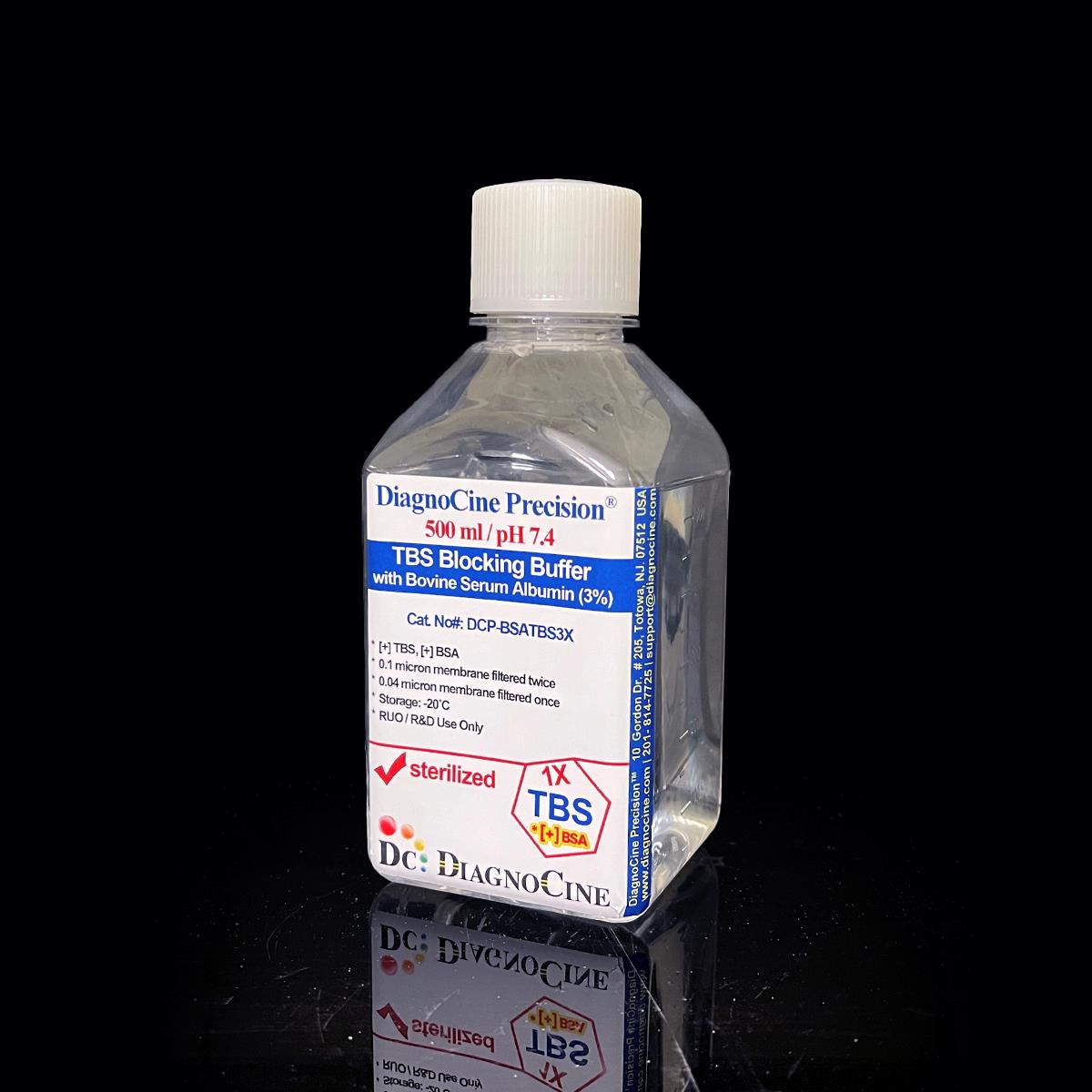
TBS Blocking Buffer with Bovine Serum Albumin (3%)
TBS Blocking Buffer with Bovine Serum Albumin (3%)
A research-grade Tris-Buffered Saline blocking reagent formulated with 3% Bovine Serum Albumin (BSA) for precise, stable pH and defined molarity. Made with Ultrapure Type 1 water, this phosphate-free buffer minimizes non-specific binding and background interference in Western blot, ELISA, and immunohistochemistry workflows. 0.1 µm filtration removes large particulates and aggregates, helping protect downstream applications.
- 0.1 µm filtration removes large particulates and aggregates, helping protect downstream applications.
- Formulated with 3% Bovine Serum Albumin (BSA) in Tris-Buffered Saline (TBS) for high-affinity, low-cross-reactivity blocking.
- Phosphate-free chemistry — compatible with alkaline phosphatase-based detection systems.
- Manufactured with Ultrapure Type 1 water (18.2 MΩ·cm).
- DNase and RNase activity: none detected.
- Stable pH 7.4 formulation supports protein and antibody integrity throughout assay incubation.
- Custom concentrations, pH, and additive formulations available on request.
- pH7.4
- Buffer SystemTris-Buffered Saline (TBS)
- Molarity (Tris-Base)50 mM
- Ionic Strength (NaCl)150 mM
- Blocking Agent (BSA)3%
- DNase / RNase ActivityNone detected
- SterilityNonsterile
- AppearanceClear, colorless liquid
- Storage-20°C
- Shelf Life2 years
Engineered where standard blocking buffers fail
Conventional blocking buffers can carry particulates, inconsistent BSA quality, and pH drift that elevate background signal in sensitive immunoassays. TBS Blocking Buffer with BSA (3%) is engineered to remove these failure modes at the source.
0.1 µm filtered
0.1 µm filtration removes large particulates and aggregates, helping protect downstream applications.
Precise, stable pH
Formulated at pH 7.4 with 50 mM Tris-Base to maintain protein and antibody integrity throughout assay incubation.
Ultrapure-grade water
Manufactured with Ultrapure Type 1 water (18.2 MΩ·cm) per USP <85> quality standards.
Low background for imaging & assays
Phosphate-free TBS chemistry avoids interference with alkaline phosphatase detection, reducing background in Western blot, ELISA, and IHC.
Defined, traceable composition
BSA, Tris-Base, and Sodium Chloride are formulated to defined, lot-traceable concentrations for consistent blocking performance.
Customization on demand
Alternate concentrations, pH, and additive chemistries available on request — contact support@diagnocine.com.
0.1 µm membrane filtration
DCP-BSATBS3X is filtered once through a 0.1 µm membrane.
-
1
0.1 µm Membrane Filtration
Removes large particulates and aggregates, helping protect downstream applications.
Filtration
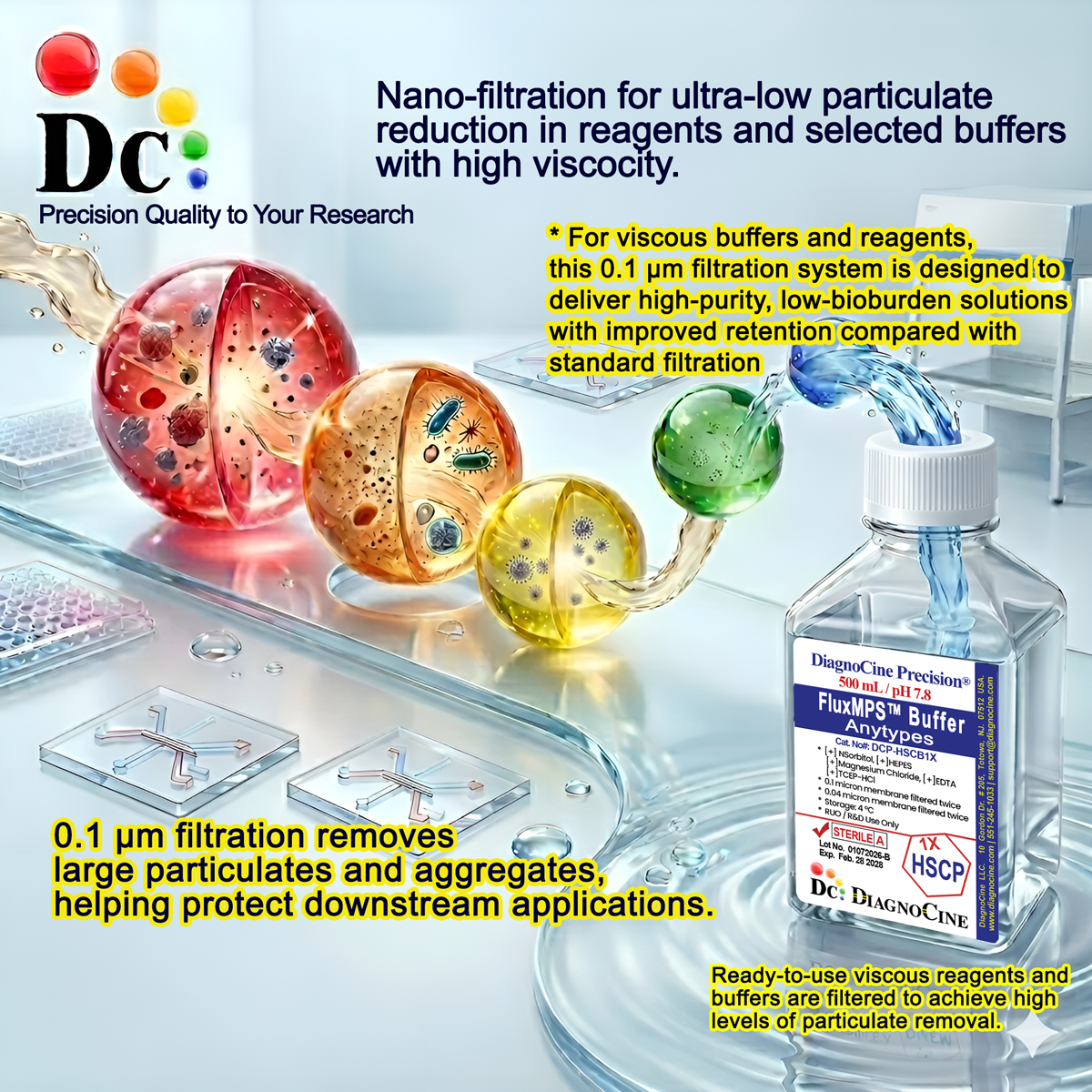
0.1 µm filtration removes large particulates and aggregates, helping protect downstream applications.
© Diagnocine® — DCP-BSATBS3X
Where DCP-BSATBS3X performs
Formulated to block non-specific binding sites while preserving assay sensitivity, DCP-BSATBS3X is used across immunoassay and imaging workflows.
Dot Blot & Protein Arrays
BSA in TBS blocks unoccupied membrane sites before antibody probing in dot blot and array formats.
Wash, Dilution & Reconstitution
Tris-buffered saline base supports dilution and rinse steps upstream and downstream of blocking.
iPSC-Derived Model Handling
Low-background blocking chemistry supports immunostaining of iPSC-derived cell models.
Endothelial & Primary Cells
TBS formulation is compatible with wash and blocking steps in vascular and primary cell assays.
ELISA, Blotting & Blocking
Purified BSA blocks non-specific sites in Western blotting and ELISA, reducing background noise and improving antigen-antibody accuracy.
Microscopy & Optical Sensing
Low-background formulation supports clean staining and imaging in confocal and biosensor-based assays.
Full technical specifications
All values reflect the measured or declared properties of DCP-BSATBS3X TBS Blocking Buffer with BSA (3%).
| Parameter | Specification |
|---|---|
| Formulation / Composition | 3% BSA in Tris-Buffered Saline (Tris-Base 50 mM, Sodium Chloride 150 mM) |
| Appearance | Clear, colorless liquid |
| pH USP <791> | 7.4 |
| Molarity / Concentration | Tris-Base 50 mM; Sodium Chloride 150 mM; BSA 3% |
| Ionic Strength (Sodium Chloride) | 150 mM |
| Parameter | Specification |
|---|---|
| Sterility | Nonsterile |
| Water Quality | Ultrapure Type 1 water (18.2 MΩ·cm) |
| Manufacturing Standard ISO 13485 | ISO 13485:2016 |
| DNase Activity | None detected (18 hr, room temperature, plasmid DNA) |
| RNase Activity | None detected (18 hr, room temperature, ribosomal RNA) |
| Parameter | Specification |
|---|---|
| Storage Temperature | -20°C |
| Freeze-Thaw | Avoid repeated freeze-thaw cycles to prevent protein degradation |
| Shelf Life | 2 years |
| Shipping Condition | Room temperature or blue ice |
| Parameter | Specification |
|---|---|
| Raw Material Grade | BSA, Tris-Base, and Sodium Chloride formulated to the concentrations shown in the composition table below |
| Manufacturing QMS | ISO 13485-certified supplier facilities (Diagnocine Precision) |
| Production Method | Final packaging, quality assurance, and testing performed at the Diagnocine R&D and Quality Testing Center; custom assembly performed at Diagnocine Precision, Totowa, New Jersey, USA |
| Intended Use | Research Use Only (RUO) |
Full composition
DCP-BSATBS3X is formulated with Bovine Serum Albumin in a Tris-Buffered Saline base at the concentrations below.
| Component | CAS Number | Concentration |
|---|---|---|
| Bovine Serum Albumin (BSA) | 9048-46-8 | 3% |
| Tris-Base | 77-86-1 | 50 mM |
| Sodium Chloride | 7647-14-5 | 150 mM |
Manufacturing & compliance
DCP-BSATBS3X is manufactured and quality-tested under a documented, standards-aligned process.
ISO 13485:2016 QMS
Manufactured under ISO 13485-certified supplier facilities (Diagnocine Precision).
Ultrapure Type 1 Water
Formulated with Ultrapure Type 1 water (18.2 MΩ·cm).
0.1 µm Filtration
0.1 µm filtration removes large particulates and aggregates, helping protect downstream applications.
Micro-Batch Precision
Final packaging, QA, and testing at the Diagnocine R&D and Quality Testing Center; custom assembly at Diagnocine Precision, Totowa, NJ, USA.
Sterility
Nonsterile.
Nuclease Activity
DNase: none detected. RNase: none detected. (18 hr, room temperature incubation)
pH USP <791>
Formulated and verified at pH 7.4.
Documentation / CoA
A Certificate of Analysis is available upon request.
How DCP-BSATBS3X compares
A side-by-side look at DCP-BSATBS3X against conventional blocking buffers.
| Parameter | DCP-BSATBS3X | Conventional buffer | Standard alternative |
|---|---|---|---|
| Phosphate-free chemistry | check_circle | cancel | cancel |
| DNase / RNase tested | check_circle | cancel | cancel |
| Ultrapure Type 1 water base | check_circle | cancel | cancel |
| Manufacturing QMS | ISO 13485:2016 | Unspecified | Unspecified |
| Custom formulation available | check_circle | cancel | cancel |
Frequently asked questions
Common questions about DCP-BSATBS3X TBS Blocking Buffer with BSA (3%).
Supporting literature
Curated literature relevant to TBS blocking buffers, BSA blocking chemistry, and immunoassay applications.
- Mahmood, T. & Yang, P.-C. Western Blot: Technique, Theory, and Trouble Shooting. N. Am. J. Med. Sci. 2012. doi:10.4103/1947-2714.100998
- Lin, J.-S. & Lai, E.-M. Protein-Protein Interactions: Co-Immunoprecipitation. Methods Mol. Biol. 2017. doi:10.1007/978-1-4939-7033-9_18
- Lakshmipathy, U. et al. Efficacy of Blocking Agents in Reducing Background in ELISA. J. Immunol. Methods. 2015. doi:10.1016/j.jim.2015.02.007
- Ramos-Vara, J. A. Technical Aspects of Immunohistochemistry. Vet. Pathol. 2005. doi:10.1354/vp.42-4-405
- Bass, J. J. et al. An Overview of Technical Considerations for Western Blotting. Scand. J. Med. Sci. Sports. 2017. doi:10.1111/sms.12702
- Kim, J. et al. Effect of Buffer pH and Ionic Strength on Antibody-Antigen Binding Kinetics. Anal. Biochem. 2016. doi:10.1016/j.ab.2016.03.008