- Home
- FluxMPS™ Glasgow's Minimum Essential Medium (GMEM), High Glucose with Tryptose Phosphate Broth w/o Sodium Bicarbonate(TPB): 1X Liquid
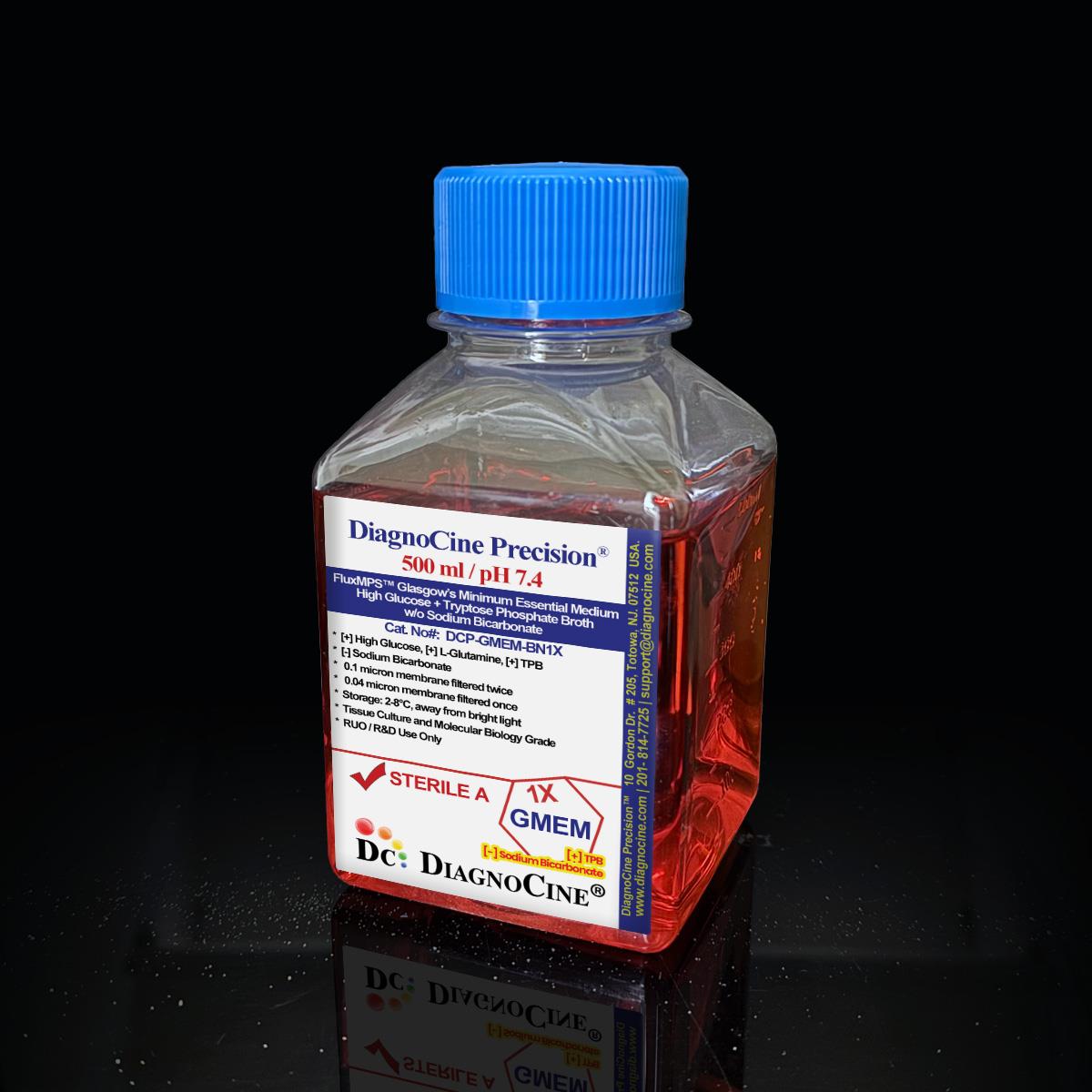
FluxMPS™ Glasgow's Minimum Essential Medium (GMEM), High Glucose with Tryptose Phosphate Broth w/o Sodium Bicarbonate(TPB): 1X Liquid
FluxMPS™ Glasgow's Minimum Essential Medium (GMEM), High Glucose with Tryptose Phosphate Broth w/o Sodium Bicarbonate (TPB): 1X Liquid
ureFluxMPS™ DCP-GMEM-BN1X is a Microfluidics Suitable, quadruple-stage ultra-filtered (0.1 µm ×2 + 0.04 µm ×2) 1X liquid Glasgow's Minimum Essential Medium (GMEM) formulated with high glucose and Tryptose Phosphate Broth (TPB), without sodium bicarbonate. It is engineered for microfluidic channels, organ-on-a-chip (OoC) and microphysiological system (MPS) platforms requiring ultra-low particulate and endotoxin backgrounds.
- High-glucose (4500 mg/L / 4.5 g/L) GMEM base supplemented with Tryptose Phosphate Broth (2950 mg/L), commonly used for BHK-21 and other fastidious cell lines
- Bicarbonate-free formulation — buffering strategy selectable by the end user for open or closed culture systems
- Quadruple-stage filtration train (0.1 µm ×2 + 0.04 µm ×2) reaching a 0.04 µm final polish
- Endotoxin release specification < 0.05 EU/mL (LAL, USP <85>), tested per manufacturing batch
- pH 7.4, manufactured under an ISO 13485:2016 quality management system
- 30 verified ingredients across inorganic salts, amino acids, vitamins and TPB, with CAS traceability
- Custom pH, glucose, salts and nutrient modifications available on request
- Formulation[+] L-Glutamine, [+] Phenol Red, [+] Calcium, [+] Magnesium, [+] Glucose, [-] Sodium Bicarbonate
- Glucose4500.000 mg/L
- Tryptose Phosphate Broth2950.000 mg/L
- pH (USP <791>)7.4
- Osmolality (USP <785>)Contact for specification
- Endotoxin (USP <85>)< 0.05 EU/mL
- Filtration0.1 µm ×2 + 0.04 µm ×2 (Quadruple-stage)
- Storage2–8°C, protect from light
- Shelf Life12 months from date of manufacture, unopened
- ShippingCold pack
Engineered where standard media fails
Conventional 0.22 µm–filtered media passes mycoplasma-sized organisms, subvisible particulates, and endotoxin fragments that confound sensitive on-chip assays.
Microchannel-safe purity
0.04 µm final filtration with USP <788> Method 1 (light obscuration) particulate compliance, suited to microfluidic chips sensitive to channel fouling.
Total metabolic control
A defined high-glucose, TPB-supplemented, bicarbonate-free base lets you set the carbon source, buffer system and metabolic inputs of your experimental system.
Ultrapure-grade water
18.2 MΩ·cm Type 1 water (ASTM D1193 / ISO 3696) with trace-metal and organic carbon (TOC) control at the point of manufacture.
Low background for imaging
Rigorous particulate control supports confocal microscopy, biosensor measurements and other imaging workflows on-chip. Note this formulation contains phenol red and riboflavin, which contribute optical background independent of particulate filtration.
Rich, stable nutrient profile
30 verified ingredients per lot across inorganic salts, amino acids, vitamins and Tryptose Phosphate Broth. Full CAS traceability, micro-batch precision manufacturing.
Customization on demand
pH, glucose concentration, salts, buffer system and nutrient composition available on request — contact support@diagnocine.com.
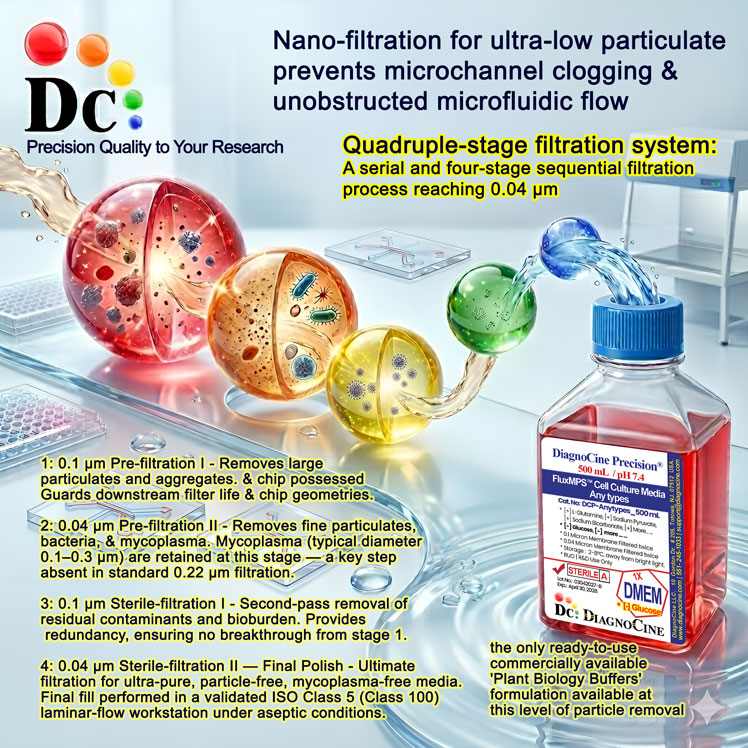
Quadruple-stage filtration system
Four filtration passes — two paired 0.1 µm prefilter / 0.04 µm final-filter stages, each 0.04 µm final filter protected by its own dedicated 0.1 µm prefilter — reach a 0.04 µm final pore size, well below the 0.22 µm typical of conventional cell culture media.
-
1
0.1 µm Prefiltration I
Removes large particulate, cell debris and protein aggregates; protects the first 0.04 µm final-filter cartridge.
-
2
0.04 µm Final filtration I
First 0.04 µm pass; retains sub-micron particulates and microaggregates that a 0.22 µm filter passes.
-
3
0.1 µm Prefiltration II
Second dedicated prefilter, protecting the second 0.04 µm final-filter cartridge.
-
4
0.04 µm Final filtration II — Polish
Ultimate polishing filter; aseptic fill & finish under ISO Class 5 (Class 100) conditions.
Purity architecture
DCP-GMEM-BN1X is processed through two paired prefilter/final-filter passes (0.1 µm ×2 + 0.04 µm ×2), giving full redundancy at the 0.04 µm final cut-off.
© Diagnocine® — DCP-GMEM-BN1X
OoC and MPS applications
FluxMPS™ DCP-GMEM-BN1X delivers Microfluidics Suitable purity for organ-on-a-chip and microfluidic applications.
Automated Bioreactors & Robotics
An optional 0.01 µm (10 nm) MPS Grade variant is available on request for automated bioreactors and robotic perfusion systems requiring the finest available cut-off.
- Total Particulate Exclusion: 10 nm filtration removes nanoparticulate aggregates that foul automated systems
- Valve & Sensor Protection: Reduces micro-fouling in automated perfusion and recirculation systems
- Extended Perfusion Stability: Consistent nutrient delivery over long-duration culture runs
Inquiry Required: Contact support@diagnocine.com to request the 0.01 µm MPS Grade variant.
Micro Physiological System (MPS) & Chip
0.04 µm filtered media for organ-on-a-chip, tissue-on-a-chip and body-on-a-chip applications where particle-free media reduces channel fouling.
Fastidious & Virus-Permissive Cell Lines
Tryptose Phosphate Broth supplementation supports BHK-21 and related fastidious cell lines historically used in virus production and vaccine research.
iPSC-Derived Models
Ultra-clean base for iPSC differentiation protocols requiring defined, particulate-free media.
Endothelial & Primary Cells
Particle-free formulation for primary cells and endothelial monolayer studies on-chip.
Metabolic Flux Analysis
Defined formulation for ¹³C isotope tracing and NMR metabolomics. Not compatible with Agilent Seahorse XF assays, which require bicarbonate-free, phenol red-free medium; this formulation contains phenol red.
Microscopy & Optical Sensing
Ultra-low particulate background for confocal microscopy, biosensor measurements, and TEER monitoring on-chip.
Analytical release specifications
Every lot released against the full specification matrix. Certificate of Analysis available: support@diagnocine.com.
| Parameter | Specification |
|---|---|
| Formulation | [+] L-Glutamine, [+] Phenol Red, [+] Calcium, [+] Magnesium, [+] Glucose, [-] Sodium Bicarbonate |
| Appearance | Red to pink-red, clear liquid (phenol red pH indicator present) |
| Total ingredients | 30 |
| pH USP <791> | 7.4 |
| Osmolality USP <785> | Contact for specification |
| Glucose | 4500.000 mg/L |
| L-Glutamine | 292.000 mg/L |
| Tryptose Phosphate Broth | 2950.000 mg/L |
| Phenol Red | 15.000 mg/L |
| Parameter | Specification |
|---|---|
| Endotoxin USP <85> BET | < 0.05 EU/mL |
| Sterility USP <71> | No growth / 14 days |
| Mycoplasma | 0.1 µm mycoplasma-retentive filtration (not tested per lot) |
| Particulate ≥10 µm USP <788> Method 1 | NMT 25/mL |
| Particulate ≥25 µm USP <788> Method 1 | NMT 3/mL |
| Water purity | Type 1, 18.2 MΩ·cm |
| Manufacturing std. ISO | ISO 13485:2016 |
| Fill environment | ISO Class 5 (Class 100) |
| Parameter | Specification |
|---|---|
| Storage temperature | 2–8°C, protect from light |
| Freeze-thaw | Do not freeze |
| Shelf life | 12 months from date of manufacture, unopened |
| Shipping condition | Cold pack |
| CO2 requirement | Bicarbonate-free formulation; validate CO2 per your buffering system & incubator — contact for specification |
| Available pack sizes | 500 mL, 1000 mL |
| Parameter | Specification |
|---|---|
| Raw material grade | Reagent / cell culture grade |
| Traceability | Full lot traceability per ISO 13485 |
| Manufacturing QMS ISO | ISO 13485:2016 certified |
| UNSPSC | 41116155 — Molecular biology and cell culture growth media (UNv260801) |
| Regulatory alignment | 21 CFR Part 820 (QMSR) aligned |
| Production method | Micro-batch, per-lot QC release |
| Intended use | Research Use Only (RUO) |
Full composition (mg/L)
Glasgow's Minimum Essential Medium (GMEM), High Glucose with Tryptose Phosphate Broth w/o Sodium Bicarbonate: 1X Liquid — 30 ingredients verified per lot with CAS numbers for raw-material traceability. All ingredients from the original formulation are preserved exactly.
| Component | CAS Number | mg/L |
|---|---|---|
| INORGANIC SALTS | ||
| Calcium chloride dihydrate | 10035-04-8 | 265.000 |
| Ferric nitrate nonahydrate | 7782-61-8 | 0.100 |
| Magnesium sulfate anhydrous | 7487-88-9 | 97.720 |
| Potassium chloride | 7447-40-7 | 400.000 |
| Sodium chloride | 7647-14-5 | 6400.000 |
| Sodium dihydrogen phosphate anhydrous | 7558-80-7 | 109.000 |
| Component | CAS Number | mg/L |
|---|---|---|
| AMINO ACIDS | ||
| L-Arginine hydrochloride | 1119-34-2 | 42.000 |
| L-Cystine | 30925-07-6 | 24.000 |
| L-Glutamine | 56-85-9 | 292.000 |
| L-Histidine hydrochloride | 5934-29-2 | 21.000 |
| L-Isoleucine | 73-32-5 | 52.400 |
| L-Leucine | 61-90-5 | 52.400 |
| L-Lysine hydrochloride | 657-27-2 | 73.100 |
| L-Methionine | 63-68-3 | 15.000 |
| L-Phenylalanine | 63-91-2 | 33.000 |
| L-Threonine | 72-19-5 | 47.600 |
| L-Tryptophan | 73-22-3 | 8.000 |
| L-Tyrosine Disodium salt | 69847-45-6 | 52.000 |
| L-Valine | 72-18-4 | 46.800 |
| Component | CAS Number | mg/L |
|---|---|---|
| VITAMINS | ||
| Choline chloride | 67-48-1 | 2.000 |
| D-Ca-Pantothenate | 137-08-6 | 2.000 |
| Folic acid | 59-30-3 | 2.000 |
| Nicotinamide | 98-92-0 | 2.000 |
| Pyridoxal hydrochloride | 65-22-5 | 2.000 |
| Riboflavin | 83-88-5 | 0.200 |
| Thiamine hydrochloride | 67-03-8 | 2.000 |
| i-Inositol | 87-89-8 | 3.600 |
| OTHERS | ||
| D-Glucose | 50-99-7 | 4500.000 |
| Phenol red sodium salt | 34487-61-1 | 15.000 |
| Tryptose Phosphate Broth | 2950.000 | |
ISO 13485 manufacturing & compliance
Every batch of FluxMPS™ DCP-GMEM-BN1X is manufactured under a certified ISO 13485:2016 QMS with full lot traceability and multi-parameter QC release testing.
ISO 13485:2016 QMS
Full quality management system with documented procedures, deviation control and CAPA. Every lot traceable from raw material to final release.
Ultrapure Type 1 Water
18.2 MΩ·cm resistivity, ASTM D1193 / ISO 3696 Type 1 water, with trace-metal and organic carbon (TOC) control at the manufacturing source.
ISO Class 5 Fill & Finish
Final aseptic filling in ISO Class 5 (Class 100) cleanroom. Immediate post-filtration fill to prevent recontamination.
Micro-Batch Precision
Small-batch manufacturing with per-lot QC release. Every batch tested independently — not pooled or blended across lots.
Endotoxin USP <85> BET
LAL-based endotoxin test per batch. Release specification: < 0.05 EU/mL; assay sensitivity 0.005 EU/mL.
Particulate USP <788> Method 1
Light obscuration particulate count test. NMT 25/mL at ≥10 µm; NMT 3/mL at ≥25 µm.
Osmolality USP <785>
Osmolality verified per lot using vapor pressure or freezing-point depression osmometry per USP <785>.
Documentation / CoA
Full Certificate of Analysis available per lot. Includes all QC parameters, test dates and raw material lot numbers. Request: support@diagnocine.com.
- Endotoxin — LAL assay, USP <85> Bacterial Endotoxins Test; assay sensitivity 0.005 EU/mL; release specification < 0.05 EU/mL
- pH, osmolality, conductivity, appearance and clarity
- Sterility
How DCP-GMEM-BN1X compares
FluxMPS™ versus conventional 0.22 µm filtered media for OoC and MPS applications.
| Parameter | DCP-GMEM-BN1X (FluxMPS™) | Conventional 0.22 µm Filtered | Standard Alternative |
|---|---|---|---|
| Grade | Microfluidics Suitable (0.04 µm final cut-off) | Not specified | Not specified |
| Formulation | [+] L-Glutamine, [+] Phenol Red, [+] Calcium, [+] Magnesium, [+] Glucose, [-] Sodium Bicarbonate | Not specified | Not specified |
| Final filtration pore size | 0.04 µm | Not specified | Not specified |
| Number of filtration passes | 4 (0.1 µm ×2 + 0.04 µm ×2) | Not specified | Not specified |
| Mycoplasma-retentive filtration | check_circle | Not specified | Not specified |
| Endotoxin (release specification) | < 0.05 EU/mL | Corning classical liquid media — < 0.25 EU/mL Sigma-Aldrich DMEM complete medium — ≤ 2 EU/mL Gibco classical DMEM — Not specified (recorded per lot) |
|
| USP <788> particulate compliance | Method 1 | Not specified | Not specified |
| Water quality | Type 1, 18.2 MΩ·cm | Not specified | Not specified |
| Manufacturing QMS | ISO 13485:2016 | Not specified | Not specified |
| Microfluidic channel compatibility | check_circle | Not specified | Not specified |
| Custom formulation | check_circle | Not specified | Not specified |
Comparison figures from published supplier specifications, accessed 2026-09-02. Suppliers that publish no numeric endotoxin specification are shown as "Not specified".
Frequently asked questions
Common questions about FluxMPS™ DCP-GMEM-BN1X and its use in OoC and MPS applications.
Supporting literature
Curated peer-reviewed references relevant to OoC and MPS applications and FluxMPS™ ultra-filtered cell culture media.
- Bhatia SN, Ingber DE. Microfluidic organs-on-chips. Nature Biotechnology. 2014;32(8):760–772.doi:10.1038/nbt.2989
- Sackmann EK, Fulton AL, Beebe DJ. The present and future role of microfluidics in biomedical research. Nature. 2014;507(7491):181–189.doi:10.1038/nature13118
- Huh D, et al. Reconstituting organ-level lung functions on a chip. Science. 2010;328(5986):1662–1668.doi:10.1126/science.1188302
- Ingber DE. Is it Time for Reviewer 3 to Request Human Organ Chip Experiments Instead of Animal Validation Studies? Advanced Science. 2020;7(22):2002162.doi:10.1002/advs.202002162
- Maoz BM, et al. A linked organ-on-chip model of the human neurovascular unit reveals the metabolic landscape of brain disease. Nature Biotechnology. 2018;36:865–874.doi:10.1038/nbt.4226
- Bhise NS, et al. A liver-on-a-chip platform with bioprinted hepatic spheroids. Biofabrication. 2016;8(1):014101.doi:10.1088/1758-5090/8/1/014101
- Luni C, Serena E, Elvassore N. Human-on-chip for therapy development and fundamental science. Current Opinion in Biotechnology. 2014;25:45–50.doi:10.1016/j.copbio.2013.08.015
- Erickson KA, Bhansali S. Mycoplasma contamination in cell cultures: a survey of incidence and approaches to prevention. Journal of the Association for Laboratory Automation. 2012;17(5):346–354.doi:10.1177/2211068212456089
- van Duinen V, et al. Microfluidic 3D cell culture: from tools to tissue models. Current Opinion in Biotechnology. 2015;35:118–126.doi:10.1016/j.copbio.2015.05.002
- Stanbridge E. Mycoplasmas and cell cultures. Bacteriological Reviews. 1971;35(2):206–227.doi:10.1128/br.35.2.206-227.1971