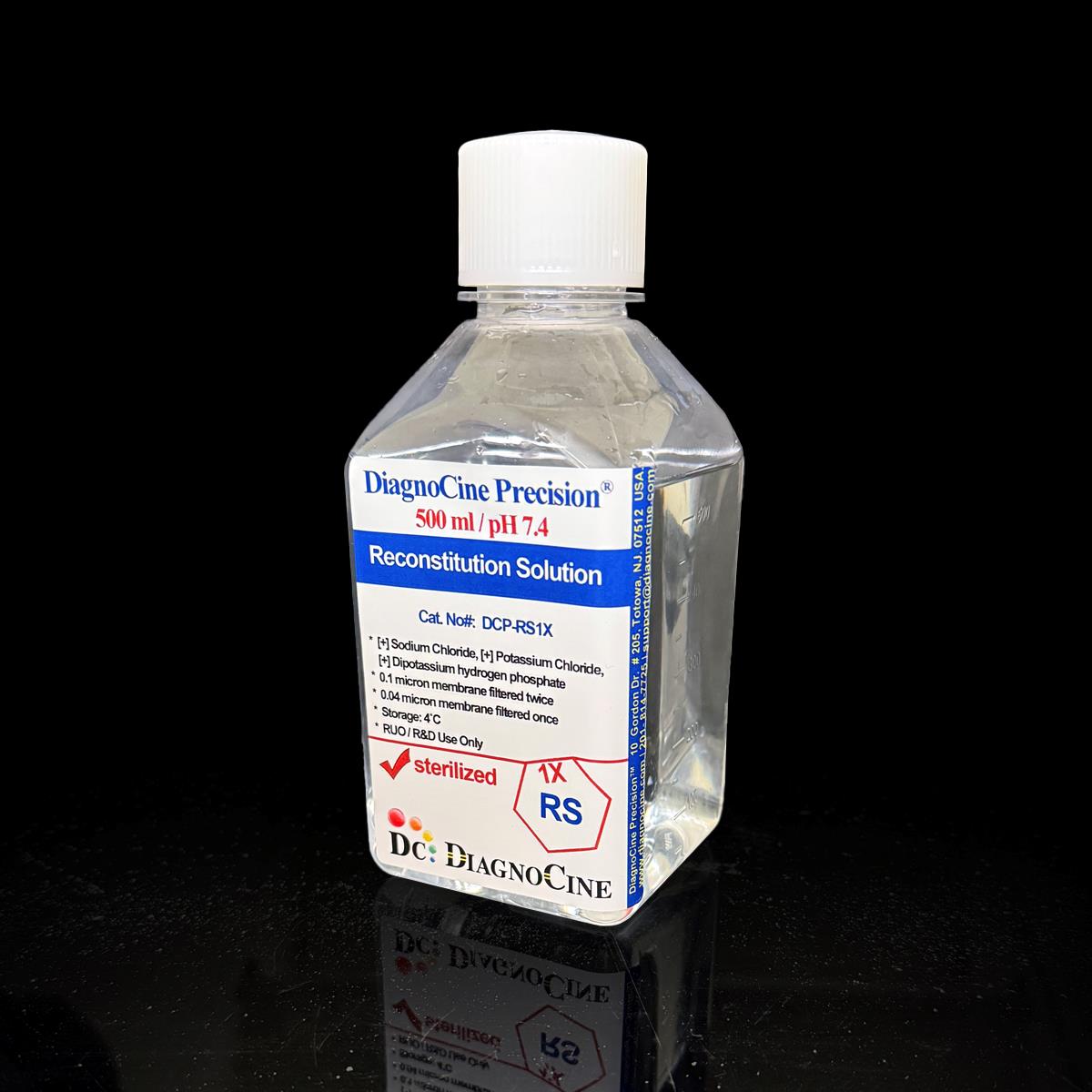
Reconstitution Solution
FluxMPS™ Reconstitution Solution
Microfluidics Suitable, quadruple-stage ultra-filtered (0.1 µm ×2 + 0.04 µm ×2) potassium-rich, sodium-poor reconstitution buffer engineered to approximate intracellular ionic conditions. A quadruple-stage train (0.1 µm ×2 + 0.04 µm ×2) reaches a 0.04 µm final cut-off, five times finer than the 0.22 µm membranes used for conventional sterile filtration — purpose-built for membrane protein reconstitution, potassium-channel electrophysiology, and microchannel-based assay systems. This is a specialized reconstitution buffer, not a complete cell growth medium.
- Potassium-rich (80 mM KCl), sodium-poor (4 mM NaCl) formulation designed to approximate intracellular ionic conditions for reconstitution and electrophysiology work
- Dipotassium hydrogen phosphate (10 mM K₂HPO₄) buffering system supports a stable pH near neutral
- Sterile, quadruple-stage filtered: 0.1 µm membrane twice + 0.04 µm membrane twice
- No DNase activity detected after 18-hour incubation with plasmid DNA at room temperature
- No RNase activity detected after 18-hour incubation with ribosomal RNA at room temperature
- pH 7.4; clear solution, free of visible particulates
- Manufactured under an ISO 13485:2016 quality management system; final packaging, QA, and testing performed at Diagnocine, Totowa, NJ, USA
- Custom ionic concentrations, tracking dye additions, and pH modifications available on request
- Pack Size500 mL
- Sodium Chloride4 mM
- Potassium Chloride80 mM
- Dipotassium Hydrogen Phosphate10 mM
- pH (USP <791>)7.4
- AppearanceClear solution
- DNase / RNase ActivityNone detected (18 hr, RT)
- FiltrationQuadruple-stage (0.1 µm ×2 + 0.04 µm ×2)
- Storage4°C
- Shelf Life12 months from date of manufacture, unopened
Engineered where standard buffers fail
Conventional physiological buffers such as PBS are sodium-rich and potassium-poor — the inverse of the intracellular environment. Where an assay demands a high-potassium, low-sodium chemistry, or where microliter-scale channels cannot tolerate particulates that a standard 0.22 µm filter passes through, FluxMPS™ Reconstitution Solution is built to hold up.
Microchannel-safe purity
A 0.04 µm final filter retains sub-micron particulates and microaggregates that pass through a conventional 0.22 µm membrane, reducing the risk of channel occlusion in narrow-bore microfluidic and chip-based systems.
Precision high-K?, low-Na? chemistry
80 mM potassium chloride against 4 mM sodium chloride gives an ionic ratio closer to the cytoplasm than to extracellular fluid, supporting potassium-channel studies and membrane protein work where standard PBS is the wrong tool.
Ultrapure processing
Manufactured with rigorously filtered process water and reagents. Quadruple-stage filtration removes particulates and microbial contamination risk ahead of aseptic fill, supporting clean molecular and cell biology workflows.
Nuclease-free confidence
No DNase activity was detected after 18-hour incubation with plasmid DNA, and no RNase activity was detected after 18-hour incubation with ribosomal RNA, both at room temperature — supporting use alongside nucleic acid workflows.
Defined, reproducible chemistry
A fixed three-component ionic formulation (NaCl, KCl, K₂HPO₄) manufactured to the same specification lot after lot, so buffer chemistry is not a variable in your experiment.
Customization on demand
Alternate ionic concentrations, tracking dye additions, and pH adjustments can be produced on request — contact support@diagnocine.com.
Quadruple-stage filtration system
Reconstitution Solution is manufactured through a validated four-pass train reaching a 0.04 µm final pore size: a dedicated 0.1 µm prefilter protects each of two 0.04 µm final filters, run in series for full redundancy.
-
1
0.1 µm Prefiltration I
Removes large particulate matter and protein aggregates ahead of the first 0.04 µm cartridge.
-
2
0.04 µm Final filtration I
First 0.04 µm pass; retains sub-micron particulates and microaggregates that a 0.22 µm filter would pass through.
-
3
0.1 µm Prefiltration II
A second, dedicated prefilter protects the second 0.04 µm cartridge from load-related fouling.
-
4
0.04 µm Final filtration II — Polish
Ultimate polishing filter ahead of aseptic fill & finish.
Performance vs. conventional filtration
A 0.04 µm final cut-off is five times finer than the 0.22 µm membrane rating used for conventional sterile-filtered buffers, run across four validated passes rather than one.

© Diagnocine® — DCP-RS1X
Where high-potassium, low-sodium chemistry matters
This buffer's ionic profile — potassium-rich, sodium-poor, phosphate-buffered near neutral pH — makes it useful across reconstitution, electrophysiology, and biochemical assay contexts where standard PBS is not appropriate.
Automated Bioreactors & Robotics
For automated, robotics-driven perfusion and dispensing systems where microvalve and sensor fouling is a persistent failure mode, Diagnocine also offers an optional 0.01 µm (10 nm) ultra nano-filtered MPS Grade variant of this buffer chemistry.
- Total Particulate Exclusion — six-stage cascade filtration down to 0.01 µm
- Valve & Sensor Protection — reduces particulate load on precision microvalves and optical sensors
- Extended Perfusion Stability — supports longer unattended run times in automated culture systems
Inquiry Required: the 0.01 µm MPS Grade variant is produced to order; contact support@diagnocine.com to discuss requirements.
Microphysiological Systems & Chip-Based Assays
Quadruple-stage filtration to 0.04 µm supports use in narrow-bore microfluidic channels where standard buffers risk occlusion.
Potassium-Channel & Patch-Clamp Studies
High-potassium, low-sodium chemistry is suited to patch-clamp and other electrophysiological investigations requiring elevated extracellular or pipette-solution potassium.
Membrane Protein Reconstitution
May be used for reconstituting membrane proteins that function optimally in high-potassium environments.
Enzyme Kinetics
Suitable for studying enzymes that require or are affected by high potassium concentrations.
Specialized Cell Culture Applications
Potentially useful for specialized cell culture applications requiring elevated potassium levels.
Biochemical Assays & Intracellular Simulation
High potassium and low sodium concentrations mimic the ionic composition inside cells, and may be employed in assays where standard PBS or other common buffers are not optimal due to their sodium content.
Full specification sheet
Every value below is stated as reported for this product; parameters not part of this product's release specification are omitted rather than estimated.
| Parameter | Specification |
|---|---|
| Formulation | Sodium Chloride (4 mM), Potassium Chloride (80 mM), Dipotassium Hydrogen Phosphate (10 mM) Fixed formulation |
| Appearance | Clear solution |
| pH (USP <791>) USP | 7.4 |
| Sodium Chloride | 4 mM |
| Potassium Chloride | 80 mM |
| Dipotassium Hydrogen Phosphate (K₂HPO₄) | 10 mM |
| Parameter | Specification |
|---|---|
| Sterility | Quadruple-stage filtered (0.1 µm ×2 + 0.04 µm ×2) under aseptic conditions |
| Mycoplasma | 0.1 µm mycoplasma-retentive filtration (not tested per lot); mycoplasma diameter approx. 0.2–0.3 µm |
| DNase Activity | None detected (plasmid DNA, 18 hr incubation, room temperature) |
| RNase Activity | None detected (ribosomal RNA, 18 hr incubation, room temperature) |
| Manufacturing Standard ISO | ISO 13485:2016 |
| Parameter | Specification |
|---|---|
| Storage | 4°C |
| Shelf Life | 12 months from date of manufacture, unopened |
| Parameter | Specification |
|---|---|
| Manufacturing QMS ISO | ISO 13485:2016 |
| UNSPSC | 41116155 — Molecular biology and cell culture growth media (UNv260801) |
| Regulatory Alignment | ISO 13485:2016 certified manufacturing |
| Traceability | Final packaging, quality assurance, and customization performed at Diagnocine, Totowa, NJ, USA |
| Intended Use | Research Use Only (RUO) |
Full composition
Reconstitution Solution is a fixed, three-component ionic buffer. All three ingredients are listed below with CAS numbers; concentrations are reported as given, in millimolar (mM).
| Component | CAS Number | Concentration (mM) |
|---|---|---|
| INORGANIC SALTS | ||
| Sodium Chloride | 7647-14-5 | 4 |
| Potassium Chloride | 7447-40-7 | 80 |
| Dipotassium Hydrogen Phosphate | 7758-11-4 | 10 |
| Component | CAS Number | Concentration (mM) |
|---|---|---|
| Not applicable — this formulation contains no amino acid components. | ||
| Component | CAS Number | Concentration (mM) |
|---|---|---|
| Not applicable — this formulation contains no vitamin or other supplementary components. | ||
Manufacturing & compliance
Reconstitution Solution is manufactured under an ISO 13485:2016 quality management system, with final packaging, quality assurance, and customization performed at Diagnocine, Totowa, NJ, USA.
ISO 13485:2016 QMS
Manufactured under an ISO 13485-certified quality management system at Diagnocine Precision's supplier facilities.
Quadruple-stage sterile filtration
0.1 µm ×2 + 0.04 µm ×2 filtration train applied prior to aseptic fill.
Nuclease-free QC
No DNase or RNase activity detected following 18-hour incubation with plasmid DNA or ribosomal RNA at room temperature.
Final QC & customization in Totowa, NJ
All final packaging, quality assurance, testing, and customization requests are completed at the Diagnocine R&D and Quality Testing Center, Totowa, New Jersey, USA.
Sterility
Quadruple-stage filtration (0.1 µm ×2 + 0.04 µm ×2) under aseptic fill conditions.
pH (USP <791>)
7.4
DNase Activity
None detected.
RNase Activity
None detected.
How DCP-RS1X compares
Reconstitution Solution is compared below against standard sodium-rich physiological buffers and published supplier endotoxin specifications where available.
| Parameter | DCP-RS1X (FluxMPS™) | Conventional buffer (0.22 µm filtered) | Standard alternative (0.22 µm filtered) |
|---|---|---|---|
| Grade | Microfluidics Suitable | Not specified | Not specified |
| Ionic profile | High-K? (80 mM) / low-Na? (4 mM) | Standard PBS (Na?-rich) | Standard physiological saline |
| Final filtration pore size | 0.04 µm | 0.22 µm | 0.22 µm |
| Number of filtration stages | 4 (0.1 µm ×2 + 0.04 µm ×2) | 1 | 1 |
| Mycoplasma-retentive filtration | check_circle | cancel | cancel |
| Endotoxin (release specification) | Not specified | Corning classical liquid media — < 0.25 EU/mL Sigma-Aldrich DMEM complete medium — ≤ 2 EU/mL Gibco classical DMEM — Not specified (recorded per lot) |
|
| Nuclease testing (DNase/RNase) | None detected | Not specified | Not specified |
| Manufacturing QMS | ISO 13485:2016 | Not specified | Not specified |
| Microfluidic channel compatibility | check_circle | Not specified | Not specified |
| Custom formulation available | check_circle | Not specified | Not specified |
Comparison figures from published supplier specifications, accessed 2026-09-02. Suppliers that publish no numeric endotoxin specification are shown as "Not specified".
Frequently asked questions
Common questions about DCP-RS1X Reconstitution Solution.
Supporting literature
Curated peer-reviewed references relevant to potassium-buffer chemistry, membrane protein reconstitution, electrophysiology, mycoplasma control, and microfluidic/organ-on-a-chip applications.
- Hamill OP, Marty A, Neher E, Sakmann B, Sigworth FJ. Improved patch-clamp techniques for high-resolution current recording from cells and cell-free membrane patches. Pflugers Arch. 1981. doi:10.1007/BF00656997
- Armstrong CM, Hille B. Voltage-gated ion channels and electrical excitability. Neuron. 1998. doi:10.1016/S0896-6273(00)80528-6
- Seddon AM, Curnow P, Booth PJ. Membrane proteins, lipids and detergents: not just a soap opera. Biochim Biophys Acta. 2004. doi:10.1016/j.bbamem.2004.04.011
- Clausen MV, Hilbers F, Poulsen H. The structure and function of the Na,K-ATPase isoforms in health and disease. Front Physiol. 2017. doi:10.3389/fphys.2017.00371
- Bhatia SN, Ingber DE. Microfluidic organs-on-chips. Nat Biotechnol. 2014. doi:10.1038/nbt.2989
- Huh D, Matthews BD, Mammoto A, Montoya-Zavala M, Hsin HY, Ingber DE. Reconstituting organ-level lung functions on a chip. Science. 2010. doi:10.1126/science.1188302
- Razin S, Yogev D, Naot Y. Molecular biology and pathogenicity of mycoplasmas. Microbiol Mol Biol Rev. 1998. doi:10.1128/MMBR.62.4.1094-1156.1998
- Uphoff CC, Drexler HG. Detection of mycoplasma contamination in cell cultures. Methods Mol Biol. 2011. doi:10.1007/978-1-61779-108-6_1
- Zeuthen T. Water-transporting proteins. J Membr Biol. 2010. doi:10.1007/s00232-010-9268-1