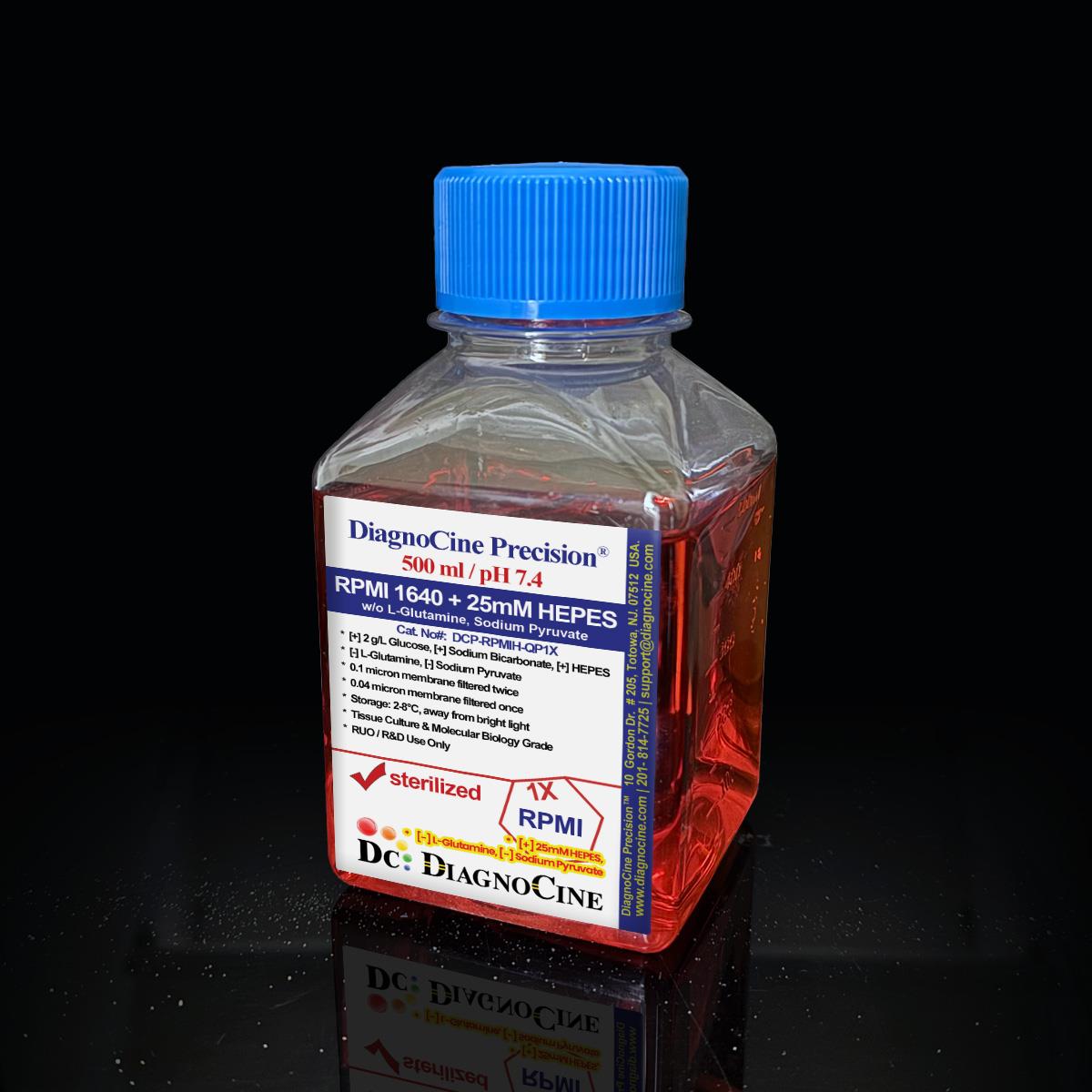
FluxMPS™ RPMI 1640 Medium with 25mM HEPES w/o L-Glutamine, Sodium Pyruvate: 1X Liquid
FluxMPS™ RPMI 1640 + 25mM HEPES (w/o L-Glutamine & Sodium Pyruvate)
FluxMPS™ DCP-RPMIH-QP1X is a Microfluidics Suitable, quadruple-stage ultra-filtered RPMI 1640 + 25mM HEPES formulation engineered for hematopoietic and lymphocyte cell models on organ-on-a-chip (OoC) and microphysiological system (MPS) platforms. Processed through a quadruple-stage filtration train (0.1 µm ×2 + 0.04 µm ×2) to a 0.04 µm final cut-off — five times finer than the 0.22 µm membranes used for conventional sterile filtration. HEPES (25 mM, pKa 7.3 at 37°C) supplements bicarbonate buffering for pH stability during open-bench handling and sample prep. Formulation: [+] Sodium Bicarbonate, [+] Phenol Red, [+] 25mM HEPES, [+] Calcium, [+] Magnesium, [+] 2.0 g/L Glucose | [-] L-Glutamine, [-] Sodium Pyruvate.
- Glucose source: 2000 mg/L (2.0 g/L) D-Glucose for a defined carbon input
- 25 mM HEPES (pKa 7.3 at 37°C) supplements bicarbonate buffering for pH stability during open-bench handling
- Glutathione (reduced, 1.0 mg/L) included — antioxidant support for redox-sensitive lymphocyte and hematopoietic cultures
- No L-Glutamine or Sodium Pyruvate — formulate your own nitrogen/carbon supplementation regimen
- Quadruple-stage filtration (0.1 µm ×2 + 0.04 µm ×2) to a 0.04 µm final cut-off; endotoxin release specification < 0.05 EU/mL
- Phenol red present (5.3 mg/L) for visual pH monitoring; a phenol-red-free variant is available on request for imaging-sensitive assays
- Manufactured under an ISO 13485:2016 quality management system; final QC at Diagnocine, Totowa, NJ
- Custom pH, salts, HEPES, and nutrient composition available on request
- Media familyRPMI 1640 + 25mM HEPES
- Formulation[+] Sodium Bicarbonate, [+] Phenol Red, [+] 25mM HEPES, [+] Calcium, [+] Magnesium, [+] 2.0 g/L Glucose | [-] L-Glutamine, [-] Sodium Pyruvate
- Glucose2000 mg/L (2.0 g/L)
- HEPES25 mM, pKa 7.3 at 37°C
- pH (USP <791>)7.4
- Osmolality (USP <785>)280 - 320 mOsm/kg H2O
- Endotoxin (USP <85>)< 0.05 EU/mL
- Filtration0.1 µm ×2 + 0.04 µm ×2
- Storage2-8°C, protect from light
- Shelf Life12 months from date of manufacture, unopened
Engineered where standard media fails
Conventional 0.22 µm–filtered RPMI passes subvisible particulates and lacks a dedicated mycoplasma-retentive stage, both of which can confound sensitive lymphocyte and hematopoietic assays. FluxMPS™ is built to reduce those risks at the filtration stage.
Microchannel-safe, low-endotoxin purity
0.04 µm final filtration with USP <788> Method 1 (light obscuration) particulate compliance and a < 0.05 EU/mL endotoxin release specification — formulated to reduce the risk of particulate and LPS-driven activation artefacts in immune cell assays.
Dual metabolic & pH control
No L-glutamine or sodium pyruvate — add your own nitrogen and carbon sources at the concentration your assay requires. 25 mM HEPES supplements bicarbonate buffering for pH-stable handling outside the incubator.
Ultrapure-grade water
Formulated with Type 1 water (18.2 MΩ·cm) to minimize ionic and trace-metal contaminants carried into the finished medium.
Low background for imaging
The 0.04 µm final filtration reduces particulate baseline for confocal and biosensor-based workflows. Note this formulation contains phenol red (5.3 mg/L); a phenol-red-free variant is available on request for autofluorescence-sensitive imaging modalities.
Immune cell–optimized formulation
RPMI 1640 base contains glutathione (reduced, antioxidant support) and the standard balanced amino acid and vitamin profile used for lymphocyte and hematopoietic cell culture.
Customization on demand
pH, nutrient concentrations, HEPES, and component modifications available. Contact support@diagnocine.com.
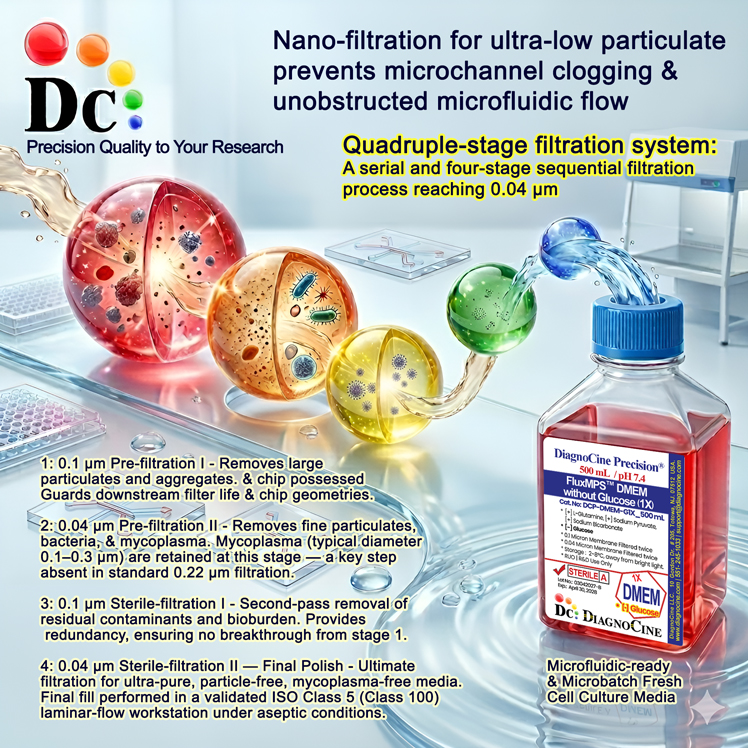
Quadruple-stage filtration system
Four serial filtration passes — two paired prefilter/final-filter cycles — reaching a 0.04 µm final cut-off under aseptic fill conditions.
-
1
0.1 µm Prefiltration I — Large Particulate Removal
Removes large aggregates and cell debris; protects the first 0.04 µm final filter cartridge.
-
2
0.04 µm Final Filtration I — Mycoplasma-Retentive Pass
First 0.04 µm pass; a mycoplasma-retentive grade of filtration not present in standard 0.22 µm processing.
-
3
0.1 µm Prefiltration II — Second Prefilter
Dedicated second prefilter protecting the second 0.04 µm final filter cartridge.
-
4
0.04 µm Final Filtration II — Polish
Second 0.04 µm pass; final polishing filtration ahead of aseptic fill & finish.
Performance vs. conventional media
A quadruple-stage train (0.1 µm ×2 + 0.04 µm ×2) reaches a 0.04 µm final cut-off, five times finer than the 0.22 µm membranes used for conventional sterile filtration, with a mycoplasma-retentive 0.1 µm stage built into every production run.
© Diagnocine® — DCP-RPMIH-QP1X
Immune cell OoC and hematopoietic applications
FluxMPS™ DCP-RPMIH-QP1X — RPMI 1640 + 25mM HEPES — delivers 0.04 µm filtered purity for hematopoietic cells, lymphocytes, and related microfluidic applications.
Automated Bioreactors & Robotics
An optional 0.01 µm (10 nm) ultra nano-filtered MPS Grade variant of this formulation is available on request for automated perfusion systems.
- Total Particulate Exclusion: 0.01 µm filtration removes nanoparticulate aggregates
- Valve & Sensor Protection: Reduces micro-fouling risk in automated perfusion systems
- Extended Perfusion Stability: Consistent nutrient delivery over long-duration culture
Inquiry Required: Contact support@diagnocine.com for the 0.01 µm MPS Grade variant.
Immune Cell OoC & MPS
0.04 µm filtered RPMI for tumor-immune interaction chips, vascular-immune microphysiological systems, and lymph node-on-chip models.
T Cell & Lymphocyte Culture
RPMI 1640 is the standard base for primary T cells, B cells, NK cells, and monocytes; 0.04 µm filtration reduces particulate exposure in sensitive immune assays.
Leukemia & Lymphoma Lines
RPMI supports Jurkat, Raji, K562, HL-60, and other hematopoietic cancer lines where DMEM-based formulations would alter proliferation and signaling behavior.
CAR-T & TIL Expansion
Low endotoxin release specification (<0.05 EU/mL) supports CAR-T manufacturing and TIL expansion protocols sensitive to LPS-driven activation artefacts.
Immune Cell Metabolic Flux
Not compatible with Agilent Seahorse XF assays, which require bicarbonate-free, phenol red-free medium. Suited to 13C isotope tracing and LC-MS–based metabolic flux analysis of lymphocyte activation states.
Flow Cytometry & Confocal
Ultra-low particulate baseline for flow cytometry and confocal imaging of immune cell models; a phenol-red-free variant is available for autofluorescence-sensitive channels.
Analytical release specifications
Every lot released against the full specification matrix. CoA: support@diagnocine.com.
| Parameter | Specification |
|---|---|
| Formulation | [+] Sodium Bicarbonate, [+] Phenol Red, [+] 25mM HEPES, [+] Calcium, [+] Magnesium, [+] 2.0 g/L Glucose | [-] L-Glutamine, [-] Sodium Pyruvate |
| Appearance | Red-colored, clear solution (phenol red present) |
| Glucose | 2000 mg/L (2.0 g/L) |
| HEPES | 25 mM (pKa 7.3 at 37°C) |
| pH USP <791> | 7.4 |
| Osmolality USP <785> | 280 - 320 mOsm/kg H2O |
| Total ingredients | 40 components across 4 formulation categories |
| Parameter | Specification |
|---|---|
| Endotoxin USP <85> BET | < 0.05 EU/mL |
| Sterility USP <71> | No growth / 14 days |
| Mycoplasma | 0.1 µm mycoplasma-retentive filtration (not tested per lot) |
| Particulate ≥10 µm USP <788> M1 | NMT 25/mL |
| Particulate ≥25 µm USP <788> M1 | NMT 3/mL |
| Water purity | Type 1, 18.2 MΩ·cm |
| Manufacturing std. | ISO 13485:2016 |
| Fill environment | ISO Class 5 (Class 100) |
| Parameter | Specification |
|---|---|
| Storage temperature | 2-8°C, away from light |
| Freeze-thaw | Do not freeze |
| Shelf life | 12 months from date of manufacture, unopened |
| Shipping condition | Cold pack |
| CO₂ requirement | 5% CO2 recommended for bicarbonate buffering; 25 mM HEPES provides supplemental pH stability during open-bench handling |
| Parameter | Specification |
|---|---|
| Raw material grade | Reagent / cell culture grade |
| Traceability | Full lot traceability per ISO 13485 |
| Manufacturing QMS ISO | ISO 13485:2016 certified |
| UNSPSC | 41116155 — Molecular biology and cell culture growth media (UNv260801) |
| Regulatory alignment | 21 CFR Part 820 (QMSR) aligned |
| Production method | Micro-batch, per-lot QC release |
| Intended use | Research Use Only (RUO) |
Full composition (mg/L)
RPMI 1640 + 25mM HEPES: 40 ingredients verified per lot with CAS numbers for full raw-material traceability. Contains glutathione (reduced, antioxidant) and the standard balanced RPMI 1640 amino acid and vitamin profile used for lymphocyte and hematopoietic cell culture.
| Component | CAS Number | mg/L |
|---|---|---|
| INORGANIC SALTS | ||
| Calcium nitrate tetrahydrate | 13477-34-4 | 100.000 |
| Magnesium sulfate anhydrous | 7487-88-9 | 48.840 |
| Potassium chloride | 7447-40-7 | 400.000 |
| Sodium bicarbonate | 144-55-8 | 2000.000 |
| Sodium chloride | 7647-14-5 | 6000.000 |
| Sodium phosphate dibasic anhydrous | 7558-79-4 | 800.000 |
| Component | CAS Number | mg/L |
|---|---|---|
| AMINO ACIDS | ||
| Glycine | 56-40-6 | 10.000 |
| L-Arginine hydrochloride | 1119-34-2 | 241.000 |
| L-Asparagine | 70-47-3 | 50.000 |
| L-Aspartic acid | 56-84-8 | 20.000 |
| L-Cystine dihydrochloride | 30925-07-6 | 65.200 |
| L-Glutamic acid | 56-86-0 | 20.000 |
| L-Histidine hydrochloride monohydrate | 5934-29-2 | 20.960 |
| L-Hydroxyproline | 51-35-4 | 20.000 |
| L-Isoleucine | 73-32-5 | 50.000 |
| L-Leucine | 61-90-5 | 50.000 |
| L-Lysine hydrochloride | 657-27-2 | 40.000 |
| L-Methionine | 63-68-3 | 15.000 |
| L-Phenylalanine | 63-91-2 | 15.000 |
| L-Proline | 147-85-3 | 20.000 |
| L-Serine | 56-45-1 | 30.000 |
| L-Threonine | 72-19-5 | 20.000 |
| L-Tryptophan | 73-22-3 | 5.000 |
| L-Tyrosine Disodium Salt | 69847-45-6 | 28.830 |
| L-Valine | 72-18-4 | 20.000 |
| Component | CAS Number | mg/L |
|---|---|---|
| VITAMINS | ||
| Choline chloride | 67-48-1 | 3.000 |
| D-Biotin | 58-85-5 | 0.200 |
| D-Ca-Pantothenate | 137-08-6 | 0.250 |
| Folic acid | 59-30-3 | 1.000 |
| Niacinamide | 98-92-0 | 1.000 |
| Pyridoxine hydrochloride | 58-56-0 | 1.000 |
| Riboflavin | 83-88-5 | 0.200 |
| Thiamine hydrochloride | 67-03-8 | 1.000 |
| Vitamin B12 | 68-19-9 | 0.005 |
| p-Amino benzoic acid (PABA) | 150-13-0 | 1.000 |
| OTHERS | ||
| D-Glucose | 50-99-7 | 2000.000 |
| Glutathione reduced | 70-18-8 | 1.000 |
| HEPES | 7365-45-9 | 5958.000 |
| Phenol red sodium salt | 34487-61-1 | 5.300 |
| i-Inositol | 87-89-8 | 35.000 |
Manufacturing & compliance
Every FluxMPS™ product is manufactured and released under a multi-layer quality system.
ISO 13485:2016 Quality Management
Manufactured under an ISO 13485:2016-certified quality management system. Final QC at Diagnocine R&D Center, Totowa, NJ, USA.
Ultrapure Type 1 Water
18.2 MΩ·cm — minimizes ionic and trace-metal contaminants.
ISO Class 5 Fill & Finish
Aseptic fill in validated ISO Class 5 (Class 100) laminar-flow workstations.
Micro-Batch Precision
Small-batch, per-lot tested — no blending; Certificate of Analysis available for every lot.
Endotoxin — USP <85> BET
LAL assay; release specification < 0.05 EU/mL per batch.
Particulate — USP <788> Method 1
Light obscuration count: NMT 25/mL (≥10 µm), NMT 3/mL (≥25 µm).
Osmolality — USP <785>
Target: 280 - 320 mOsm/kg H2O.
Documentation & CoA
Full CoA with raw-material traceability available on request.
- Endotoxin — LAL assay, USP <85> Bacterial Endotoxins Test; assay sensitivity 0.005 EU/mL; release specification < 0.05 EU/mL
- pH, osmolality, conductivity, appearance and clarity
- Sterility
How DCP-RPMIH-QP1X compares
FluxMPS™ DCP-RPMIH-QP1X vs. conventional 0.22 µm–filtered RPMI formulations.
| Parameter | DCP-RPMIH-QP1X (FluxMPS™) | Conventional RPMI 1640 + 25mM HEPES (0.22 µm filtered) | Standard DMEM/RPMI (0.22 µm filtered) |
|---|---|---|---|
| Grade | Microfluidics Suitable | Not specified | Not specified |
| Formulation: no Glutamine, no Pyruvate; dual bicarbonate + HEPES buffering | check_circle Yes | cancel No | cancel No |
| Final filtration pore size | 0.04 µm | 0.22 µm | 0.22 µm |
| Number of filtration passes | 4 (Quadruple-stage) | 1 | 1 |
| Mycoplasma-retentive filtration | check_circle Yes (0.1 µm stage) | cancel No | cancel No |
| Endotoxin (release specification) | < 0.05 EU/mL | Corning classical liquid media — < 0.25 EU/mL Sigma-Aldrich DMEM complete medium — ≤ 2 EU/mL Gibco classical DMEM — Not specified (recorded per lot) |
|
| USP <788> Method 1 particulate tested | check_circle Yes | cancel Not specified | cancel Not specified |
| Water quality | Type 1, 18.2 MΩ·cm | Not specified | Not specified |
| Manufacturing QMS | ISO 13485:2016 | Not specified | Not specified |
| Microfluidic channel compatibility | check_circle Microfluidics Suitable | cancel Risk of clogging | cancel Risk of clogging |
| Custom formulation available | check_circle Yes | cancel No | cancel No |
Comparison figures from published supplier specifications, accessed 2026-09-02. Suppliers that publish no numeric endotoxin specification are shown as “Not specified”.
Frequently asked questions
Common questions about FluxMPS™ DCP-RPMIH-QP1X — RPMI 1640 + 25mM HEPES.
Supporting literature
Key publications supporting RPMI 1640 + 25mM HEPES in immune cell culture and organ-on-a-chip applications.
- Moore GE, et al. Culture of normal human leukocytes. JAMA. 1967;199:519–524. doi:10.1001/jama.1967.03120080053007
- Huh D, et al. Reconstituting organ-level lung functions on a chip. Science. 2010;328:1662–1668. doi:10.1126/science.1188302
- Bhatia SN, Ingber DE. Microfluidic organs-on-chips. Nat Biotechnol. 2014;32:760–772. doi:10.1038/nbt.2989
- Novak R, et al. Robotic fluidic coupling and interrogation of multiple vascularized organ chips. Nat Biomed Eng. 2020;4:407–420. doi:10.1038/s41551-019-0497-x
- Rothbauer M, et al. Recent advances in microfluidic technologies for cell-to-cell interaction studies. Lab Chip. 2018;18:249–270. doi:10.1039/c7lc00815e
- Schimek K, et al. Integrating biological vasculature into a multi-organ-chip microsystem. Lab Chip. 2013;13:3588–3598. doi:10.1039/c3lc50217a
- Ronaldson-Bouchard K, Vunjak-Novakovic G. Organs-on-a-chip: a fast track for engineered human tissues in drug development. Cell Stem Cell. 2018;22:310–324. doi:10.1016/j.stem.2018.02.011
- Sung JH, et al. Microfabricated mammalian organ systems. Lab Chip. 2013;13:1201–1212. doi:10.1039/c3lc41017j