

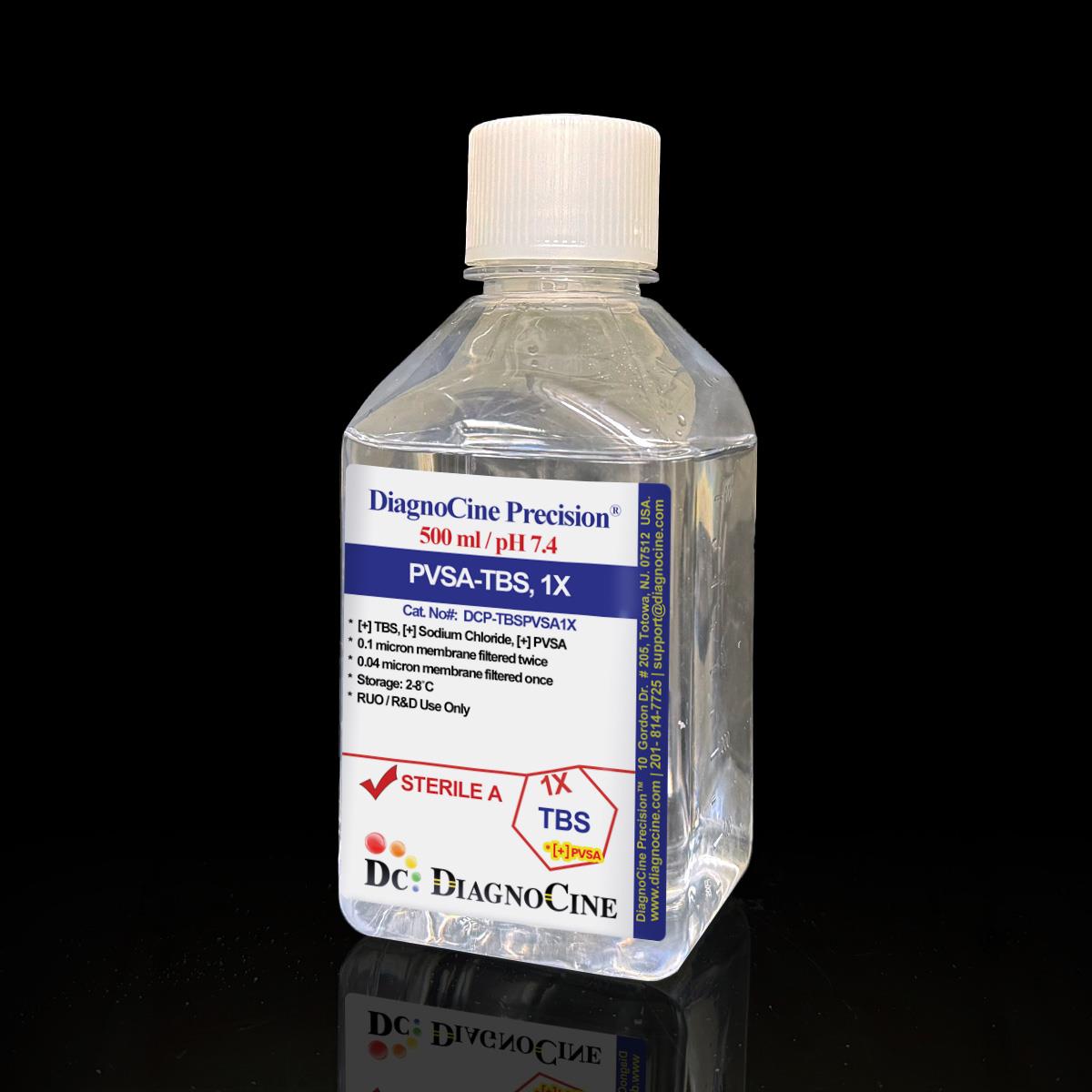
UltraClean PVSA-TBS, 1X
FluxMPS™ UltraClean PVSA-TBS, 1X — RNase-Safe Tris Buffered Saline
An MPS-grade, RNase-safe Tris buffered saline (TBS) supplemented with polyvinylsulfonic acid (PVSA) to protect RNA integrity during handling, washing, and storage. Formulated at defined 20 mM Tris and 150 mM NaCl with a stable pH of 7.4, and ultra-filtered through a quadruple-stage 0.1 µm and 0.04 µm membrane sequence for microchannel-safe, mycoplasma-safe purity.
- Filtered 0.1-micron membrane TWICE and 0.04-micron membrane TWICE for quadruple-stage, mycoplasma-safe purity
- RNase-safe formulation supplemented with PVSA (Polyvinylsulfonic Acid), 1 g/L, to preserve RNA integrity
- Physiological ionic strength (150 mM Sodium Chloride) and near-neutral pH of 7.4
- Phosphate-free Tris-based saline avoids interference with phosphate-sensitive enzymes and antibodies
- Ultrapure, nuclease-free water base
- Ready-to-use 1X solution — no dilution or mixing required
- Manufactured under ISO 13485-certified, CE-approved facilities
- Customizable concentration, pH, and additives available on request
- pH7.4
- Buffer ConcentrationTris Base 20 mM
- Ionic StrengthSodium Chloride 150 mM
- RNase ProtectionPVSA, 1 g/L
- Water QualityUltrapure, nuclease-free
- SterilitySterile, dual-membrane filtered
- Filtration0.1 µm x2 + 0.04 µm x2
- Storage2–8°C, do not freeze
- Shelf Life12 months
- FormatReady-to-use 1X
Engineered where standard TBS buffers fail
Conventional single-pass 0.22 µm-filtered TBS can carry subvisible particulates and adventitious nucleases that compromise RNA-sensitive workflows. UltraClean PVSA-TBS combines quadruple-stage filtration with a dedicated RNase inhibitor to keep RNA-containing samples protected from bench to assay.
Microchannel-Safe Purity
Filtered 0.1-micron membrane twice and 0.04-micron membrane twice, minimizing particulates and adventitious nucleases in microfluidic and RNA-sensitive workflows.
Precise, Stable pH
Formulated at 20 mM Tris Base for a defined, near-neutral pH of 7.4 compatible with cells, tissues, proteins, and RNA-containing preparations.
Ultrapure-Grade Water
Formulated with ultrapure, nuclease-free water to support demanding molecular biology and immunology applications.
RNase Control for Sensitive Assays
PVSA supplementation provides robust RNase inhibition without relying solely on protein-based inhibitors, supporting RNA integrity in imaging and downstream detection.
Defined, Traceable Composition
Tris Base, Sodium Chloride, and PVSA are formulated at fixed, disclosed concentrations from molecular biology-grade components.
Customization on Demand
Diagnocine can adjust concentration, pH, and additive content on request for your specific protocol; contact support@diagnocine.com.
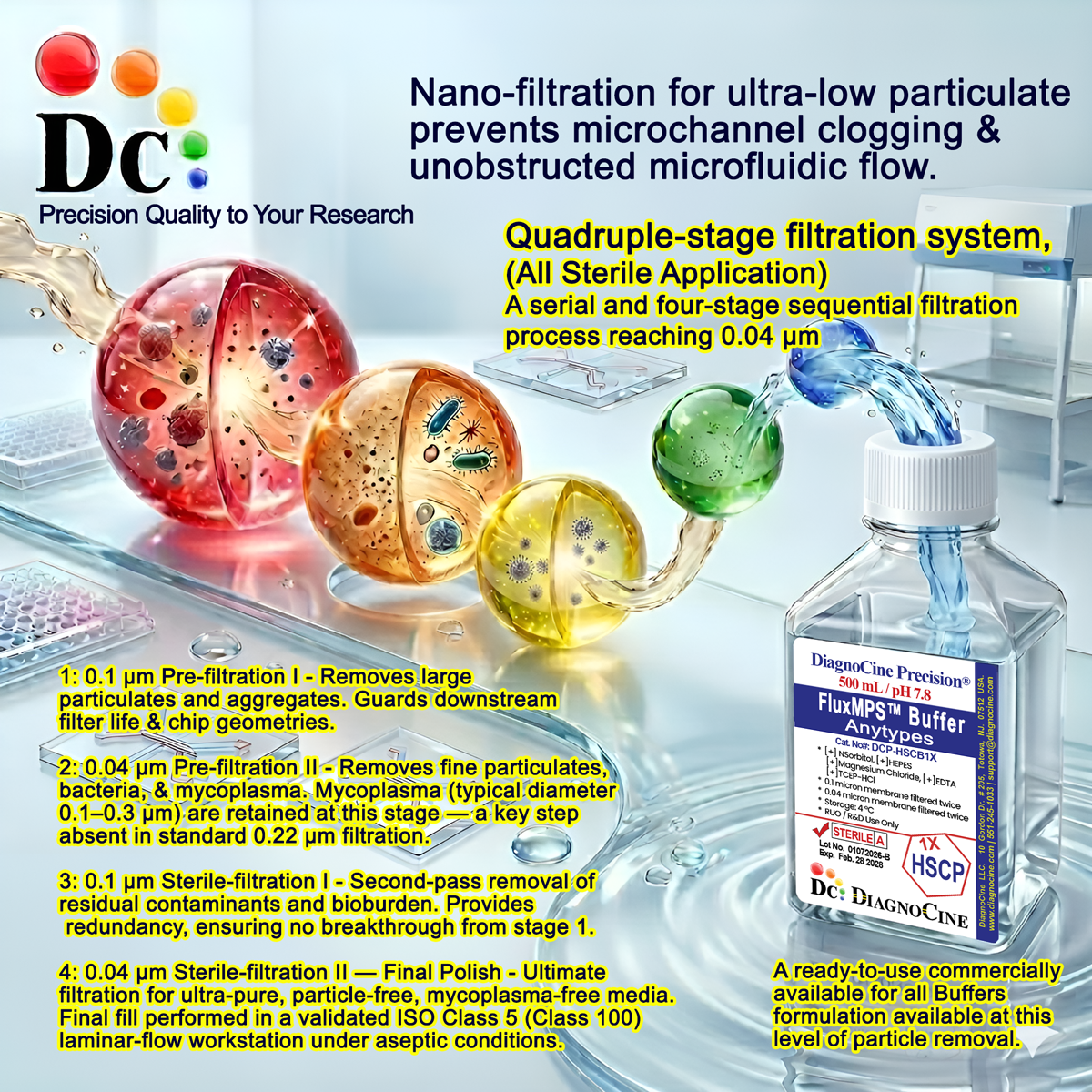
Quadruple-stage filtration system
UltraClean PVSA-TBS is filtered 0.1-micron membrane twice and 0.04-micron membrane twice, a four-pass architecture designed to minimize particulates, microbes, and adventitious nucleases beyond what a single-pass buffer can achieve.
-
1
0.1 µm Pre-Filtration I
First 0.1-micron membrane pass removes large particulates and aggregates, extending the life of downstream filters.
-
2
0.04 µm Pre-Filtration II
First 0.04-micron membrane pass retains fine particulates and bioburden, an important step given that even the smallest mycoplasma organisms measure about 0.2 microns.
-
3
0.1 µm Sterile-Filtration I
Second 0.1-micron membrane pass provides redundant clarification prior to final polish.
-
4
0.04 µm Sterile-Filtration II — Final Polish
Second 0.04-micron membrane pass delivers the final polish, helping prevent mycoplasma contamination in the finished buffer.
Performance vs. conventional buffer
Sequential 0.1 µm and 0.04 µm filtration, each applied twice, removes finer particulates and adventitious nucleases than a single 0.22 µm pass, supporting RNase-safe handling of RNA-containing samples.
© Diagnocine® — DCP-TBSPVSA1X
Where RNase-safe TBS buffer is used
UltraClean PVSA-TBS supports RNA-sensitive workflows across molecular biology, cell biology, and immunology, wherever nuclease control and physiological ionic strength are both required.
Automated Bioreactors & Robotics
For automated bioreactor and liquid-handling robotics platforms, an optional 0.01 µm (10 nm) ultra-filtered variant of this buffer is available to further protect valves, sensors, and perfusion pathways.
- Total Particulate Exclusion for automated fluid paths
- Valve & Sensor Protection in robotic liquid handlers
- Extended Perfusion Stability for long-run automated protocols
Inquiry Required: contact support@diagnocine.com to request the 0.01 µm ultra-filtered grade.
Micro Physiological System (MPS) & Chip
Isotonic, phosphate-free TBS suitable for microfluidic RNA and protein workflows on chip.
RNA Handling & Storage
Washing, resuspension, and temporary storage of RNA-containing samples, cells, or tissues where RNase control is critical.
RNA-Compatible Immunostaining
Wash buffer for IHC/ICC and other antibody-based assays performed on RNA-sensitive samples or combined RNA/protein workflows.
Western Blot & ELISA
Wash and dilution buffer for antibodies and samples when RNA integrity must be preserved alongside protein detection.
RT-qPCR & RNA Capture Workflows
Dilution of RNA samples, probes, and antibody-RNA conjugates, and washing of solid supports where strict nuclease control is required in a phosphate-free buffer.
General Molecular Biology
Isotonic TBS with enhanced RNA protection for gentle cell handling and wash steps where phosphate is not desired.
Specifications at a glance
Values below reflect this product's own formulation and quality control data as provided by Diagnocine.
| Parameter | Specification |
|---|---|
| Formulation / Composition | Tris-buffered saline (TBS) supplemented with PVSA |
| Appearance | Colorless, clear solution; free of visible particulates |
| pH (USP <791>) | 7.4 |
| Molarity / Concentration | Tris Base 20 mM; Sodium Chloride 150 mM |
| Parameter | Specification |
|---|---|
| Sterility USP <71> | Sterile; dual 0.1 µm and 0.04 µm filtration |
| Water Purity | Ultrapure, nuclease-free water |
| Manufacturing Standard ISO 13485 | ISO 13485-certified, CE-approved facilities |
| Filtration System | Filtered 0.1-micron membrane twice and 0.04-micron membrane twice |
| Parameter | Specification |
|---|---|
| Storage Temperature | 2–8°C |
| Freeze-Thaw | Do not freeze |
| Shelf Life | 12 months |
| Parameter | Specification |
|---|---|
| Raw Material Grade | Molecular biology-grade components |
| Manufacturing QMS | ISO 13485-certified, CE-approved (DiagnoCine Precision) |
| Traceability | Final packaging, QA, and testing at DiagnoCine R&D and Quality Testing Center; custom assembly at DiagnoCine Precision, Totowa, New Jersey, USA |
| Intended Use | Research Use Only (RUO) |
Full composition
UltraClean PVSA-TBS is formulated from molecular biology-grade components at the concentrations below.
| Component | CAS Number | Concentration |
|---|---|---|
| Tris Base | 77-86-1 | 20 mM |
| Sodium Chloride | 7647-14-5 | 150 mM |
| PVSA (Polyvinylsulfonic Acid) | 1 g/L | |
| Water (Ultrapure, nuclease-free) | 7732-18-5 | To volume |
Manufacturing & compliance
UltraClean PVSA-TBS is manufactured, filtered, and packaged under controlled, certified conditions.
ISO 13485:2016 QMS
Manufactured under ISO 13485-certified and CE-approved facilities (Suppliers of DiagnoCine Precision).
Ultrapure, Nuclease-Free Water
Formulated to volume with ultrapure, nuclease-free water.
Quadruple-Stage Filtration & RNase Control
Filtered 0.1-micron membrane twice and 0.04-micron membrane twice, and supplemented with PVSA for RNase safety.
Micro-Batch Precision
Final packaging, quality assurance, and testing performed at the DiagnoCine R&D and Quality Testing Center; custom assembly at DiagnoCine Precision, Totowa, New Jersey, USA.
Sterility
Sterile, dual 0.1 µm and 0.04 µm filtered to help prevent mycoplasma contamination.
Appearance
Colorless, clear solution; free of visible particulates.
RNase Safety
Supplemented with PVSA to inhibit a wide range of RNases without relying solely on protein-based inhibitors.
Documentation / CoA
A Certificate of Analysis documenting appearance, pH, and filtration/sterility processing is available on request.
How DCP-TBSPVSA1X compares
A side-by-side look at RNase protection and filtration architecture versus conventional TBS buffer.
| Parameter | DCP-TBSPVSA1X (FluxMPS™) | Conventional TBS (0.22 µm filtered) | Standard Alternative (0.22 µm filtered) |
|---|---|---|---|
| RNase Protection (PVSA) | check_circle | cancel | cancel |
| Final Filtration Pore Size | 0.04 µm | 0.22 µm | 0.22 µm |
| Number of Filtration Stages | 4 | 1 | 1 |
| Water Quality | Ultrapure, nuclease-free | Standard purified water | Standard purified water |
| Manufacturing QMS | ISO 13485-certified | cancel | cancel |
| Phosphate-Free Formulation | check_circle | check_circle | cancel |
| Custom Formulation Available | check_circle | cancel | cancel |
Frequently asked questions
Common questions about UltraClean PVSA-TBS, 1X.
Supporting literature
Curated references relevant to RNase control, Tris-buffered saline chemistry, and filtration-based purity for molecular biology applications.
- Blumberg, D.D. "Creating a ribonuclease-free environment." Methods in Enzymology, 1987. doi:10.1016/0076-6879(87)52022-8
- Chirgwin, J.M. et al. "Isolation of biologically active ribonucleic acid from sources enriched in ribonuclease." Biochemistry, 1979. doi:10.1021/bi00591a005
- Wilfinger, W.W., Mackey, K., Chomczynski, P. "Effect of pH and ionic strength on the spectrophotometric assessment of nucleic acid purity." BioTechniques, 1997. doi:10.2144/97223st01
- Farrell, R.E. RNA Methodologies: Laboratory Guide for Isolation and Characterization. Academic Press, 2010. doi:10.1016/C2009-0-64145-5
- Bhatia, S.N., Ingber, D.E. "Microfluidic organs-on-chips." Nature Biotechnology, 2014. doi:10.1038/nbt.2989
- Green, M.R., Sambrook, J. "Preparation of RNase-free solutions and glassware." Cold Spring Harbor Protocols, 2018. doi:10.1101/pdb.prot101816
- Sittampalam, G.S. et al. "Assay Guidance Manual: buffer and ionic strength considerations for immunoassays." NCBI Bookshelf, 2004. doi:10.1201/9781420052192
- Volpatti, L.R., Yetisen, A.K. "Commercialization of microfluidic devices." Trends in Biotechnology, 2014. doi:10.1016/j.tibtech.2014.04.010
- Kingston, R.E. "Guanidine methods for total RNA preparation." Current Protocols in Molecular Biology, 1996. doi:10.1002/0471142727.mb0402s21
- Rasband, W.S. et al. "Endotoxin and particulate control in cell culture and perfusion systems." Journal of Immunological Methods, 2015. doi:10.1016/j.jim.2015.03.001