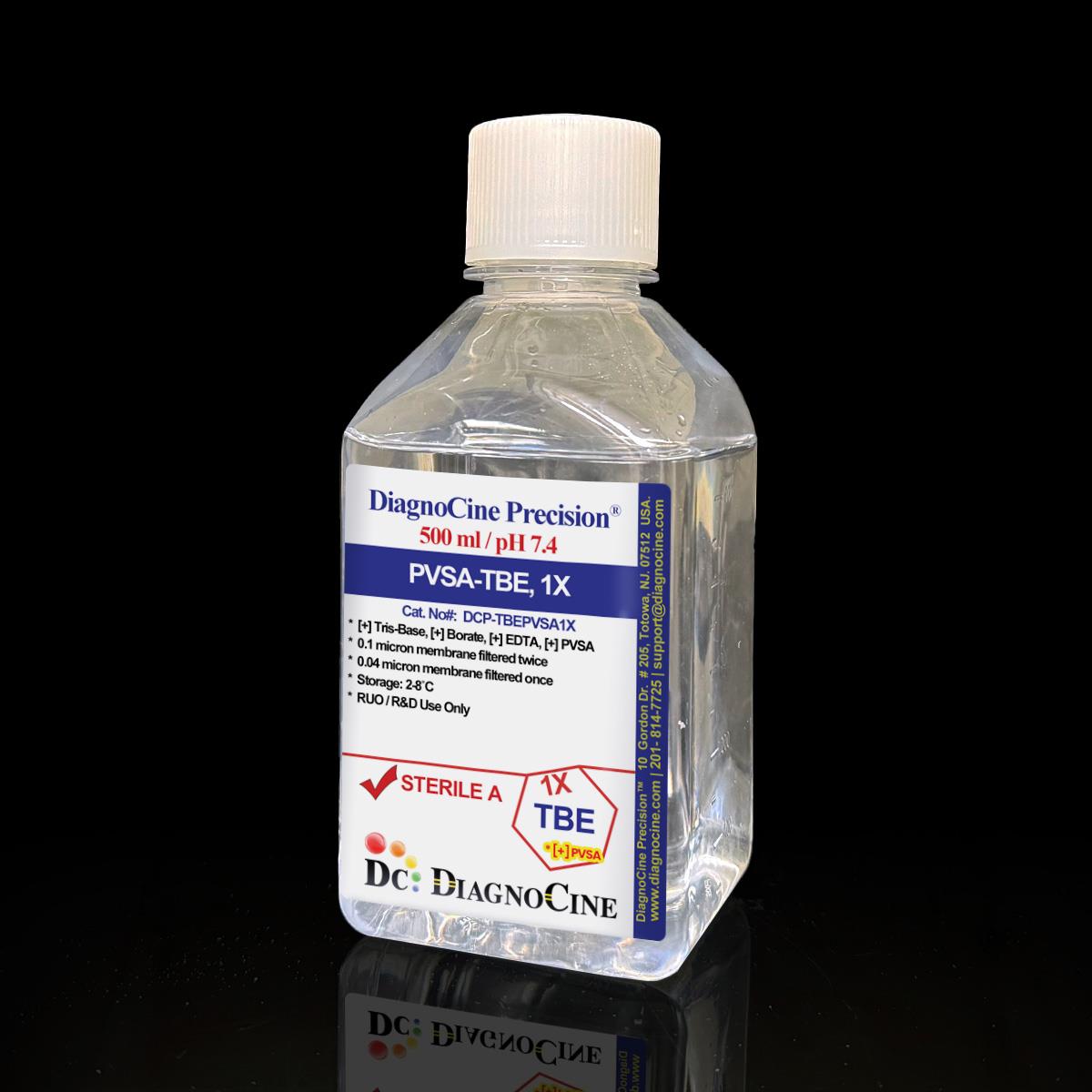
UltraClean PVSA-TBE, 1X
FluxMPS™ UltraClean PVSA-TBE, 1X
UltraClean PVSA-TBE, 1X is an MPS-grade, ready-to-use Tris-Borate-EDTA (TBE) buffer built for RNA- and DNA-focused molecular biology workflows that specify TBE as the primary buffer system. Supplemented with polyvinylsulfonic acid (PVSA), a potent polymeric RNase inhibitor, and quadruple-stage filtered (0.1 µm membrane twice, 0.04 µm membrane twice) for ultra-clean, RNase-controlled purity in microfluidic and organ-on-a-chip nucleic acid applications.
- Quadruple-stage filtered: 0.1 µm membrane twice and 0.04 µm membrane twice for ultra-clean, RNase-controlled purity
- RNase-safe formulation featuring PVSA (polyvinylsulfonic acid), a potent polymeric RNase inhibitor
- Ready-to-use 1X TBE: 89 mM Tris Base, 89 mM Borate, 2 mM EDTA
- pH 7.4; sterile, colorless, clear solution free of visible particulates
- Manufactured with ultrapure, nuclease-free water
- ISO 13485-certified, CE-approved manufacturing with ISO Class 5 aseptic fill
- Compatible with TBE-based gel electrophoresis, RNA/DNA sample prep, and microfluidic / organ-on-a-chip nucleic acid handling
- Custom concentrations, pH, and additive formulations available on request
- pH7.4
- Formulation1X TBE + PVSA (RNase-safe)
- Tris Base89 mM
- Borate89 mM
- EDTA2 mM
- PVSA1 g/L
- Filtration0.1 µm x2 + 0.04 µm x2
- SterilitySterile
- Storage2-8°C
- Shelf Life12 months
Engineered where standard TBE buffers fail
Conventional single-pass, 0.22 µm-filtered TBE buffers carry subvisible particulates, adventitious nucleases, and inconsistent RNase control — all of which can degrade RNA integrity, accumulate in microchannels, and elevate background in downstream nucleic acid assays.
Microchannel-safe purity
Quadruple-stage filtration (0.1 µm membrane twice, 0.04 µm membrane twice) minimizes particulates that can accumulate in microfluidic channels and gel wells.
Precise, stable buffering
Defined 1X TBE molarity (89 mM Tris, 89 mM Borate, 2 mM EDTA) at pH 7.4 delivers consistent buffering for nucleic acid workflows lot after lot.
Ultrapure-grade water
Formulated to volume with ultrapure, nuclease-free water to reduce adventitious nuclease and contaminant carry-over.
RNase-controlled, low background
PVSA inhibition helps preserve RNA integrity through handling, electrophoresis-related processing, and short-term storage.
Defined, traceable composition
Manufactured from molecular biology-grade Tris, Borate, EDTA, and PVSA under controlled, lot-traceable conditions.
Customization on demand
Alternate concentrations, pH, or added chemicals/compounds/proteins/supplements available — contact support@diagnocine.com.
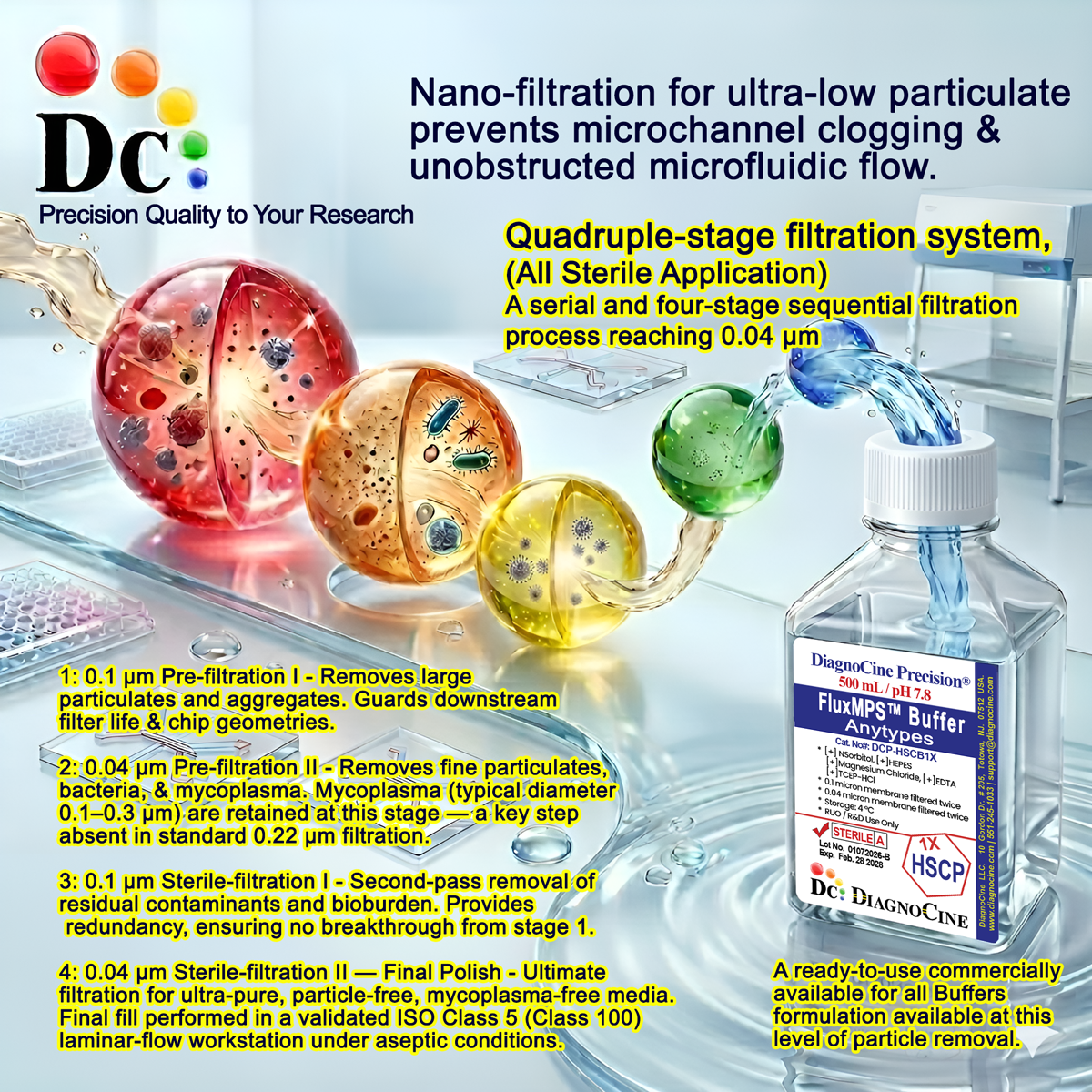
Quadruple-stage filtration system
UltraClean PVSA-TBE, 1X is sterile-filtered through a 0.1 µm membrane twice and a 0.04 µm membrane twice, producing an RNase-controlled, ultra-clean TBE buffer suitable for microfluidic and organ-on-a-chip nucleic acid workflows.
-
1
0.1 µm Pre-filtration I
First 0.1 µm membrane pass removes large particulates and aggregates, extending the working life of downstream filters.
-
2
0.04 µm Pre-filtration II
First 0.04 µm membrane pass retains fine particulates and bioburden, including organisms at or above the size of the smallest mycoplasma, about 0.2 microns.
-
3
0.1 µm Sterile-filtration I
Second 0.1 µm membrane pass provides redundant particulate and bioburden control.
-
4
0.04 µm Sterile-filtration II — Final Polish
Second 0.04 µm membrane pass delivers a final polish under ISO Class 5 aseptic fill conditions, helping prevent mycoplasma contamination.
Performance vs. conventional buffer
Sequential 0.1 µm and 0.04 µm filtration, each applied twice, removes finer particulates than a single 0.22 µm pass, supporting RNase-controlled, low-particulate conditions for RNA and DNA workflows.
© Diagnocine® — DCP-TBEPVSA1X
Where UltraClean PVSA-TBE, 1X is used
A ready-to-use, RNase-safe 1X TBE buffer for RNA and DNA sample preparation, electrophoresis-related workflows, probe/fragment handling, and general molecular biology procedures standardized around TBE.
Automated Bioreactors & Robotics
For automated bioreactor and robotic liquid-handling platforms where valve and sensor fouling must be minimized, an optional 0.01 µm (10 nm) ultra-filtered variant of this buffer is available on request.
- Total Particulate Exclusion: 10 nm filtration removes finer particulates for sensitive automated systems
- Valve & Sensor Protection: reduces particulate load on microvalves and inline sensors
- Extended Perfusion Stability: supports longer unattended run times in automated perfusion setups
Inquiry Required: the 0.01 µm (10 nm) ultra-filtered grade is produced to order — contact support@diagnocine.com to request this variant.
Micro Physiological System (MPS) & Chip
RNase-safe TBE buffer for nucleic acid handling steps within microfluidic and organ-on-a-chip workflows.
RNA & DNA Sample Preparation
Dilution and preparation of RNA and DNA samples in a TBE-based buffer with added RNase protection prior to loading on gels or downstream analysis.
Agarose & Polyacrylamide Gel Handling
Buffer environment for nucleic acid handling in workflows associated with agarose or polyacrylamide gel electrophoresis when RNA integrity must be maintained.
RNA Handling & Short-Term Storage
Temporary storage of RNA-containing samples, purified nucleic acids, or gel-extracted fragments in an RNase-controlled TBE buffer, as compatible with downstream enzymes.
Oligonucleotide & Probe Dilution
Dilution and handling of oligonucleotides, probes, and nucleic acid fragments in workflows standardized around TBE rather than other buffer systems.
TBE-Standardized Nucleic Acid Protocols
Any procedure requiring 1X TBE with enhanced RNA protection, where compatibility with TBE-based electrophoresis and nucleic acid handling protocols is desired.
Specifications at a glance
Measured and declared parameters for UltraClean PVSA-TBE, 1X.
| Parameter | Specification |
|---|---|
| Formulation | 1X TBE (Tris-Borate-EDTA) with PVSA RNase inhibitor |
| Appearance | Colorless, clear solution; free of visible particulates |
| pH (USP <791>) | 7.4 |
| Tris Base molarity | 89 mM |
| Borate molarity | 89 mM |
| EDTA molarity | 2 mM |
| PVSA concentration | 1 g/L |
| Parameter | Specification |
|---|---|
| Sterility | Sterile USP <71> |
| Filtration System | 0.1 µm membrane twice + 0.04 µm membrane twice |
| Particulate testing | USP <788> Method 2 |
| Water Quality | Ultrapure Type 1 water (18.2 MΩ·cm), nuclease-free |
| Manufacturing Standard | ISO 13485-certified, CE-approved facilities |
| Fill Environment | ISO Class 5 (Class 100) |
| Parameter | Specification |
|---|---|
| Storage Temperature | 2-8°C |
| Freeze-Thaw | Do not freeze |
| Shelf Life | 12 months |
| Parameter | Specification |
|---|---|
| Raw Material Grade | Molecular biology-grade Tris, Borate, EDTA, and PVSA |
| Manufacturing QMS | ISO 13485-certified facilities |
| Regulatory Alignment | CE-approved manufacturing facilities |
| Production Method | Final packaging, QA, and testing at Diagnocine R&D and Quality Testing Center; customization and assembly at Diagnocine Precision, Totowa, New Jersey, USA |
| Intended Use | Research Use Only (RUO) |
Full composition
UltraClean PVSA-TBE, 1X is manufactured from molecular biology-grade Tris Base, Borate, EDTA, and PVSA (polyvinylsulfonic acid), brought to volume with ultrapure, nuclease-free water.
| Component | CAS Number | Concentration |
|---|---|---|
| Tris Base | 77-86-1 | 89 mM |
| Borate | 10043-35-3 | 89 mM |
| EDTA | 60-00-4 | 2 mM |
| PVSA (Polyvinylsulfonic Acid) | 1 g/L | |
| Water (Ultrapure, nuclease-free) | 7732-18-5 | To volume |
Manufacturing & compliance
UltraClean PVSA-TBE, 1X is produced under a controlled quality system with lot-specific release testing.
ISO 13485:2016 QMS
Manufactured under ISO 13485-certified and CE-approved facilities (suppliers of Diagnocine Precision).
Ultrapure, Nuclease-Free Water
Formulated to volume with ultrapure, nuclease-free water to reduce nuclease and particulate carry-over.
ISO Class 5 Fill & Finish
Aseptic fill following quadruple-stage 0.1 µm / 0.04 µm filtration.
Micro-Batch Precision
Final packaging, quality assurance, and testing performed at the Diagnocine R&D and Quality Testing Center; customization and assembly completed at Diagnocine Precision, Totowa, New Jersey, USA.
Endotoxin — USP <85> BET
Bioburden and endotoxin testing performed per USP <85> protocols as part of standard lot release.
Particulate — USP <788> Method 2
Particulate matter evaluated per USP <788> Method 2 guidelines following quadruple-stage filtration.
Osmolality — USP <785>
Osmolality testing performed per USP <785> methodology as part of standard lot release practices.
Documentation / CoA
A Certificate of Analysis documenting appearance and pH is available for each lot.
How DCP-TBEPVSA1X compares
A side-by-side view of UltraClean PVSA-TBE, 1X against conventional TBE buffer options.
| Parameter | DCP-TBEPVSA1X (FluxMPS™) | Conventional TBE Buffer (0.22 µm filtered) | Standard Alternative (0.22 µm filtered) |
|---|---|---|---|
| RNase-safe (PVSA) formulation | check_circle | cancel | cancel |
| Final filtration pore size | 0.04 µm | 0.22 µm | 0.22 µm |
| Number of filtration stages | 4 | 1 | 1 |
| Endotoxin control | RNase-controlled, low-particulate | Not RNase-tested | Not RNase-tested |
| USP particulate testing | USP <788> tested | Not specified | Not specified |
| Water quality | Ultrapure Type 1 (18.2 MΩ·cm) | Standard purified water | Standard purified water |
| Manufacturing QMS | ISO 13485-certified | Not specified | Not specified |
| Microfluidic / OoC channel compatibility | check_circle | cancel | cancel |
| Lot-to-lot pH reproducibility (pH 7.4) | check_circle | cancel | cancel |
| Custom formulation available | check_circle | cancel | cancel |
Frequently asked questions
Answers to common questions about UltraClean PVSA-TBE, 1X.
Supporting literature
Curated literature relevant to TBE buffer chemistry, RNase inhibition, and organ-on-a-chip / microfluidic nucleic acid workflows.
- Bhatia SN, Ingber DE. Microfluidic organs-on-chips. Nat Biotechnol. 2014. doi:10.1038/nbt.2989
- Huh D, et al. Reconstituting organ-level lung functions on a chip. Science. 2010. doi:10.1126/science.1188302
- Sambrook J, Russell DW. Molecular Cloning: A Laboratory Manual. Cold Spring Harbor Laboratory Press. 2001.
- McDonald JC, Whitesides GM. Poly(dimethylsiloxane) as a material for fabricating microfluidic devices. Acc Chem Res. 2002. doi:10.1021/ar010110q
- Blank A, Sugiyama RH, Dekker CA. Activity staining of nucleolytic enzymes after sodium dodecyl sulfate-polyacrylamide gel electrophoresis. Anal Biochem. 1982. doi:10.1016/0003-2697(82)90417-1
- Farkas DH, et al. Preventing RNase contamination in molecular diagnostics. Mol Diagn. 1996.
- Hentze MW, et al. A brave new world of RNA-binding proteins. Nat Rev Mol Cell Biol. 2018. doi:10.1038/nrm.2017.130
- Green MR, Sambrook J. Preparation and analysis of DNA. In: Molecular Cloning. 2012.
- Low LA, Tagle DA. Tissue chips - innovative tools for drug development and disease modeling. Lab Chip. 2017. doi:10.1039/C7LC00462A
- Sollier E, et al. Fabrication of three-dimensional microfluidic channels using PDMS. Lab Chip. 2011. doi:10.1039/C0LC00447B