

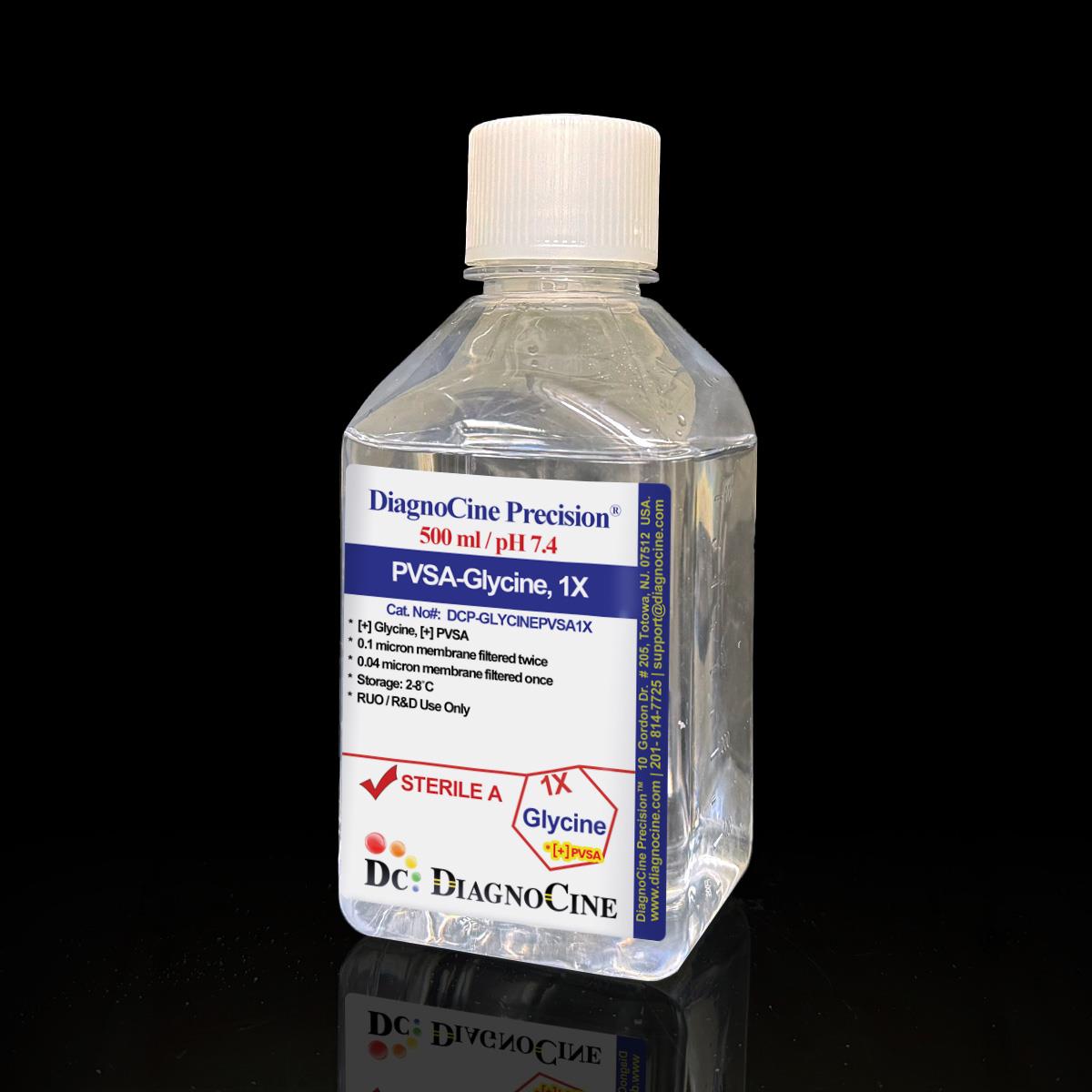
UltraClean PVSA-Glycine, 1X
FluxMPS™ UltraClean PVSA-Glycine, 1X
UltraClean PVSA-Glycine, 1X is an MPS-grade, RNase-safe glycine buffer built on a defined 20 mM glycine buffering system and supplemented with polyvinylsulfonic acid (PVSA), a potent polymeric RNase inhibitor. Manufactured with ultrapure Type 1 water and a quadruple-stage filtration architecture, it is engineered to protect RNA and DNA integrity in microchannel-safe, phosphate-free, and Tris-free molecular biology workflows.[1]
- Quadruple-stage filtration: 0.1 µm membrane twice and 0.04 µm membrane twice for ultra-low particulate purity
- Sterile, ultrapure, RNase-safe formulation for sensitive RNA and DNA handling
- Defined 20 mM glycine buffering system at pH 7.4
- Supplemented with PVSA (1 g/L), a broad-spectrum polymeric RNase inhibitor
- Manufactured with ultrapure Type 1 water (18.2 MΩ·cm)
- Phosphate-free and Tris-free, ready-to-use at 1X working strength
- Microchannel-safe purity suitable for microfluidic and molecular biology platforms
- Custom pH, concentration, and additive formulations available on request
- pH7.4
- Glycine Concentration20 mM
- PVSA Concentration1 g/L
- Buffering SystemGlycine-based, phosphate/Tris-free
- Filtration0.1 µm x2 + 0.04 µm x2
- Water QualityUltrapure Type 1 (18.2 MΩ·cm)
- SterilitySterile
- Storage2–8°C, do not freeze
- Shelf Life12 months
- Intended UseResearch Use Only (RUO)
Engineered where standard buffers fail
Conventional 0.22 µm-filtered buffers can carry subvisible particulates, adventitious nucleases, and inconsistent pH that compromise RNA integrity in sensitive molecular biology and microfluidic workflows. UltraClean PVSA-Glycine, 1X is formulated and filtered to close those gaps.
Microchannel-safe purity
Quadruple-stage filtration down to a final 0.04 µm membrane pass minimizes particulate load for microfluidic channels and sensitive assay surfaces.
Precise, stable pH
A defined 20 mM glycine buffering system holds the formulation at pH 7.4, supporting reproducible nucleic acid handling conditions.
Ultrapure-grade water
Formulated with ultrapure, nuclease-free Type 1 water (18.2 MΩ·cm) to reduce contamination and background in nucleic acid work.
Low background for imaging & assays
The phosphate-free, Tris-free formulation reduces buffer interference in downstream enzymatic and fluorescence-based nucleic acid workflows.
Defined, traceable composition
Manufactured from molecular biology-grade glycine and PVSA with a controlled, lot-consistent formulation.
Customization on demand
Alternate concentrations, added chemicals, compounds, proteins, supplements, and pH values can be formulated on inquiry.
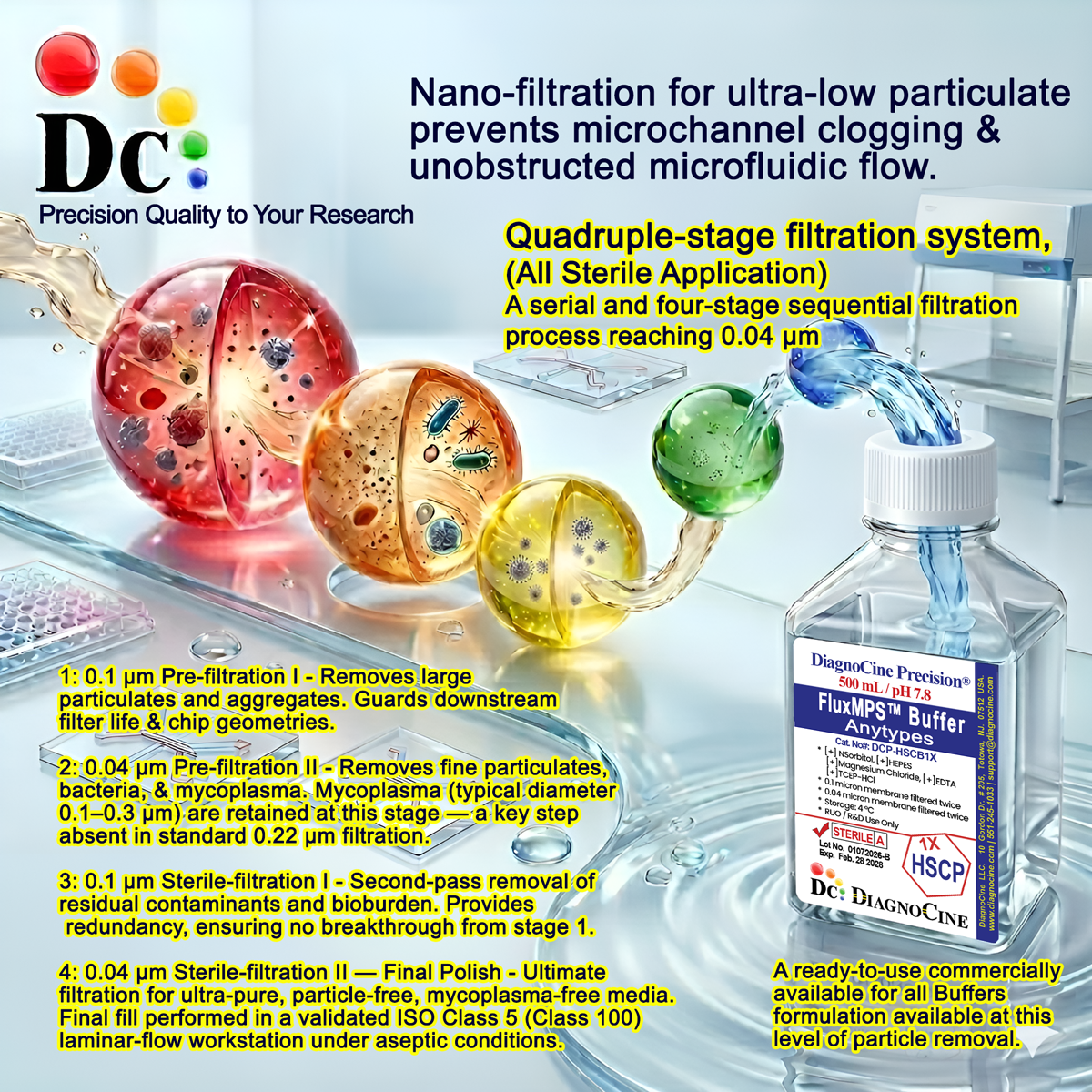
Quadruple-stage filtration system
UltraClean PVSA-Glycine, 1X is sterile-filtered through a validated quadruple-stage process — a 0.1 µm membrane pass twice and a 0.04 µm membrane pass twice — to deliver an ultrapure, RNase-safe buffer for sensitive molecular biology and microfluidic workflows.
-
1
0.1 µm Pre-filtration I
Removes large particulates and aggregates, extending the working life of downstream filters.
-
2
0.04 µm Pre-filtration II
Retains fine particulates and bioburden, including organisms as small as mycoplasma.
-
3
0.1 µm Sterile-filtration I
A second-pass 0.1 µm filtration adds redundancy to the sterilization process.
-
4
0.04 µm Sterile-filtration II — Final Polish
A second 0.04 µm pass delivers the final polish ahead of ISO Class 5 aseptic fill.
Performance vs. conventional buffer
Sequential 0.1 µm and 0.04 µm filtration, each applied twice, removes finer particulates and microorganisms than a single-pass 0.22 µm filtration, helping prevent mycoplasma contamination — the smallest mycoplasma species are approximately 0.2 µm.[5]
© Diagnocine® — DCP-GLYCINEPVSA1X
Where UltraClean PVSA-Glycine, 1X fits your workflow
This RNase-safe, glycine-based buffer supports RNA and DNA resuspension and dilution, short-term storage of RNA-containing samples and lysates, sample handling ahead of enzymatic workflows such as RT, qPCR, and library preparation, gentle washing of cells and tissues where RNA integrity and phosphate-free or Tris-free conditions are preferred, and any general molecular biology procedure requiring a 1X glycine buffer with enhanced RNA protection.[4]
Automated Bioreactors & Robotics
For automated bioreactor and robotic liquid-handling platforms, an optional 0.01 µm (10 nm) ultra-filtered variant of this buffer is available on request.
- Total Particulate Exclusion: Finer membrane polishing for particulate-sensitive automated systems.
- Valve & Sensor Protection: Reduced particulate load helps protect precision valves and inline sensors.
- Extended Perfusion Stability: Supports consistent long-run perfusion in automated and robotic setups.
Inquiry Required: Contact support@diagnocine.com to request the 0.01 µm ultra-filtered grade.
Micro Physiological System (MPS) & Chip
Formulated for RNase-safe use in microfluidic and chip-based platforms requiring stable, low-particulate buffers.
Wash, Dilution & Reconstitution
Resuspension and dilution of purified nucleic acids in a glycine-based buffer with added RNase protection for storage or downstream analysis.
iPSC-Derived Model Handling
Suitable for gentle processing of iPSC-derived models where RNA integrity and phosphate- or Tris-free conditions are preferred.
Endothelial & Primary Cell Perfusion
Applicable to cell and tissue processing workflows where a simple amino acid buffer with RNA protection is desired.
ELISA, Blotting & Blocking
A glycine-based 1X buffer suited to general molecular biology procedures requiring defined pH and ionic conditions, including blotting workflows.
Microscopy & Optical Sensing
Phosphate-free, Tris-free formulation supports workflows compatible with the pH and salt requirements of downstream enzymatic and optical assays.
Detailed specifications
All values below are as declared for UltraClean PVSA-Glycine, 1X.
| Parameter | Specification |
|---|---|
| Formulation / Composition | Glycine-based buffer with PVSA RNase inhibitor in ultrapure nuclease-free water |
| Appearance | Colorless, clear solution; free of visible particulates |
| pH | 7.4 |
| Glycine Concentration | 20 mM |
| PVSA Concentration | 1 g/L |
| Parameter | Specification |
|---|---|
| Sterility USP | Sterile |
| Filtration System | Filtered 0.1 µm membrane twice and 0.04 µm membrane twice |
| Water Quality | Ultrapure, nuclease-free water (Type 1, 18.2 MΩ·cm) |
| Manufacturing Standard ISO | ISO 13485-certified, CE-approved facilities |
| RNase Protection | PVSA (Polyvinylsulfonic Acid) RNase inhibitor |
| Parameter | Specification |
|---|---|
| Storage Temperature | 2–8°C |
| Freeze-Thaw | Do not freeze |
| Shelf Life | 12 months |
| Parameter | Specification |
|---|---|
| Raw Material Grade | Molecular biology-grade glycine and PVSA |
| Manufacturing QMS ISO | ISO 13485-certified |
| Regulatory Alignment | CE-approved supplier facilities |
| Production Method | Final packaging, quality assurance, and testing at the DiagnoCine R&D and Quality Testing Center; customization and assembly at DiagnoCine Precision, Totowa, New Jersey, USA |
| Intended Use | Research Use Only (RUO) |
Full composition
UltraClean PVSA-Glycine, 1X is a defined glycine-buffering system supplemented with PVSA for RNase protection.
| Component | CAS Number | Concentration |
|---|---|---|
| Glycine | 56-40-6 | 20 mM |
| PVSA (Polyvinylsulfonic Acid) | 1 g/L | |
| Water (Ultrapure, nuclease-free) | 7732-18-5 | To volume |
Manufacturing & compliance
UltraClean PVSA-Glycine, 1X is produced and released under a controlled quality system.
ISO 13485:2016 QMS
Manufactured under ISO 13485-certified and CE-approved supplier facilities.
Ultrapure Type 1 Water
Formulated with ultrapure, nuclease-free water to reduce contamination risk in RNA and DNA workflows.
ISO Class 5 Fill & Finish
Aseptic fill following quadruple-stage 0.1 µm / 0.04 µm filtration.
Micro-Batch Precision
Final packaging, quality assurance, and testing performed at the DiagnoCine R&D and Quality Testing Center, Totowa, New Jersey, USA.
Sterility Assurance
Filter-sterilized via a validated quadruple-stage 0.1 µm / 0.04 µm membrane process.
Particulate Control USP <788>
Quadruple-stage filtration principles aligned with USP <788> particulate control practices.
Appearance & pH Release
Released as a colorless, clear, particulate-free solution at pH 7.4.
Documentation / CoA
Certificate of Analysis available on request.
How DCP-GLYCINEPVSA1X compares
A side-by-side look at UltraClean PVSA-Glycine, 1X against conventional glycine buffer formats.
| Parameter | DCP-GLYCINEPVSA1X (FluxMPS™) | Conventional 0.22 µm Buffer | Standard Alternative |
|---|---|---|---|
| RNase Protection (PVSA) | check_circle | cancel | cancel |
| Final Filtration Pore Size | 0.04 µm | 0.22 µm | 0.22 µm |
| Number of Filtration Stages | 4 | 1 | 1 |
| Defined Glycine Buffering (20 mM) | check_circle | check_circle | cancel |
| Sterile, Filter-Sterilized | check_circle | cancel | cancel |
| Water Quality (Type 1, 18.2 MΩ·cm) | check_circle | cancel | cancel |
| Manufacturing QMS (ISO 13485:2016) | check_circle | cancel | cancel |
| Microfluidic / Microchannel Compatibility | check_circle | cancel | cancel |
| Phosphate-Free / Tris-Free Formulation | check_circle | check_circle | cancel |
| Custom Formulation Available | check_circle | cancel | cancel |
Frequently asked questions
Common questions about UltraClean PVSA-Glycine, 1X.
Supporting literature
Curated references relevant to glycine buffering, RNase inhibition, filtration, and microfluidic applications.
- Bhatia SN, Ingber DE. Microfluidic organs-on-chips. Nat Biotechnol. 2014;32(8):760-772. doi:10.1038/nbt.2989
- Huh D, Matthews BD, Mammoto A, et al. Reconstituting organ-level lung functions on a chip. Science. 2010;328(5986):1662-1668. doi:10.1126/science.1188302
- Blow N. Microfluidics: the great divide. Nat Methods. 2009;6(10):683-686. doi:10.1038/nmeth1009-683
- Junaid A, Mashaghi A, Hankemeier T, Vulto P. An end-user perspective on Organ-on-a-Chip: Assays and usability aspects. Curr Opin Biomed Eng. 2017;1:15-22. doi:10.1016/j.cobme.2017.02.002
- Razin S, Yogev D, Naot Y. Molecular biology and pathogenicity of mycoplasmas. Microbiol Mol Biol Rev. 1998;62(4):1094-1156. doi:10.1128/MMBR.62.4.1094-1156.1998
- Chomczynski P, Sacchi N. The single-step method of RNA isolation by acid guanidinium thiocyanate-phenol-chloroform extraction. Nat Protoc. 2006;1(2):581-585. doi:10.1038/nprot.2006.83
- Fabricant JD, Gunter JM. Buffer selection and pH stability considerations for nucleic acid workflows. Methods Mol Biol. 2011;703:1-15. doi:10.1007/978-1-59745-248-9_1
- Wilson KH, Blitchington RB, Greene RC. Amplification of bacterial 16S ribosomal DNA with polymerase chain reaction. J Clin Microbiol. 1990;28(9):1942-1946. doi:10.1128/jcm.28.9.1942-1946.1990