Nonidet-P40 (NP-40) Buffer [1X]
FluxMPS™ Nonidet-P40 (NP-40) Buffer [1X]
An MPS-grade, non-ionic detergent lysis and protein-extraction buffer formulated with defined Tris HCl molarity and a precise pH of 7.4. Quadruple-stage filtered (0.1 µm membrane twice, 0.04 µm membrane twice) with ultrapure Type 1 water, it solubilizes membrane proteins without denaturing them, making it suitable for microchannel-safe workflows on organ-on-a-chip and microfluidic platforms.
- Quadruple-stage filtration: 0.1 µm membrane filtration twice and 0.04 µm membrane filtration twice
- Precise pH 7.4 for reproducible protein extraction and downstream immunoassays
- Non-ionic NP-40 detergent (1%) preserves native protein-protein interactions
- Glycerol-stabilized (10%) formulation supports protein solubility and yield
- Defined Tris HCl (20 mM), NaCl (137 mM), and EDTA (2 mM) composition
- Ultrapure Type 1 water (18.2 MΩ·cm) base
- Microchannel-safe for organ-on-a-chip and microfluidic lysis protocols
- Custom concentrations, pH, and additive formulations available on request
- pH7.4
- Tris HCl20 mM
- NaCl137 mM
- NP-40 Detergent1%
- Glycerol10%
- EDTA2 mM
- Filtration0.1 µm x2 + 0.04 µm x2
- Storage4°C
- Shelf Life3 years
- Format100 mL & 500 mL
Engineered where standard lysis buffers fail
Conventional single-pass, 0.22 µm-filtered lysis buffers can carry subvisible particulates and bioburden into sensitive downstream assays, causing background signal, protein aggregation, and inconsistent pH. DCP-NP401X is built to remove those failure modes at the source.
Microchannel-safe purity
Quadruple-stage filtration (0.1 µm membrane twice, 0.04 µm membrane twice) removes particulates that can accumulate in narrow microfluidic channels.
Precise, stable pH
Formulated to a defined pH of 7.4 with 20 mM Tris HCl buffering for reproducible protein extraction.
Ultrapure-grade water
Prepared with ultrapure Type 1 water (18.2 MΩ·cm) consistent with USP <85> expectations.
Low background for imaging & assays
The non-denaturing nature of NP-40 preserves protein-protein interactions, supporting clean results in ELISA, Luminex, Western blotting, and immunoprecipitation.
Defined, traceable composition
Tris HCl, NaCl, glycerol, NP-40, and EDTA are each present at a declared, controlled concentration.
Customization on demand
Alternate concentrations, pH, and additional chemicals, compounds, proteins, or supplements can be requested.
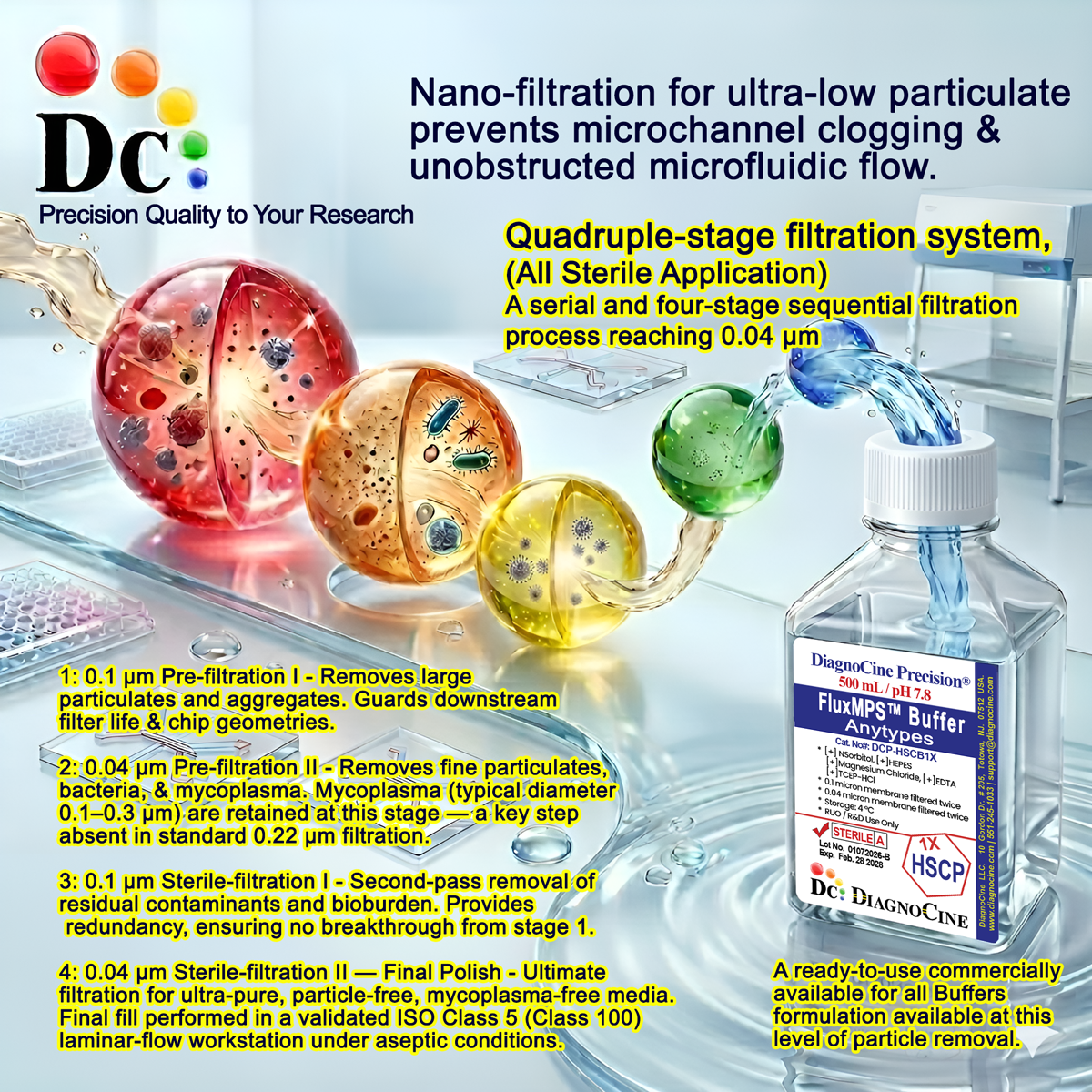
Quadruple-stage filtration system
DCP-NP401X is ultrapure and filtered through a 0.1 µm membrane twice and a 0.04 µm membrane twice, positioning it as one of the cleanest buffers available for cell and molecular biology experiments.
- 1
0.1 µm Pre-filtration I
Removes large particulates and aggregates, extending the life of downstream filters.
- 2
0.04 µm Pre-filtration II
Retains fine particulates and bioburden, including organisms as small as mycoplasma, whose smallest forms are about 0.2 microns in size.
- 3
0.1 µm Sterile-filtration I
A second 0.1 µm pass adds redundancy ahead of final polishing.
- 4
0.04 µm Sterile-filtration II — Final Polish
A second 0.04 µm pass provides the final polish for an ISO Class 5 (Class 100) aseptic fill.
Performance vs. conventional buffer
Sequential 0.1 µm and 0.04 µm filtration, each repeated twice, removes finer particulates than a single 0.22 µm pass and helps prevent mycoplasma contamination, since even the smallest mycoplasma species are about 0.2 microns in size.
© Diagnocine® — DCP-NP401X
Where DCP-NP401X performs
This non-denaturing NP-40 buffer solubilizes membrane proteins without disrupting their native structure and function, enabling extraction of cytoplasmic proteins from both adherent and suspension-cultured mammalian cells.
Automated Bioreactors & Robotics
For fully automated perfusion and robotic liquid-handling platforms, an optional 0.01 µm (10 nm) ultra-filtered grade can further reduce particulate load beyond the standard quadruple-stage architecture.
- Total Particulate Exclusion for closed-loop systems
- Valve & Sensor Protection in automated fluidic paths
- Extended Perfusion Stability for long-duration runs
Inquiry Required: contact support@diagnocine.com to request the 0.01 µm ultra-filtered grade.
Micro Physiological System (MPS) & Chip
Supports lysis and buffer-exchange steps within microphysiological and chip-based platforms.
Cell Lysis & Protein Extraction
Solubilizes and extracts membrane proteins and protein complexes without denaturing them.
iPSC-Derived Model Handling
Enables gentle lysis of iPSC-derived cell models while preserving native protein complexes.
Endothelial & Primary Cell Perfusion
Selectively lyses the cytoplasmic membrane while leaving the nuclear membrane intact for compartment-specific analysis.
ELISA, Western Blotting & Immunoprecipitation
Its mild, non-denaturing properties suit ELISA, Luminex, Western blotting, and immunoprecipitation protocols.
Microscopy & Optical Sensing
Low-background formulation supports downstream optical detection of extracted proteins.
Specifications
Values below are drawn directly from the product's release documentation.
| Parameter | Specification |
|---|---|
| Appearance | Clear, Colorless Liquid |
| pH USP <791> | 7.4 |
| Tris HCl Concentration | 20 mM |
| NaCl Concentration | 137 mM |
| Glycerol Concentration | 10% |
| NP-40 Concentration | 1% |
| EDTA Concentration | 2 mM |
| Parameter | Specification |
|---|---|
| Sterility | Filtered 0.1 micron membrane twice and 0.04 micron membrane twice in a sterile environment |
| DNase Activity | None detected (18 hr incubation with plasmid DNA, room temperature) |
| RNase Activity | None detected (18 hr incubation with ribosomal RNA, room temperature) |
| Water Quality | Ultrapure Type 1 water (18.2 MΩ·cm) |
| Manufacturing Standard ISO 13485 | ISO 13485-certified, CE-approved facility |
| Fill Environment | ISO Class 5 (Class 100) |
| Parameter | Specification |
|---|---|
| Storage Temperature | 4°C |
| Shelf Life | 3 years |
| Parameter | Specification |
|---|---|
| Manufacturing QMS | ISO 13485-certified facility |
| Regulatory Alignment | CE-approved |
| Production Method | Final packaging, QA, and testing at the DiagnoCine R&D and Quality Testing Center; customization and assembly at DiagnoCine Precision, Totowa, New Jersey, USA |
| Intended Use | For Research Use Only (RUO) |
Full composition
Component concentrations below are provided exactly as declared on the product's release documentation.
| Component | CAS Number | Concentration |
|---|---|---|
| Tris HCl | 1185-53-1 | 20 mM |
| NaCl | 7647-14-5 | 137 mM |
| Glycerol | 56-81-5 | 10% |
| NP-40 | 9036-19-5 | 1% |
| EDTA | 60-00-4 | 2 mM |
Manufacturing & compliance
DCP-NP401X is produced and released under a documented quality system.
ISO 13485:2016 QMS
Manufactured under ISO 13485-certified and CE-approved facilities.
Ultrapure Type 1 Water
Formulated with ultrapure Type 1 water (18.2 MΩ·cm).
ISO Class 5 Fill & Finish
Final sterile filtration and fill occur in an ISO Class 5 (Class 100) environment.
Micro-Batch Precision
All specific customization requests and assembly were accomplished at DiagnoCine Precision in Totowa, New Jersey, USA.
DNase Activity Testing
None was detected after incubation of plasmid DNA with this product for 18 hours at room temperature.
RNase Activity Testing
No RNase activity was detected after incubating ribosomal RNA with this product for 18 hours at room temperature.
Sterility Filtration Validation
Filtered 0.1 micron membrane twice and 0.04 micron membrane twice in a sterile environment.
Documentation / CoA
A Certificate of Analysis is available for this lot.
How DCP-NP401X compares
A side-by-side look at filtration architecture and formulation control.
| Parameter | DCP-NP401X (FluxMPS™) | Conventional NP-40 Buffer | Standard Alternative |
|---|---|---|---|
| Filtration architecture | check_circle Quadruple-stage (0.1 µm x2 + 0.04 µm x2) | cancel Single 0.22 µm pass | cancel Single 0.22 µm pass |
| Final filtration pore size | 0.04 µm | 0.22 µm | 0.22 µm |
| Number of filtration stages | 4 | 1 | 1 |
| Defined pH | check_circle 7.4 | cancel Variable | cancel Variable |
| Declared NP-40 content | check_circle 1% | cancel Undefined | cancel Undefined |
| Glycerol stabilization | check_circle 10% | cancel Variable | cancel None |
| Manufacturing QMS | check_circle ISO 13485-certified | cancel Unspecified | cancel Unspecified |
| Microfluidic channel compatibility | check_circle | cancel | cancel |
| Custom formulation | check_circle | cancel | cancel |
Frequently asked questions
Common questions about DCP-NP401X.
Supporting literature
Curated references relevant to NP-40 lysis buffer chemistry and its use in microfluidic and organ-on-a-chip workflows.
- Bhatia, S.N. & Ingber, D.E. Microfluidic organs-on-chips. Nat Biotechnol. doi:10.1038/nbt.2989
- Seddon, A.M., Curnow, P. & Booth, P.J. Membrane proteins, lipids and detergents: not just a soap opera. Biochim Biophys Acta. doi:10.1016/j.bbamem.2004.04.011
- Linke, D. Detergents: an overview. Methods Enzymol. doi:10.1016/S0076-6879(09)63034-2
- Phizicky, E.M. & Fields, S. Protein-protein interactions: methods for detection and analysis. Microbiol Rev. doi:10.1128/mr.59.1.94-123.1995
- Mahmood, T. & Yang, P.C. Western blot: technique, theory, and trouble shooting. N Am J Med Sci. doi:10.4103/1947-2714.100998
- Good, N.E. et al. Hydrogen ion buffers for biological research. Biochemistry. doi:10.1021/bi00866a011
- Wilson, K. & Walker, J. (eds). Principles and Techniques of Biochemistry and Molecular Biology — EDTA chelation in protein extraction. Cambridge University Press.
- Low, L.A. et al. Organs-on-chips: into the next decade. Nat Rev Drug Discov. doi:10.1038/s41573-020-0079-3
- Ryall, K.A. et al. Detergent-based cell lysis and its effects on downstream immunoassays. J Immunol Methods. doi:10.1016/j.jim.2015.05.005