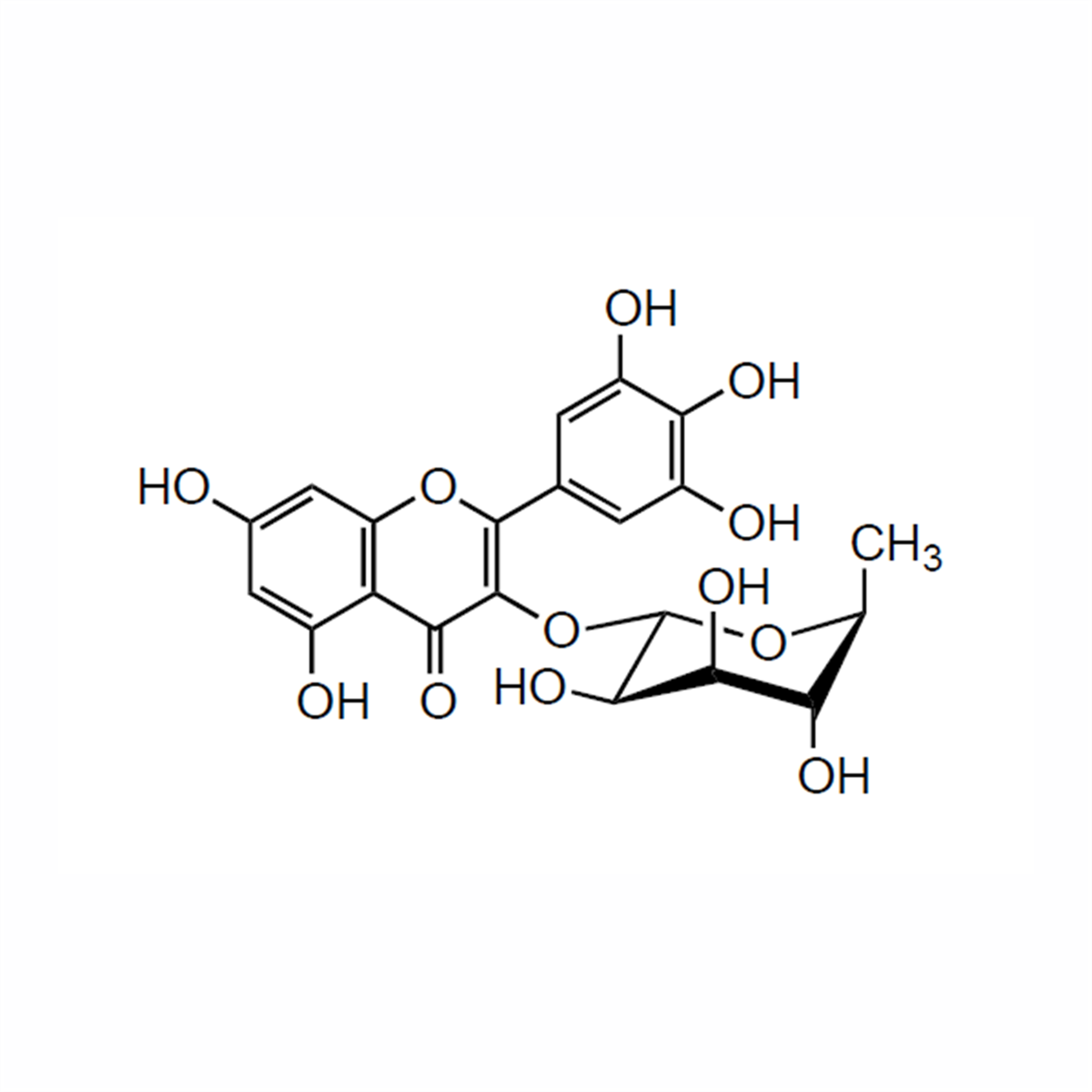
Myricitrin (100 mg)
Product#: FNK-NS540103
$1,387.09
Availability:
Ships in 1-2 Weeks
Myricitrin (100 mg)
- CAT Number : FNK-NS540103
- CAS Number : 17912-87-7
- Molecular Weight : 464.38
- Molecular Formula : C21H20O12
- Pack size: 100 mg
- Store: –20 ℃
- Purity: >99%(HPLC)
Myricitrin is a flavonoid glycoside found naturally in various plants. It is a 100 mg research-grade compound typically used for scientific studies investigating its biological activities and potential health benefits.
Property
- Chemical Formula: C21H20O12
- Molecular Weight: 464.38 g/mol
- Appearance: Likely a pale yellow to off-white crystalline powder
- Solubility: Soluble in polar organic solvents, poorly soluble in water
- Research: Used in studies investigating its antioxidant and anti-inflammatory properties
- Pharmaceutical Development: Investigated for potential therapeutic applications
- Analytical Standard: May be used as a reference compound in plant extract analysis
- Biochemical Studies: Used to study flavonoid metabolism and bioactivity
- Storage: Store in a cool, dry place, protected from light
- Handling: Use appropriate personal protective equipment, including gloves and eye protection
- Safety Measures: For research use only; not for human consumption without proper testing and approval
- Cardiovascular Diseases
- Myricitrin exhibits cardioprotective properties that may help prevent and manage cardiovascular diseases:
- It reduces oxidative stress and inflammation, which are key factors in the development of heart disease.
- Myricitrin improves lipid profiles by lowering LDL cholesterol and increasing HDL cholesterol levels, reducing the risk of atherosclerosis.
- It enhances endothelial function, which can help lower blood pressure and improve overall vascular health.
- Myricitrin exhibits cardioprotective properties that may help prevent and manage cardiovascular diseases:
- Diabetes
- Myricitrin shows potential in managing diabetes and its complications:
- It improves insulin sensitivity by activating the AMP-activated protein kinase (AMPK) pathway.
- Myricitrin inhibits enzymes like α-glucosidase and α-amylase, slowing down glucose absorption from the digestive system.
- It protects pancreatic beta cells from oxidative stress, supporting overall insulin function and glucose management.
- Myricitrin shows potential in managing diabetes and its complications:
- Neurodegenerative Diseases
- Myricitrin demonstrates neuroprotective effects that may be beneficial in treating neurodegenerative disorders:
- It inhibits the aggregation of amyloid proteins, which is associated with Alzheimer's disease.
- Myricitrin protects against oxidative stress and inflammation in the brain, potentially slowing the progression of neurodegenerative diseases.
- It has shown promise in treating post-ischemic brain neurodegeneration and dementia.
- Myricitrin demonstrates neuroprotective effects that may be beneficial in treating neurodegenerative disorders:
- Cancer
- Myricitrin exhibits anticancer properties through various mechanisms:
- It acts as an antioxidant, neutralizing free radicals that can damage cellular DNA and promote cancer growth.
- Myricitrin inhibits cancer cell growth by disrupting signaling pathways like PI3K/Akt and MAPK.
- It induces apoptosis (programmed cell death) in cancer cells and suppresses angiogenesis, the formation of new blood vessels that feed tumors.
- Myricitrin exhibits anticancer properties through various mechanisms:
- Inflammatory Disorders
- Myricitrin's anti-inflammatory effects may help in managing various inflammatory conditions:
- It inhibits the production of pro-inflammatory chemicals like prostaglandins and leukotrienes.
- Myricitrin modulates nuclear factor-kappa B (NF-κB), a key transcription factor in inflammation.
- It shows potential in treating chronic inflammatory disorders such as rheumatoid arthritis and atopic dermatitis.
- Myricitrin's anti-inflammatory effects may help in managing various inflammatory conditions:
- Liver Diseases
- Myricitrin demonstrates hepatoprotective properties:
- It attenuates oxidative stress in liver cells.
- Myricitrin regulates the inflammatory response through the AMPK/SREBP-1c pathway in liver cells.
- Myricitrin demonstrates hepatoprotective properties:
- PI3K/Akt/mTOR Pathway
- Myricetin exhibits a dual effect on the PI3K/Akt pathway:
- In healthy tissues, it promotes signaling through the Akt pathway to induce cytoprotection.
- In cancer cells, it suppresses this signaling cascade to induce apoptosis.
- Myricetin exhibits a dual effect on the PI3K/Akt pathway:
Myricetin targets PI3K expression both in vitro and in vivo, and directly interacts with Akt to suppress its kinase activity. By inhibiting PI3K and Akt phosphorylation, myricetin also disrupts mTOR activation.
- MAPK Pathway
- Myricetin modulates the Raf/MEK/ERK cascade:
- It binds to Raf in an ATP-noncompetitive manner, halting its activity.
- It disrupts the kinase activity of MEK1 and suppresses ERK phosphorylation.
- Myricetin reduces p38-MAPK protein levels.
- Myricetin modulates the Raf/MEK/ERK cascade:
- NF-κB Pathway
- Myricetin inhibits the NF-κB pathway:
- It suppresses NF-κB activation by halting the phosphorylation of Akt or ERK1/2.
- Myricetin reduces protein levels of phosphorylated IKKα and IκBα.
- Myricetin inhibits the NF-κB pathway:
- JAK/STAT Pathway
- Myricetin interacts with and inhibits JAK1, consequently attenuating the phosphorylation-activation of STAT3. It also targets STAT1 in certain conditions.
- Nrf2 Pathway
- Contrary to its inhibitory effects on other pathways, myricetin promotes the Nrf2 pathway:
- It prevents Nrf2 ubiquitination-mediated destruction.
- Myricetin mediates Nrf2 translocation to the nucleus, leading to activation of ARE and up-regulation of associated genes.
- Contrary to its inhibitory effects on other pathways, myricetin promotes the Nrf2 pathway:
- TGFβ/Smad Pathway
- Myricetin induces signaling through the TGFβ/Smad cascade. It targets TGFβ1 expression in certain conditions and can up-regulate TGFβ expression.
- Wnt/β-catenin Pathway
- Myricetin modulates the canonical Wnt pathway:
- It alters the phosphorylation status of β-catenin and GSK-3β.
- In breast carcinoma cells, myricetin promotes dephosphorylation of GSK-3β through inhibiting PAK1 protein expression.
- Myricetin modulates the canonical Wnt pathway:
- Apoptotic Pathways
- Myricetin influences apoptotic pathways:
- It promotes intrinsic apoptosis by directly enhancing Bax expression and mitochondrial translocation.
- In healthy cells, it activates PI3K/Akt signaling and inhibits ERK/JNK pathway to induce cytoprotection.
- Myricetin influences apoptotic pathways: