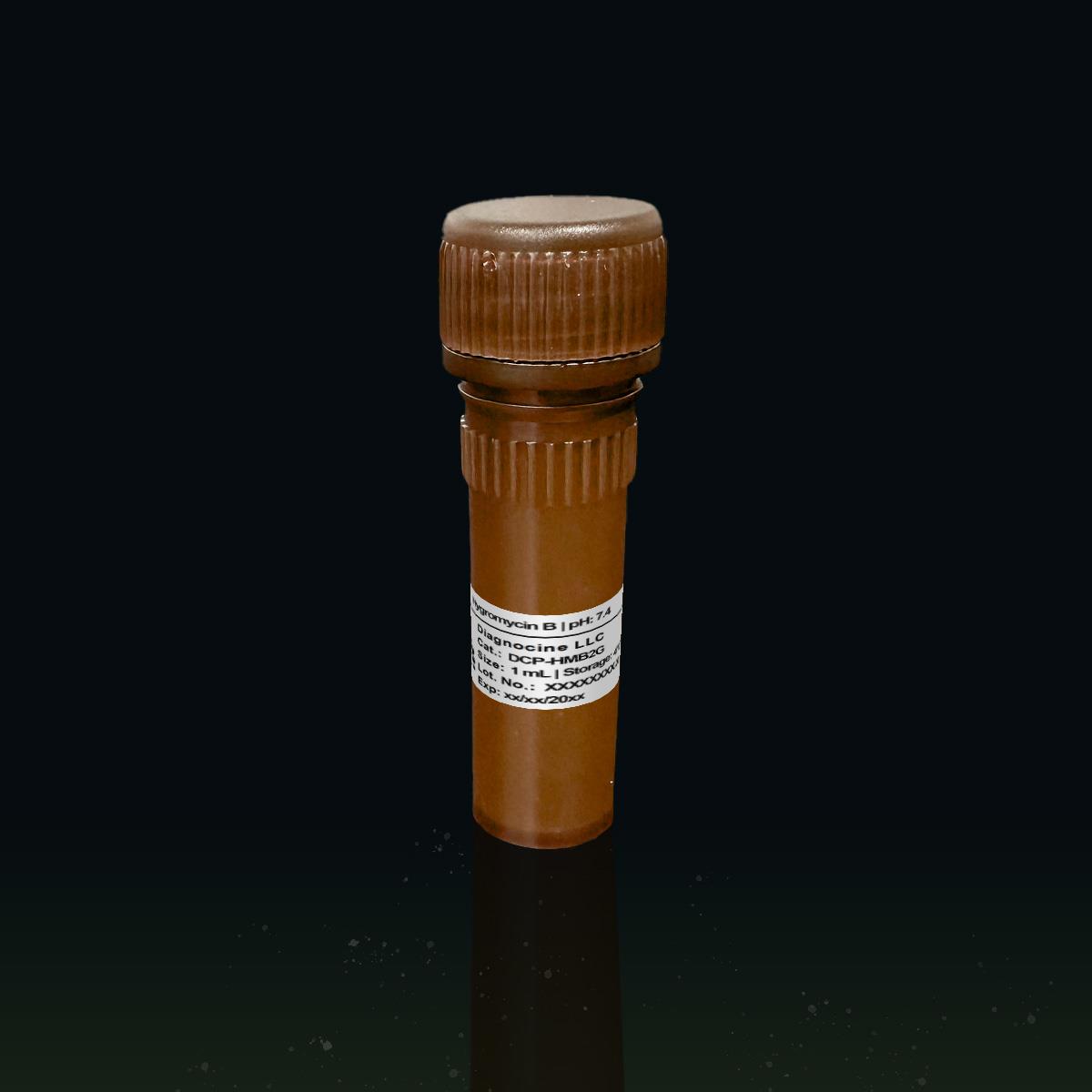
FluxMPS™ Hygromycin B (100 mg/mL) Antibiotic Selection Solution
A ready-to-use, 100 mg/mL Hygromycin B solution formulated in sterile HEPES buffer for immediate addition to selection media. Sterile-filtered through a 0.22 µm membrane and further processed through Diagnocine's dual-stage 0.1 µm + 0.04 µm filtration polish, delivering a low-particulate, Microfluidics Suitable reagent for stable-line selection, CRISPR/Cas9 workflows, and microfluidic culture systems.
- Ready-to-use 100 mg/mL Hygromycin B solution formulated in sterile HEPES buffer — no reconstitution required
- Produced by Streptomyces hygroscopicus; selects for cells expressing hygromycin B phosphotransferase (hyg/hph resistance genes)
- Sterile-filtered through a 0.22 µm membrane and further polished through a dual-stage 0.1 µm + 0.04 µm filtration train
- Tested free of detectable DNase and RNase activity after an 18-hour incubation challenge at room temperature
- Compatible with CRISPR/Cas9 and other genome-editing workflows requiring stable integration and long-term antibiotic selection
- Supports dual-selection strategies alongside G418 or blasticidin S for generating multi-resistant cell lines
- Supplied as 20 x 1 mL single-use vials (20 mL total); do not autoclave — heat destroys antibiotic activity
- Manufactured under an ISO 13485:2016 quality management system, with final QC, packaging, and customization completed at Diagnocine, Totowa, NJ
- Concentration100 mg/mL
- VehicleHEPES buffer
- AppearanceClear, colorless liquid
- pH7.4
- Source organismStreptomyces hygroscopicus
- Resistance markerhyg/hph (hygromycin B phosphotransferase)
- DNase activityNone detected
- RNase activityNone detected
- Filtration0.22 µm sterile filter + 0.1/0.04 µm dual-stage polish
- Storage4°C, in the dark; do not freeze
Engineered where standard antibiotic reagents fall short
Conventional 0.22 µm-filtered antibiotic solutions leave sub-micron particulates, mycoplasma-scale contaminants, and microaggregates in the reagent stream — a risk in microfluidic dosing lines, long-term selection cultures, and imaging-based screens. FluxMPS™ Hygromycin B addresses each failure mode directly.
Microchannel-safe purity
A dual-stage 0.1 µm + 0.04 µm filtration polish, downstream of the primary 0.22 µm sterilizing filtration, reduces sub-micron particulate load for safe dosing into microfluidic channels and automated liquid-handling lines.
Validated nuclease-free purity
Each lot is challenged with plasmid DNA and ribosomal RNA for 18 hours at room temperature; no DNase or RNase activity was detected, protecting nucleic acid integrity in transfection and genome-editing workflows.
HEPES-buffered stability
Formulated in sterile HEPES buffer at pH 7.4 for excellent physiological compatibility and minimal disruption to culture pH upon addition.
Low background for imaging
A clear, colorless, optically clean solution that avoids introducing background absorbance or particulate interference into fluorescence-based selection assays and confocal imaging workflows.
Rigorous quality control
Every batch is released against appearance, pH, sterility, and nuclease-activity specifications before it ships.
Customization on demand
Alternate concentrations, additional chemicals/compounds/proteins/supplements, different pH, and other modifications are available — contact support@diagnocine.com.
Dual-stage filtration system
Beyond the primary 0.22 µm sterilizing-grade filtration used to render this solution sterile, Diagnocine applies a dedicated dual-stage polish — a 0.1 µm mycoplasma-retentive prefilter followed by a 0.04 µm final filter — to reduce sub-micron particulate and microaggregate load below what a single 0.22 µm pass removes.
- 1
0.1 µm Prefiltration
Removes large particulate, cell debris, and protein/antibiotic aggregates, and provides mycoplasma-retentive-grade filtration ahead of the final polish.
- 2
0.04 µm Final filtration — Polish
Retains sub-micron particulates and microaggregates that pass a standard 0.22 µm filter, delivering an ultra-clean, microfluidic-channel-safe liquid reagent.
Performance vs. single-pass 0.22 µm filtration
The dual-stage 0.1 µm + 0.04 µm polish is applied in addition to, not instead of, the standard 0.22 µm sterilizing filtration already used to render this solution sterile.
Selection and maintenance across research systems
Hygromycin B (100 mg/mL) is used for selection of stable transfectants or transduced cells, maintenance of established hygromycin-resistant lines, dual-selection strategies, and antiviral research, across mammalian, insect, plant, fungal, yeast, and bacterial systems.
Automated Bioreactors & Robotics
For automated perfusion bioreactors, valve-actuated microfluidic systems, and robotic liquid handlers, Diagnocine offers an optional 0.01 µm (10 nm) ultra nano-filtered MPS Grade variant of this reagent on request.
- Total Particulate Exclusion — six-stage cascade down to 0.01 µm for particulate-sensitive automated systems
- Valve & Sensor Protection — minimizes fouling risk in microvalves and in-line biosensors
- Extended Perfusion Stability — supports longer unattended run times in closed perfusion loops
Inquiry Required: the 0.01 µm MPS Grade variant is available by request — contact support@diagnocine.com.
Microphysiological System (MPS) & Chip Selection Assays
Low-particulate formulation suited for dosing into microfluidic selection lines without channel fouling.
Stable Transfection & CRISPR/Cas9 Selection
Stringent, long-term selection of cells carrying integrated hyg/hph resistance cassettes.
Dual & Multi-Selection Strategies
Combine with G418, blasticidin S, or puromycin to generate multi-resistant cell lines.
Cross-Species Selection Marker
Effective across mammalian, insect, plant, fungal, yeast, and bacterial systems carrying hyg/hph.
Selective Entry into Virus-Infected Cells
Exploits hygromycin B's increased entry into virus-infected cells with elevated membrane permeability to selectively inhibit translation.
Long-Term Selection Monitoring
Low-background, particulate-clean reagent compatible with fluorescent reporter lines and extended imaging-based selection monitoring.
Full parameter breakdown
Every specification below is sourced directly from Diagnocine's product record for DCP-HMB2G; unsupported parameters are omitted rather than estimated.
| Parameter | Specification |
|---|---|
| Formulation | Hygromycin B, 100 mg/mL, in HEPES buffer |
| Concentration | 100 mg/mL |
| Vehicle | Sterile HEPES buffer |
| Appearance | Clear, colorless liquid |
| pH | 7.4 |
| Parameter | Specification |
|---|---|
| Sterility | 0.22 µm membrane filtration, once Aseptic |
| Mycoplasma | 0.1 µm mycoplasma-retentive prefiltration (not tested per lot) |
| DNase activity | None detected (18 hr, room temperature, plasmid DNA challenge) |
| RNase activity | None detected (18 hr, room temperature, ribosomal RNA challenge) |
| Parameter | Specification |
|---|---|
| Storage | 4°C, in the dark |
| Freeze-thaw / Handling | Do not freeze |
| Shelf life | 2 years from date of manufacture, unopened |
| Handling caution | Do not autoclave — destroys antibiotic activity |
| Parameter | Specification |
|---|---|
| Raw material source | Streptomyces hygroscopicus-derived aminoglycoside antibiotic |
| Traceability | Manufactured, packaged, and QC-tested at Diagnocine, Totowa, NJ, USA |
| Manufacturing QMS | ISO 13485:2016 ISO |
| UNSPSC | 41116155 — Molecular biology and cell culture growth media (UNv260801) |
| Regulatory alignment | ISO 13485:2016 certified manufacturing |
| Intended use | Research Use Only (RUO) |
Full composition
Hygromycin B (100 mg/mL) is a single-active-ingredient antibiotic solution rather than a multi-component growth medium. The tabs below reflect the active pharmaceutical ingredient and formulation vehicle exactly as specified; the Inorganic Salts and Amino Acids tabs are retained for structural consistency across the FluxMPS™ catalogue and are not applicable to this product.
| Component | CAS Number | mg/L |
|---|---|---|
| Not applicable — no inorganic salt components are part of this formulation. | ||
| Component | CAS Number | mg/L |
|---|---|---|
| Not applicable — no amino acid components are part of this formulation. | ||
| Component | CAS Number | mg/L |
|---|---|---|
| ACTIVE INGREDIENT & VEHICLE | ||
| Hygromycin B | 31282-04-9 | 100,000 mg/L (100 mg/mL) |
| HEPES buffer | 7365-45-9 | Not disclosed |
Manufacturing & compliance
DCP-HMB2G is manufactured under a controlled quality management system with per-batch release testing.
ISO 13485:2016 Quality Management System
Manufactured under an ISO 13485-certified quality management system.
Dual-Stage 0.1 µm + 0.04 µm Filtration Polish
Applied downstream of primary 0.22 µm sterilizing filtration for microfluidic-channel-safe purity.
Per-Batch DNase/RNase & pH Release Testing
Each lot is challenged for nuclease activity and tested for pH and appearance before release.
Final QC, Packaging & Customization
Final packaging, quality assurance, and customization requests are completed at Diagnocine's R&D and Quality Testing Center in Totowa, New Jersey, USA.
Sterility
0.22 µm membrane filtration, performed once, prior to fill.
Nuclease Activity (DNase/RNase)
None detected after an 18-hour challenge with plasmid DNA and ribosomal RNA at room temperature.
pH Release Testing
Formulated and tested to pH 7.4 per batch.
Documentation / CoA
A Certificate of Analysis is available on request.
- Appearance — clear, colorless liquid
- pH — 7.4
- DNase and RNase activity — none detected (18 hr challenge, room temperature)
- Sterility — 0.22 µm membrane filtration, once
How DCP-HMB2G compares
A parameter-by-parameter comparison against a conventional single-pass 0.22 µm-filtered hygromycin B solution and a generic aminoglycoside selection reagent.
| Parameter | DCP-HMB2G (FluxMPS™) | Standard 0.22 µm-Filtered Hygromycin B | Generic Aminoglycoside Selection Reagent |
|---|---|---|---|
| Grade | check_circle Microfluidics Suitable | cancel Not specified | cancel Not specified |
| Formulation | Ready-to-use, 100 mg/mL in sterile HEPES buffer | Often supplied as lyophilized powder requiring reconstitution | Varies by supplier |
| Final filtration pore size | 0.04 µm | 0.22 µm | 0.22 µm |
| Number of filtration stages | 2 (0.1 µm + 0.04 µm, in addition to 0.22 µm sterilizing filtration) | 1 (0.22 µm single pass) | 1 (0.22 µm single pass) |
| Mycoplasma barrier filtration | check_circle 0.1 µm mycoplasma-retentive prefilter | cancel Not typically included | cancel Not specified |
| Endotoxin (release specification) | Not specified | Corning classical liquid media — < 0.25 EU/mL Sigma-Aldrich DMEM complete medium — ≤ 2 EU/mL Gibco classical DMEM — Not specified (recorded per lot) |
|
| Nuclease testing (DNase/RNase) | check_circle Tested, none detected | cancel Not typically disclosed | cancel Not specified |
| Manufacturing QMS | check_circle ISO 13485:2016 | cancel Varies | cancel Not specified |
| Microfluidic channel compatibility | check_circle Yes | cancel Limited by particulate load | cancel Not specified |
| Custom formulation available | check_circle Yes, on request | cancel No | cancel No |
Comparison figures from published supplier specifications, accessed 2026-09-02. Suppliers that publish no numeric endotoxin specification are shown as "Not specified".
Frequently asked questions
Common questions about DCP-HMB2G Hygromycin B (100 mg/mL).
Supporting literature
Curated references on hygromycin B mechanism, resistance genetics, mycoplasma filtration, and microfluidic culture selection.
- Gritz L, Davies J. Plasmid-encoded hygromycin B resistance: the sequence of hygromycin B phosphotransferase gene and its expression in Escherichia coli and Saccharomyces cerevisiae. Gene. 1983. doi:10.1016/0378-1119(83)90140-9
- Rao RN, Allen NE, Hobbs JN Jr, et al. Genetic and enzymatic basis of hygromycin B resistance in Escherichia coli. Antimicrob Agents Chemother. 1983. doi:10.1128/AAC.24.5.689
- Blochlinger K, Diggelmann H. Hygromycin B phosphotransferase as a selectable marker for DNA transfer experiments with higher eukaryotic cells. Mol Cell Biol. 1984. doi:10.1128/mcb.4.12.2929
- Gonzalez A, Jimenez A, Vazquez D, Davies JE, Schindler D. Studies on the mode of action of hygromycin B, an inhibitor of translocation in eukaryotes. Biochim Biophys Acta. 1978. doi:10.1016/0005-2787(78)90050-9
- Cabanas MJ, Vazquez D, Modolell J. Inhibition of ribosomal translocation by aminoglycoside antibiotics. Biochem Biophys Res Commun. 1978. doi:10.1016/0006-291X(78)90855-8
- Huh D, Matthews BD, Mammoto A, Montoya-Zavala M, Hsin HY, Ingber DE. Reconstituting organ-level lung functions on a chip. Science. 2010. doi:10.1126/science.1188302
- Bhatia SN, Ingber DE. Microfluidic organs-on-chips. Nat Biotechnol. 2014. doi:10.1038/nbt.2989
- Young L, Sung J, Stacey G, Masters JR. Detection of Mycoplasma in cell cultures. Nat Protoc. 2010. doi:10.1038/nprot.2010.16
- Giacomini M, Salini I, Aluigi MG, et al. Detection of mycoplasma contamination in cell cultures. Curr Protoc Mol Biol. 2014. doi:10.1002/0471142727.mb2404s106