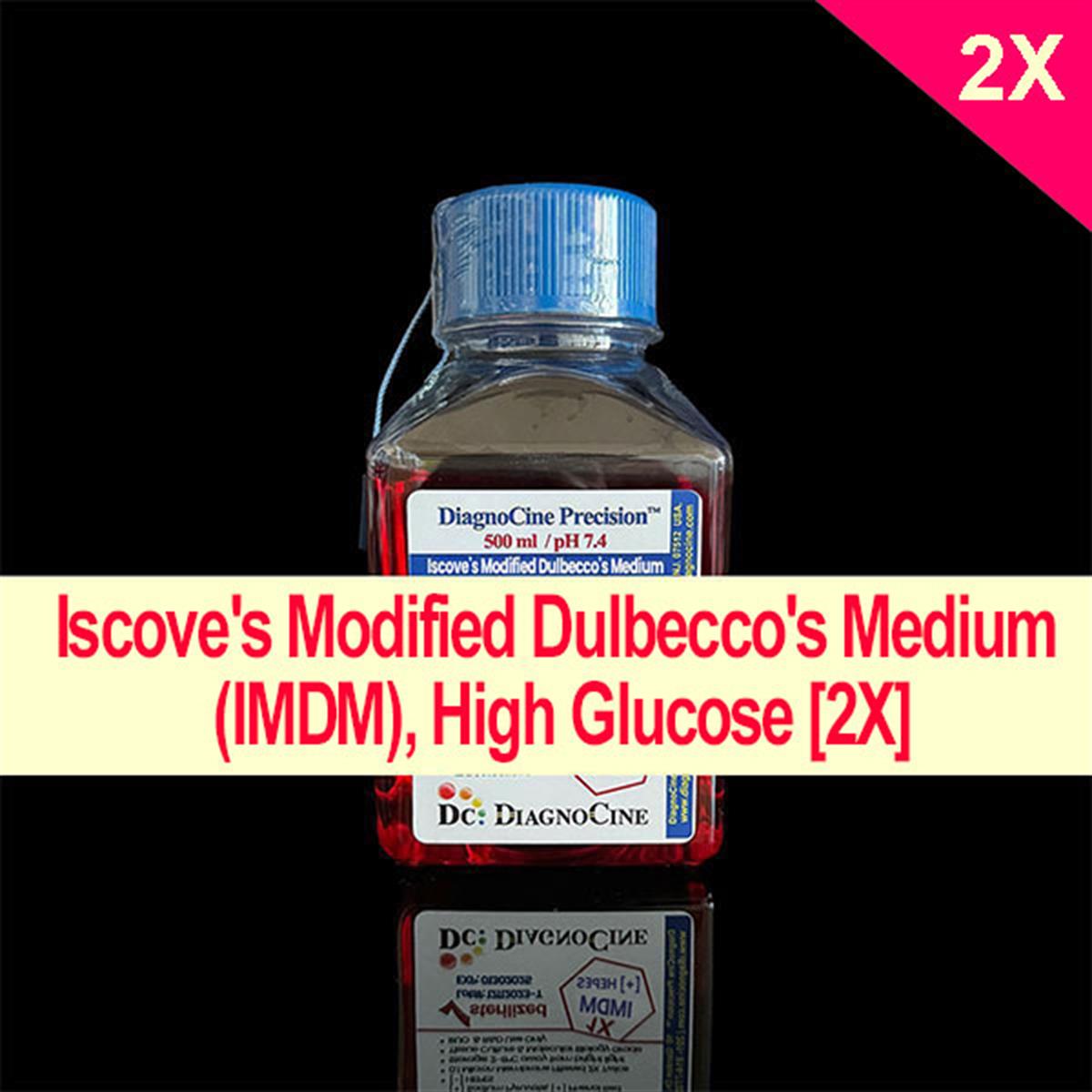
FluxMPS™ Iscove's Modified Dulbecco's Medium (IMDM), High Glucose [2X] Family
Select See the table below
- See the table below
FluxMPS™ Iscove's Modified Dulbecco's Medium (IMDM), High Glucose [2X] Family
IMDM is a highly enriched cell culture medium designed for rapidly proliferating, high-density cell cultures — a modification of Dulbecco's Modified Eagle Medium (DMEM) that adds selenium, extra amino acids and vitamins, sodium pyruvate and HEPES buffer, and uses potassium nitrate in place of iron nitrate. FluxMPS™ supplies it as a 2X (double-strength) liquid in sixteen supplement configurations — 9,000 mg/L glucose in the concentrate, 4,500 mg/L at 1X — so methylcellulose, agarose, hydrogels, treatment solutions or cell suspensions can be added 1:1 without diluting the basal nutrients. Every configuration is purified through a quadruple-stage filtration architecture to 0.04 microns for organ-on-chip, tissue-on-chip and lab-on-chip workflows where the medium itself is part of the instrument.
- Sixteen 2X liquid configurations in two parallel series — a bicarbonate-buffered series (DCP-IMDM2X, DCP-IMDM-Q2X, DCP-IMDM-B2X, DCP-IMDM-R2X, DCP-IMDM-QB2X, DCP-IMDM-QR2X, DCP-IMDM-BR2X, DCP-IMDM-QBR2X) and a 50 mM HEPES series (DCP-IMDMH2X, DCP-IMDMH-Q2X, DCP-IMDMH-B2X, DCP-IMDMH-R2X, DCP-IMDMH-QB2X, DCP-IMDMH-QR2X, DCP-IMDMH-BR2X, DCP-IMDMH-QBR2X) — varying by L-Glutamine, Sodium Bicarbonate, HEPES and Phenol Red.
- 2X concentrate: mix with an equal volume of a compatible solution or matrix for a final 1X medium.
- Highly enriched formulation design — selenium as sodium selenite, additional amino acids and vitamins, sodium pyruvate and HEPES, with potassium nitrate replacing the ferric nitrate of DMEM, so the base carries no added iron.
- High glucose at 9,000 mg/L in the 2X (4,500 mg/L, 4.5 g/L at 1X) to sustain vigorous proliferation at high cell density.
- Sodium pyruvate is included in all sixteen configurations at 220 mg/L in the 2X (110 mg/L at 1X); L-Glutamine, where included, is supplied at 1,168 mg/L in the 2X (584 mg/L, 4 mM at 1X); HEPES series: 50 mM in the 2X (25 mM at 1X).
- Purified to 0.04 microns — finer than any ready-to-use cell culture media currently available — through two 0.1 micron pre-filtration stages followed by two 0.04 micron final filtration stages.
- Validated across demanding cell types — erythrocyte progenitor cells, macrophages, mouse B lymphocytes, bone-marrow hematopoietic cells, T lymphocytes and hybridoma cells, plus Jurkat, COS-7 and K-562 lines and ESC/iPSC differentiation workflows; the 2X product pages add methylcellulose CFU assays, plaque overlays, soft agar and 3D hydrogels.
- 500 mL size, stored at 2–8 °C away from bright light, do not freeze; concentration, glucose, HEPES, pH and supplement customizations available on request.
- Concentration2X (double strength)
- Working strength1X after 1:1 mixing
- Glucose9,000 mg/L at 2X (4,500 mg/L at 1X)
- L-Glutamine (where included)1,168 mg/L at 2X (584 mg/L at 1X)
- Sodium pyruvate (all configs)220 mg/L at 2X (110 mg/L at 1X)
- HEPES (HEPES series)11,916 mg/L (50 mM) at 2X; 25 mM at 1X
- Sodium bicarbonate (where included)6,048 mg/L at 2X (3,024 mg/L at 1X)
- Salt baseModified Earle's-type, KNO3
- Trace elementSodium selenite
- BufferingBicarbonate, 5-10% CO2
- Configurations16
- Size500 mL
- Storage2-8 C, away from light; do not freeze
Sixteen IMDM, High Glucose [2X] configurations — filter by the supplements you need
Tick the supplement or supplements your protocol requires and press Search; every configuration that includes all of them is highlighted, and Clear resets the table. Each row links straight through to its product page from both the catalog number and the View button. Sodium pyruvate is present in all sixteen configurations, so it is stated here once rather than repeated as a column.
| Name | Cat No. | L-Glutamine | Sodium Bicarbonate | HEPES | Phenol Red | Product Page |
|---|---|---|---|---|---|---|
| IMDM | DCP-IMDM2X | check | check | remove | check | Viewarrow_forward |
| IMDM w/o Glutamine | DCP-IMDM-Q2X | remove | check | remove | check | Viewarrow_forward |
| IMDM w/o Bicarbonate | DCP-IMDM-B2X | check | remove | remove | check | Viewarrow_forward |
| IMDM w/o Phenol Red | DCP-IMDM-R2X | check | check | remove | remove | Viewarrow_forward |
| IMDM w/o Glutamine, Bicarbonate | DCP-IMDM-QB2X | remove | remove | remove | check | Viewarrow_forward |
| IMDM w/o Glutamine, Phenol Red | DCP-IMDM-QR2X | remove | check | remove | remove | Viewarrow_forward |
| IMDM w/o Bicarbonate, Phenol Red | DCP-IMDM-BR2X | check | remove | remove | remove | Viewarrow_forward |
| IMDM w/o Glutamine, Bicarbonate, Phenol Red | DCP-IMDM-QBR2X | remove | remove | remove | remove | Viewarrow_forward |
| IMDM + HEPES | DCP-IMDMH2X | check | check | check | check | Viewarrow_forward |
| IMDM + HEPES w/o Glutamine | DCP-IMDMH-Q2X | remove | check | check | check | Viewarrow_forward |
| IMDM + HEPES w/o Bicarbonate | DCP-IMDMH-B2X | check | remove | check | check | Viewarrow_forward |
| IMDM + HEPES w/o Phenol Red | DCP-IMDMH-R2X | check | check | check | remove | Viewarrow_forward |
| IMDM + HEPES w/o Glutamine, Bicarbonate | DCP-IMDMH-QB2X | remove | remove | check | check | Viewarrow_forward |
| IMDM + HEPES w/o Glutamine, Phenol Red | DCP-IMDMH-QR2X | remove | check | check | remove | Viewarrow_forward |
| IMDM + HEPES w/o Bicarbonate, Phenol Red | DCP-IMDMH-BR2X | check | remove | check | remove | Viewarrow_forward |
| IMDM + HEPES w/o Glutamine, Bicarbonate, Phenol Red | DCP-IMDMH-QBR2X | remove | remove | check | remove | Viewarrow_forward |
A highly enriched medium for high-density, rapidly proliferating, and serum-free cell culture
Iscove's Modified Dulbecco's Medium (IMDM) is a highly enriched synthetic basal medium developed in the late 1970s by Norman N. Iscove and Fritz Melchers. It is one of the most nutrient-dense modifications of Dulbecco's Modified Eagle's Medium (DMEM), engineered to support the vigorous proliferation of hematopoietic precursors, lymphocytes and hybridomas at high cell densities under serum-free or serum-reduced, chemically defined conditions.
Compared with DMEM, IMDM adds selenium (as sodium selenite), additional amino acids and vitamins, sodium pyruvate, and a 25 mM HEPES buffer, and replaces the ferric nitrate in DMEM with potassium nitrate. Because it lacks iron and lipids, IMDM is designed to be completed with transferrin, albumin and a lipid source when true serum-free growth is required — exactly as intended in Iscove's original work. Notably, the use of potassium nitrate instead of iron nitrate is beneficial for rapid cell proliferation.
The medium is particularly well-suited for culturing erythrocyte progenitor cells, macrophages, mouse B lymphocytes, bone marrow hematopoietic cells, T lymphocytes and various hybridoma cells. It can also serve as a base solution for some unique serum-free media formulations. While it contains many necessary ingredients for cell culture, IMDM does not include proteins, lipids or growth factors, so it typically requires supplementation with serum or serum-free additives. The medium uses a sodium bicarbonate buffer system and requires a 5–10% CO2 environment to maintain physiological pH.
Why a 2X (double-strength) format
Researchers may use the 2X formulation to incorporate glucose solutions, alternative carbon sources, treatment solutions, hydrogels, agarose, methylcellulose, cell suspensions, or other high-volume components without diluting the basal nutrients. For a true twofold concentrate of a 4500 mg/L glucose formulation, the stock glucose concentration is 9000 mg/L, returning to 4500 mg/L after equal-volume mixing with a compatible glucose-free component; this is a dilution calculation, not evidence of a particular commercial 2X product. Every other formulated component is likewise supplied at twice its working level — L-glutamine 1,168 mg/L (584 mg/L at 1X), sodium pyruvate 220 mg/L (110 mg/L at 1X), sodium bicarbonate 6,048 mg/L (3,024 mg/L at 1X) where included, and HEPES 50 mM (25 mM at 1X) in the HEPES series. Other ingredients contributed by the diluent, serum, cell suspension, and supplements must be included when determining the final composition. The purpose is dilution compensation, not automatically faster growth or a recommendation to culture cells at twice the normal medium strength. A documented example is making an IMDM-containing methylcellulose preparation for hematopoietic progenitor colony assays.
Norman Iscove and the hematopoietic growth challenge
In the 1970s, clonal culture of hematopoietic precursors — B-lymphocyte precursors, erythroid progenitors and related cells — relied on high concentrations of fetal bovine serum, typically 20–30%, together with undefined supplements. These high-serum conditions introduced batch-to-batch variability and confounded efforts to identify the specific factors regulating cell growth. Working at the Friedrich Miescher Institute and then the Basel Institute for Immunology (Basel, Switzerland), Norman N. Iscove set out to define these requirements by removing serum altogether. He found that classical basal media such as MEM and standard DMEM became nutrient-limiting as cell densities rose, and so re-engineered the base medium to prevent depletion of key nutrients.
Two foundational papers
Guilbert & Iscove (1976), Nature 263: 594–595 — "Partial replacement of serum by selenite, transferrin, albumin and lecithin in hemopoietic cell cultures."[2] This study first established that defined components could replace much of the serum requirement, and this is why selenium is a signature component of IMDM.
Iscove & Melchers (1978), J. Exp. Med. 147(3): 923–933 — "Complete replacement of serum by albumin, transferrin, and soybean lipid in cultures of lipopolysaccharide-reactive B lymphocytes."[1] This is the definitive paper describing the enriched medium and demonstrating that LPS-stimulated murine B lymphocytes could grow and mature to immunoglobulin secretion in fully serum-free conditions supplemented only with albumin, transferrin and soybean lipid.
Evolution to a standalone standard
Although optimized initially for murine B-lymphocytes, IMDM's superior nutrient capacity led to rapid adoption across many demanding cell types. It became a default choice for hybridoma antibody production,[7] high-density suspension and bioreactor cultures, and hematopoietic and stem-cell workflows where classical media could not sustain exponential growth. It also became the base for several downstream serum-free formulations, such as the X-VIVO hematopoietic media.[3]
The IMDM family tree
IMDM sits one step downstream of DMEM and upstream of several modern serum-free formulations. Its position in that lineage explains every one of its distinguishing components.
- MEM and standard DMEM (the constraint) — classical basal media that became nutrient-limiting as cell densities rose, which is the specific problem the IMDM re-engineering set out to solve.
- DMEM (the parent) — IMDM is a modification of Dulbecco's Modified Eagle Medium and shares its 4500 mg/L high-glucose level.[6] The ~2× or greater glucose difference is relative to RPMI-1640 and low-glucose formulations, not to DMEM.
- IMDM (this family) — adds selenium as sodium selenite, additional amino acids and vitamins, sodium pyruvate and 25 mM HEPES; substitutes potassium nitrate for ferric nitrate, so the base contains no added iron; adds biotin and vitamin B12, which standard DMEM lacks. Offered here as a 2X concentrate.
- Serum-free descendants — IMDM became the base for several downstream serum-free formulations, including the X-VIVO hematopoietic media, and serves as a base solution for other unique serum-free media formulations.
Standard IMDM formulation — 1X and 2X
Values are mg/L. HiMedia supplies IMDM both with 25 mM HEPES and 3.024 g/L sodium bicarbonate (AL070A, complete) and with 25 mM HEPES but without bicarbonate (AT070, to which 3.024 g/L NaHCO3 is added before use). Individual FluxMPS™ configurations omit L-Glutamine, Sodium Bicarbonate, HEPES or Phenol Red exactly as indicated in the supplement matrix above.
IMDM uses a modified Earle's-type salt base. Its defining inorganic feature is potassium nitrate (KNO3) in place of the ferric nitrate found in DMEM, meaning the base medium contains no added iron — iron is instead delivered by transferrin under serum-free conditions. It also includes sodium selenite as an essential trace element.
| Ingredient | CAS No. | 1X (mg/L) | 2X as supplied (mg/L) |
|---|---|---|---|
| Calcium Chloride dihydrate (CaCl2·2H2O) | 10035-04-8 | 219.00 | 438.000 |
| Magnesium Sulfate, anhydrous (MgSO4) | 7487-88-9 | 97.67 | 195.440 |
| Potassium Chloride (KCl) | 7447-40-7 | 330.00 | 660.000 |
| Potassium Nitrate (KNO3) | 7757-79-1 | 0.076 | 0.152 |
| Sodium Bicarbonate (NaHCO3) (not in the w/o Sodium Bicarbonate configurations) | 144-55-8 | 3024.00 | 6048.000 |
| Sodium Chloride (NaCl) | 7647-14-5 | 4505.00 | 9010.000 |
| Sodium Phosphate Monobasic, anhydrous (NaH2PO4) | 7558-80-7 | 109.00 | 218.000 |
| Sodium Selenite (Na2SeO3) | 10102-18-8 | 0.017 | 0.0346 |
IMDM carries an expanded, concentrated amino acid profile. Relative to DMEM, it adds several non-essential amino acids directly to the base — free L-alanine, L-asparagine, L-aspartic acid, L-glutamic acid and L-proline — sparing rapidly dividing cells the metabolic cost of synthesizing them.
| Ingredient | CAS No. | 1X (mg/L) | 2X as supplied (mg/L) |
|---|---|---|---|
| Glycine | 56-40-6 | 30.00 | 60.000 |
| L-Alanine | 56-41-7 | 25.00 | 50.000 |
| L-Arginine hydrochloride | 1119-34-2 | 84.00 | 168.000 |
| L-Asparagine monohydrate (2X product pages: L-Asparagine, CAS 70-47-3) | 70-47-3 | 28.40 | 50.000 |
| L-Aspartic acid | 56-84-8 | 30.00 | 60.000 |
| L-Cystine dihydrochloride | 30925-07-6 | 91.24 | 182.480 |
| L-Glutamic acid | 56-86-0 | 75.00 | 150.000 |
| L-Glutamine (not in the w/o L-Glutamine configurations) | 56-85-9 | 584.00 | 1168.000 |
| L-Histidine hydrochloride monohydrate | 5934-29-2 | 42.00 | 84.000 |
| L-Isoleucine | 73-32-5 | 105.00 | 209.600 |
| L-Leucine | 61-90-5 | 105.00 | 209.600 |
| L-Lysine hydrochloride | 657-27-2 | 146.00 | 292.400 |
| L-Methionine | 63-68-3 | 30.00 | 60.000 |
| L-Phenylalanine | 63-91-2 | 66.00 | 132.000 |
| L-Proline | 147-85-3 | 40.00 | 80.000 |
| L-Serine | 56-45-1 | 42.00 | 84.000 |
| L-Threonine | 72-19-5 | 95.00 | 190.400 |
| L-Tryptophan | 73-22-3 | 16.00 | 32.000 |
| L-Tyrosine disodium salt dihydrate (2X product pages: L-Tyrosine disodium salt, CAS 69847-45-6) | 69847-45-6 | 103.79 | 208.400 |
| L-Valine | 72-18-4 | 94.00 | 187.200 |
IMDM's vitamin complement is enriched relative to DMEM chiefly by the addition of biotin and vitamin B12, which standard DMEM lacks; the remaining vitamins are largely carried at DMEM-level concentrations. This prevents vitamins from becoming limiting during long-term, high-density proliferation.
| Ingredient | CAS No. | 1X (mg/L) | 2X as supplied (mg/L) |
|---|---|---|---|
| D-Biotin | 58-85-5 | 0.013 | 0.026 |
| Choline chloride | 67-48-1 | 4.00 | 8.000 |
| D-Calcium pantothenate | 137-08-6 | 4.00 | 8.000 |
| Folic acid | 59-30-3 | 4.00 | 8.000 |
| myo-Inositol | 87-89-8 | 7.20 | 14.400 |
| Niacinamide | 98-92-0 | 4.00 | 8.000 |
| Pyridoxal hydrochloride | 65-22-5 | 4.00 | 8.000 |
| Riboflavin | 83-88-5 | 0.40 | 0.800 |
| Thiamine hydrochloride | 67-03-8 | 4.00 | 8.000 |
| Vitamin B12 (Cyanocobalamin) | 68-19-9 | 0.013 | 0.026 |
IMDM incorporates HEPES directly at 25 mM in its standard formulation, giving robust pH control including at culture initiation and outside a CO2 incubator. HEPES is a zwitterionic buffer with a pKa of ~7.3 at 37 °C, which prevents the initial pH rise that tends to occur when a culture is started.[10] In this [2X] family, HEPES is carried by the HEPES series at 50 mM in the concentrate (25 mM at 1X); the bicarbonate series contains no HEPES.
| Ingredient | CAS No. | 1X (mg/L) | 2X as supplied (mg/L) |
|---|---|---|---|
| D-Glucose (Dextrose) | 50-99-7 | 4500.00 (High Glucose) | 9000.000 |
| HEPES (HEPES series only) | 7365-45-9 | 5958.00 (25 mM) | 11916.000 (50 mM) |
| Phenol red sodium salt (not in the w/o Phenol Red configurations) | 34487-61-1 | 15.00 | 30.000 |
| Sodium pyruvate | 113-24-6 | 110.00 | 220.000 |
Physical specifications (HiMedia, 1X powder reference)
| Parameter | Complete (with NaHCO3) | Without NaHCO3 (add before use) |
|---|---|---|
| Appearance (powder) | Off-white to creamish homogeneous powder | Off-white to creamish homogeneous powder |
| pH (reconstituted) | 6.7 – 7.3 | 5.2 – 5.8 |
| Osmolality (mOsm/kg H2O) | 280 – 320 | 210 – 250 |
| Storage | 2–8 °C, protected from light | 2–8 °C, protected from light |
IMDM vs. key counterparts
How IMDM differs from its parent medium and from the two media most often considered alongside it. Values refer to 1X working strength.
| Feature | IMDM (2X family, at 1X) | DMEM (High-Glucose) | RPMI-1640 | Williams' Medium E |
|---|---|---|---|---|
| Primary design goal | High-density hematopoietic / serum-free culture | Fast-growing adherent monolayer culture | Suspension lymphoid culture | Primary hepatocyte specialized culture |
| Glucose (mg/L) | 4500 (25 mM) | 4500 (25 mM) | 2000 (11.1 mM) | 2000 (11.1 mM) |
| HEPES in base | Present (25 mM) | Absent (optional add-on) | Absent (optional add-on) | Absent |
| Iron / nitrate source | Potassium nitrate (KNO3); no added iron | Ferric nitrate | None | Trace metals (Cu, Mn, Zn, Fe) |
| Selenium | Present (sodium selenite) | Absent | Absent | Absent |
| Biotin / Vitamin B12 | Present | Absent | Present | Present |
| Ca2+ | 1.49 mM | 1.8 mM | 0.42 mM | ~1.8 mM |
| Sodium pyruvate | Present (110 mg/L) | Optional | Absent | Present |
IMDM, High Glucose: 1X vs. 2X
| Feature | IMDM, High Glucose, 1X | IMDM, High Glucose, 2X |
|---|---|---|
| Supplied concentration | 1X (ready to use) | 2X (double strength) |
| Preparation before use | None | Mix with an equal volume of a compatible solution or matrix (methylcellulose, agarose, hydrogels, glucose-free treatment solutions or cell suspensions) for a final 1X medium |
| Component concentrations as supplied | As listed in the 1X column of the composition tables | 2X column of the composition tables, before dilution |
| Composition at working strength | Standard IMDM formulation | Standard IMDM formulation, after 1:1 dilution |
| Glucose | 4500 mg/L | 9,000 mg/L (4,500 mg/L after 1:1 dilution) |
| L-Glutamine (where included) | 584 mg/L | 1,168 mg/L (584 mg/L after 1:1 dilution) |
| Sodium bicarbonate (where included) | 3024 mg/L | 6,048 mg/L (3,024 mg/L after 1:1 dilution) |
| HEPES (HEPES series) | 25 mM | 50 mM (25 mM after 1:1 dilution) |
| Catalog variants | 16 (8 bicarbonate-buffered + 8 HEPES) | 16 (8 without HEPES + 8 with 50 mM HEPES) |
| Catalog number suffix | ...1X | ...2X (e.g., DCP-IMDM2X) |
| Filtration | Quadruple-stage, 0.04 micron final | Quadruple-stage, 0.04 micron final |
| Sizes | 500 mL / 1000 mL | 500 mL |
| Storage | 2–8 °C, away from bright light | 2–8 °C, away from bright light; do not freeze |
Built for the architecture of the future. Not the flask of the past.
Traditional cell culture media were formulated for static well plates and flasks — environments that tolerate impurities, precipitates and particle loads that would immediately compromise a microfluidic system. FluxMPS™ was designed from the ground up for platforms where the medium itself is part of the instrument.
Purified to 0.04 microns
Finer than any ready-to-use cell culture media currently available. Microscopic particulates and protein aggregates are eliminated before the media ever reaches your chip.
Engineered for flow, not just growth
Every component is optimized for consistent, laminar flow performance across complex micro-channel geometries and capillary-bed or vascular simulations.
Zero-clogging as a baseline
Zero-clogging performance is not a feature — it is the baseline specification. Your platform stays operational and your data stays clean.
Optical clarity for live imaging
Optical clarity for real-time imaging and integrated biosensing in organ-on-chip platforms, where false biological signals from particulates are unacceptable.
Stability over long perfusion runs
Consistent formulation stability over weeks of continuous flow, supporting long-term automated perfusion studies that run without interruption.
Configurable to your protocol
Sixteen stocked IMDM, High Glucose [2X] configurations, plus other concentrations, added compounds, proteins, supplements, a different pH and further modifications on request.
Quadruple-stage filtration
FluxMPS™ media pass through four sequential filtration stages — two 0.1 micron pre-filtration stages followed by two 0.04 micron final filtration stages.
-
01
Pre-Filtration Stage 1 0.1 µm
First reduction of the particulate and aggregate load carried by a freshly formulated medium.
-
02
Pre-Filtration Stage 2 0.1 µm
Second pass at the same rating, conditioning the stream before the final stage.
-
03
Final Filtration Stage 1 0.04 µm
The stage that takes the medium below the threshold at which micro-channel blockage and flow disruption originate.
-
04
Final Filtration Stage 2 0.04 µm
Final pass delivering media purified to 0.04 microns — finer than any ready-to-use cell culture media currently available.
Why 0.04 microns matters for IMDM workflows
IMDM is used at high cell density and over long, continuous runs — precisely the conditions in which accumulated particulates and protein aggregates cause channel blockage, disrupted laminar flow and false biological signals. Filtering below that threshold protects the platform, not just the culture.

Where IMDM is the medium of record
IMDM's superior nutrient capacity led to rapid adoption across many demanding cell types where classical media could not sustain exponential growth.
Hematopoietic progenitor cells
A gold-standard basis for bone marrow cells, splenic lymphocytes, B-cell precursors and erythroid colony-forming units (CFU-E/BFU-E), including erythrocyte progenitor cells.
Hybridoma culture and monoclonal antibodies
Widely used to maximize hybridoma growth yields and antibody secretion; a default choice for hybridoma antibody production.
T and B lymphocytes
Supports high-density activation and blastogenesis of primary human and murine T and B cells after mitogen stimulation, including mouse B lymphocytes.
Suspension and adherent lines
Supports rapidly proliferating, high-density cultures, including high-density suspension and bioreactor work, plus macrophages.
Stem cell work
Provides a foundational basis for multi-lineage differentiation protocols for embryonic (ESC) and induced pluripotent (iPSC) stem cells.
Serum-free and chemically defined culture
Engineered for serum-free or serum-reduced, chemically defined conditions, and used as a base solution for unique serum-free media formulations.
IMDM [2X] — double-strength applications
With appropriate supplementation, IMDM supports selected rapidly proliferating and high-density cultures, including lymphoid and macrophage cell systems; it can be used in laboratory investigations of hematopoietic cells, cell proliferation, and hybridoma culture when the formulation and supplements are suitable for the chosen cells.[1,7] It is not a complete growth medium by itself; serum or a validated alternative supplement system is generally required.
Hematopoietic CFU Assays
A 2X base for IMDM-containing methylcellulose preparations used in hematopoietic progenitor colony-forming assays.
Hybridoma & Lymphoid Cells
Developed for high-density lymphoid culture and widely used for hybridoma and semi-solid cloning when appropriately supplemented.[1,7]
Plaque & Overlay Assays
Mix 1:1 with agarose, Avicel or CMC for plaque, focus-forming, PRNT and plaque-purification overlays at 1X medium strength.[6]
Soft Agar & Hydrogel Embedding
Compensates for dilution in soft-agar, collagen, alginate, fibrin, PEG, hyaluronic acid and GelMA preparations.[8,9]
Organ-on-a-Chip & MPS
Microchannel-safe medium for perfused organ-, tissue- and body-on-a-chip platforms.[12,13,14]
Microscopy & Optical Sensing
Fewer particles mean cleaner fields for colony counting, confocal imaging and on-chip biosensors; the Phenol Red-free configurations add no Phenol Red background.
1. Virus assays (semi-solid overlays)
Viral plaque assay (agarose overlay); viral plaque assay (Avicel / CMC liquid overlay); overlay added directly onto inoculum; focus-forming assay; plaque reduction neutralization test (PRNT); virus plaque purification; baculovirus plaque assay (insect cells).
2. Anchorage-independent growth and clonogenic assays
Soft agar colony formation / transformation assay; tumor stem-cell and drug-sensitivity clonogenic assay; semi-solid cloning (hybridoma, CHO, HEK293); hematopoietic colony-forming (CFU) assay; embryoid body / sphere formation in methylcellulose.
3. 3D hydrogel embedding
Collagen I gel culture; agarose gel culture (chondrocytes); alginate encapsulation; fibrin gel culture; PEG hydrogel culture; hyaluronic acid hydrogel culture; gelatin / GelMA bioinks and 3D bioprinting; microfluidic and organ-on-chip gel loading.
4. Aqueous test material at high volume
Environmental water toxicity testing; plant / herbal water extract testing; medical device saline extract testing (ISO 10993-5 type); nanoparticle suspension testing; body fluid testing (serum, CSF, urine, milk); conditioned medium replenishment; water- or buffer-dissolved compound dosing; osmolality / medium-strength studies.
5. Cryopreservation
2X freezing medium (cell vials); 96-well clone freezing (ES cells).
6. Media preparation and bioprocess
Double-strength stock from powdered medium; concentrated feeds for fed-batch and perfusion bioreactors.
Working with IMDM in the laboratory
Four handling points determine whether an IMDM culture performs as Iscove's formulation intends.
Serum-free supplementation is required
IMDM is nutrient-rich but contains no lipids and no iron-transport proteins. For true serum-free growth as Iscove intended, complete it with a defined supplement package — typically albumin, a lipid source and transferrin with iron, and in many protocols insulin and selenium (selenium is already present in the base). Transferrin matters specifically because the base contains no added iron.
High-glucose management
At 4500 mg/L glucose (9,000 mg/L in the 2X), cells metabolize rapidly and generate lactic acid. Even with 25 mM HEPES and bicarbonate, monitor phenol-red color shifts and adjust feeding schedules in high-density cultures.
Buffering and CO2
The complete, bicarbonate-containing medium is intended for 5–10% CO2 once diluted to 1X. Added HEPES improves buffering at seeding and during brief handling outside the incubator, but does not eliminate the CO2 requirement of the bicarbonate system.
Light sensitivity
HEPES, riboflavin and tryptophan are light-sensitive; store medium in the dark, at 2–8 °C away from bright light.
Frequently asked questions
Selection, formulation and handling questions researchers ask most often about FluxMPS™ IMDM, High Glucose [2X].
IMDM is one of the most nutrient-dense modifications of Dulbecco's Modified Eagle's Medium. Compared with DMEM it adds selenium as sodium selenite, additional amino acids and vitamins, sodium pyruvate and a 25 mM HEPES buffer, and it replaces the ferric nitrate of DMEM with potassium nitrate. Because the base therefore contains no added iron, iron is instead delivered by transferrin under serum-free conditions. The vitamin complement is enriched chiefly by biotin and vitamin B12, which standard DMEM lacks, while the amino acid profile adds free L-alanine, L-asparagine, L-aspartic acid, L-glutamic acid and L-proline directly to the base, sparing rapidly dividing cells the metabolic cost of synthesizing them.
The FluxMPS™ IMDM, High Glucose [2X] catalog is organized as two parallel series of eight configurations each. The first series is buffered by sodium bicarbonate alone; the second series carries 50 mM HEPES in the 2X concentrate — 25 mM after 1:1 dilution, the canonical HEPES concentration of Iscove's formulation — in addition to the bicarbonate system. Within each series the same three variables are offered in every combination: L-Glutamine, Sodium Bicarbonate and Phenol Red. Sodium pyruvate is present in all sixteen configurations. Use the supplement filter to check HEPES if your workflow requires the zwitterionic buffer, or leave it unchecked to see the bicarbonate-only series.
Start from the variables your protocol constrains. Select a configuration without L-Glutamine when you intend to substitute a stabilized dipeptide or add fresh L-glutamine just before use; L-glutamine breaks down in liquid medium over time, releasing ammonia that can stress sensitive cultures. Select a configuration without sodium bicarbonate when you buffer the medium yourself, add bicarbonate before use, or let the solution or matrix mixed with the 2X carry the buffer. Select a configuration without phenol red for fluorescence and estrogen-sensitive readouts; Phenol Red adds background in fluorescence and absorbance readouts and has weak estrogen-like activity[11], so track pH with a meter or indicator strip. Select a HEPES-containing configuration when cultures are handled outside the incubator, when pH control at culture initiation matters, or while you mix in methylcellulose, agarose or hydrogels.[10] Check the supplements you require in the filter above and press Search; every matching configuration is highlighted with its catalog number and product page link.
Mix 2X IMDM with an equal volume of a compatible component — methylcellulose, agarose, hydrogels, glucose-free treatment solutions or cell suspensions — so glucose returns from 9,000 mg/L to 4,500 mg/L and amino acids, vitamins and salts end up at their 1X concentration.[8,9] Every component falls to half its supplied level: L-glutamine 1,168 mg/L to 584 mg/L, sodium pyruvate 220 mg/L to 110 mg/L, sodium bicarbonate 6,048 mg/L to 3,024 mg/L where included, and HEPES 50 mM to 25 mM in the HEPES series. Ingredients contributed by the diluent, serum, cells and supplements must be included in the final composition; the purpose is dilution compensation, not culture at twice the normal strength. Serum, antibiotics and other supplements can be added before or after filter sterilization, observing sterility precautions.
No. IMDM is nutrient-rich but contains no proteins, no lipids and no iron-transport proteins, so it requires supplementation with serum or with serum-free additives. For true serum-free growth as Iscove intended, complete the medium with a defined supplement package, typically albumin, a lipid source and transferrin with iron, and in many protocols insulin and selenium, noting that selenium is already present in the base as sodium selenite. Transferrin is important specifically because the IMDM base contains no added iron.
For the bicarbonate-containing configurations, yes. Once diluted to 1X (3,024 mg/L sodium bicarbonate), the complete medium is intended for a 5–10% CO2 environment. HEPES is a zwitterionic buffer with a pKa of approximately 7.3 at 37 °C, and it improves buffering at seeding and during brief handling outside the incubator, including preventing the initial pH rise that tends to occur when a culture is started. It does not, however, eliminate the CO2 requirement of the bicarbonate system. For the HEPES configurations without sodium bicarbonate, CO2 is not required for buffering (25 mM HEPES at 1X); add sodium bicarbonate if the final medium will be held in a CO2 incubator. For the bicarbonate-free configurations without HEPES, it depends on the buffer you add.
At 4500 mg/L glucose (9,000 mg/L in the 2X concentrate), cells metabolize rapidly and generate lactic acid. Even with 25 mM HEPES and bicarbonate present, monitor phenol-red color shifts and adjust feeding schedules in high-density cultures. Note that the 4500 mg/L of IMDM is identical to that of high-glucose DMEM, its parent medium; the roughly two-fold or greater difference is relative to RPMI-1640 and to low-glucose formulations, not to DMEM. If you have selected a phenol-red-free configuration, plan an alternative pH readout since the visual indicator is absent.
FluxMPS™ media are purified to 0.04 microns, finer than any ready-to-use cell culture media currently available, through a quadruple-stage filtration architecture of two 0.1 micron pre-filtration stages followed by two 0.04 micron final filtration stages. At this level the microscopic particulates and protein aggregates that silently block micro-channels, disrupt laminar flow and generate false biological signals are eliminated before the media reaches the chip. That makes the format well matched to organ-on-chip, tissue-on-chip and lab-on-chip platforms, to microfluidic and organ-on-chip gel loading, to long-term automated perfusion running continuously for weeks, and to metabolic tracing where an ultra-pure matrix avoids contaminant interference.[12,13,14]
Every configuration is supplied as a 2X liquid in a 500 mL size. Store at 2–8 °C, away from bright light; do not freeze. HEPES, riboflavin and tryptophan are light-sensitive, so keep the medium in the dark. The standard format for this family is 2X concentration with 9.0 g/L glucose (4.5 g/L at 1X) and a 50 mM HEPES buffer concentration (25 mM at 1X) in the HEPES series. Other concentrations, additions of chemicals, compounds, proteins and supplements, a different pH, and further modifications as needed are available on request from support@diagnocine.com. A 10 nm (0.01 micron) ultra-filtered grade for automated bioreactors, liquid-handling robots and closed perfusion loops is also made on request — email your catalog number and volume.
Verified references
The primary literature and authoritative supplier formulations underlying the descriptions and composition tables on this page.
- Iscove NN, Melchers F. Complete replacement of serum by albumin, transferrin, and soybean lipid in cultures of lipopolysaccharide-reactive B lymphocytes. J Exp Med. 1978;147(3):923–933. doi:10.1084/jem.147.3.923 (The seminal primary paper; open-access via PMC.)
- Guilbert LJ, Iscove NN. Partial replacement of serum by selenite, transferrin, albumin and lecithin in haemopoietic cell cultures. Nature. 1976;263:594–595. doi:10.1038/263594a0 (Precursor study establishing the selenium / transferrin / albumin / lipid basis.)
- Review — serum-free media history and IMDM lineage: Use of serum-free media for peripheral blood mononuclear cell culture and the impact on T and B cell readouts. Frontiers in Toxicology, 2024. doi:10.3389/ftox.2024.1462688 (Modern overview placing IMDM among serum-free media and its derivatives such as X-VIVO.)
- HiMedia / Diagnocine product technical data sheet — IMDM (AT070, w/ L-glutamine and 25 mM HEPES; AL070A, w/ L-glutamine, 3.024 g/L NaHCO3 and 25 mM HEPES). Authoritative supplier formulation used for the composition tables above.
- ATCC formulation — IMDM (ATCC 30-2005) and Gibco/Thermo Fisher IMDM formulation (Cat. 12440). Independent authoritative component tables; cross-checked here for sodium chloride (4505 mg/L), sodium selenite, and the potassium-nitrate-for-ferric-nitrate substitution.
- Dulbecco, R. & Freeman, G. (1959). Plaque production by the polyoma virus. Virology, 8(3): 396–397. doi:10.1016/0042-6822(59)90043-1
- Köhler, G. & Milstein, C. (1975). Continuous cultures of fused cells secreting antibody of predefined specificity. Nature, 256(5517): 495–497. doi:10.1038/256495a0
- Borowicz, S., Van Scoyk, M., Avasarala, S., et al. (2014). The soft agar colony formation assay. J Vis Exp, (92): e51998. doi:10.3791/51998
- Bell, E., Ivarsson, B. & Merrill, C. (1979). Production of a tissue-like structure by contraction of collagen lattices by human fibroblasts of different proliferative potential in vitro. Proc Natl Acad Sci USA, 76(3): 1274–1278. doi:10.1073/pnas.76.3.1274
- Good, N.E., Winget, G.D., Winter, W., Connolly, T.N., Izawa, S. & Singh, R.M.M. (1966). Hydrogen ion buffers for biological research. Biochemistry, 5(2): 467–477. doi:10.1021/bi00866a011
- Berthois, Y., Katzenellenbogen, J.A. & Katzenellenbogen, B.S. (1986). Phenol red in tissue culture media is a weak estrogen: implications concerning the study of estrogen-responsive cells in culture. Proc Natl Acad Sci USA, 83(8): 2496–2500. doi:10.1073/pnas.83.8.2496
- Bhatia, S.N. & Ingber, D.E. (2014). Microfluidic organs-on-chips. Nature Biotechnology, 32(8): 760–772. doi:10.1038/nbt.2989
- Low, L.A., Mummery, C., Berridge, B.R., Austin, C.P. & Tagle, D.A. (2021). Organs-on-chips: into the next decade. Nature Reviews Drug Discovery, 20(5): 345–361. doi:10.1038/s41573-020-0079-3
- Leung, C.M., de Haan, P., Ronaldson-Bouchard, K., et al. (2022). A guide to the organ-on-a-chip. Nature Reviews Methods Primers, 2: 33. doi:10.1038/s43586-022-00118-6
- Drexler, H.G. & Uphoff, C.C. (2002). Mycoplasma contamination of cell cultures: incidence, sources, effects, detection, elimination, prevention. Cytotechnology, 39(2): 75–90. doi:10.1023/A:1022913015916
- Halldorsson, S., Lucumi, E., Gómez-Sjöberg, R. & Fleming, R.M.T. (2015). Advantages and challenges of microfluidic cell culture in polydimethylsiloxane devices. Biosensors and Bioelectronics, 63: 218–231. doi:10.1016/j.bios.2014.07.029
References [1]-[5] are the IMDM family bibliography; references [6]-[16] are cited on the 2X product pages.
FluxMPS™ — Precision Cell Culture Media for Microphysiological Systems
Built for the architecture of the future. Not the flask of the past.
Traditional cell culture media were formulated for static well plates and flasks — environments that tolerate impurities, precipitates, and particle loads that would immediately compromise a microfluidic system. FluxMPS™ was designed from the ground up for Organ-on-Chip (OoC), Tissue-on-Chip (ToC), and Lab-on-Chip (LoC) platforms, where the medium itself is part of the instrument.
Purity That Protects Your Platform
FluxMPS™ is purified to 0.04 microns — finer than any ready-to-use cell culture media currently available. At this level, the microscopic particulates and protein aggregates that silently block micro-channels, disrupt laminar flow, and generate false biological signals are eliminated before the media ever reaches your chip.
The result: your platform stays operational, your data stays clean, and your biology drives the result — not your media.
Engineered for Flow, Not Just Growth
The name FluxMPS™ reflects its core design principle. Every component is optimized for consistent, laminar flow performance across:
- Complex micro-channel geometries
- Capillary-bed and vascular simulations
- Long-term automated perfusion studies running continuously for weeks
Zero-clogging performance is not a feature — it is the baseline specification.
Applications & Performance
| Application | What FluxMPS™ Delivers |
|---|---|
| Microfluidics | Stable shear stress; no channel blockage |
| Metabolic Tracing | Ultra-pure matrix with no contaminant interference |
| Long-term Perfusion | Consistent formulation stability over weeks of continuous flow |
| Organ-on-Chip | Optical clarity for real-time imaging and integrated biosensing |
Regulatory Foundation
FluxMPS™ is formulated to support FDA-recognized physiological modeling standards, providing a validated, reproducible media foundation for drug discovery, toxicology screening, and translational research. When your downstream data needs to stand up to regulatory scrutiny, your upstream media cannot be an afterthought.
The Bottom Line
Microfluidic platforms are precision instruments. They require precision inputs.
FluxMPS™ is the only ready-to-use cell culture medium engineered specifically to meet that standard — protecting your chip, your cells, and your science.