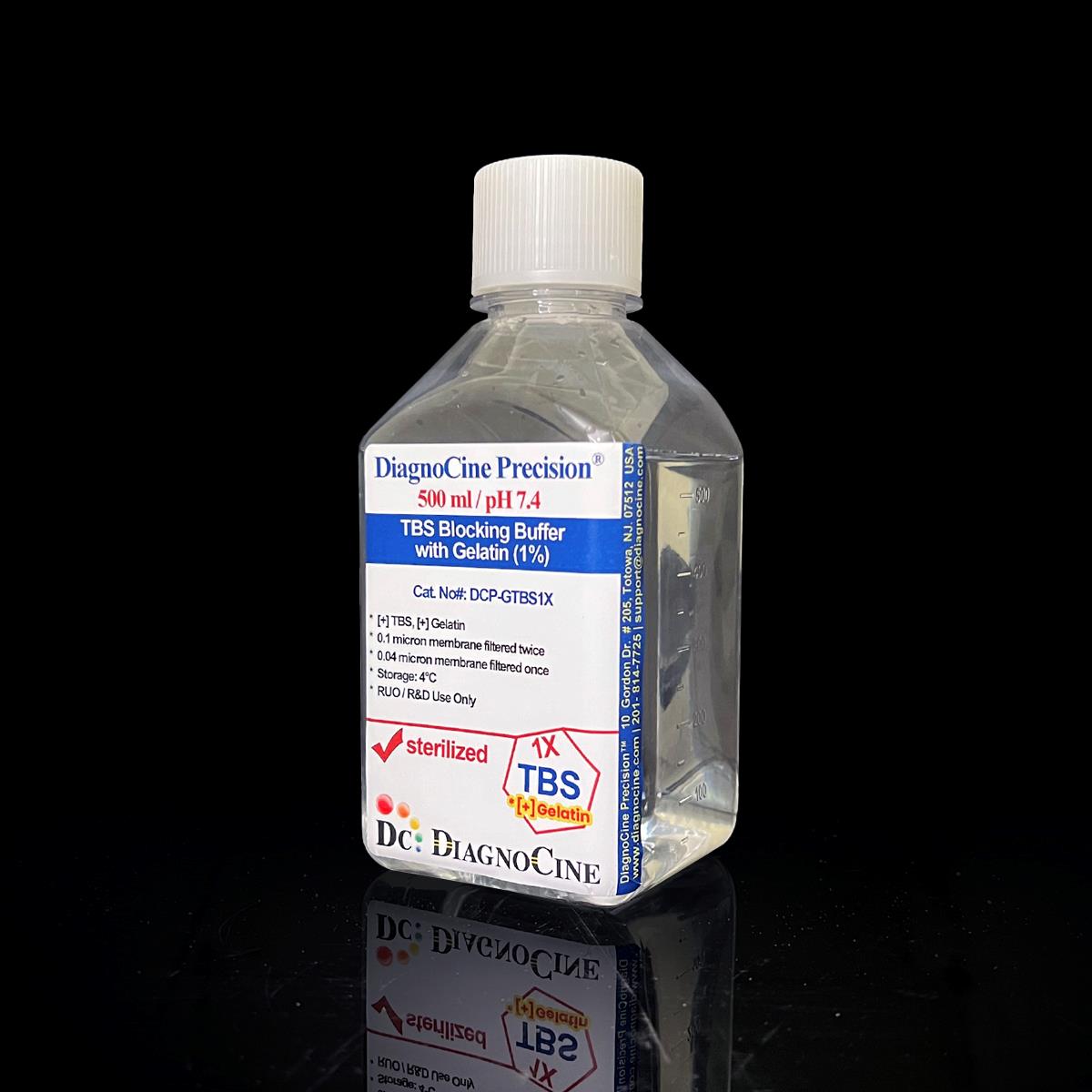
TBS Blocking Buffer with Gelatin (1%)
TBS Blocking Buffer with Gelatin (1%)
A research-grade Tris-buffered saline blocking reagent formulated with 1% gelatin, engineered for a stable pH of 7.4 and defined 50 mM Tris-Base / 150 mM Sodium Chloride molarity. It reduces non-specific binding and background noise across Western blotting, ELISA, and immunohistochemistry workflows. 0.1 µm filtration removes large particulates and aggregates, helping protect downstream applications.
- 0.1 µm membrane filtration (single step)
- Ultrapure Tris-buffered saline base with 1% gelatin blocking agent
- Stable target pH of 7.4 for consistent immunoassay performance
- DNase- and RNase-free, verified by direct incubation testing
- Compatible with nitrocellulose, nylon, and charge-modified nylon membranes
- Manufactured under ISO 13485-certified facilities
- Customizable concentration, pH, and additive formulation on request
- pH7.4
- Tris-Base Concentration50 mM
- Sodium Chloride150 mM
- Gelatin1%
- Filtration0.1 µm membrane filtration (single step)
- DNase ActivityNone Detected
- RNase ActivityNone Detected
- Storage4°C (-20°C long-term)
- Shelf Life6 months
- FormatLiquid Buffer
Engineered where standard blocking buffers fail
Particulates and inconsistent pH can raise background noise and obscure target signal in sensitive immunoassays. TBS Blocking Buffer with Gelatin (1%) is built to remove those failure modes at the source.
0.1 µm filtered
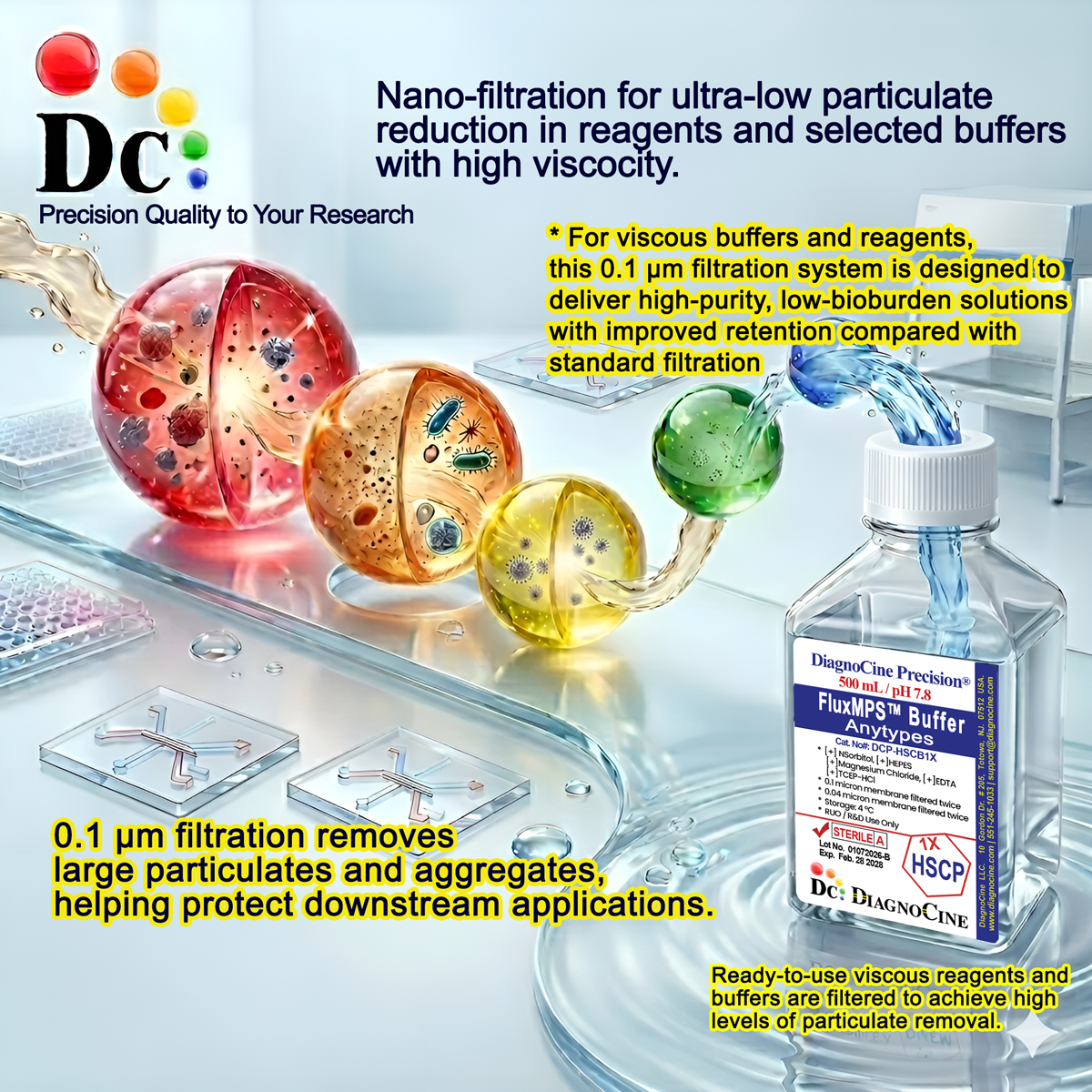
0.1 µm filtration removes large particulates and aggregates, helping protect downstream applications.
Precise, stable pH
Formulated to a defined pH of 7.4 with 50 mM Tris-Base and 150 mM Sodium Chloride, maintaining a consistent environment for protein and antibody integrity.
Ultrapure-grade water
Prepared with Ultrapure Type 1 water (18.2 MΩ·cm) for sensitive assay reagents.
Low background for imaging & assays
The 1% gelatin matrix densely covers non-specific binding sites, improving signal-to-noise ratio for Western blot, ELISA, and IHC detection.
Defined, traceable composition
Every component — gelatin, Tris-Base, and Sodium Chloride — is disclosed at its exact working concentration with lot-based quality control.
Customization on demand
Alternate gelatin concentrations, additional salts, detergents, or pH adjustments can be formulated on request — contact support@diagnocine.com.
0.1 µm membrane filtration
DCP-GTBS1X is filtered once through a 0.1 µm membrane.
-
1
0.1 µm Membrane Filtration
Removes large particulates and aggregates, helping protect downstream applications.
0.1 µm filtration
0.1 µm filtration removes large particulates and aggregates, helping protect downstream applications.
© Diagnocine® — DCP-GTBS1X
Where TBS Blocking Buffer with Gelatin (1%) is used
Formulated to block non-specific binding sites on membranes and microplates, DCP-GTBS1X supports a range of immunoassay workflows.
Dot Blot & Protein Arrays
Blocks unoccupied binding sites on membranes used for dot blots and protein arrays, helping reduce background.
Wash, Dilution & Reconstitution
Tris-buffered saline base with defined pH and ionic strength supports gentle wash and dilution steps ahead of blocking and detection.
iPSC-Derived Model Immunostaining
Reduces non-specific antibody binding when staining iPSC-derived neuron, cardiomyocyte, and hepatocyte cultures.
Endothelial & Primary Cell Immunolabeling
Supports low-background immunolabeling of endothelial and primary cell cultures.
ELISA, Western Blotting & Blocking
The 1% gelatin matrix blocks unoccupied binding sites on membranes and microplates, reducing background and improving assay signal-to-noise.
Microscopy & Optical Detection
Low-background blocking supports clearer immunofluorescence and chromogenic detection in microscopy-based readouts.
Physical, chemical & quality parameters
Specifications below reflect the values stated for DCP-GTBS1X; parameters not measured for this product are omitted rather than estimated.
| Parameter | Specification |
|---|---|
| Appearance | Clear, Colorless Liquid |
| pH | 7.4 |
| Tris-Base Concentration | 50 mM |
| Sodium Chloride Concentration | 150 mM |
| Gelatin Concentration | 1% |
| Parameter | Specification |
|---|---|
| Sterility | Nonsterile |
| DNase Activity | None detected (18 hr, room temperature, plasmid DNA) |
| RNase Activity | None detected (18 hr, room temperature, ribosomal RNA) |
| Water Quality | Ultrapure Type 1 water (18.2 MΩ·cm) |
| Manufacturing Standard ISO 13485 | ISO 13485-certified facility |
| Parameter | Specification |
|---|---|
| Storage Temperature | 4°C (long-term storage: -20°C) |
| Shelf Life | 6 months |
| Parameter | Specification |
|---|---|
| Manufacturing QMS ISO 13485 | ISO 13485-certified facility (DiagnoCine Precision suppliers) |
| Production & Assembly | Final packaging, quality assurance, and testing performed at the DiagnoCine R&D and Quality Testing Center; custom assembly completed at DiagnoCine Precision, Totowa, New Jersey, USA |
| Intended Use | For Research Use Only (RUO); not for clinical, diagnostic, or therapeutic use in humans |
Full composition
TBS Blocking Buffer with Gelatin (1%) is a defined, lot-released Tris-buffered saline formulation blended with gelatin blocking protein. Every component below is disclosed at its exact working concentration.
| Component | CAS Number | Concentration |
|---|---|---|
| Gelatin | 9000-70-8 | 1% |
| Tris-Base | 77-86-1 | 50 mM |
| Sodium Chloride | 7647-14-5 | 150 mM |
Manufacturing & compliance
DCP-GTBS1X is manufactured, tested, and packaged under a controlled quality system spanning raw material sourcing through final fill.
ISO 13485:2016 QMS
Produced under ISO 13485-certified supplier facilities within the DiagnoCine Precision network.
Ultrapure Type 1 Water
Formulated with Ultrapure Type 1 water (18.2 MΩ·cm) to minimize ionic and organic background.
Micro-Batch Precision
Final packaging, quality assurance, and testing are completed at the DiagnoCine R&D and Quality Testing Center, with custom assembly at DiagnoCine Precision, Totowa, New Jersey, USA.
Endotoxin
See CoA.
Particulate Control USP <788>
0.1 µm filtration removes large particulates and aggregates, helping protect downstream applications.
Osmolality Reference USP <785>
Buffer formulations are developed with reference to USP <785> osmolality testing principles.
Documentation / CoA
A Certificate of Analysis documenting the manufactured lot is available for this product.
How DCP-GTBS1X compares
A side-by-side view of DCP-GTBS1X against conventionally filtered gelatin blocking buffers.
| Parameter | DCP-GTBS1X | Conventional Blocking Buffer | Standard Alternative |
|---|---|---|---|
| Gelatin Blocking Formulation (1%) | check_circle | cancel | cancel |
| DNase / RNase Tested | check_circle | cancel | cancel |
| Water Quality (Ultrapure Type 1) | check_circle | cancel | cancel |
| Manufacturing QMS (ISO 13485) | check_circle | cancel | cancel |
| Custom Formulation Available | check_circle | cancel | cancel |
Frequently asked questions
Common questions about DCP-GTBS1X TBS Blocking Buffer with Gelatin (1%).
Supporting literature
Curated references relevant to gelatin blocking chemistry, Tris-buffered saline, and immunoassay applications.
- Mahmood T, Yang PC. Western blot: technique, theory, and trouble shooting. N Am J Med Sci. 2012. doi:10.4103/1947-2714.100998
- Kurien BT, Scofield RH. Western blotting. Methods. 2006. doi:10.1016/j.ymeth.2005.11.007
- Good NE, Winget GD, Winter W, et al. Hydrogen ion buffers for biological research. Biochemistry. 1966. doi:10.1021/bi00866a011
- Ferguson WJ, Braunschweiger KI, Braunschweiger WR, et al. Hydrogen ion buffers for biological research. Anal Biochem. 1980. doi:10.1016/0003-2697(80)90405-3
- Crowther JR. The ELISA Guidebook. Methods Mol Biol. 2009. doi:10.1007/978-1-60327-254-4
- Bass JJ, Wilkinson DJ, Rankin D, et al. An overview of technical considerations for Western blotting applications to physiological research. Scand J Med Sci Sports. 2017. doi:10.1111/sms.12702