FluxMPS™, Microfluidic-Ready, 50 mM HEPES Buffer
FluxMPS™ 50 mM HEPES Buffer
A ready-to-use, zwitterionic Good’s buffer solution at pH 7.4, providing highly stable buffering near physiological pH with minimal temperature-dependent drift. Ideal as a base buffer for protein work, enzyme assays, and general molecular biology. At 50 mM, it offers robust buffering capacity with moderate ionic strength, making it suitable as a base buffer for cell and tissue lysates, protein preparations, enzyme assays, and general molecular biology applications.
- 4-stage filtration process (0.1 µm → 0.04 µm, followed by sterile 0.1 µm → 0.04 µm)
- pH 7.4 is close to typical intracellular and extracellular conditions, ideal for many biochemical and cell-related workflows.
- Zwitterionic, low toxicity, low metal binding, and low UV absorbance, reducing interference in enzyme and spectrophotometric assays.
- Strong buffering capacity while remaining easy to supplement with salts, detergents, or other additives without excessive ionic strength.
- Can be readily combined with NaCl, KCl, Mg², Ca², reducing agents, and detergents to build custom lysis or assay buffers.
- Ultrapure Type 1 water (18.2 MΩ·cm)
- ISO Class 5 laminar-flow fill & finish
- Customizable formulation available upon request
- pH7.4
- AppearanceClear Solution
- Filtration0.1µm×2 + 0.04µm×2
- Storage2-8 °C
- Shelf Life2 years
Engineered for maximum purity & performance
Standard laboratory reagents filtered at 0.22 µm leave sub-micron particulates, mycoplasma, and aggregates that interfere with sensitive downstream applications. FluxMPS™ 50 mM HEPES Buffer is manufactured under ISO 13485 quality systems with multi-stage ultra-filtration to eliminate these failure modes.
Physiological pH buffering
pH 7.4 provides optimal buffering near intracellular and extracellular conditions for biochemical and cell-related workflows.
Minimal interference
Zwitterionic structure with low metal binding and low UV absorbance reduces interference in enzyme assays and spectrophotometric readouts.
Easily supplemented
Compatible with NaCl, KCl, Mg², Ca², reducing agents, and detergents to build custom lysis, assay, or wash buffers.
Temperature-stable pH
HEPES exhibits minimal pH shift across temperature ranges, maintaining reliable buffering at room temperature and 37 °C.
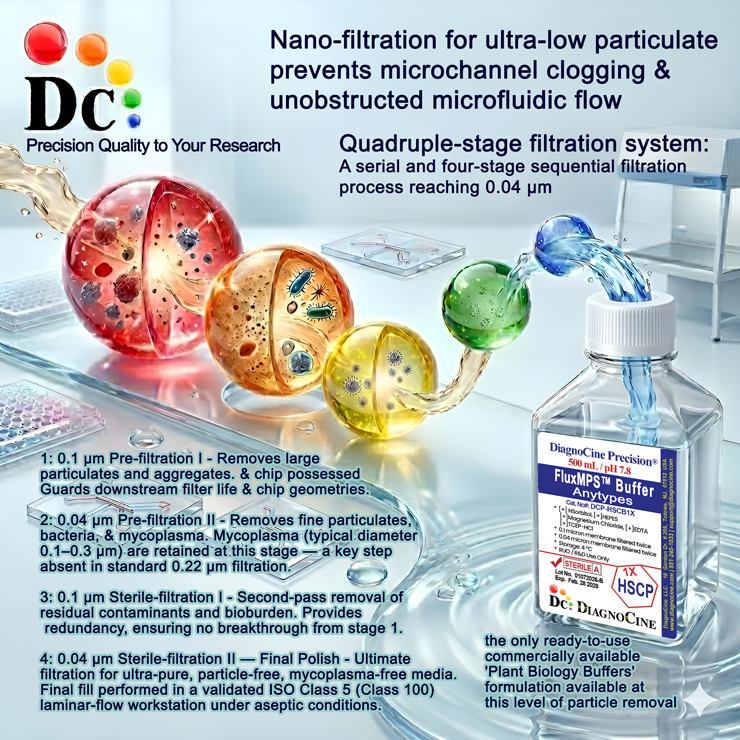
Quadruple-stage filtration system
A serial four-stage sequential filtration process reaching 0.04 µm—the only commercially available buffer at this level of particle removal.
-
1
0.1 µm Pre-filtration I
Removes large particulates and aggregates. Primary guard to extend downstream filter lifetime.
-
2
0.04 µm Pre-filtration II
Removes fine particulates, bacteria, and mycoplasma (0.1–0.3 µm)—a key step absent in standard 0.22 µm filtration.
-
3
0.1 µm Sterile-filtration I
Second-pass removal of residual contaminants and bioburden with full redundancy.
-
4
0.04 µm Sterile-filtration II — Final Polish
Ultimate filtration for particle-free, mycoplasma-free product. Final fill in validated ISO Class 5 laminar-flow workstation.
Performance vs. conventional reagents
Standard 0.22 µm single-pass filtration leaves particles in the 0.05–0.22 µm range. FluxMPS™ removes these contaminants for cleaner results and higher reproducibility.
Validated applications
- Base buffer for protein extraction and purification workflows.
- Preparation of lysis buffers, assay buffers, and wash solutions near physiological pH.
- Enzyme assays and biochemical reactions requiring stable pH around 7.4.
- General laboratory use as a standard pH 7.4 buffer in the HEPES 7.0-8.0 range.
Protocol & usage instructions
- Use as supplied or dilute to the desired working concentration with high-purity water or compatible solutions.
- Adjust ionic strength and composition by adding salts or other components as required by your protocol.
- If needed, fine-tune pH at the working temperature with small additions of NaOH or acid.
Quality assurance & logistics
ISO 13485:2016 Certified
Manufactured under certified QMS with full traceability and lot documentation.
Made in USA
All manufacturing, QA testing, and final assembly at DiagnoCine Precision, Totowa, NJ.
Supporting literature
- Good NE, Winget GD, Winter W, et al. Hydrogen ion buffers for biological research. Biochemistry. 1966;5(2):467-477.
- Ferreira CM, Pinto IS, Soares EV, Soares HM. (Un)suitability of the use of pH buffers in biological, biochemical and environmental studies. RSC Adv. 2015;5:30989-31003.