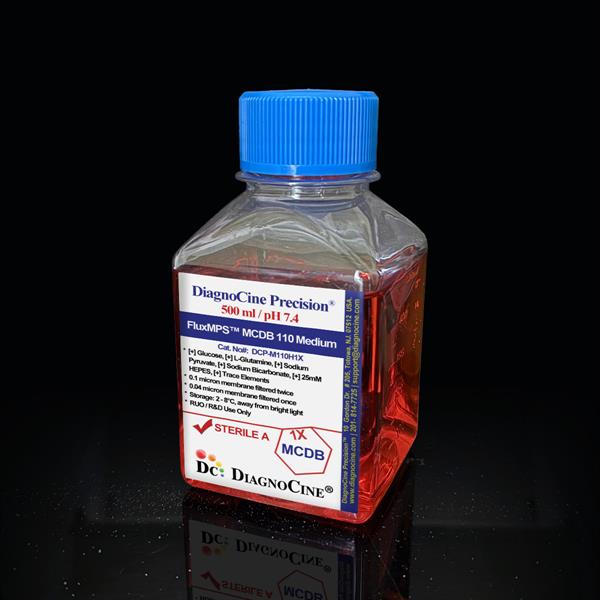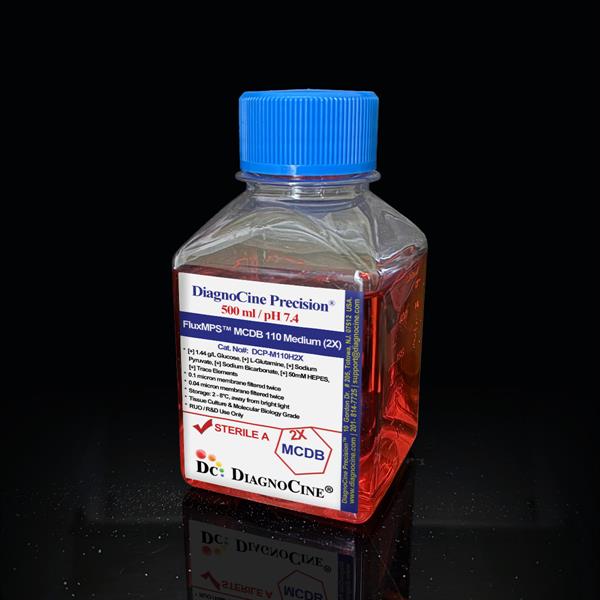
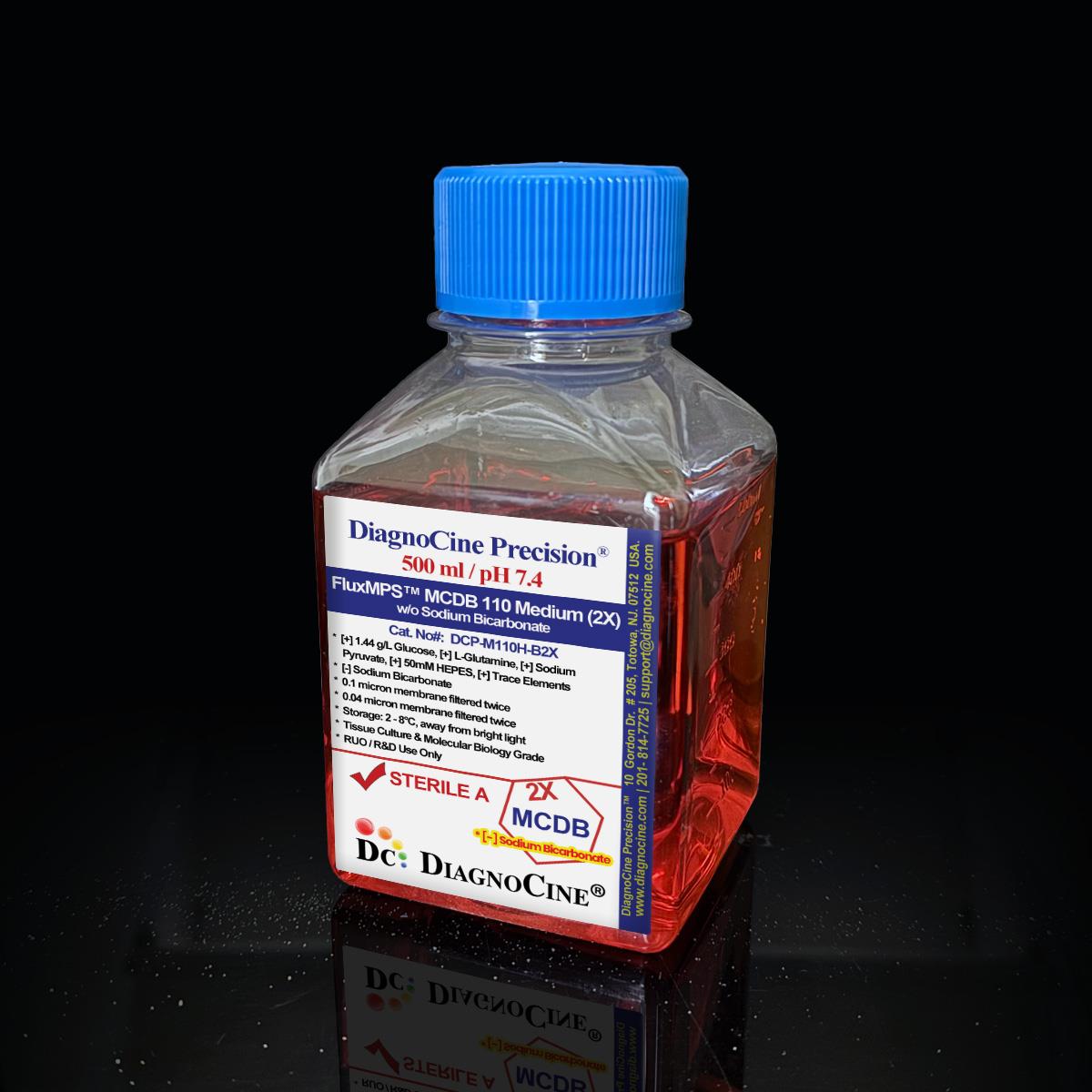
FluxMPS™ MCDB 110 Medium w/o Sodium Bicarbonate: 2X Liquid
FluxMPS™ MCDB 110 Medium w/o Sodium Bicarbonate: 2X Liquid
Double-strength (2X) MCDB 110 with 50 mM HEPES — 1.44 g/L glucose in the concentrate, 0.72 g/L at 1X — for WI-38, MRC-5, IMR-90 and foreskin fibroblasts, low-protein or defined fibroblast media, soft agar and 3D hydrogels, ultra-filtered through a quadruple-stage 0.1 µm / 0.04 µm filtration system. With a 50 mM HEPES buffer, bicarbonate-free, it is approximately 5× cleaner than conventional 0.22 µm-filtered media by particulate count.
- 2X concentrate: mix with an equal volume of a compatible solution or matrix for a final 1X medium
- MCDB 104 modification optimized for long-term survival and rapid clonal growth of normal human diploid fibroblast-like cells
- Trace elements included: V, Cu, Fe, Mn, Mo, Ni, Si, Se, Sn, Zn
- 50 mM HEPES (25 mM at 1X) for CO₂-independent pH stability during handling
- Quadruple-stage filtration: 0.1 µm membrane filtered twice, 0.04 µm membrane filtered twice
- 0.04 µm nano-filtration final polish acts as a mycoplasma barrier
- Endotoxin < 0.05 EU/mL (USP <85> BET)
- Formulation: [+] 1.44 g/L Glucose, [+] L-Glutamine, [+] Sodium Pyruvate, [+] Phenol Red, [+] 50mM HEPES, [+] Trace Elements; [−] Sodium Bicarbonate
- Ultrapure Type 1 water (18.2 MΩ·cm); ISO Class 5 (Class 100) aseptic fill in Totowa, NJ
- Custom formulations available — pH, glucose, HEPES, salts, and nutrient composition on request
- D-Glucose1,441 mg/L
- L-Glutamine731 mg/L
- Sodium Pyruvate220 mg/L
- Buffer50 mM HEPES (no NaHCO₃)
- Phenol Red2.484 mg/L
- AppearanceRed
- pH7.4 (± 0.04)
- Endotoxin< 0.05 EU/mL
- Filtration0.1 µm ×2 + 0.04 µm ×2
- Format2X liquid, 500 mL
Engineered where standard media fails
Conventional MCDB 110 is sterile-filtered once at 0.22 µm. That pore size can pass mycoplasma and leaves subvisible particulates that settle in microchannels, foul membranes and hydrogels, and add noise to optical readouts.[11,12] FluxMPS™ MCDB 110 keeps Ham's MCDB formulation and removes that failure mode.
Microchannel-safe purity
A 0.04 µm final filter and USP <788> particulate control keep subvisible debris out of chips, tubing, membranes and matrices.
Total metabolic control
Defined 1,441 mg/L D-glucose, 731 mg/L L-glutamine and 220 mg/L sodium pyruvate in the 2X (half that at 1X).
Ultrapure-grade water
Made with Ultrapure Type 1 water (18.2 MΩ·cm) and released at < 0.05 EU/mL endotoxin by USP <85>.
Low background for imaging
Particle-depleted medium reduces scatter and debris artifacts in colony counting, confocal imaging and on-chip sensing.
Matrix-ready 2X strength
53 components at double strength, so agar, collagen, hydrogels or treatment solutions can be added 1:1 without diluting the medium below 1X.
Customization on demand
pH, glucose, HEPES, salts, and nutrient composition on request — contact support@diagnocine.com.
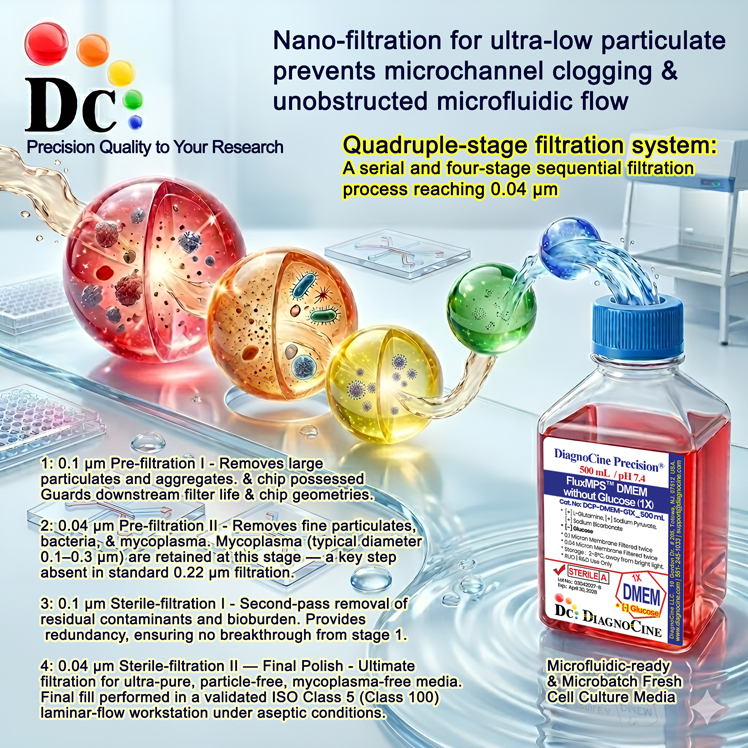
Quadruple-stage filtration system
Every lot of DCP-M110H-B2X is membrane filtered at 0.1 µm twice and 0.04 µm twice — a ready-to-dilute 2X MCDB 110 polished to a 0.04 µm final pore size, a purity level single-pass 0.22 µm media cannot reach.
-
01
0.1 µmPre-filtration I
Removes large particulates and aggregates and extends the life of the downstream filters.
-
02
0.04 µmPre-filtration II
Retains fine particulates, bacteria and mycoplasma.
-
03
0.1 µmSterile-filtration I
Second-pass redundancy that catches anything shed or bypassed upstream.
-
04
0.04 µmSterile-filtration II — Final Polish
Final nano-polish immediately before ISO Class 5 aseptic fill.
Performance vs. conventional media
By particulate count, FluxMPS™ MCDB 110 is approximately 5× cleaner than conventional 0.22 µm-filtered media, lowering clog risk in narrow channels and long perfusion runs.
© Diagnocine® — DCP-M110H-B2X
Where FluxMPS™ MCDB 110 fits
MCDB 110 Medium is a modification of MCDB 104 optimized for long-term survival and rapid clonal growth of normal human diploid fibroblast-like cells, including WI-38, MRC-5, IMR-90, and low-passage human foreskin fibroblasts.[1] It was developed as a basal platform for low-protein or chemically defined culture using carefully selected hormones, growth factors, antioxidants, lipids, and attachment components.[1,3]
A common version includes trace elements, L-glutamine, sodium pyruvate, HEPES, and phenol red, while bicarbonate may vary by configuration. The basal medium alone should not be described as a complete fibroblast growth medium unless all required supplements are included.
MCDB 110 Medium 2X is a double-strength version of the corresponding 1X basal formulation. It is intended for laboratory preparation of customized fibroblast media in which equal-volume or other major additions would otherwise reduce basal nutrients below 1X.
Research for:
1. Virus assays (semi-solid overlays)
- Viral plaque assay (agarose overlay)
- Viral plaque assay (Avicel / CMC liquid overlay)
- Overlay added directly onto inoculum
- Focus-forming assay
- Plaque reduction neutralization test (PRNT)
- Virus plaque purification
- Baculovirus plaque assay (insect cells)
2. Anchorage-independent growth and clonogenic assays
- Soft agar colony formation / transformation assay
- Tumor stem-cell and drug-sensitivity clonogenic assay
- Semi-solid cloning (hybridoma, CHO, HEK293)
- Hematopoietic colony-forming (CFU) assay
- Embryoid body / sphere formation in methylcellulose
3. 3D hydrogel embedding
- Collagen I gel culture
- Agarose gel culture (chondrocytes)
- Alginate encapsulation
- Fibrin gel culture
- PEG hydrogel culture
- Hyaluronic acid hydrogel culture
- Gelatin / GelMA bioinks and 3D bioprinting
- Microfluidic and organ-on-chip gel loading
4. Aqueous test material at high volume
- Environmental water toxicity testing
- Plant / herbal water extract testing
- Medical device saline extract testing (ISO 10993-5 type)
- Nanoparticle suspension testing
- Body fluid testing (serum, CSF, urine, milk)
- Conditioned medium replenishment
- Water- or buffer-dissolved compound dosing
- Osmolality / medium-strength studies
5. Cryopreservation
- 2X freezing medium (cell vials)
- 96-well clone freezing (ES cells)
6. Media preparation and bioprocess
- Double-strength stock from powdered medium
- Concentrated feeds for fed-batch and perfusion bioreactors
Automated Bioreactors & Robotics
For automated bioreactors, liquid-handling robots and closed perfusion loops with fine valves and in-line sensors, an optional 10 nm (0.01 µm) ultra-filtered grade of this medium is available.
- Total Particulate Exclusion: 0.01 µm filtration removes virtually all particulates down to the nanometer scale.
- Valve & Sensor Protection: keeps micro-valves, pumps and optical or electrochemical sensors free of deposits.
- Extended Perfusion Stability: supports long, uninterrupted perfusion runs with fewer line changes.
Inquiry Required: the 0.01 µm grade is made on request — email support@diagnocine.com with your catalog number and volume.
Rapid Clonal Fibroblast Growth
Supports long-term survival and rapid clonal growth of WI-38, MRC-5, IMR-90 and low-passage foreskin fibroblasts.[1]
Low-Protein & Defined Culture
A basal platform for chemically defined fibroblast media with selected hormones, growth factors, antioxidants, lipids and attachment factors.[1,3]
Soft-Agar & Semi-Solid Culture
Mix 1:1 with molten agar, agarose or methylcellulose for anchorage-independent growth, semi-solid cloning and overlay assays at 1X medium strength.[4]
Hydrogel Embedding
Compensates for dilution in collagen, agarose, alginate, fibrin, PEG, hyaluronic acid and GelMA preparations.[5]
Organ-on-a-Chip & MPS
Microchannel-safe medium for perfused organ-, tissue- and body-on-a-chip platforms.[8,9,10]
Microscopy & Optical Sensing
Fewer particles means cleaner fields for colony counting, confocal imaging and on-chip biosensors.
Specifications & quality control
Release specifications for DCP-M110H-B2X. Lot-specific values are reported on the Certificate of Analysis.
| Parameter | Specification |
|---|---|
| Formulation | [+] 1.44 g/L Glucose, [+] L-Glutamine, [+] Sodium Pyruvate, [+] Phenol Red, [+] 50mM HEPES, [+] Trace Elements; [−] Sodium Bicarbonate |
| Concentration | 2X (dilute 1:1 to 1X) |
| Appearance | Red |
| pH | 7.4 (± 0.04) USP <791> |
| Osmolality | Measured per lot; reported on CoA USP <785> |
| D-Glucose | 1,441 mg/L (1.44 g/L; 0.72 g/L at 1X) |
| L-Glutamine | 731 mg/L |
| Sodium Pyruvate | 220 mg/L |
| Sodium Bicarbonate | Not included |
| Phenol Red | 2.484 mg/L |
| HEPES | 11,916 mg/L (50 mM; 25 mM at 1X) |
| Trace elements | Included (V, Cu, Fe, Mn, Mo, Ni, Si, Se, Sn, Zn) |
| Parameter | Specification |
|---|---|
| Endotoxin | < 0.05 EU/mL USP <85> BET |
| Sterility | No bacterial or fungal growth after 14 days of incubation USP <71> |
| Mycoplasma | 0.04 µm barrier filtration USP <63> equiv. |
| Particulate ≥10 µm | Meets limits USP <788> M2 |
| Particulate ≥25 µm | Meets limits USP <788> M2 |
| Water purity | Ultrapure Type 1, 18.2 MΩ·cm |
| Manufacturing std. | ISO 13485:2016 ISO |
| Fill environment | ISO Class 5 (Class 100) ISO |
| Parameter | Specification |
|---|---|
| Storage temperature | 2–8 °C, protected from light |
| Freeze-thaw | Do not freeze |
| Shelf life | 12 months; use before the expiry date on the product label |
| Shipping condition | Ice Pack |
| CO₂ requirement | Not required for HEPES buffering (50 mM in the 2X, 25 mM at 1X); add sodium bicarbonate if the final medium will be held in a CO₂ incubator |
| Parameter | Specification |
|---|---|
| Raw material grade | High-purity, cell-culture-tested components |
| Traceability | Lot-traceable; CoA per lot |
| Manufacturing QMS | ISO 13485:2016 ISO |
| Regulatory alignment | 21 CFR Part 820 (cGMP) aligned |
| Production method | Micro-batch 2X liquid, quadruple-stage filtered; aseptic fill and finish in Totowa, NJ |
| Intended use | For Research Use Only (RUO) |
Full composition (mg/L)
DCP-M110H-B2X is 2X MCDB 110 with 1.44 g/L glucose, L-glutamine, sodium pyruvate, Phenol Red, 50 mM HEPES and trace elements. It does not contain sodium bicarbonate. Users are advised to review the literature for recommendations regarding medium supplementation and physiological growth requirements specific for different cell lines. All 53 components are listed below at 2X strength; values are per-lot release basis and are halved after 1:1 dilution.
| Component | CAS Number | mg/L |
|---|---|---|
| INORGANIC SALTS | ||
| Ammonium metavanadate | 7803-55-6 | 0.001170 |
| Calcium chloride dihydrate | 10035-04-8 | 294.000 |
| Cupric sulphate pentahydrate | 7758-99-8 | 0.00050 |
| Disodium hydrogen phosphate anhydrous | 7558-79-4 | 851.880 |
| Ferrous sulphate heptahydrate | 7782-63-0 | 0.00278 |
| Magnesium sulphate anhydrous | 7487-88-9 | 240.760 |
| Manganese sulphate | 7785-87-7 | 0.000302 |
| Molybdic acid ammonium tetrahydrate | 12054-85-2 | 0.00248 |
| Nickel chloride | 7718-54-9 | 0.00024 |
| Potassium chloride | 7447-40-7 | 745.500 |
| Sodium chloride | 7647-14-5 | 13092.000 |
| Sodium metasilicate nonahydrate | 13517-24-3 | 0.284 |
| Sodium selenite | 10102-18-8 | 0.0076 |
| Stannous chloride dihydrate | 10025-69-1 | 0.000226 |
| Zinc sulphate heptahydrate | 7446-20-0 | 0.288 |
| Component | CAS Number | mg/L |
|---|---|---|
| AMINO ACIDS | ||
| Glycine | 56-40-6 | 45.040 |
| L-Alanine | 56-41-7 | 17.820 |
| L-Arginine hydrochloride | 1119-34-2 | 421.400 |
| L-Asparagine monohydrate | 5794-13-8 | 30.000 |
| L-Aspartic acid | 56-84-8 | 26.620 |
| L-Cysteine hydrochloride monohydrate | 7048-04-6 | 17.560 |
| L-Glutamic acid | 56-86-0 | 29.420 |
| L-Glutamine | 56-85-9 | 730.600 |
| L-Histidine hydrochloride monohydrate | 5934-29-2 | 41.940 |
| L-Isoleucine | 73-32-5 | 7.880 |
| L-Leucine | 61-90-5 | 26.240 |
| L-Lysine hydrochloride | 657-27-2 | 73.080 |
| L-Methionine | 63-68-3 | 8.960 |
| L-Phenylalanine | 63-91-2 | 9.920 |
| L-Proline | 147-85-3 | 69.060 |
| L-Serine | 56-45-1 | 21.020 |
| L-Threonine | 72-19-5 | 23.820 |
| L-Tryptophan | 73-22-3 | 4.080 |
| L-Tyrosine disodium salt dihydrate | 122666-87-4 | 15.680 |
| L-Valine | 72-18-4 | 23.440 |
| Component | CAS Number | mg/L |
|---|---|---|
| VITAMINS | ||
| Choline chloride | 67-48-1 | 27.920 |
| D-Biotin | 58-85-5 | 0.014678 |
| D-Ca-Pantothenate | 137-08-6 | 0.476 |
| Folinic acid (Calcium) | 1492-18-8 | 0.001204 |
| Niacinamide | 98-92-0 | 12.220 |
| Pyridoxine hydrochloride | 58-56-0 | 0.1234 |
| Riboflavin | 83-88-5 | 0.226 |
| Thiamine hydrochloride | 67-03-8 | 0.674 |
| Vitamin B12 | 68-19-9 | 0.272 |
| myo-Inositol | 87-89-8 | 36.040 |
| OTHERS | ||
| Adenine hydrochloride | 2922-28-3 | 3.440 |
| D-Glucose | 50-99-7 | 1441.280 |
| HEPES | 7365-45-9 | 11916.000 |
| Phenol Red | 34487-61-1 | 2.484 |
| Putrescine dihydrochloride | 333-93-7 | 0.000322 |
| Sodium pyruvate | 113-24-6 | 220.000 |
| Thioctic acid | 1077-28-7 | 0.00412 |
| Thymidine | 50-89-5 | 0.1454 |
Manufacturing & compliance
Manufactured under an ISO 13485:2016 quality management system; aseptic fill and finish in Totowa, NJ, with every lot released against compendial test methods.
ISO 13485:2016 QMS
Documented, audited quality management system aligned with 21 CFR Part 820 (cGMP).
Ultrapure Type 1 Water
18.2 MΩ·cm water as the formulation base for low ionic and endotoxin background.
ISO Class 5 Fill & Finish
Aseptic filling in an ISO Class 5 (Class 100) environment in Totowa, NJ, right after the final 0.04 µm polish.
Micro-Batch Precision
Small, tightly controlled batches for consistent composition and pH from lot to lot.
Endotoxin — USP <85> BET
Released at < 0.05 EU/mL.
Particulate — USP <788> Method 2
Subvisible particles ≥10 µm and ≥25 µm within compendial limits.
Osmolality — USP <785>
Measured per lot and reported on the CoA.
Documentation / CoA
Appearance, pH 7.4 (± 0.04), 14-day sterility, endotoxin and osmolality per lot.
How DCP-M110H-B2X compares
Same MCDB 110 chemistry, different purity class. Conventional columns describe typical single-pass 0.22 µm-filtered catalog media.
| Parameter | DCP-M110H-B2X (FluxMPS™) | Conventional MCDB 110, 1X (0.22 µm filtered) | Conventional 2X medium (0.22 µm filtered) |
|---|---|---|---|
| Formulation | 2X MCDB 110 + 50 mM HEPES; free of sodium bicarbonate | 1X MCDB 110, ready to use | Double-strength, for semisolid culture |
| Final filtration pore size | 0.04 µm | 0.22 µm | 0.22 µm |
| Number of filtration stages | 4 | 1 | 1 |
| Mycoplasma barrier filtration | check_circle | cancel | cancel |
| Endotoxin specification | < 0.05 EU/mL | Often not specified at this level | Often not specified at this level |
| USP <788> particulate compliance | check_circle | cancel | cancel |
| Ultrapure Type 1 water (18.2 MΩ·cm) | check_circle | Varies | Varies |
| ISO 13485:2016 manufacturing | check_circle | Varies | Varies |
| Microfluidic channel compatibility | check_circle | cancel | cancel |
| Custom formulation | check_circle | cancel | cancel |
Frequently asked questions
Common questions about using DCP-M110H-B2X for semisolid, 3D, microfluidic and conventional culture.
Supporting literature
Peer-reviewed background on MCDB 110 and Ham's MCDB media, soft-agar and hydrogel culture, HEPES buffering, Phenol Red, organ-on-a-chip culture and mycoplasma control.
- Bettger WJ, Boyce ST, Walthall BJ, Ham RG. Rapid clonal growth and serial passage of human diploid fibroblasts in a lipid-enriched synthetic medium supplemented with epidermal growth factor, insulin, and dexamethasone. Proc Natl Acad Sci USA. 1981;78(9):5588–5592. doi:10.1073/pnas.78.9.5588
- Ham RG. Clonal growth of mammalian cells in a chemically defined, synthetic medium. Proc Natl Acad Sci USA. 1965;53(2):288–293. doi:10.1073/pnas.53.2.288
- McKeehan WL, Ham RG. Stimulation of clonal growth of normal fibroblasts with substrata coated with basic polymers. J Cell Biol. 1976;71(3):727–734. doi:10.1083/jcb.71.3.727
- Borowicz S, Van Scoyk M, Avasarala S, et al. The soft agar colony formation assay. J Vis Exp. 2014;(92):e51998. doi:10.3791/51998
- Bell E, Ivarsson B, Merrill C. Production of a tissue-like structure by contraction of collagen lattices by human fibroblasts of different proliferative potential in vitro. Proc Natl Acad Sci USA. 1979;76(3):1274–1278. doi:10.1073/pnas.76.3.1274
- Good NE, Winget GD, Winter W, Connolly TN, Izawa S, Singh RMM. Hydrogen ion buffers for biological research. Biochemistry. 1966;5(2):467–477. doi:10.1021/bi00866a011
- Berthois Y, Katzenellenbogen JA, Katzenellenbogen BS. Phenol red in tissue culture media is a weak estrogen: implications concerning the study of estrogen-responsive cells in culture. Proc Natl Acad Sci USA. 1986;83(8):2496–2500. doi:10.1073/pnas.83.8.2496
- Bhatia SN, Ingber DE. Microfluidic organs-on-chips. Nat Biotechnol. 2014;32(8):760–772. doi:10.1038/nbt.2989
- Low LA, Mummery C, Berridge BR, Austin CP, Tagle DA. Organs-on-chips: into the next decade. Nat Rev Drug Discov. 2021;20(5):345–361. doi:10.1038/s41573-020-0079-3
- Leung CM, de Haan P, Ronaldson-Bouchard K, et al. A guide to the organ-on-a-chip. Nat Rev Methods Primers. 2022;2:33. doi:10.1038/s43586-022-00118-6
- Drexler HG, Uphoff CC. Mycoplasma contamination of cell cultures: incidence, sources, effects, detection, elimination, prevention. Cytotechnology. 2002;39(2):75–90. doi:10.1023/A:1022913015916
- Halldorsson S, Lucumi E, Gómez-Sjöberg R, Fleming RMT. Advantages and challenges of microfluidic cell culture in polydimethylsiloxane devices. Biosens Bioelectron. 2015;63:218–231. doi:10.1016/j.bios.2014.07.029