

- Home
- FluxMPS™ Dulbecco’s Modified Eagle Medium/ Ham's F-12 Nutrient Mixture (DMEM/F-12) (3:1) with 15mM HEPES w/o Sodium Bicarbonate, Calcium Chloride: 1X Liquid
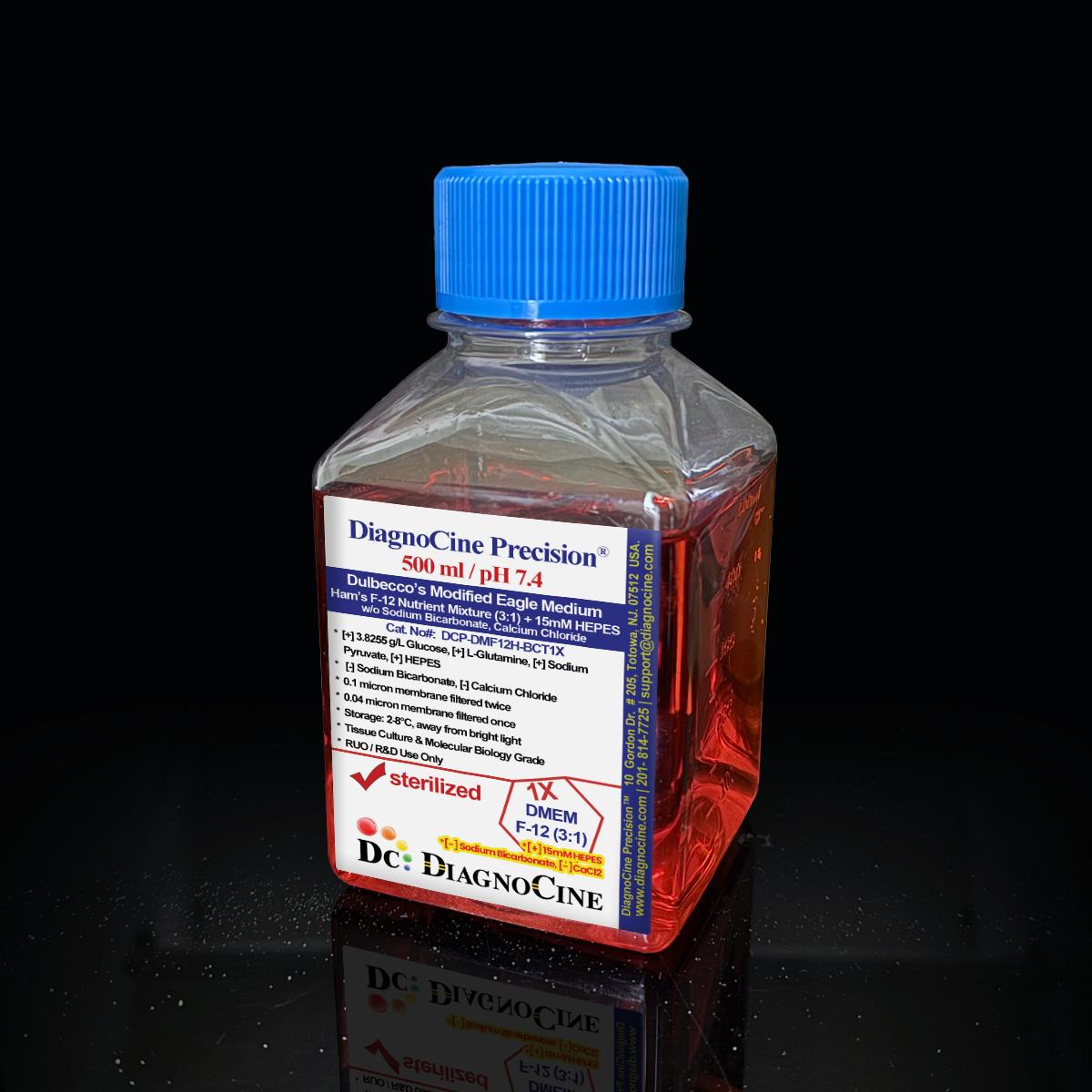
FluxMPS™ Dulbecco’s Modified Eagle Medium/ Ham's F-12 Nutrient Mixture (DMEM/F-12) (3:1) with 15mM HEPES w/o Sodium Bicarbonate, Calcium Chloride: 1X Liquid
FluxMPS™ Dulbecco’s Modified Eagle Medium/ Ham's F-12 Nutrient Mixture (DMEM/F-12) (3:1) with 15mM HEPES w/o Sodium Bicarbonate, Calcium Chloride: 1X Liquid
Microfluidics Suitable, quadruple-stage ultra-filtered (0.1 µm ×2 + 0.04 µm ×2) 1X liquid cell culture medium engineered for microfluidic channels, organ-on-a-chip (OoC), and microphysiological systems (MPS). Manufactured under ISO 13485:2016 in an ISO Class 5 fill environment using Ultrapure Type 1 water (18.2 MΩ·cm). HEPES-buffered (15 mM) and formulated without sodium bicarbonate or calcium chloride for reduced CO2 dependence.
- Quadruple-stage filtration (0.1 µm ×2 + 0.04 µm ×2) — 0.04 µm final pore size for microchannel-safe purity
- Endotoxin release specification: < 0.05 EU/mL (LAL, USP <85>), tested per manufacturing batch
- 3.8255 g/L glucose (DMEM/F-12, 3:1 base), 474.5 mg/L L-glutamine, 27.525 mg/L sodium pyruvate
- 15 mM HEPES buffering; formulated without sodium bicarbonate and without calcium chloride
- Phenol red sodium salt included (12.235 mg/L) as a pH indicator dye
- Manufactured under an ISO 13485:2016 quality management system; final QC and customization at Diagnocine, Totowa, NJ
- Custom pH, glucose, HEPES, salts & nutrients available — support@diagnocine.com
- Glucose3825.500 mg/L (3.8255 g/L) ([+])
- L-Glutamine474.500 mg/L ([+])
- Sodium Pyruvate27.525 mg/L ([+])
- HEPES15 mM (3574.500 mg/L) ([+])
- Osmolality (USP <785>)260 - 300 mOsm/kg
- Endotoxin (USP <85>)< 0.05 EU/mL
- Filtration0.1µm ×2 + 0.04µm ×2 (Quadruple-stage)
- Storage2-8°C, protect from light
- Shelf Life12 months from date of manufacture, unopened
- ShippingCold pack (2–8°C)
Engineered where standard media fails
Conventional 0.22 µm filtered media allows mycoplasma (typically 0.2–0.3 µm), sub-visible particulates, and microaggregates to pass freely — clogging microchannels, corrupting biosensors, and invalidating metabolic assays. FluxMPS™ closes that gap.
Microchannel-safe purity
0.04 µm final filter and USP <788> Method 1 (light obscuration) particulate testing support unobstructed flow in narrow microchannels.
Total metabolic control
Precisely defined carbon sources enable Warburg-effect studies, glycolysis inhibition, and ¹³C metabolic tracing.
Ultrapure-grade water
Prepared with Ultrapure Type 1 water (18.2 MΩ·cm) with rigorous trace-metal and total organic carbon (TOC) control for demanding analytical applications.
Low background for imaging
Ultra-low particulate baseline supports confocal live-cell imaging, fluorescent biosensors, and automated high-content analysis on chip.
Rich, stable nutrient profile
4× BME amino acid and vitamin concentrations with micro-batch precision — tight lot-to-lot consistency for long-duration MPS perfusion.
Customization on demand
pH, glucose, HEPES, salts, and nutrients adjusted on request. Contact support@diagnocine.com.
Quadruple-stage filtration system
A validated four-stage sequential filtration train — two paired 0.1 µm prefilter / 0.04 µm final-filter cycles run in series — reaching a final pore size of 0.04 µm.
-
1
0.1 µm Prefiltration I
Removes large particulates, cell debris, and protein aggregates; protects the first 0.04 µm final filter cartridge.
-
2
0.04 µm Final filtration I
First 0.04 µm pass; retains sub-micron particulates and microaggregates that pass a conventional 0.22 µm filter.
-
3
0.1 µm Prefiltration II
Second dedicated prefilter, protecting the second 0.04 µm final filter cartridge.
-
4
0.04 µm Final filtration II — Polish
Ultimate polishing filter; aseptic fill in a validated ISO Class 5 (Class 100) laminar-flow environment.
Performance vs. conventional media
The paired 0.1 µm / 0.04 µm filtration train runs twice in series, reaching a validated 0.04 µm final pore size — well below the 0.22 µm cut-off used in conventional cell culture media, and within range of mycoplasma-scale organisms (0.2–0.3 µm).

© Diagnocine® — DCP-DMF12H-BCT1X
Full composition (mg/L)
Every ingredient below is present in this 1X liquid formulation at the exact concentration listed. Total: 50 components across 4 category groups (Inorganic Salts, Amino Acids, Vitamins, Others), organized into 3 tabs below. All values are per-lot verified and reported on the Certificate of Analysis (CoA).
| Component | CAS Number | mg/L |
|---|---|---|
| Copper sulphate pentahydrate | 7758-99-8 | 0.000625 |
| Disodium hydrogen phosphate anhydrous | 7558-79-4 | 35.510 |
| Ferric nitrate nonahydrate | 7782-61-8 | 0.075 |
| Ferrous sulphate heptahydrate | 7782-63-0 | 0.209 |
| Magnesium chloride hexahydrate | 7791-18-6 | 14.412 |
| Magnesium sulphate anhydrous | 7487-88-9 | 73.290 |
| Potassium chloride | 7447-40-7 | 356.000 |
| Sodium chloride | 7647-14-5 | 6699.750 |
| Sodium dihydrogen phosphate monohydrate | 10049-21-5 | 81.750 |
| Zinc sulphate heptahydrate | 7446-20-0 | 0.215 |
| Component | CAS Number | mg/L |
|---|---|---|
| Glycine | 56-40-6 | 24.380 |
| L-Alanine | 56-41-7 | 2.227 |
| L-Arginine hydrochloride | 1119-34-2 | 115.520 |
| L-Asparagine monohydrate | 5794-13-8 | 3.752 |
| L-Aspartic acid | 56-84-8 | 3.325 |
| L-Cysteine dihydrochloride | 7048-04-6 | 8.780 |
| L-Cystine hydrochloride monohydrate | 46.927 | |
| L-Glutamic acid | 56-86-0 | 3.675 |
| L-Glutamine | 56-85-9 | 474.500 |
| L-Histidine hydrochloride monohydrate | 5934-29-2 | 36.740 |
| L-Isoleucine | 73-32-5 | 79.735 |
| L-Leucine | 61-90-5 | 82.025 |
| L-Lysine hydrochloride | 657-27-2 | 118.625 |
| L-Methionine | 63-68-3 | 23.625 |
| L-Phenylalanine | 63-91-2 | 50.740 |
| L-Proline | 147-85-3 | 8.625 |
| L-Serine | 56-45-1 | 34.125 |
| L-Threonine | 72-19-5 | 74.225 |
| L-Tryptophan | 73-22-3 | 12.510 |
| L-Tyrosine disodium salt | 79.795 | |
| L-Valine | 72-18-4 | 73.425 |
| Component | CAS Number | mg/L |
|---|---|---|
| VITAMINS | ||
| Choline chloride | 67-48-1 | 6.490 |
| D-Biotin | 58-85-5 | 0.001825 |
| D-Ca-Pantothenate | 137-08-6 | 3.120 |
| Folic acid | 59-30-3 | 3.330 |
| Nicotinamide | 98-92-0 | 3.000 |
| Pyridoxine hydrochloride | 58-56-0 | 3.015 |
| Riboflavin | 83-88-5 | 0.309 |
| Thiamine hydrochloride | 67-03-8 | 3.085 |
| Vitamin B12 | 68-19-9 | 0.340 |
| myo-Inositol | 87-89-8 | 9.900 |
| OTHERS | ||
| D-Glucose | 50-99-7 | 3825.500 |
| DL-Thioctic acid | 1077-28-7 | 0.053 |
| HEPES buffer | 7365-45-9 | 3574.500 |
| Hypoxanthine | 68-94-0 | 1.200 |
| Linoleic acid | 60-33-3 | 0.021 |
| Phenol red sodium salt | 34487-61-1 | 12.235 |
| Putrescine hydrochloride | 333-93-7 | 0.040 |
| Sodium pyruvate | 113-24-6 | 27.525 |
| Thymidine | 50-89-5 | 0.183 |
Full technical specification
Every lot of FluxMPS™ Dulbecco’s Modified Eagle Medium/ Ham's F-12 Nutrient Mixture (DMEM/F-12) (3:1) with 15mM HEPES w/o Sodium Bicarbonate, Calcium Chloride: 1X Liquid is released against comprehensive multi-parameter QC specifications.
| Parameter | Specification |
|---|---|
| Formulation | [+] L-Glutamine, Phenol Red, 15mM HEPES, Magnesium, 3.8255 g/L Glucose, Sodium Pyruvate / [-] Sodium Bicarbonate, Calcium Chloride |
| Appearance | Clear solution with characteristic phenol red coloration (pH indicator dye) |
| Osmolality USP <785> | 260 - 300 mOsm/kg H₂O |
| Glucose | 3825.500 mg/L (3.8255 g/L) ([+]) |
| L-Glutamine | 474.500 mg/L ([+]) |
| Sodium Pyruvate | 27.525 mg/L ([+]) |
| Phenol Red | 12.235 mg/L ([+]) |
| HEPES | 15 mM (3574.500 mg/L) ([+]) |
| Parameter | Specification |
|---|---|
| Endotoxin USP <85> | < 0.05 EU/mL (batch release specification — see Manufacturing & Compliance) |
| Sterility USP <71> | No growth after 14 days |
| Mycoplasma | 0.1 µm mycoplasma-retentive filtration (not tested per lot) |
| Particulate ≥10 µm <788> M1 | Compliant (USP <788> Method 1, light obscuration) |
| Particulate ≥25 µm <788> M1 | Compliant (USP <788> Method 1) |
| Water purity | Ultrapure Type 1, 18.2 MΩ·cm |
| Manufacturing | ISO 13485:2016 ISO |
| Fill environment | ISO Class 5 (Class 100) |
| Parameter | Specification |
|---|---|
| Storage | 2-8°C, protect from light |
| Freeze–thaw | Do not freeze |
| Shelf life | 12 months from date of manufacture, unopened |
| Shipping | Cold pack (2–8°C) |
| CO2 requirement | HEPES-buffered; reduced CO2 dependence (validate per cell line) |
| Parameter | Specification |
|---|---|
| Raw material grade | Pharmaceutical/research grade CoA |
| Traceability | Full lot traceability; CoA available per batch |
| Manufacturing QMS | ISO 13485:2016 ISO |
| UNSPSC | 41116155 — Molecular biology and cell culture growth media (UNv260801) |
| Regulatory alignment | 21 CFR Part 820 (QMSR) aligned |
| Production method | Micro-batch; Totowa, NJ, USA |
| Intended use | RUO only |
Available pack sizes: 500 mL, 1000 mL
Optimized for next-generation cell biology platforms
FluxMPS™ Dulbecco’s Modified Eagle Medium/ Ham's F-12 Nutrient Mixture (DMEM/F-12) (3:1) with 15mM HEPES w/o Sodium Bicarbonate, Calcium Chloride: 1X Liquid is validated for applications where microchannel cleanliness, signal fidelity, and metabolic precision are critical.
Automated Bioreactors & Robotics
For automated perfusion systems and robotic liquid handling, an optional 0.01 µm (10 nm) MPS Grade ultra nano-filtered variant of this formulation is available — see the Grade note in the Purity Architecture section above.
- Total particulate exclusion for long-duration closed-loop perfusion
- Valve & sensor protection in automated fluidic handling systems
- Extended perfusion stability for multi-day, unattended culture runs
Inquiry Required: The 0.01 µm MPS Grade variant is produced to order. Contact support@diagnocine.com to discuss requirements.
Micro Physiological System (MPS) & Chip
Ultra-low particulate media for perfusion in organ chips, tissue chips (ToC), and body-on-a-chip (BoC) devices.
Warburg Effect & Metabolic Research
Defined glucose and pyruvate levels support Warburg-effect studies, aerobic glycolysis, and cancer metabolomics.
iPSC-Derived Models
Ultra-clean, low-endotoxin baseline minimizes non-specific signals in iPSC differentiation and functional organoid readouts.
Endothelial & Primary Cells
Particle-free perfusion media for TEER measurement, endothelial monolayer integrity, and primary cell culture.
Metabolic Flux Analysis
Chemically defined formulation for ¹³C metabolic tracing and NMR metabolomics. Not compatible with Agilent Seahorse XF assays, which require bicarbonate-free, phenol-red-free medium.
Microscopy & Optical Sensing
Ultra-low particulate medium for confocal microscopy, fluorescent biosensors, and automated imaging on chip.
Manufacturing & compliance
Every batch is subjected to multi-parameter lot-release testing before distribution.
ISO 13485:2016 QMS
Manufactured by ISO 13485-certified suppliers. Final packaging, QA and testing at Diagnocine R&D Center; customization at Diagnocine Precision, Totowa, NJ, USA.
Ultrapure Type 1 Water
18.2 MΩ·cm resistivity with low total organic carbon (TOC) control, supporting trace-metal-sensitive assays and biosensor-based readouts.
ISO Class 5 Fill & Finish
Validated ISO Class 5 laminar-flow workstation with real-time particle monitoring, preserving filtration gains through final fill.
Micro-Batch Precision
Small-batch production supports tight lot-to-lot consistency in osmolality, endotoxin, and nutrient concentration — critical for reproducible long-duration MPS experiments.
Endotoxin — USP <85> BET
LAL assay. Assay sensitivity: 0.005 EU/mL. Release specification: < 0.05 EU/mL.
Particulate — USP <788> Method 1
Light obscuration particle count method. Compliant with USP <788> Method 1 limits.
Osmolality — USP <785>
Freezing-point depression osmometry. Release range: 260 - 300 mOsm/kg H₂O.
Certificate of Analysis (CoA)
Full CoA per lot. Request at support@diagnocine.com with lot number.
- Endotoxin — LAL assay, USP <85> Bacterial Endotoxins Test; assay sensitivity 0.005 EU/mL; release specification < 0.05 EU/mL
- pH, osmolality, conductivity, appearance and clarity
- Sterility
How DCP-DMF12H-BCT1X compares
Critical advantages in filtration, mycoplasma-risk mitigation, water quality, and QC depth relative to conventional media for MPS and microfluidic applications.
| Parameter | DCP-DMF12H-BCT1X (FluxMPS™) | Standard DMEM/F-12 (0.22 µm) | Competitor DMEM/F-12 (0.22 µm) |
|---|---|---|---|
| Grade | Microfluidics Suitable | Not specified | Not specified |
| Formulation | [+] L-Glutamine, Phenol Red, 15mM HEPES, Magnesium, 3.8255 g/L Glucose, Sodium Pyruvate / [-] Sodium Bicarbonate, Calcium Chloride | Standard | Standard |
| Final filtration pore size | 0.04 µm (40 nm) | 0.22 µm | 0.22 µm |
| Filtration stages | 4 (Quadruple) | 1 | 1 |
| Mycoplasma-retentive filtration | check_circle | cancel | cancel |
| Endotoxin (release specification) | < 0.05 EU/mL | Corning classical liquid media — < 0.25 EU/mL Sigma-Aldrich DMEM complete medium — ≤ 2 EU/mL Gibco classical DMEM — Not specified (recorded per lot) |
|
| USP <788> particulate compliance | check_circle Method 1 compliant | cancel | cancel |
| Water quality | Ultrapure Type 1, 18.2 MΩ·cm | Unspecified | Unspecified |
| Manufacturing QMS | ISO 13485:2016 | Varies | Varies |
| Microfluidic channel compatibility | check_circle | cancel | cancel |
| Custom formulation | check_circle On request | cancel | cancel |
Comparison figures from published supplier specifications, accessed 2026-09-02. Suppliers that publish no numeric endotoxin specification are shown as "Not specified".
Frequently asked questions
Common questions about FluxMPS™ Dulbecco’s Modified Eagle Medium/ Ham's F-12 Nutrient Mixture (DMEM/F-12) (3:1) with 15mM HEPES w/o Sodium Bicarbonate, Calcium Chloride: 1X Liquid (DCP-DMF12H-BCT1X).
Supporting literature
- Huh D, et al. Reconstituting organ-level lung functions on a chip. Science. 2010;328:1662–1668. doi:10.1126/science.1188302
- Bhatia SN, Ingber DE. Microfluidic organs-on-chips. Nat Biotechnol. 2014;32:760–772. doi:10.1038/nbt.2989
- Vander Heiden MG, et al. Understanding the Warburg effect. Science. 2009;324:1029–1033. doi:10.1126/science.1160809
- Sontheimer-Phelps A, et al. Modelling cancer in microfluidic human organs-on-chips. Nat Rev Cancer. 2019;19:65–81. doi:10.1038/s41568-018-0104-6
- van Duinen V, et al. Microfluidic 3D cell culture. Curr Opin Biotechnol. 2015;35:118–126. doi:10.1016/j.copbio.2015.05.002
- Jang KJ, et al. Reproducing human drug toxicities using a Liver-Chip. Sci Transl Med. 2019;11:eaax5516. doi:10.1126/scitranslmed.aax5516
- Kasendra M, et al. Primary human Small Intestine-on-a-Chip. Sci Rep. 2018;8:2871. doi:10.1038/s41598-018-21201-7
- Skardal A, et al. Multi-tissue organ-on-a-chip platform. Sci Rep. 2017;7:8837. doi:10.1038/s41598-017-08879-x