

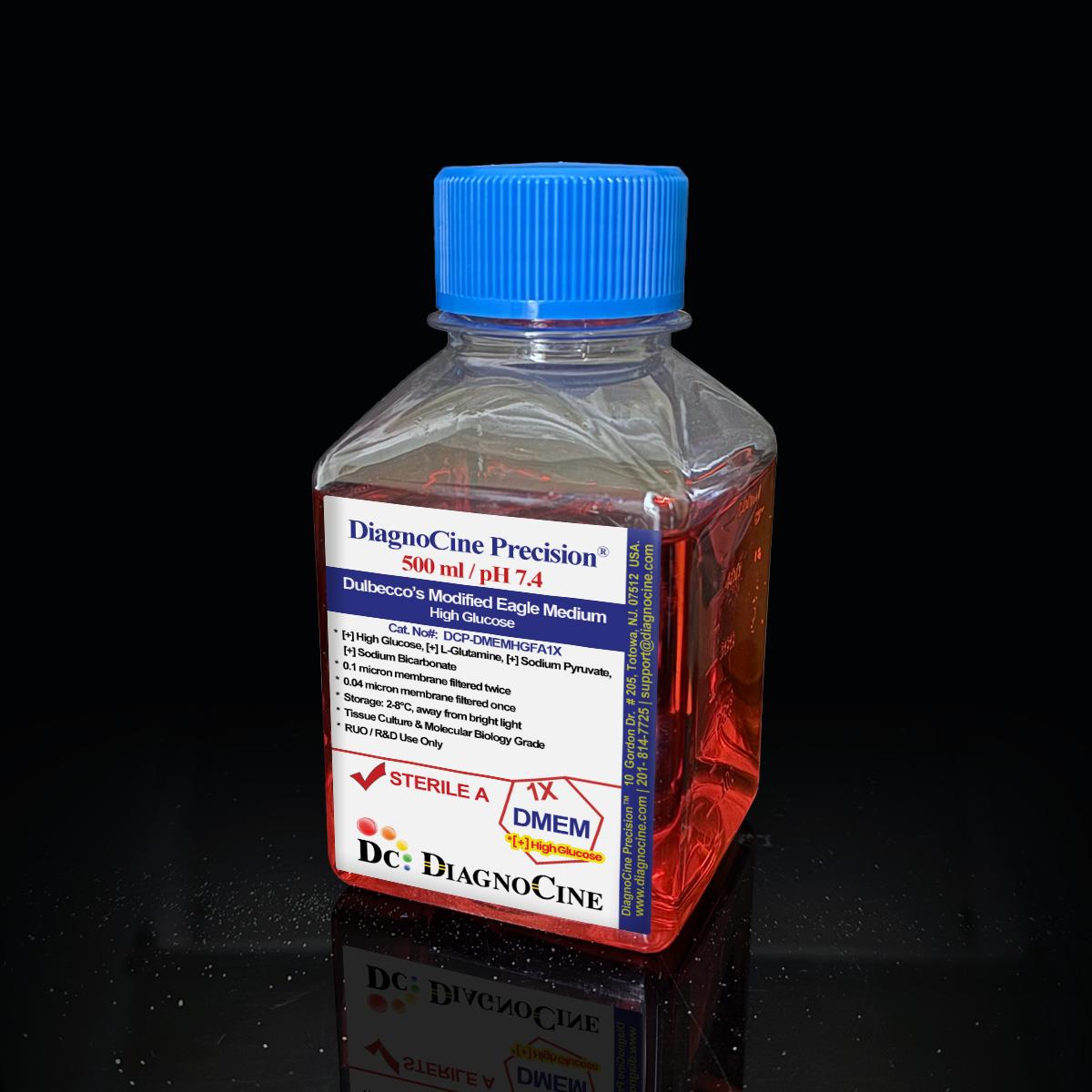
FluxMPS™ Dulbecco’s Modified Eagle Medium (DMEM), High Glucose: 1X Liquid
FluxMPS™ Dulbecco’s Modified Eagle Medium (DMEM), High Glucose: 1X Liquid
FluxMPS™ DCP-DMEMHGFA1X is a Microfluidics Suitable, quadruple-stage ultra-filtered Dulbecco’s Modified Eagle Medium formulated with 4,500 mg/L D-glucose, L-glutamine, sodium pyruvate, sodium bicarbonate, phenol red, and folic acid — engineered for microfluidic channels, organ-on-a-chip (OoC), and microphysiological systems (MPS) where particulate contamination corrupts biosensor signals and blocks micron-scale conduits. Filtered through a validated 0.1 µm ×2 + 0.04 µm ×2 cascade (four passes total) and released to an endotoxin specification of < 0.05 EU/mL, this medium is formulated as a ready-to-use, full-nutrient high-glucose DMEM for chip-based biology.[1,2]
- Quadruple-stage filtration train: 0.1 µm (Prefiltration I) → 0.04 µm (Final filtration I) → 0.1 µm (Prefiltration II) → 0.04 µm (Final filtration II — Polish)
- Endotoxin release specification < 0.05 EU/mL (LAL assay, USP <85> BET), controlled and tested per manufacturing batch
- Full-nutrient high-glucose formulation: 4,500 mg/L D-Glucose, 584 mg/L L-Glutamine, 110 mg/L Sodium Pyruvate, 3,700 mg/L Sodium Bicarbonate, and 4 mg/L Folic Acid
- Sodium bicarbonate-buffered at 3.7 g/L — formulated for a 10% CO2 incubator environment
- Manufactured under an ISO 13485:2016 quality management system; 21 CFR Part 820 (QMSR) aligned
- Microfluidics Suitable, 0.04 µm final cut-off — engineered for organ-on-a-chip (OoC) and microphysiological systems (MPS) applications
- Customizable formulation: pH, glucose concentration, salts, HEPES, folic acid level, and nutrient composition available on request — contact support@diagnocine.com
- D-Glucose4,500 mg/L
- L-Glutamine584 mg/L
- Sodium Pyruvate110 mg/L
- Folic Acid4 mg/L (included)
- pH (USP <791>)7.0 - 7.4
- Osmolality (USP <785>)280 - 320 mOsm/kg
- Endotoxin (USP <85>)< 0.05 EU/mL
- Filtration System0.1 µm ×2 + 0.04 µm ×2
- Storage2–8 °C, protected from light
- Shelf Life12 months from manufacture, unopened
Engineered where standard DMEM falls short
Conventional 0.22 µm-filtered DMEM can leave behind subvisible particulates and mycoplasma-scale debris (0.2–0.3 µm) that accumulate at chip inlets, corrupt TEER and electrochemical biosensor baselines, and block gravity-fed perfusion in microchannels as narrow as 10–100 µm. FluxMPS™ DCP-DMEMHGFA1X is filtered through a four-stage nano-filtration train specifically to address these failure modes.[3,4]
Microchannel-Safe Purity
A final 0.04 µm filter stage reduces particulate and bacterial-fragment burden relative to single-pass 0.22 µm filtration, supporting use in narrow chip geometries where particulate accumulation is a known failure mode.
Total Metabolic Control
4,500 mg/L glucose powers energy-demanding cancer, neuronal, and cardiomyocyte models. Paired with 584 mg/L L-glutamine, sodium pyruvate, and folic acid, this formulation supports TCA-cycle and one-carbon metabolic flux studies.[5]
Ultrapure-Grade Water
Prepared with Type 1 ultrapure water (18.2 MΩ·cm) controlled for trace-metal content and organic carbon (USP <643> TOC), supporting clean baselines for biosensor and imaging applications.
Low Background for Imaging
Reduced particulate baseline versus single-stage 0.22 µm media supports confocal microscopy, fluorescence-based biosensors, and TEER measurements where particulate debris — not optical clarity per se — is the primary confound.
Rich, Stable Nutrient Profile
4× BME amino acid and vitamin concentrations per DMEM specification, including glycine, serine, ferric nitrate, and folic acid — supporting rapidly dividing, proliferating cell populations in perfusion-based chip systems.[6]
Customization on Demand
pH, glucose concentration, salts, HEPES, folic acid level, and overall nutrient composition are available on request. Contact support@diagnocine.com.
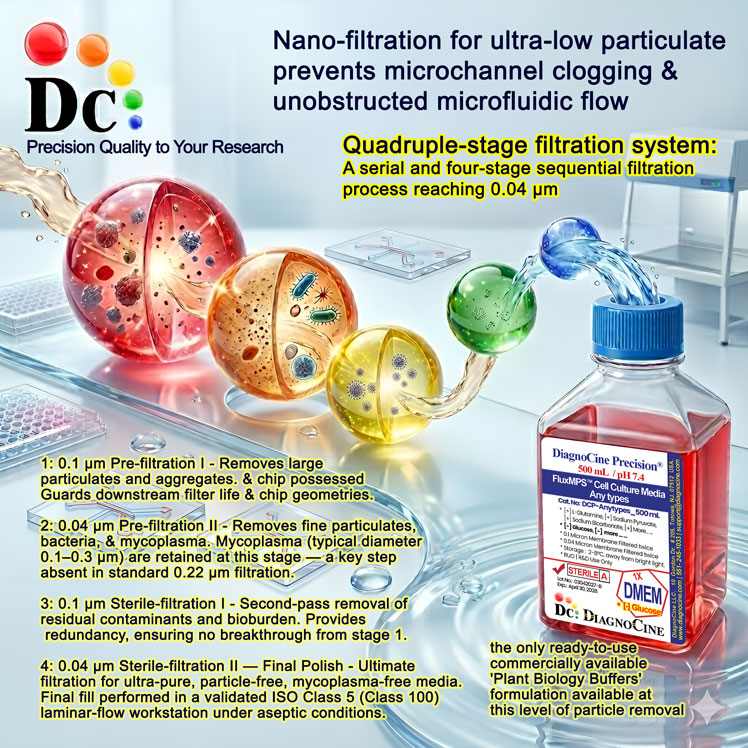
Quadruple-stage filtration system
DCP-DMEMHGFA1X is filtered through a four-stage 0.1 µm ×2 + 0.04 µm ×2 train, alternating a dedicated prefilter ahead of each final-filter cartridge. Each stage is independently processed before aseptic fill.
-
1
0.1 µm Prefiltration I
The first 0.1 µm membrane captures macro-aggregates, undissolved powder residues, and large particulate matter generated during formulation, protecting the downstream 0.04 µm cartridge.
-
2
0.04 µm Final filtration I
The first 0.04 µm (40 nm) pass retains fine particulates and mycoplasma-sized debris (0.2–0.3 µm), delivering a polished stream ahead of the second prefilter/final-filter pair.
-
3
0.1 µm Prefiltration II
A second, independent 0.1 µm prefilter protects the second 0.04 µm cartridge, providing redundant capacity rather than polishing the effluent of stage 2.
-
4
0.04 µm Final filtration II — Polish
The final 40 nm polish stage is immediately followed by aseptic fill under laminar flow. Particulate burden is verified by USP <788> Method 1 (light obscuration) prior to release.
Filtration architecture vs. conventional 0.22 µm DMEM
Reducing final pore size from 0.22 µm to 0.04 µm and doubling the number of filtration passes is intended to reduce subvisible particulate carryover and support mycoplasma-scale debris retention relative to single-pass 0.22 µm filtration. Each batch is separately released against the endotoxin specification of < 0.05 EU/mL (see Manufacturing & Compliance).
0.1 µm ×2 + 0.04 µm ×2
pore size
© Diagnocine® — DCP-DMEMHGFA1X
Designed for next-generation cell culture platforms
DCP-DMEMHGFA1X supports advanced mammalian cell culture from classical monolayer experiments to perfused microphysiological systems. Its Microfluidics Suitable purity is especially relevant for models requiring low particulate background, biosensor precision, and multi-week perfusion runs. Folic acid inclusion supports applications requiring active folate-pathway metabolism and one-carbon cycle studies.[7,8]
Automated Bioreactors & Robotics
For fully automated perfusion bioreactors and robotic liquid-handling platforms, an optional 0.01 µm (10 nm) ultra-filtered MPS Grade variant of DCP-DMEMHGFA1X is available on inquiry, adding two further filtration stages beyond the 0.04 µm cut-off described above.
- Total Particulate Exclusion: 10 nm filtration is intended to reduce subvisible debris and protect micro-valves and pneumatic actuators in automated systems
- Valve & Sensor Protection: Reduced particulate burden helps limit valve seat fouling and optical sensor drift in closed-loop perfusion circuits
- Extended Perfusion Stability: Cleaner medium is intended to reduce fouling of perfusion tubing and inline sampling ports
Inquiry Required: The 0.01 µm (10 nm) MPS Grade variant is produced on request. Contact support@diagnocine.com to request this grade.
Micro Physiological System (MPS) & Chip
Microfluidics Suitable purity (0.04 µm final filtration) is designed for perfusion of organ-on-a-chip, tissue-on-a-chip, and body-on-a-chip platforms where particulates can block microchannels and corrupt TEER readouts.
Warburg Effect & Metabolic Research
High glucose (4,500 mg/L) combined with folic acid supports aerobic glycolysis studies, Warburg-effect profiling, and one-carbon metabolism research in cancer cell lines. Pyruvate supplementation supports mitochondrial vs. glycolytic flux dissection.[5]
iPSC-Derived Models
Folic acid is an essential cofactor for rapidly proliferating iPSC-derived neurons, cardiomyocytes, and hepatocytes. Reduced particulate filtration is intended to limit particulate-associated stress in fragile differentiated progeny cultures.
Endothelial & Primary Cells
A low endotoxin release specification (< 0.05 EU/mL) is relevant for endothelial cultures, where LPS-level contamination can activate NF-κB, disrupt barrier integrity, and confound shear-stress experiments on vascular-on-a-chip models.
Metabolic Flux Analysis
Defined, lot-certified composition supports stable isotope tracing and NMR metabolomics. Folic acid inclusion supports one-carbon and methionine-cycle flux studies. Not compatible with Agilent Seahorse XF assays, which require bicarbonate-free, phenol red-free medium.
Microscopy & Optical Sensing
Reduced particulate background relative to single-stage 0.22 µm media supports high-resolution confocal imaging, fluorescence-based biosensors, and TEER electrical measurements.
Validated quality parameters
Every lot of DCP-DMEMHGFA1X is released against a specification panel covering physical/chemical properties, sterility, purity, storage, and regulatory traceability. Certificates of Analysis are available upon request from support@diagnocine.com.
| Parameter | Specification |
|---|---|
| Formulation | [+] High Glucose, [+] L-Glutamine, [+] Sodium Pyruvate, [+] Sodium Bicarbonate, [+] Folic Acid, [+] Phenol Red |
| Appearance | Red-colored (phenol red indicator), clear solution |
| pH USP <791> | 7.0 - 7.4 |
| Osmolality USP <785> | 280 - 320 mOsm/kg H2O |
| D-Glucose | 4,500 mg/L (High Glucose) |
| L-Glutamine | 584 mg/L |
| Sodium Pyruvate | 110 mg/L |
| Phenol Red | Present (pH indicator) |
| Parameter | Specification |
|---|---|
| Endotoxin USP <85> BET | < 0.05 EU/mL (batch release specification) |
| Sterility USP <71> | No growth at 14 days |
| Mycoplasma | 0.1 µm and 0.04 µm mycoplasma-retentive filtration (not tested per lot) |
| Particulate ≥10 µm USP <788> M1 | ≤ 6,000 particles/mL |
| Particulate ≥25 µm USP <788> M1 | ≤ 600 particles/mL |
| Water Purity | Ultrapure Type 1, 18.2 MΩ·cm; TOC-controlled USP <643> |
| Manufacturing Std. | ISO 13485:2016; 21 CFR Part 820 (QMSR) aligned ISO |
| Fill Environment | Aseptic fill & finish under laminar flow |
| Parameter | Specification |
|---|---|
| Storage Temperature | 2 - 8 °C; protect from strong light |
| Freeze-Thaw | Do not freeze; single-use aliquot recommended |
| Shelf Life | 12 months from date of manufacture, unopened |
| Shipping Condition | Refrigerated (cold pack, 2-8 °C) |
| CO2 Requirement | 10% CO2 incubator recommended (formulated for 3.7 g/L NaHCO3) |
| Available Pack Sizes | 500 mL, 1000 mL |
| Parameter | Specification |
|---|---|
| Raw Material Grade | Cell-culture grade, lot-tested components |
| Traceability | Full lot-to-lot CoA available; raw material lot records retained |
| Manufacturing QMS | ISO 13485:2016 certified facility ISO 13485 |
| Regulatory Alignment | 21 CFR Part 820 (QMSR) aligned |
| UNSPSC | 41116155 — Molecular biology and cell culture growth media (UNv260801) |
| Production Method | Quadruple-stage filtration; micro-batch formulation |
| Intended Use | Research Use Only (RUO) — not for clinical or therapeutic use |
Full composition (mg/L)
DCP-DMEMHGFA1X contains 4× BME amino acid and vitamin concentrations per the standard DMEM specification, with folic acid included in the vitamins fraction. Total: 33 components across 4 categories. All values are per-lot release targets verified on the Certificate of Analysis.
| Component | CAS Number | mg/L |
|---|---|---|
| INORGANIC SALTS | ||
| Calcium chloride dihydrate | 10035-04-8 | 265.000 |
| Ferric nitrate nonahydrate | 7782-61-8 | 0.100 |
| Magnesium sulfate anhydrous | 7487-88-9 | 97.720 |
| Potassium chloride | 7447-40-7 | 400.000 |
| Sodium bicarbonate | 144-55-8 | 3700.000 |
| Sodium chloride | 7647-14-5 | 6400.000 |
| Sodium dihydrogen phosphate anhydrous | 7558-80-7 | 109.000 |
| Component | CAS Number | mg/L |
|---|---|---|
| AMINO ACIDS | ||
| Glycine | 56-40-6 | 30.000 |
| L-Arginine hydrochloride | 1119-34-2 | 84.000 |
| L-Cystine dihydrochloride | 30925-07-6 | 62.570 |
| L-Glutamine | 56-85-9 | 584.000 |
| L-Histidine hydrochloride monohydrate | 5934-29-2 | 42.000 |
| L-Isoleucine | 73-32-5 | 105.000 |
| L-Leucine | 61-90-5 | 105.000 |
| L-Lysine hydrochloride | 657-27-2 | 146.000 |
| L-Methionine | 63-68-3 | 30.000 |
| L-Phenylalanine | 63-91-2 | 66.000 |
| L-Serine | 56-45-1 | 42.000 |
| L-Threonine | 72-19-5 | 95.000 |
| L-Tryptophan | 73-22-3 | 16.000 |
| L-Tyrosine disodium salt | 69847-55-8 | 103.790 |
| L-Valine | 72-18-4 | 94.000 |
| Component | CAS Number | mg/L |
|---|---|---|
| VITAMINS | ||
| Choline chloride | 67-48-1 | 4.000 |
| D-Ca-Pantothenate | 137-08-6 | 4.000 |
| Folic acid | 59-30-3 | 4.000 |
| Nicotinamide | 98-92-0 | 4.000 |
| Pyridoxal 5 phosphate | 54-47-7 | 4.000 |
| Riboflavin | 83-88-5 | 0.400 |
| Thiamine hydrochloride | 67-03-8 | 4.000 |
| OTHERS | ||
| D-Glucose | 50-99-7 | 4500.000 |
| i-Inositol | 87-89-8 | 7.200 |
| Phenol red sodium salt | 34487-61-1 | 15.900 |
| Sodium pyruvate | 113-24-6 | 110.000 |
ISO 13485:2016 manufacturing & multi-standard compliance
Every batch of DCP-DMEMHGFA1X is produced under a documented ISO 13485:2016 Quality Management System with 21 CFR Part 820 (QMSR) alignment, supporting the regulatory traceability required for tissue-chip platform qualification and reproducibility.
ISO 13485:2016 QMS
Quality management system covering design control, batch records, raw material qualification, in-process testing, and final product release.
Quadruple-Stage Filtration
0.1 µm ×2 + 0.04 µm ×2 filtration train applied to every batch prior to fill.
Per-Lot QC & CoA
Appearance, pH, osmolality, endotoxin, sterility, and particulate testing performed on every batch; results reported on the Certificate of Analysis.
Micro-Batch Precision
Small, defined production batches support tighter lot-to-lot consistency for longitudinal chip experiments. Batch size is documented in the CoA.
Endotoxin — USP <85> BET
LAL assay performed on every batch. Assay sensitivity 0.005 EU/mL; release specification < 0.05 EU/mL.
Particulate — USP <788> Method 1
Light-obscuration particle counting performed on each batch, against ≥10 µm and ≥25 µm thresholds.
Osmolality — USP <785>
Freezing-point depression osmometry per USP <785>. Release range: 280-320 mOsm/kg H2O.
Documentation & CoA
Certificate of Analysis including appearance, pH, osmolality, endotoxin, sterility, particulate count, and lot traceability available at release.
- Endotoxin — LAL assay, USP <85> Bacterial Endotoxins Test; assay sensitivity 0.005 EU/mL; release specification < 0.05 EU/mL
- pH, osmolality, conductivity, appearance and clarity
- Sterility
How DCP-DMEMHGFA1X compares
The table below contrasts FluxMPS™ DCP-DMEMHGFA1X against two categories of conventional 0.22 µm-filtered DMEM High Glucose products.
| Parameter | DCP-DMEMHGFA1X (FluxMPS™) |
Conventional DMEM w/ Folic Acid (0.22 µm filtered) |
Standard DMEM High Glucose (0.22 µm filtered) |
|---|---|---|---|
| Grade | Microfluidics Suitable | Standard reagent grade | Standard reagent grade |
| Folic Acid Included | check_circle 4 mg/L | check_circle 4 mg/L | cancel Absent |
| Final Filtration Pore Size | 0.04 µm (40 nm) | 0.22 µm | 0.22 µm |
| Number of Filtration Stages | 4 passes | 1 pass | 1 pass |
| Mycoplasma-Retentive Filtration | check_circle 0.1 & 0.04 µm stages | cancel Not addressed | cancel Not addressed |
| Endotoxin (release specification) | < 0.05 EU/mL | Corning classical liquid media — < 0.25 EU/mL Sigma-Aldrich DMEM complete medium — ≤ 2 EU/mL Gibco classical DMEM — Not specified (recorded per lot) |
|
| USP Particulate Compliance | check_circle USP <788> Method 1 tested | cancel Not tested | cancel Not tested |
| Water Quality | Ultrapure Type 1, 18.2 MΩ·cm | Tissue culture grade | Tissue culture grade |
| Manufacturing QMS | ISO 13485:2016 certified | ISO 9001 (typical) | ISO 9001 (typical) |
| Microfluidic Channel Compatibility | check_circle Microfluidics Suitable | cancel Not validated | cancel Not validated |
| Custom Formulation | check_circle Available on request | cancel Fixed formulation | cancel Fixed formulation |
Comparison figures from published supplier specifications, accessed 2026-09-02. Suppliers that publish no numeric endotoxin specification are shown as "Not specified".
Frequently asked questions
Common questions about DCP-DMEMHGFA1X formulation, filtration, and use in advanced cell culture platforms.
Supporting literature
Peer-reviewed references supporting the science behind Microfluidics Suitable cell culture media, organ-on-a-chip applications, microfluidic perfusion, and media purity for chip-based biological models.
- Huh D, Matthews BD, Mammoto A, Montoya-Zavala M, Hsin HY, Ingber DE. Reconstituting organ-level lung functions on a chip. Science. 2010;328(5986):1662-1668. doi:10.1126/science.1188302
- Bhattacharya M, Malinen MM, Lauren P, Lou YR, Kuisma SW, Kanninen L, et al. Nanofibrillar cellulose hydrogel promotes three-dimensional liver cell culture. J Control Release. 2012;164(3):291-298. doi:10.1016/j.jconrel.2012.06.039
- Berthier E, Young EW, Beebe D. Engineers are from PDMS-land, biologists are from Polystyrenia. Lab Chip. 2012;12(7):1224-1237. doi:10.1039/c2lc20982a
- Leung CM, de Haan P, Ronaldson-Bouchard K, Kim GA, Ko J, Rho HS, et al. A guide to the organ-on-a-chip. Nat Rev Methods Primers. 2022;2:33. doi:10.1038/s43586-022-00118-6
- Warburg O. On the origin of cancer cells. Science. 1956;123(3191):309-314. doi:10.1126/science.123.3191.309
- Eagle H. Amino acid metabolism in mammalian cell cultures. Science. 1959;130(3373):432-437. doi:10.1126/science.130.3373.432
- Ribas J, Pawlikowska J, Rouwkema J. Microphysiological systems: analysis of the current status, challenges and commercial future. Microphysiological Syst. 2021;5:6. doi:10.21037/mps-20-7
- Ducker GS, Rabinowitz JD. One-carbon metabolism in health and disease. Cell Metab. 2017;25(1):27-42. doi:10.1016/j.cmet.2016.08.009
- Stover PJ, Field MS. Vitamin B-9. Adv Nutr. 2011;2(6):536-537. doi:10.3945/an.111.000786
- van der Meer AD, van den Berg A. Organs-on-chips: breaking the in vitro impasse. Integr Biol. 2012;4(5):461-470. doi:10.1039/c2ib00176d
