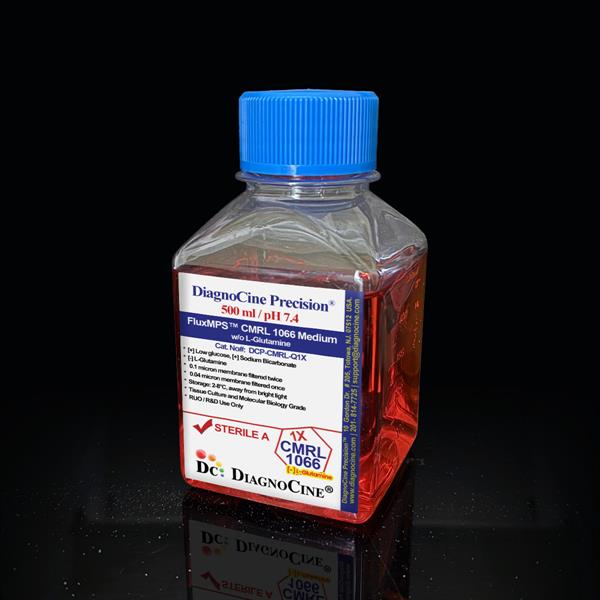
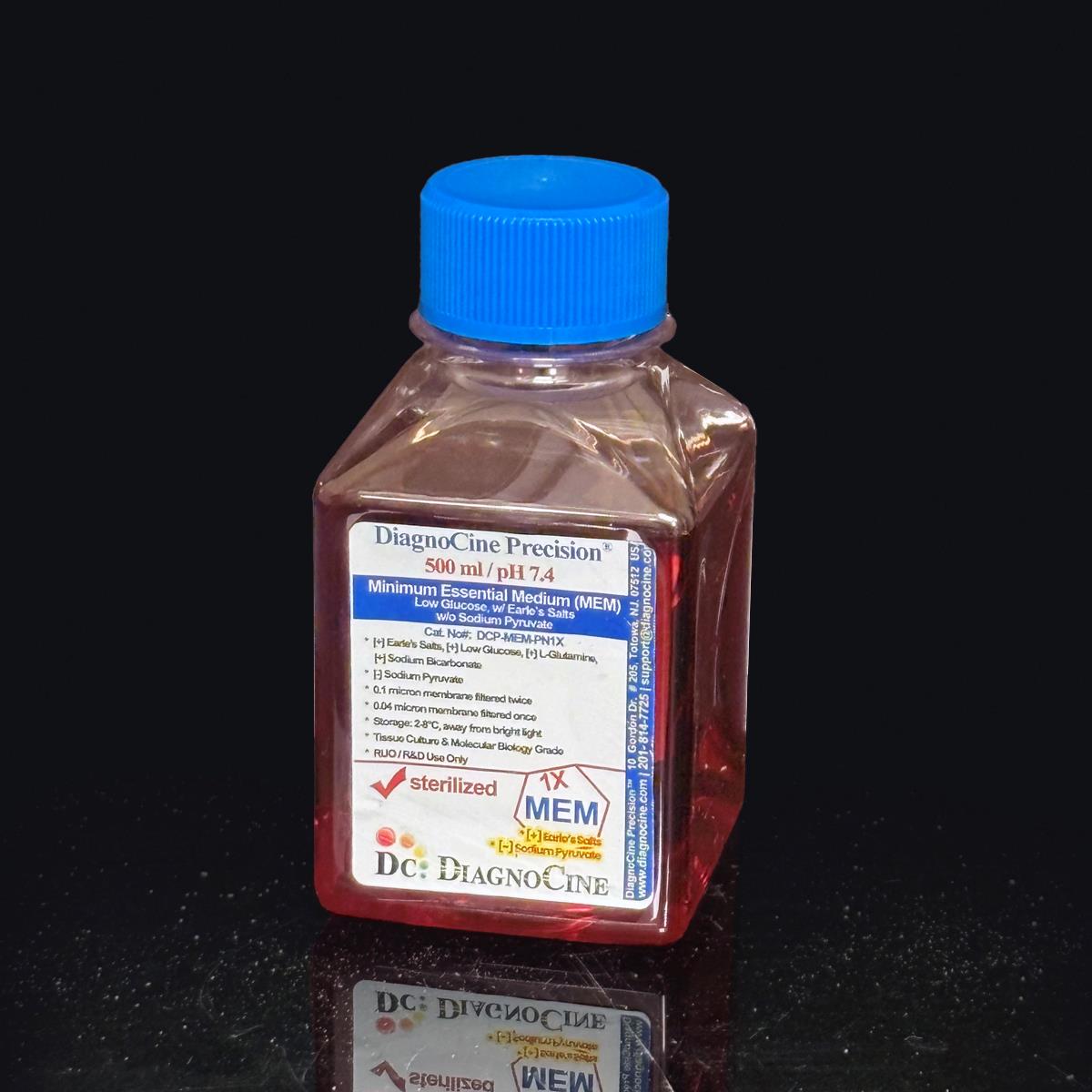
FluxMPS™ MEM Low Glucose with Earle's Salts w/o Sodium Pyruvate
FluxMPS™ MEM Low Glucose with Earle's Salts w/o Sodium Pyruvate
Microfluidics Suitable, quadruple-stage ultra-filtered (0.1 µm x2 + 0.04 µm x2) 1X liquid Minimum Essential Medium formulated with Earle's salts, low glucose, L-glutamine, and sodium bicarbonate — without sodium pyruvate — for precise carbon-source control in microfluidic systems, organ-on-a-chip platforms, and sensitive mammalian cell culture.
- Quadruple-stage filtration: 0.1 µm x2 passes + 0.04 µm x2 passes — Microfluidics Suitable, microchannel-safe purity
- Endotoxin release specification: less than 0.05 EU/mL (USP <85> BET), tested per manufacturing batch
- Low-glucose formulation (1.0 g/L D-glucose) with Earle's salts for pH and osmotic balance; formulated without sodium pyruvate
- Contains L-glutamine (292.0 mg/L), sodium bicarbonate (2200 mg/L), and phenol red indicator (11.0 mg/L); formulated without HEPES
- Manufactured under an ISO 13485:2016 quality management system with ISO Class 5 (Class 100) aseptic fill; final QC at Diagnocine Precision, Totowa, NJ
- Sterility per USP <71> — no bacterial or fungal growth observed after 14 days of incubation
- Custom pH, glucose concentration, salts, HEPES, and nutrient composition available on request — contact support@diagnocine.com
- Glucose1.0 g/L (Low)
- L-Glutamine292.0 mg/L (Included)
- Sodium PyruvateNot included
- pH (USP <791>)7.4
- Osmolality (USP <785>)265–305 mOsm/kg H2O
- Endotoxin (USP <85>)< 0.05 EU/mL
- Filtration0.1 µm x2 + 0.04 µm x2 (Quadruple-stage)
- Storage2–8°C, protected from light
- Shelf Life12 months from date of manufacture, unopened
- ShippingAmbient (cold pack on request)
Engineered where standard media fails
Conventional 0.22 µm-filtered MEM-grade media leaves behind subvisible particulates and mycoplasma-sized organisms that clog microchannels, corrupt metabolic assay signals, and undermine reproducibility in organ-on-a-chip and high-sensitivity cell culture systems. A quadruple-stage train (0.1 µm ×2 + 0.04 µm ×2) reaches a 0.04 µm final cut-off, five times finer than the 0.22 µm membranes used for conventional sterile filtration.
Microchannel-Safe Purity
Final 0.04 µm filtration is compliant with USP <788> Method 1 (light obscuration) particulate thresholds — helps prevent aggregate accumulation that can block microfluidic channels and distort flow profiles.
Total Metabolic Control
Low-glucose (1.0 g/L) Earle's salt formulation without sodium pyruvate enables precise Warburg-effect studies and carbon-source-defined metabolic experiments free from pyruvate interference.
Sub-Mycoplasma Filtration Stages
The 0.1 µm and 0.04 µm membrane stages are sized below the diameter of the smallest mycoplasma species (0.2–0.3 µm), providing mycoplasma-retentive filtration that is not tested per lot.
Ultrapure Type 1 Water
Formulated with 18.2 MΩ·cm ultrapure Type 1 water — supporting low trace-metal and organic-carbon background for sensitive formulation work.
Regulatory-Grade QMS
Manufactured under an ISO 13485:2016 quality management system, 21 CFR Part 820 (QMSR) aligned. Every lot released against endotoxin, sterility, pH, osmolality, and cultural-response testing.
Customization on Demand
pH, glucose concentration, Earle's vs. Hank's salts, HEPES addition, and nutrient modifications available on request — support@diagnocine.com.
Quadruple-stage filtration system
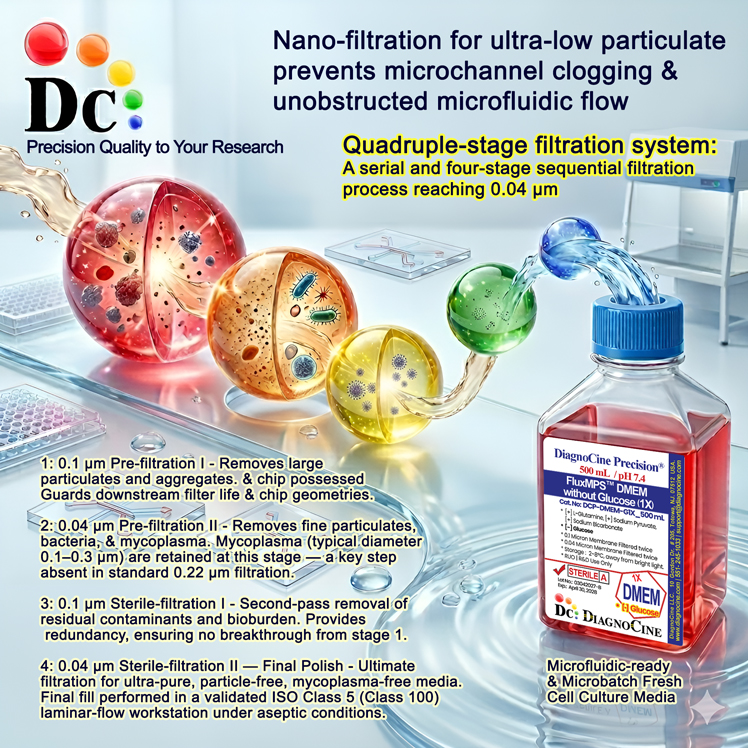
FluxMPS™ MEM is a Microfluidics Suitable, ready-to-use 0.04 µm-polished MEM. Each lot passes through four sequential filtration stages, run as two dedicated prefilter-plus-final-filter pairs, in an ISO Class 5 (Class 100) aseptic fill environment — delivering validated sterility and ultra-low particulate burden for demanding microfluidic and high-sensitivity cell culture applications.
-
1
0.1 µm Prefiltration I
Removes large particulates and aggregates from raw formulation, and protects the first 0.04 µm final-filter cartridge downstream.
-
2
0.04 µm Final Filtration I
First 0.04 µm pass; retains sub-micron particulates and microaggregates that pass a standard 0.22 µm filter.
-
3
0.1 µm Prefiltration II
A second, dedicated prefilter that protects the second 0.04 µm final-filter cartridge — this is not polishing the first filter's effluent, it is a fresh prefilter for the second pair.
-
4
0.04 µm Final Filtration II — Polish
Ultimate polishing filter ahead of aseptic fill and finish in an ISO Class 5 (Class 100) environment — delivers the lowest achievable particulate count for this liquid MEM.
Performance vs. conventional media
Conventional 0.22 µm-filtered MEM allows passage of subvisible particles and mycoplasma-sized organisms that can accumulate in microfluidic channels, interfere with optical biosensors, and add background to metabolic flux measurements. The 0.04 µm final filter in FluxMPS™ MEM delivers a substantially cleaner particulate baseline for sensitivity-critical experiments.
© Diagnocine® — DCP-MEM-PN1X
Where FluxMPS™ MEM performs
FluxMPS™ MEM Low Glucose with Earle's Salts supports research applications that demand both precise low-glucose metabolic control and Microfluidics Suitable purity. From microfluidic organ-on-a-chip platforms to Warburg-effect metabolomics, this formulation supports consistent, reproducible results across sensitive biological systems.
Automated Bioreactors & Robotics
An optional 0.01 µm (10 nm) ultra nano-filtered MPS Grade variant of FluxMPS™ MEM is available for automated bioreactor and liquid-handling robotics applications where even 0.04 µm-level particulates may risk valve fouling, sensor drift, or perfusion inconsistency over extended culture runs.
- Total Particulate Exclusion: 10 nm filtration removes nanoscale aggregates incompatible with precision fluidic systems
- Valve & Sensor Protection: Helps reduce particulate-driven fouling in microvalves, pressure transducers, and optical sensors
- Extended Perfusion Stability: Ultra-clean media supply intended for multi-day perfusion culture
Inquiry Required: The 0.01 µm (10 nm) MPS Grade variant is produced in small batches and is not listed as a standard catalog item. Contact support@diagnocine.com to request this variant.
Micro Physiological System (MPS) & Chip
Microfluidics Suitable, low-particulate MEM for organ-on-a-chip and tissue-chip platforms requiring particulate-controlled media compatible with PDMS and glass microchannel surfaces.
Warburg Effect & Metabolic Research
Low-glucose, pyruvate-free formulation supports isolating glycolytic flux from oxidative phosphorylation — enables Warburg-effect modeling without confounding exogenous carbon sources.
iPSC-Derived Models
Earle's salt formulation supports iPSC-derived cell types sensitive to osmotic fluctuation and metabolic perturbation during differentiation and functional assay phases.
Endothelial & Primary Cells
MEM with Earle's salts supports primary endothelial and hepatocyte cultures, and is broadly used for fibroblast culture, virus propagation, HeLa, BHK-21, 293, HEp-2, HT-1080, and MCF-7 applications.
Metabolic Flux Analysis
Pyruvate-free, defined low-glucose base medium supports isotope-tracing metabolic flux experiments with a clearly defined carbon source. Not compatible with Agilent Seahorse XF assays, which require bicarbonate-free, phenol red-free medium.
Microscopy & Optical Sensing
Low particulate burden helps minimize particulate-driven background scatter in live-cell imaging, biosensor, and TEER measurement setups.
Lot-release analytical parameters
Every lot of FluxMPS™ MEM Low Glucose with Earle's Salts is released against the following analytical criteria. Values represent specification limits; Certificates of Analysis with lot-specific measured values are available on request. Available pack sizes: 500 mL, 1000 mL.
| Parameter | Specification |
|---|---|
| Formulation | MEM with Earle's Salts — [+] L-Glutamine, [+] Sodium Bicarbonate, [+] Phenol Red, [+] Calcium, [+] Magnesium, [+] Glucose, [-] HEPES, [-] Sodium Pyruvate |
| Appearance | Orange-to-red, clear solution (phenol red indicator) |
| pH USP <791> | 7.4 |
| Osmolality USP <785> | 265–305 mOsm/kg H2O |
| D-Glucose | 1,000 mg/L (1.0 g/L) |
| L-Glutamine | 292.0 mg/L |
| Sodium Pyruvate | Not present |
| Phenol Red | 11.0 mg/L (sodium salt) |
| Parameter | Specification |
|---|---|
| Endotoxin USP <85> BET | < 0.05 EU/mL (batch release specification) |
| Sterility USP <71> | No growth after 14 days |
| Mycoplasma | 0.1 µm and 0.04 µm mycoplasma-retentive filtration (not tested per lot) |
| Particulate ≥ 10 µm USP <788> Method 1 | Compliant |
| Particulate ≥ 25 µm USP <788> Method 1 | Compliant |
| Water Purity | Ultrapure Type 1 (18.2 MΩ·cm) |
| Manufacturing Std. | ISO 13485:2016 certified supplier |
| Fill Environment | ISO Class 5 (Class 100) aseptic |
| Parameter | Specification |
|---|---|
| Storage Temperature | 2–8°C, protected from light |
| Freeze-Thaw | Do not freeze |
| Shelf Life | 12 months from date of manufacture, unopened |
| Shipping Condition | Ambient (cold pack on request) |
| CO2 Requirement | Approximately 5% CO2 atmosphere recommended (consistent with Earle's salts sodium bicarbonate buffering at 2200 mg/L) |
| Parameter | Specification |
|---|---|
| Raw Material Grade | Cell culture / reagent grade or higher |
| Traceability | Full lot-level documentation; CoA available on request |
| Manufacturing QMS ISO 13485 | ISO 13485:2016 certified supplier |
| UNSPSC | 41116155 — Molecular biology and cell culture growth media (UNv260801) |
| Regulatory Alignment | 21 CFR Part 820 (QMSR) aligned; USP <85>, <71>, <785>, <788>, <791> |
| Production Method | Compounding + quadruple-stage membrane filtration; ISO Class 5 aseptic fill |
| Intended Use | Research Use Only (RUO). Not for clinical, diagnostic, or therapeutic use. |
Full composition (mg/L)
Complete formulation at 1X concentration. Total: 29 components across 4 categories (Inorganic Salts, Amino Acids, Vitamins, Others). Customization of any component is available on request — contact support@diagnocine.com.
| Component | CAS Number | mg/L |
|---|---|---|
| INORGANIC SALTS | ||
| Calcium chloride dihydrate | 10035-04-8 | 265.000 |
| Magnesium sulfate anhydrous | 7487-88-9 | 97.720 |
| Potassium chloride | 7447-40-7 | 400.000 |
| Sodium bicarbonate | 144-55-8 | 2200.000 |
| Sodium chloride | 7647-14-5 | 6800.000 |
| Sodium phosphate dibasic anhydrous | 7558-79-4 | 122.000 |
| Component | CAS Number | mg/L |
|---|---|---|
| AMINO ACIDS | ||
| L-Arginine hydrochloride | 1119-34-2 | 126.000 |
| L-Cystine dihydrochloride | 30925-07-6 | 31.300 |
| L-Glutamine | 56-85-9 | 292.000 |
| L-Histidine hydrochloride monohydrate | 1007-42-7 | 42.000 |
| L-Isoleucine | 73-32-5 | 52.000 |
| L-Leucine | 61-90-5 | 52.000 |
| L-Lysine hydrochloride | 657-27-2 | 72.500 |
| L-Methionine | 63-68-3 | 15.000 |
| L-Phenylalanine | 63-91-2 | 32.000 |
| L-Threonine | 72-19-5 | 48.000 |
| L-Tryptophan | 73-22-3 | 10.000 |
| L-Tyrosine disodium salt | 69847-55-8 | 51.900 |
| L-Valine | 72-18-4 | 46.000 |
| Component | CAS Number | mg/L |
|---|---|---|
| VITAMINS | ||
| Choline chloride | 67-48-1 | 1.000 |
| D-Ca-Pantothenate | 137-08-6 | 1.000 |
| Folic acid | 59-30-3 | 1.000 |
| Niacinamide | 98-92-0 | 1.000 |
| Pyridoxine hydrochloride | 58-56-0 | 1.000 |
| Riboflavin | 83-88-5 | 0.100 |
| Thiamine hydrochloride | 67-03-8 | 1.000 |
| OTHERS | ||
| i-Inositol | 87-89-8 | 2.000 |
| D-Glucose | 50-99-7 | 1000.000 |
| Phenol red sodium salt | 34487-61-1 | 11.000 |
Manufacturing standards & compliance
FluxMPS™ MEM is produced under an ISO 13485:2016-certified quality management system, with final packaging, quality assurance, and testing performed at Diagnocine Precision in Totowa, New Jersey, USA.
ISO 13485:2016 QMS
Full quality management system certification covering design controls, supplier qualification, production, and post-market surveillance — 21 CFR Part 820 (QMSR) aligned.
Quadruple-Stage Filtration
0.1 µm x2 + 0.04 µm x2 filtration train delivers Microfluidics Suitable purity at every lot.
ISO Class 5 Fill & Finish
Final aseptic fill performed in an ISO Class 5 (Class 100) cleanroom environment.
Per-Lot QC & CoA
Small-batch compounding with full lot traceability — each batch is tested for pH, osmolality, endotoxin, sterility, and cultural response before release.
Endotoxin — USP <85> BET
LAL assay per USP <85>; assay sensitivity 0.005 EU/mL. Release specification: less than 0.05 EU/mL.
Particulate Matter — USP <788> Method 1
Light obscuration particle count testing per USP <788> Method 1 — confirms low particulate burden consistent with Microfluidics Suitable media.
Osmolality — USP <785>
Freezing-point depression osmometry confirms 265–305 mOsm/kg H2O for the finished formulation.
Documentation / CoA
Certificate of Analysis with lot number, expiry date, and measured release results available on request.
- Endotoxin — LAL assay, USP <85> Bacterial Endotoxins Test; assay sensitivity 0.005 EU/mL; release specification < 0.05 EU/mL
- pH, osmolality, conductivity, appearance and clarity
- Sterility
How DCP-MEM-PN1X compares
Standard 0.22 µm-filtered MEM formulations leave subvisible particulates and mycoplasma-sized organisms that can accumulate in sensitive systems. FluxMPS™ MEM addresses these gaps with a validated four-stage filtration architecture.
| Parameter | DCP-MEM-PN1X (FluxMPS™) | Conventional MEM (0.22 µm-filtered) |
|---|---|---|
| Grade | Microfluidics Suitable (0.04 µm final) | Not specified |
| Formulation | [+] L-Glutamine, [+] Sodium Bicarbonate, [+] Phenol Red, [+] Calcium, [+] Magnesium, [+] Glucose, [-] HEPES, [-] Sodium Pyruvate | Varies by supplier |
| Final filtration pore size | 0.04 µm | 0.22 µm |
| Number of filtration stages | 4 (0.1 µm x2 + 0.04 µm x2) | 1 stage |
| Mycoplasma-retentive filtration | check_circle 0.1/0.04 µm stages (not tested per lot) | cancel Not addressed |
| Endotoxin (release specification) | FluxMPS™ — < 0.05 EU/mL | Corning classical liquid media — < 0.25 EU/mL Sigma-Aldrich DMEM complete medium — ≤ 2 EU/mL Gibco classical DMEM — Not specified (recorded per lot) |
| USP <788> particulate compliance | check_circle Method 1, compliant | cancel Not specified |
| Water quality | Ultrapure Type 1 (18.2 MΩ·cm) | Not specified |
| Manufacturing QMS | ISO 13485:2016 certified | Varies |
| Microfluidic channel compatibility | check_circle Validated | cancel Not validated |
| Custom formulation | check_circle pH, salts, supplements, glucose | cancel Fixed formulation |
Comparison figures from published supplier specifications, accessed 2026-09-02. Suppliers that publish no numeric endotoxin specification are shown as "Not specified".
Frequently asked questions
Common questions about FluxMPS™ MEM Low Glucose with Earle's Salts w/o Sodium Pyruvate.
Supporting literature
The following publications provide foundational context for MEM formulation, Earle's salt buffering, microfluidic cell culture media requirements, and USP-grade media quality standards referenced in this product description.
- Eagle H. Propagation in a fluid medium of a human epidermoid carcinoma, strain KB. Proc Soc Exp Biol Med. 1955;89(3):362–364. doi:10.3181/00379727-89-21807
- Eagle H. Amino acid metabolism in mammalian cell cultures. Science. 1959;130(3373):432–437. doi:10.1126/science.130.3373.432
- Vander Heiden MG, Cantley LC, Thompson CB. Understanding the Warburg effect: the metabolic requirements of cell proliferation. Science. 2009;324(5930):1029–1033. doi:10.1126/science.1160809
- Bhatia SN, Ingber DE. Microfluidic organs-on-chips. Nat Biotechnol. 2014;32(8):760–772. doi:10.1038/nbt.2989
- Low LA, Mummery C, Berridge BR, Austin CP, Tagle DA. Organs-on-chips: into the next decade. Nat Rev Drug Discov. 2021;20:345–361. doi:10.1038/s41573-020-0079-3
- Razin S, Yogev D, Naot Y. Molecular biology and pathogenicity of mycoplasmas. Microbiol Mol Biol Rev. 1998;62(4):1094–1156. doi:10.1128/MMBR.62.4.1094-1156.1998
- Uphoff CC, Drexler HG. Detection of mycoplasma contamination in cell cultures. Curr Protoc Mol Biol. 2014;106:24.4.1–24.4.14. doi:10.1002/0471142727.mb2404s106
- Hussain SM, et al. Endotoxin testing of biopharmaceuticals: a review of the bacterial endotoxins test. PDA J Pharm Sci Technol. 2019;73(2):102–115.
- United States Pharmacopeia. USP <71> Sterility Tests; USP <85> Bacterial Endotoxins Test; USP <788> Particulate Matter in Injections; USP <791> pH; USP <785> Osmolality. USP-NF. Current edition.
- Wenger MPE, et al. TEER measurement techniques for in vitro barrier model systems. J Lab Autom. 2015;20(2):107–126. doi:10.1177/2211068214561025