

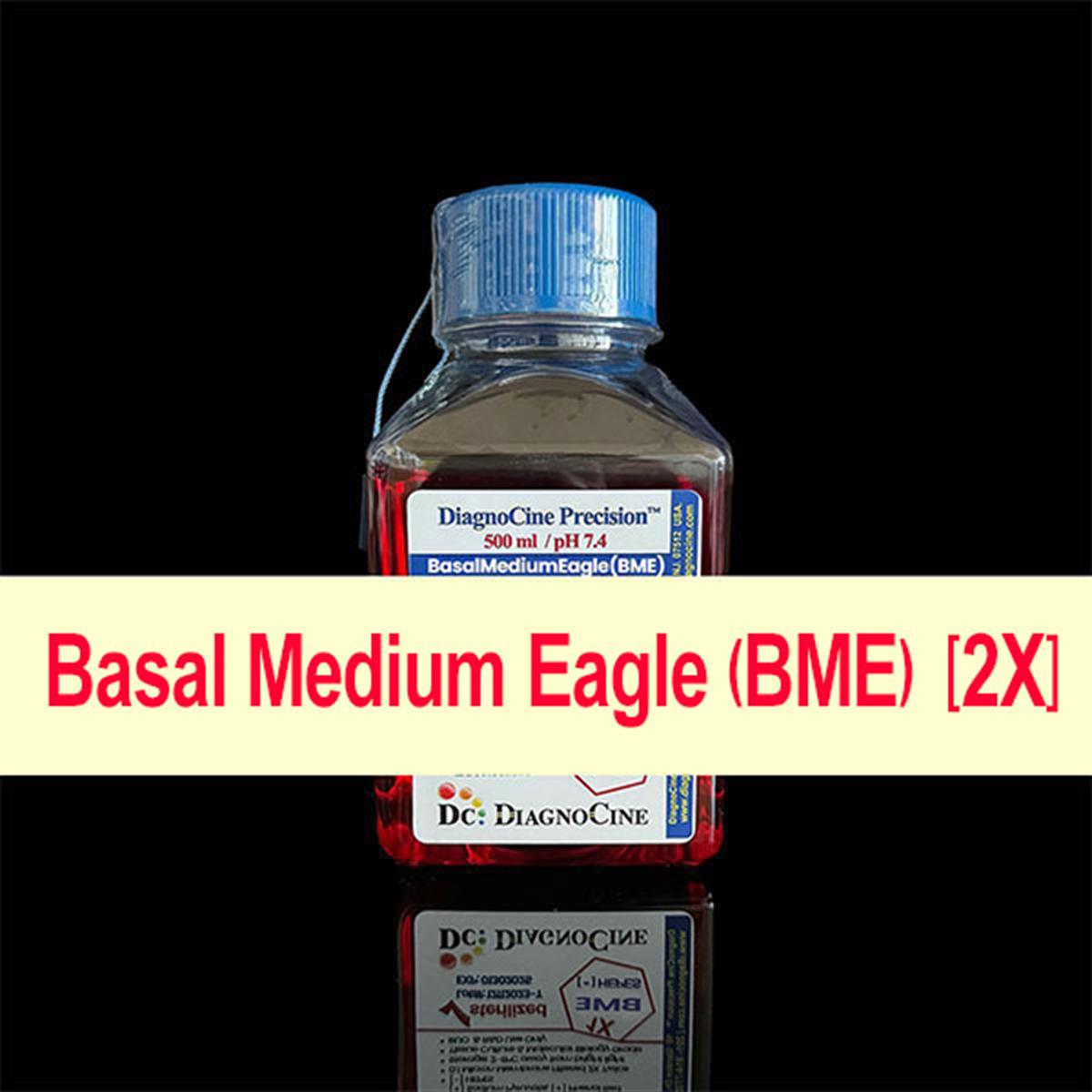
FluxMPS™ Basal Medium Eagle (BME) [2X] Family
Select BasalMediumEagle(BME)2X
- see below the table
Ships within 48 hours for in-stock items. Backordered items ship within 1–2 weeks.
FluxMPS™ Basal Medium Eagle (BME) [2X] Family
Diagnocine’s FluxMPS™ Basal Medium Eagle (BME) [2X] family is a double-strength liquid product line built on Harry Eagle’s original 27-nutrient design[1,6], the foundational chemically defined medium that later became the basis for MEM and DMEM. Each 2X concentrate is mixed 1:1 with a diluent or an agarose overlay to reach 1X working strength — the format used in viral plaque assays. Four variants cover the sodium bicarbonate and 50 mM HEPES combinations, so one family maps cleanly to HeLa, L cells, primary cultures, and microphysiological system (MPS), organ-on-a-chip (OoC), tissue-on-a-chip (ToC), and lab-on-a-chip (LoC) workflows.
- Four ready-to-use 2X liquid concentrates — DCP-BME2X, DCP-BME-B2X, DCP-BMEH2X, DCP-BMEH-B2X — that differ only in sodium bicarbonate and 50 mM HEPES; all four contain L-Glutamine and Phenol Red, and none contains sodium pyruvate.
- Double strength by design: glucose is 2.0 g/L in the 2X concentrate, which gives the classic BME level of 1.0 g/L (~5.5 mM) after 1:1 mixing.[1,6]
- Bicarbonate variants (DCP-BME2X, DCP-BMEH2X) carry 4.4 g/L sodium bicarbonate at 2X; HEPES variants (DCP-BMEH2X, DCP-BMEH-B2X) carry 50 mM HEPES at 2X, which becomes 25 mM at 1X working strength.
- Mix 1:1 with a diluent or an agarose overlay for 1X working strength, as in viral plaque assays.
- Built on Eagle’s 27 essential nutrients: 13 essential amino acids at minimal (baseline) concentrations, 9 water-soluble vitamins (including Biotin), and Earle’s Balanced Salt Solution as the salt base.[1,6]
- Purified through Diagnocine’s quadruple-stage filtration system (0.1 µm → 0.04 µm → 0.1 µm → 0.04 µm), with a 0.04 micron final polish that removes the particulates and protein aggregates that block micro-channels, disrupt laminar flow, and generate false biological signals in MPS / OoC platforms.
- Suited to HeLa, L cells, primary cultures, and organ-on-a-chip work; the same minimal-concentration design makes BME a preferred matrix for 13C / 15N isotope-labeling and metabolic tracing studies.[1,6]
- Supplied in 500 mL bottles. Store at 2–8 °C away from bright light. Custom pH, glucose, salts, HEPES level, and added supplements are available on request — contact support@diagnocine.com.
- Concentration2X (double strength)
- Working strength1X after 1:1 mixing
- Glucose2.0 g/L at 2X
- L-GlutamineIncluded
- Sodium Bicarbonate4.4 g/L at 2X, or none
- HEPES50 mM at 2X, or none
- Sodium PyruvateNot included
- Phenol RedIncluded
- Salt baseEarle’s Balanced Salt Solution
- Filtration0.1 / 0.04 / 0.1 / 0.04 µm
- Size500 mL
- Storage2–8 °C, away from bright light
Choose your BME 2X formulation
All four FluxMPS™ BME 2X variants share the same Eagle 27-nutrient core, Earle’s salts base, 2.0 g/L glucose, L-Glutamine, and Phenol Red indicator, and differ only in sodium bicarbonate and 50 mM HEPES. Check the supplement(s) you need and press Search to highlight every matching variant. Each row links to its product page through the catalog number or the View button.
| Display name | Catalog No. | L-Glutamine | Bicarbonate | HEPES | Phenol Red | Product Page |
|---|---|---|---|---|---|---|
| BME 2X | DCP-BME2X | check | check | remove | check | Viewarrow_forward |
| BME 2X w/o Na Bicarbonate | DCP-BME-B2X | check | remove | remove | check | Viewarrow_forward |
| BME 2X + 50 mM HEPES | DCP-BMEH2X | check | check | check | check | Viewarrow_forward |
| BME 2X + 50 mM HEPES w/o Na Bicarbonate | DCP-BMEH-B2X | check | remove | check | check | Viewarrow_forward |
About Basal Medium Eagle
Basal Medium Eagle (BME) is a fundamental synthetic cell culture medium widely used for supporting the growth of various mammalian cells. Developed by Harry Eagle, it was originally designed to support the growth of HeLa cells and mouse fibroblasts. BME contains essential components for cell growth, including nine B vitamins and thirteen essential amino acids. It is considered the simplest of the basal media, providing all necessary elements for cell growth. BME is typically formulated with Earle’s salts and sodium bicarbonate, so it is usually used in a 5–10% CO2 environment to maintain physiological pH.
BME is principally used for monolayer diploid cell cultures, primary cell cultures, and supporting cell lines such as HeLa and L929 mouse fibroblasts. It is particularly effective for primary mammalian fibroblasts and human transformed cell lines like WI-38 and MRC-5. BME has served as the foundation for several modified media formulations, including Minimal Essential Medium and Dulbecco’s Modified Eagle’s Medium. It is important to note that BME does not contain proteins, lipids, or growth factors. As a result, it often requires supplementation, typically with 10% fetal bovine serum (FBS), to support optimal cell growth.[1,6]
Why a 2X (double-strength) format
A 2X concentrate carries every BME component at twice its working level, so it can be combined 1:1 with a second solution and still land at the standard 1X formulation. The most common use is the viral plaque assay, where the 2X medium is mixed 1:1 with melted agarose to form a nutrient overlay. The same 1:1 rule applies when the second solution is a diluent of the researcher’s choice. In each FluxMPS™ BME 2X variant, 2.0 g/L glucose, 4.4 g/L sodium bicarbonate (bicarbonate variants), and 50 mM HEPES (HEPES variants) become 1.0 g/L, 2.2 g/L, and 25 mM after 1:1 mixing.
Origins and Development
Harry Eagle at the National Institutes of Health published a series of systematic studies in 1955 that defined, for the first time, the precise nutritional requirements of two cell lines: HeLa (human carcinoma) and L929 (mouse fibroblast). His three 1955 papers established the specific amino acid and vitamin requirements for each line individually,[2,3] and his summary paper in Science (122:501–504) then reported BME, a single consolidated medium containing the 27 essential nutrients he had identified, formulated at concentrations optimized for the growth of HeLa cells.[1,6]
Eagle himself noted that “the initial objective of these studies was the identification of the specific metabolites required for the growth of various cell types rather than the development of a chemically defined medium”, meaning BME was a byproduct of nutritional science, not an engineering goal. He also observed from the outset that BME “did not permit growth unless a small amount of serum protein was added,” acknowledging that the function of the serum component remained unclear at the time.[1,6]
The BME family tree
In 1959, Eagle published Amino Acid Metabolism in Mammalian Cell Cultures (Science, 130:432–437), describing Minimum Essential Medium (MEM), a BME derivative with increased amino acid concentrations intended to “permit the cultures to be kept for somewhat longer periods without refeeding” and to promote growth across a wider range of cell lines.[4,6] That same year, Renato Dulbecco and G. Freeman communicated, via footnote in a Virology paper (8:396–397) on polyoma virus plaque production, another BME derivative now known as DMEM, which contained even greater amino acid and vitamin concentrations and was used to support mouse embryonic cell culture.[5,6] Less than a decade later, Moore and colleagues (1967) described RPMI 1640, developed from McCoy’s 5A Medium (itself partly derived from BME), to support the growth of human blood cells.[6]
The result is a single design lineage: virtually every modern basal medium in widespread use today — MEM, DMEM, RPMI 1640 — can be traced directly back to Eagle’s original BME formulation.[6] That lineage is exactly why BME remains the reference baseline for any controlled comparison of medium composition, especially in the emerging field of physiologic media design.[6,7]
BME 2X composition
BME is built around the 27 essential nutrients Eagle identified across his 1955 studies of HeLa and L929 cells. The summary below keeps the categorical structure documented in the primary literature, which describes the 1X reference formulation; the 2X concentrate contains the same components at twice that level. Per-component mg/L values are listed on each variant’s product page (linked above) and on the variant-specific Certificate of Analysis (CoA), available on request from support@diagnocine.com.
| Component | BME 2X details |
|---|---|
| Concentration | 2X (double strength); mix 1:1 with a diluent or agarose overlay for 1X |
| Total essential nutrients | 27 components identified by Eagle and encoded in the formulation[1,6] |
| Amino acids | 13 essential amino acids, at minimal (baseline) concentrations at 1X |
| Vitamins | 9 water-soluble vitamins; includes Biotin (later dropped from MEM derivatives) |
| Inorganic salts | Earle’s Balanced Salt Solution base |
| Glucose | 2.0 g/L at 2X; 1.0 g/L (~5.5 mM) at 1X — near-physiological level[1,6] |
| L-Glutamine / Phenol Red | Included in all four variants |
| Sodium Pyruvate | Not included in any variant |
| Sodium Bicarbonate | 4.4 g/L at 2X in DCP-BME2X and DCP-BMEH2X; not included in DCP-BME-B2X and DCP-BMEH-B2X |
| HEPES | 50 mM at 2X (25 mM at 1X) in DCP-BMEH2X and DCP-BMEH-B2X; not included in DCP-BME2X and DCP-BME-B2X |
| Serum requirement | Requires 5–10% serum supplementation; BME alone is insufficient for proliferation[1,6] |
BME vs MEM vs DMEM
The table below summarizes the documented compositional and historical differences between BME and the two principal media derived from it, compared at 1X working strength.[1,4,5,6]
| Feature | BME (FluxMPS™ 2X family, at 1X) | MEM | DMEM |
|---|---|---|---|
| Amino acid level | Baseline — minimal[6] | ~2× BME[6] | ~4× BME[6] |
| Vitamin level | Baseline, includes Biotin | Often lacks Biotin | 4× BME[6] |
| Glucose | 1.0 g/L | 1.0 g/L | Up to 4.5 g/L[6] |
| Serum supplement | 5–10% recommended[6] | 5–10% recommended[6] | 10–20% typical[6] |
| Developer & year | Harry Eagle, 1955[1,6] | Harry Eagle, 1959[4,6] | Dulbecco & Freeman, 1959[5,6] |
Built for the architecture of the future. Not the flask of the past.
Traditional cell culture media were formulated for static well plates and flasks — environments that tolerate impurities, precipitates, and particle loads that would immediately compromise a microfluidic system. FluxMPS™ was designed from the ground up for Organ-on-Chip (OoC), Tissue-on-Chip (ToC), and Lab-on-Chip (LoC) platforms, where the medium itself is part of the instrument.
Purity that protects your platform
FluxMPS™ is purified to 0.04 microns, finer than any ready-to-use cell culture media currently available. Microscopic particulates and protein aggregates that silently block micro-channels, disrupt laminar flow, and generate false biological signals are eliminated before the medium ever reaches your chip.
Engineered for flow, not just growth
Every component is optimized for consistent, laminar-flow performance across complex micro-channel geometries, capillary-bed and vascular simulations, and long-term automated perfusion studies running continuously for weeks. Zero-clogging is the baseline specification, not a feature.
One concentrate, two working formats
The 2X format reaches 1X when mixed 1:1, either with a diluent or with an agarose overlay for viral plaque assays — a single bottle covers both liquid culture and overlay work.
Clean matrix for metabolic tracing
Because BME provides nutrients at the lowest defined concentrations, it is the medium of choice for isotope-labeling experiments (e.g., 13C or 15N amino acid tracing) where excess unlabeled nutrient would dilute isotopic signal and obscure results.[6]
The reference baseline
The 2019 Cantor review (Trends Cell Biol., 29:854–861) directly uses BME / MEM as the baseline comparator when demonstrating that traditional media poorly reflect human plasma metabolite composition, making BME the reference point for the emerging field of physiologic media design.[6]
Customization on demand
2X is the standard concentration; 2.0 g/L is the standard glucose; 50 mM is the standard HEPES. Custom pH, glucose, salts, HEPES level, and added supplements are available on request — contact support@diagnocine.com.
Quadruple-stage filtration system
Every FluxMPS™ BME 2X variant is delivered through Diagnocine’s quadruple-stage filtration architecture: each 0.04 µm final filter has its own dedicated 0.1 µm prefilter, run as 0.1 µm → 0.04 µm → 0.1 µm → 0.04 µm. The 0.04 µm final polish is finer than any conventional ready-to-use cell culture medium currently available, giving a microchannel-safe matrix that does not introduce particulates, aggregates, or other impurities into the instrument.
-
01
Pre-Filtration Stage 1 0.1 µm
Initial particulate removal ahead of the first fine filter.
-
02
Final Filtration Stage 1 0.04 µm
Fine filtration below standard 0.22 micron practice.
-
03
Pre-Filtration Stage 2 0.1 µm
Second particulate and aggregate reduction ahead of the final filter.
-
04
Final Filtration Stage 2 0.04 µm
Final polish for microfluidic-grade clarity, immediately upstream of aseptic fill.
Why a 4-stage architecture for BME 2X?
BME is a protein-free matrix: there is no co-formulated serum to clog the membrane and no growth-factor protein to denature on a fine filter, which makes it well suited to ultra-fine purification. Because a 2X concentrate is often mixed directly into an overlay or diluent and then placed on cells, a clean concentrate keeps the final working medium as defined as the formulation itself.
![FluxMPS™ Basal Medium Eagle (BME) [2X] Family quadruple-stage filtration system diagram ? alternating 0.1 micron prefilters and 0.04 micron final filters, engineered for organ-on-a-chip (OoC), tissue-on-a-chip (ToC), and lab-on-a-chip microfluidic cell culture media applications by Diagnocine.](https://diagnocine.com/Content/Upload/BlogImages/FluxMPS-Quadruple-stage-filtration-system-Cell-Culture-Media-Diagnocine-V2.jpg "FluxMPS™ Quadruple-Stage Filtration System ? Cell Culture Media for Microfluidic & Organ-on-a-Chip Applications | Diagnocine")
© Diagnocine® — BME 2X family (DCP-BME2X, DCP-BME-B2X, DCP-BMEH2X, DCP-BMEH-B2X)
Validated cell lines & application areas
BME’s use has been validated across the cell types and application areas below. Buffering and HEPES requirements determine which BME 2X variant fits each workflow — see the Product Family Selector above.[1,6,7]
HeLa cells
Eagle’s original model; used to define and calibrate the 27 essential nutrient set.[1,2,6]
L cells (L929 mouse fibroblasts)
Used in parallel with HeLa to demonstrate that nutritional requirements are broadly conserved across species.[1,3,6]
Viral plaque assays
The 2X concentrate is mixed 1:1 with an agarose overlay to give a 1X nutrient overlay, the classic format for plaque assays.
Human diploid fibroblasts
WI-38 and MRC-5, used for vaccine production and cellular aging studies; BME supports stable normal karyotype maintenance.
Primary mammalian cultures
BME’s minimal formulation makes it a suitable starting medium for cells isolated directly from tissue, including primary mammalian fibroblasts.
Microphysiological systems
Stable shear stress and no channel blockage on Organ-on-Chip, Tissue-on-Chip, and Lab-on-Chip platforms; the HEPES variants (DCP-BMEH2X, DCP-BMEH-B2X) are the usual choice where pH must hold outside a CO2 incubator.
Scientific applications for the BME baseline
The same low, defined nutrient set that made BME a teaching tool for cellular nutrition also makes it the right starting matrix for any experiment in which nutrient excess would obscure the biology of interest.
Metabolic tracing
Because BME provides nutrients at the lowest defined concentrations, it is the medium of choice for isotope-labeling experiments (e.g., 13C or 15N amino acid tracing) where excess unlabeled nutrient would dilute isotopic signal and obscure results.[6]
Physiologic-comparison studies
The 2019 Cantor review (Trends Cell Biol., 29:854–861) directly uses BME / MEM as the baseline comparator when demonstrating that traditional media poorly reflect human plasma metabolite composition, making BME the reference point for the emerging field of physiologic media design.[6]
Diploid cell maintenance
BME’s low-nutrient environment supports long-term maintenance of human diploid fibroblasts (WI-38, MRC-5) without inducing the metabolic overstimulation that can accompany richer media.
Regulatory foundation
FluxMPS™ is formulated to support FDA-recognized physiological modeling standards, providing a validated, reproducible media foundation for drug discovery, toxicology screening, and translational research. When your downstream data needs to stand up to regulatory scrutiny, your upstream media cannot be an afterthought.
Frequently asked questions
Common questions about the FluxMPS™ Basal Medium Eagle (BME) [2X] family. For variant-specific Certificates of Analysis or formulation questions not covered here, contact support@diagnocine.com.
All four variants share the Eagle 27-nutrient core and 2.0 g/L glucose, so the choice is driven by buffering, not by biology:
- DCP-BME2X (BME 2X) — 4.4 g/L sodium bicarbonate at 2X. Pick this for standard 5–10% CO2 incubator work, including plaque-assay overlays incubated under CO2.
- DCP-BME-B2X (BME 2X w/o Sodium Bicarbonate) — neither bicarbonate nor HEPES. Pick this when you add NaHCO3 yourself or bring a different buffer system with your diluent or overlay.
- DCP-BMEH2X (BME 2X + 50 mM HEPES) — dual-buffered (bicarbonate + 50 mM HEPES at 2X, 25 mM at 1X). Pick this when pH must hold during bench manipulation, microscope-stage imaging, or perfusion priming, while still running in a CO2 incubator the rest of the time.
- DCP-BMEH-B2X (BME 2X + 50 mM HEPES w/o Sodium Bicarbonate) — HEPES-only buffering. Pick this for CO2-independent use such as on-stage imaging without humidified CO2 or ambient-air microfluidic perfusion.
Mix the 2X concentrate 1:1 with a diluent or with an agarose overlay, as in viral plaque assays. Every component falls to half its 2X level: glucose goes from 2.0 g/L to 1.0 g/L, sodium bicarbonate from 4.4 g/L to 2.2 g/L (bicarbonate variants), and HEPES from 50 mM to 25 mM (HEPES variants). If the second solution carries its own salts, buffer, or serum, account for them in the final composition.
Yes. FluxMPS™ media are engineered specifically for OoC, ToC, and LoC platforms. Every component is optimized for consistent, laminar-flow performance across complex micro-channel geometries, capillary-bed and vascular simulations, and long-term automated perfusion studies. The 0.04 µm final filtration removes the microscopic particulates and protein aggregates that block micro-channels in conventional 0.22 µm media. For perfusion or on-stage imaging where CO2 is not always available, choose one of the HEPES variants (DCP-BMEH2X or DCP-BMEH-B2X).
BME does not contain proteins, lipids, or growth factors and was acknowledged by Eagle from the outset to require a small amount of serum protein for proliferation.[1,6] Typical use is 10% fetal bovine serum (FBS) in the final 1X medium; the Eagle / Cantor literature documents 5–10% as the recommended range.[6] The exact serum lot and percentage should be matched to the target cell line and experimental endpoint.
At 1X, BME provides nutrients at the lowest defined concentrations of any commonly used basal medium — 13 essential amino acids at minimal levels, 9 vitamins at minimal levels, and 1.0 g/L (~5.5 mM) glucose. In an isotope-labeling experiment, every unlabeled molecule of an amino acid or substrate already present in the medium dilutes the labeled tracer signal. Because BME has the smallest unlabeled background of any Eagle-derived medium, it preserves isotopic enrichment and produces cleaner tracer data.[6]
The bicarbonate-containing variants (DCP-BME2X and DCP-BMEH2X) require a 5–10% CO2 environment at working strength, because Earle’s salts use a bicarbonate / CO2 equilibrium for buffering. The HEPES-only variant (DCP-BMEH-B2X), which contains 50 mM HEPES at 2X and no sodium bicarbonate, is intended for CO2-independent use such as ambient-air imaging or perfusion. DCP-BME-B2X has neither bicarbonate nor HEPES and is designed for users who supply their own buffering chemistry.
Yes. 2X is the standard concentration, 2.0 g/L is the standard glucose concentration, and 50 mM is the standard HEPES concentration. Custom pH, glucose level, salts, HEPES level, and additions of chemicals, compounds, proteins, or supplements are all available on request. Contact support@diagnocine.com with your formulation requirements and we will return a custom configuration quote.
All four FluxMPS™ BME 2X variants are supplied in 500 mL bottles. Recommended storage is 2–8 °C, away from bright light. The label-stated shelf life is variant- and lot-specific — refer to the Certificate of Analysis (CoA) for each lot, available on request from support@diagnocine.com.
Verified bibliography
All references below are taken directly from the source description for the BME family and link to the original peer-reviewed publication or its PMC / PubMed record.
- Eagle, H. (1955). Nutrition Needs of Mammalian Cells in Tissue Culture. Science, 122(3168), 501–504. PMID: 13255879 — Original BME definition and the 27-nutrient formulation.
- Eagle, H. (1955). The specific amino acid requirements of a human carcinoma cell (strain HeLa) in tissue culture. J. Exp. Med., 102, 37–48. — Pre-BME foundational amino acid study.
- Eagle, H. (1955). The minimum vitamin requirements of the L and HeLa cells in tissue culture. J. Exp. Med., 102, 595–600. — Pre-BME foundational vitamin study.
- Eagle, H. (1959). Amino Acid Metabolism in Mammalian Cell Cultures. Science, 130(3373), 432–437. PMID: 13658943 — Describes the transition from BME to MEM.
- Dulbecco, R. & Freeman, G. (1959). Plaque production by the polyoma virus. Virology, 8, 396–397. — Origin of DMEM as a BME derivative.
- Cantor, J. R. (2019). The Rise of Physiologic Media. Trends in Cell Biology, 29(11), 854–861. PMC7001851 — Authoritative historical and scientific context for BME and its descendants.
- Yao, T. & Asayama, Y. (2017). Animal-cell culture media: History, characteristics, and current issues. Reproductive Medicine and Biology, 16(2), 99–117. PMC5661806 — Comprehensive evolution review from BME to serum-free systems.
FluxMPS™ — Precision Cell Culture Media for Microphysiological Systems
Built for the architecture of the future. Not the flask of the past.
Traditional cell culture media were formulated for static well plates and flasks — environments that tolerate impurities, precipitates, and particle loads that would immediately compromise a microfluidic system. FluxMPS™ was designed from the ground up for Organ-on-Chip (OoC), Tissue-on-Chip (ToC), and Lab-on-Chip (LoC) platforms, where the medium itself is part of the instrument.
Purity That Protects Your Platform
FluxMPS™ is purified to 0.04 microns — finer than any ready-to-use cell culture media currently available. At this level, the microscopic particulates and protein aggregates that silently block micro-channels, disrupt laminar flow, and generate false biological signals are eliminated before the media ever reaches your chip.
The result: your platform stays operational, your data stays clean, and your biology drives the result — not your media.
Engineered for Flow, Not Just Growth
The name FluxMPS™ reflects its core design principle. Every component is optimized for consistent, laminar flow performance across:
- Complex micro-channel geometries
- Capillary-bed and vascular simulations
- Long-term automated perfusion studies running continuously for weeks
Zero-clogging performance is not a feature — it is the baseline specification.
Applications & Performance
| Application | What FluxMPS™ Delivers |
|---|---|
| Microfluidics | Stable shear stress; no channel blockage |
| Metabolic Tracing | Ultra-pure matrix with no contaminant interference |
| Long-term Perfusion | Consistent formulation stability over weeks of continuous flow |
| Organ-on-Chip | Optical clarity for real-time imaging and integrated biosensing |
Regulatory Foundation
FluxMPS™ is formulated to support FDA-recognized physiological modeling standards, providing a validated, reproducible media foundation for drug discovery, toxicology screening, and translational research. When your downstream data needs to stand up to regulatory scrutiny, your upstream media cannot be an afterthought.
The Bottom Line
Microfluidic platforms are precision instruments. They require precision inputs.
FluxMPS™ is the only ready-to-use cell culture medium engineered specifically to meet that standard — protecting your chip, your cells, and your science.