
FluxMPS™, AGPC RNA Lysis Buffer
FluxMPS™ AGPC RNA Lysis Buffer
A high-performance, guanidinium thiocyanate–based lysis buffer engineered for single-step RNA isolation via the acid guanidinium–phenol–chloroform (AGPC) method. Formulated with TCEP-HCl for superior RNase inactivation and enhanced RNA yield from cells, tissues, and viral samples, and manufactured under MPS-grade purity standards for consistent, reproducible lysates.
- Powerful 4 M guanidine thiocyanate chaotropic formulation for efficient disruption of cells, viruses, and tissues with immediate RNase inactivation.
- 10 mM TCEP-HCl as a modern, odorless reducing agent, replacing β-mercaptoethanol for enhanced RNase inhibition and improved safety and handling.
- Includes 25 mM sodium citrate (pH 7.0) for buffering during lysis and 0.5% N-lauroylsarcosine for effective solubilization of cellular and viral membranes.
- Compatible with acid-phenol-chloroform (AGPC) workflows as well as silica spin columns or magnetic beads when combined with appropriate downstream reagents.
- Suitable for a broad range of sample types, including cultured cells, blood and body fluids, tissues, swabs, and viral transport media.
- Single-stage 0.1 µm membrane filtration for ultra-low particulate purity exceeding standard 0.22 µm-filtered reagents.
- Ultrapure Type 1 water (18.2 MΩ·cm).
- Customizable formulation available upon request.
- pH7.0
- Molarity / Concentration4 M guanidine thiocyanate
- Buffering System25 mM sodium citrate
- Detergent / Additive0.5% N-lauroylsarcosine
- Reducing Agent10 mM TCEP-HCl
- AppearanceClear Solution
- Filtration0.1 µm
- Storage2-8 °C
- Shelf Life1 year
- Water QualityUltrapure Type 1 (18.2 MΩ·cm)
Engineered where standard lysis reagents fall short
Standard laboratory lysis buffers filtered only at 0.22 µm, formulated with unstable reducing agents, or relying on undefined water quality introduce particulate, odor, and reproducibility problems into sensitive RNA workflows. FluxMPS™ AGPC RNA Lysis Buffer is manufactured under ISO 13485 quality systems with a defined, traceable formulation to eliminate these failure modes.
Microchannel-safe, single-stage purity
Single-pass 0.1 µm membrane filtration provides cleaner reagent purity than standard 0.22 µm-filtered buffer, supporting use in automated and microfluidic sample-prep platforms.
Powerful chaotropic lysis
4 M guanidine thiocyanate rapidly inactivates RNases and denatures proteins, ensuring complete cell disruption and immediate nucleic acid stabilization.
TCEP-HCl reducing agent
10 mM TCEP-HCl irreversibly reduces disulfide bonds in RNases without the odor, instability, or toxicity of β-mercaptoethanol or DTT.
Optimized buffer system
25 mM sodium citrate (pH 7.0) with 0.5% N-lauroylsarcosine provides stable pH during lysis and efficient membrane solubilization for clean phase separation, prepared with ultrapure Type 1 water.
Broad sample compatibility
Validated for cultured cells, blood, body fluids, tissues, swabs, and viral transport media—compatible with AGPC, spin-column, and magnetic bead workflows.
Customization on demand
pH, molarity, ionic strength, and additive content can be adjusted to match your specific extraction protocol—contact support@diagnocine.com.
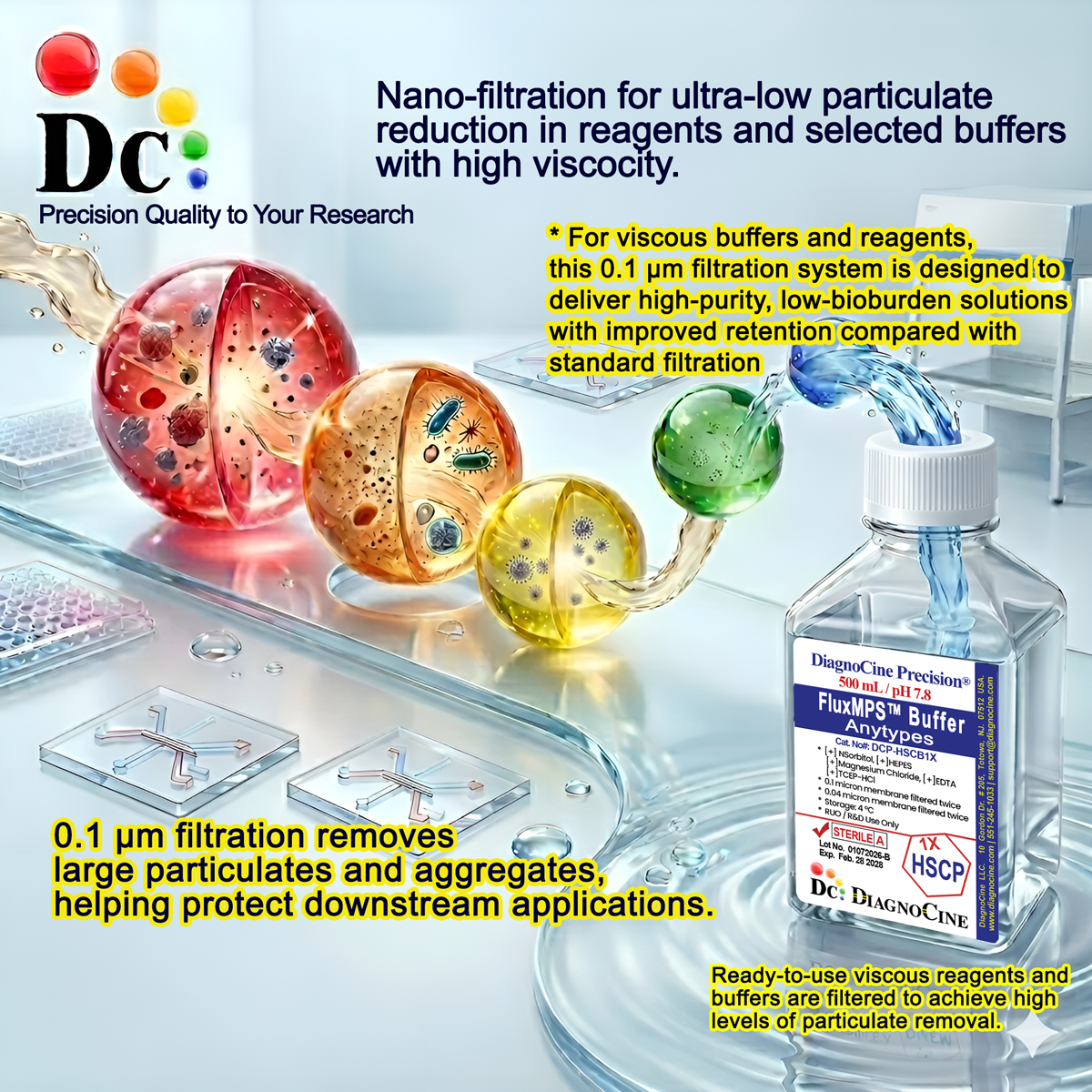
Single-stage 0.1 µm filtration
A single-pass filtration process reaching 0.1 µm delivers clean reagent purity exceeding standard 0.22 µm filtration in one efficient step.
-
1
0.1 µm filtration
Removes large particulates, aggregates, and bacteria. Primary guard providing baseline purity exceeding standard 0.22 µm filtration.
Performance vs. conventional reagents
Standard 0.22 µm single-pass filtration leaves particles in the 0.12–0.22 µm range. Our 0.1 µm final-pore membrane is 2.2 times finer than 0.22 µm, removing these residual contaminants for cleaner results and higher reproducibility.
Validated applications
FluxMPS™ AGPC RNA Lysis Buffer supports single-step lysis and RNase inactivation across a wide range of RNA extraction workflows and sample types.
Automated Bioreactors & Robotics
For high-throughput sample processing on automated liquid handlers and robotic extraction platforms, an optional 0.01 µm (10 nm) ultra-filtered variant is available to further reduce particulate load in automated fluidic pathways.
- Total Particulate Exclusion for sensitive automated liquid-handling channels.
- Valve & Sensor Protection on robotic nucleic acid extraction instruments.
- Extended Stability during repeated automated dispensing cycles.
Inquiry Required: the 0.01 µm ultra-filtered grade is produced to order—contact support@diagnocine.com to discuss your automated platform requirements.
Gene Expression Profiling
Isolation of total RNA for RT-qPCR, digital PCR, RNA-Seq, and other gene expression analyses.
Viral RNA Extraction
Extraction of viral RNA or RNA from difficult samples when strong chaotropic lysis conditions are required.
Lysate Generation for Purification
Preparation of lysates compatible with phenol-chloroform extraction or column/bead-based purification systems.
Broad Sample Type Coverage
Validated for cultured cells, blood and body fluids, tissues, and swabs across research and clinical research settings.
Core & Academic Lab Processing
High-throughput sample processing in research, academic, and core laboratory settings.
AGPC, Column & Bead Compatibility
Compatible with acid-phenol-chloroform workflows as well as silica spin columns or magnetic beads with appropriate downstream reagents.
Technical specifications
Key physical, chemical, purity, and logistical parameters for FluxMPS™ AGPC RNA Lysis Buffer.
| Parameter | Specification |
|---|---|
| Formulation / Composition | 4 M guanidine thiocyanate, 25 mM sodium citrate, 0.5% N-lauroylsarcosine, 10 mM TCEP-HCl |
| Appearance | Clear Solution |
| pH | 7.0 |
| Parameter | Specification |
|---|---|
| Water Quality USP <85> | Ultrapure Type 1 water (18.2 MΩ·cm) |
| Manufacturing Standard ISO | ISO 13485:2016 certified QMS |
| Parameter | Specification |
|---|---|
| Storage Temperature | 2-8 °C |
| Shelf Life | 1 year |
| Parameter | Specification |
|---|---|
| Traceability | Full lot documentation under ISO 13485:2016 certified QMS |
| Manufacturing QMS ISO | ISO 13485:2016 |
| Production Method | Manufactured in Totowa, NJ, USA (DiagnoCine Precision facility) |
| Intended Use | For Research Use Only (RUO). Not intended for clinical, diagnostic, or therapeutic use in humans. |
Full composition
Component list and concentrations for the AGPC RNA Lysis Buffer formulation.
| Component | CAS Number | Concentration |
|---|---|---|
| Guanidine Thiocyanate | 593-84-0 | 4 M |
| Sodium Citrate | 68-04-2 | 25 mM |
| N-lauroylsarcosine | 137-16-6 | 0.5% |
| TCEP-HCl | 51805-45-9 | 10 mM |
Manufacturing & compliance
FluxMPS™ AGPC RNA Lysis Buffer is manufactured under a certified quality system with full lot traceability.
ISO 13485:2016 Certified
Manufactured under certified QMS with full traceability and lot documentation.
Ultrapure Type 1 Water
Formulated with 18.2 MΩ·cm Type 1 water for consistent, low-background lysis performance.
ISO Class 5 (Class 100) Fill & Finish
Filled under controlled cleanroom conditions to minimize particulate ingress during packaging.
Micro-Batch Precision
Lot-controlled manufacturing with documented raw material release and formulation verification.
Endotoxin Testing USP <85>
Endotoxin testing, where applicable to the intended use, follows USP <85> Bacterial Endotoxins Test methodology.
Particulate Control USP <788>
Manufactured under ultra-filtration protocols aligned with USP <788> particulate matter methodology.
Formulation Verification
Each lot is verified for pH, appearance, and formulation consistency prior to release.
Documentation / CoA
Certificate of Analysis (CoA) available for every lot upon request, detailing identity, concentration, and QC results.
How DCP-AGPC1X compares
A side-by-side comparison against conventional AGPC-style lysis reagents.
| Parameter | DCP-AGPC1X (FluxMPS™) | Conventional 0.22 µm Reagent | Standard Alternative |
|---|---|---|---|
| RNase inactivation chemistry | 4 M guanidine thiocyanate + 10 mM TCEP-HCl | Guanidine thiocyanate only | β-mercaptoethanol based |
| Reducing agent safety profile | check_circle Odorless TCEP-HCl | Varies | cancel Volatile β-mercaptoethanol |
| Final filtration pore size | 0.1 µm | ~0.22 µm | ~0.22 µm |
| Number of filtration stages | 1 | 1 | 1 |
| Water quality | Ultrapure Type 1 (18.2 MΩ·cm) | Not specified | Not specified |
| Manufacturing QMS | check_circle ISO 13485:2016 | cancel Not certified | cancel Not certified |
| AGPC / column / bead workflow compatibility | check_circle Yes | Varies | Varies |
| Custom formulation availability | check_circle Yes | cancel No | cancel No |
Frequently asked questions
Common questions about FluxMPS™ AGPC RNA Lysis Buffer.
Supporting literature
Peer-reviewed literature supporting the AGPC method and related RNA isolation chemistry.
- Chomczynski P, Sacchi N. Single-step method of RNA isolation by acid guanidinium thiocyanate-phenol-chloroform extraction. Anal Biochem. 1987;162(1):156-159. doi:10.1006/abio.1987.9999
- Chomczynski P, Sacchi N. The single-step method of RNA isolation by acid guanidinium thiocyanate-phenol-chloroform extraction: twenty-something years on. Nat Protoc. 2006;1(2):581-585. doi:10.1038/nprot.2006.83
- Rio DC, Ares M Jr, Hannon GJ, Nilsen TW. Purification of RNA using TRIzol (TRI reagent). Cold Spring Harb Protoc. 2010;2010(6):pdb.prot5439. doi:10.1101/pdb.prot5439
- Burnouf T, et al. Guanidinium thiocyanate-based reagents in molecular diagnostics: a review of applications in nucleic acid extraction. Anal Bioanal Chem. 2016;408(24):6493-6502. doi:10.1007/s00216-016-9764-4
- Han JC, Han GY. A procedure for quantitative determination of tris(2-carboxyethyl)phosphine, an odorless reducing agent more stable and effective than dithiothreitol. Anal Biochem. 1994;220(1):5-10. doi:10.1006/abio.1994.1290
- Toledo-Arana A, Lasa I. Advances in bacterial transcriptome and post-transcriptional regulation studies using RNA extraction methodologies. Methods Mol Biol. 2011;734:3-15. doi:10.1007/978-1-61779-086-7_1
- Boom R, et al. Rapid and simple method for purification of nucleic acids. J Clin Microbiol. 1990;28(3):495-503. doi:10.1128/jcm.28.3.495-503.1990
- Tan SC, Yiap BC. DNA, RNA, and protein extraction: the past and the present. J Biomed Biotechnol. 2009;2009:574398. doi:10.1155/2009/574398