

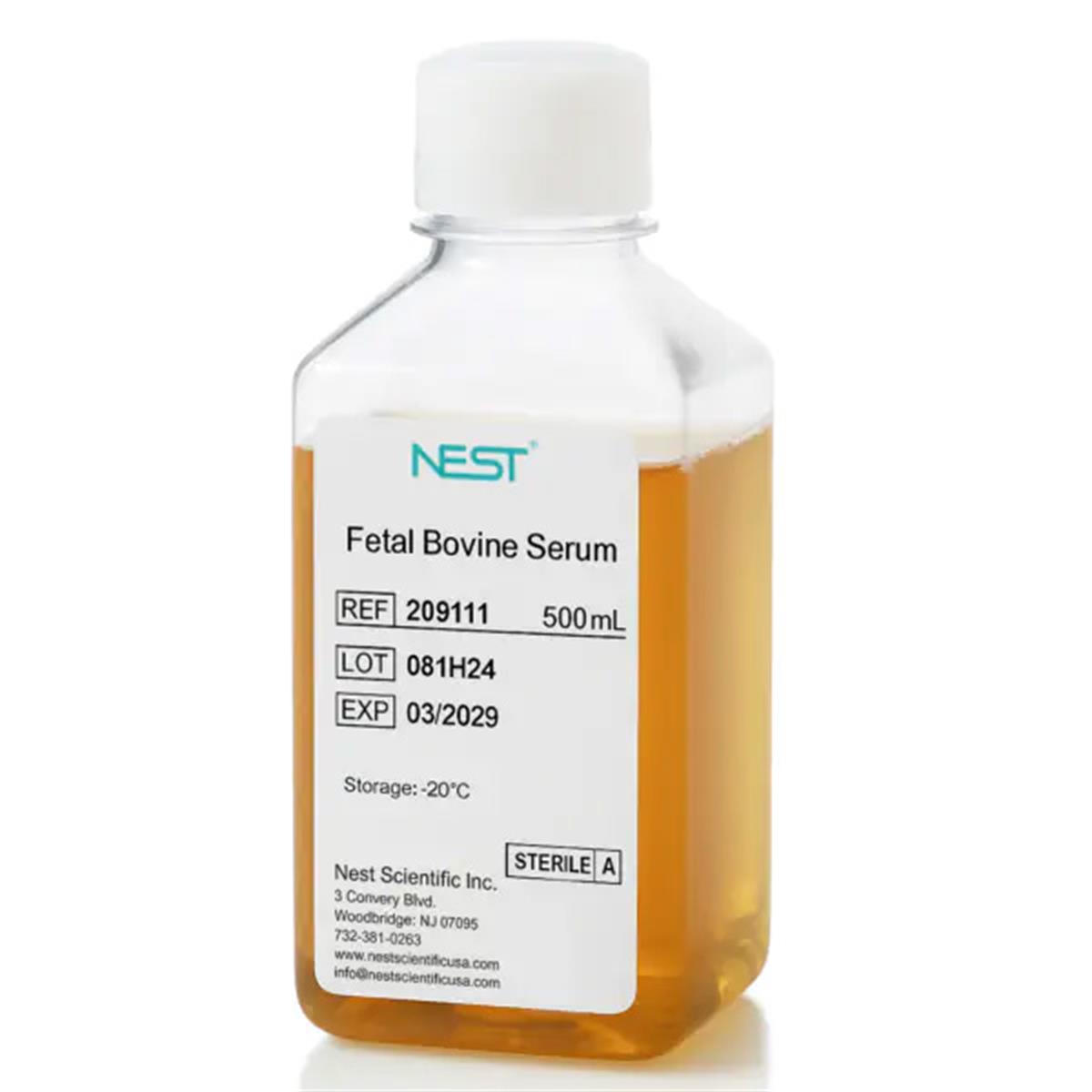
Fetal Bovine Serum (FBS), USDA Source, Trial Size
Product#: NST-209112
$93.50
Availability:
Ships in 48 hours
Fetal Bovine Serum (FBS), USDA Source
Catalog No.: NST-209112
Size: 50 mL
Storage: - 20°C
| Product Name | Catalog | Size | Link |
| Fetal Bovine Serum (FBS), USDA Source | NST-209111 | 500 mL |  |
| Fetal Bovine Serum (FBS), USDA Source, Trial | NST-209112 | 50 mL | |
| Fetal Bovine Serum (FBS), Heat Inactivated, USDA source | NST-209121 | 500 mL | |
| Fetal Bovine Serum (FBS), Heat Inactivated, USDA source, Trial | NST-209122 | 50 mL | |
Description:
Fetal bovine serum (FBS) is the most widely used supplement in in vitro mammalian cell culture. It covers almost all the components needed for research in the life sciences industry, providing almost all the necessary ingredients for adherent and suspension cell culture, most of which have not yet been chemically defined, such as growth factors, attachment factors, transport proteins, lipids, and hormones. FBS is commonly used for cell line proliferation and primary culture, and is widely used in b asic research, target/drug discovery, drug development, and clinical research.
FBS is extracted from the coagulated whole blood collected by puncturing the heart of the fetus. The serum is immediately centrifuged after collection, frozen, and transported to the processing plant. Upon arrival at the processing plant, the serum is thawed and passed through three 100nm (0.1μm) sterilizing filters, and then bottled through a sterile bottling process.
All batches of FBS undergo strict sterility, mycoplasma, and virus testing. Each batch of serum will also undergo cell growth, plate efficiency, and clone efficiency tests on the following cell lines: HeLa, L929, SP2/O-AG14, MRC-5. Certified serum also need to undergo a series of additional tests, including endotoxins, chemical components, protein electrophoresis, and radioimmunodiffusion tests.
Quality Assurance:
- Total protein content: 40±5 g /L
- Endotoxin level < 5EU/mL
- Hemoglobin level < 30 mg /100 mL
- Promote growth > 80% guarantee
Source:
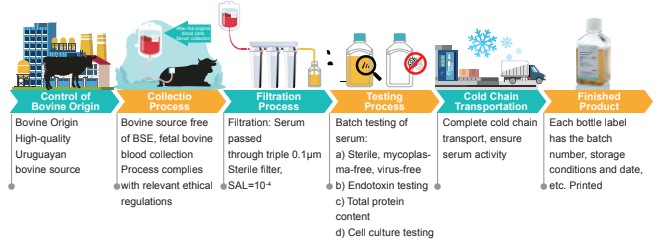
An important factor to consider in serum quality is the source of the serum, therefore, the traceability of the serum is crucial. Each production batch of FBS is strictly controlled, starting from serum collection, through all processing and production stages, to final packaging.
Filtering and Packaging:
The raw serum is filtered through three 0.1μm sterile filters. The filtered serum is thoroughly mixed to ensure uniformity. These products are packaged through a sterile filling process, each step of which is executed to ensure that the product complies with industry sterility assurance level standards SAL=10-4 (i.e., during the manufacturing process, the bacterial and fungal contamination level of the product! does not exceed 1 in 10,000 units). The filtering and bottling are carried out in a positive-pressure HEPA-filtered controlled environment room.
Storage and Transportation Conditions:
The storage conditions, batch number, and expiration date of FBS are indicated on the label. The storage condition is -20°C, and the shelf life is 60 months. When the product is stored correctly, the best product performance can be guaranteed. It needs to be transported at -20°C or on dry ice.
Batch Stability Test Items:
1. Sterility: The products are all sterility tested based on the EP or USP to ensure no bacteria, yeast, E. coli phages, etc. Sterile filtration, aseptic packaging and each batch will be sampled for sterility testing.
2. Mycoplasma: Each product batch must be tested for the presence of mycoplasma. Mycoplasma in the serum is detected through culture methods.
3. Hemoglobin: Quantitative and colorimetric methods are used to determine the residual hemoglobin concentration in each product batch.
4. Cell Culture Test: Each batch of FBS is tested for in vitro culture effects of specific cell lines, mainly evaluated based on the following three aspects:
- Growth promotion
- Cloning efficiency
- Plating efficiency

***Add cell culture media with a concentration of 10% serum to the test to evaluate the biological performance, and record the growth morphology of the cells.
5. Endotoxin test (LAL): All serum have been quantitatively tested by color dynamics to determine and quantify endotoxin levels.
6. Protein Concentration Test:

7. Osmotic Pressure: Osmotic pressure is determined by lowering the freezing temperature. Osmometers are calibrated with traceable standards.
8. No BSE Testing: For materials derived from bovine, bovine spongiform encephalopathy (BSE) testing is conducted before the corresponding blood can be processed. This fetal bovine serum is BSE-free serum.
9. Bovine Serum Specific Virus Testing: Each batch of serum undergoes additional virus testing using cell culture techniques. The serum is inoculated on GBK cells to detect the absence of the indicated virus. Virus detection is performed through indirect immunofluorescence, including BVD, IBR, and PI3 viruses, and the test is negative.