
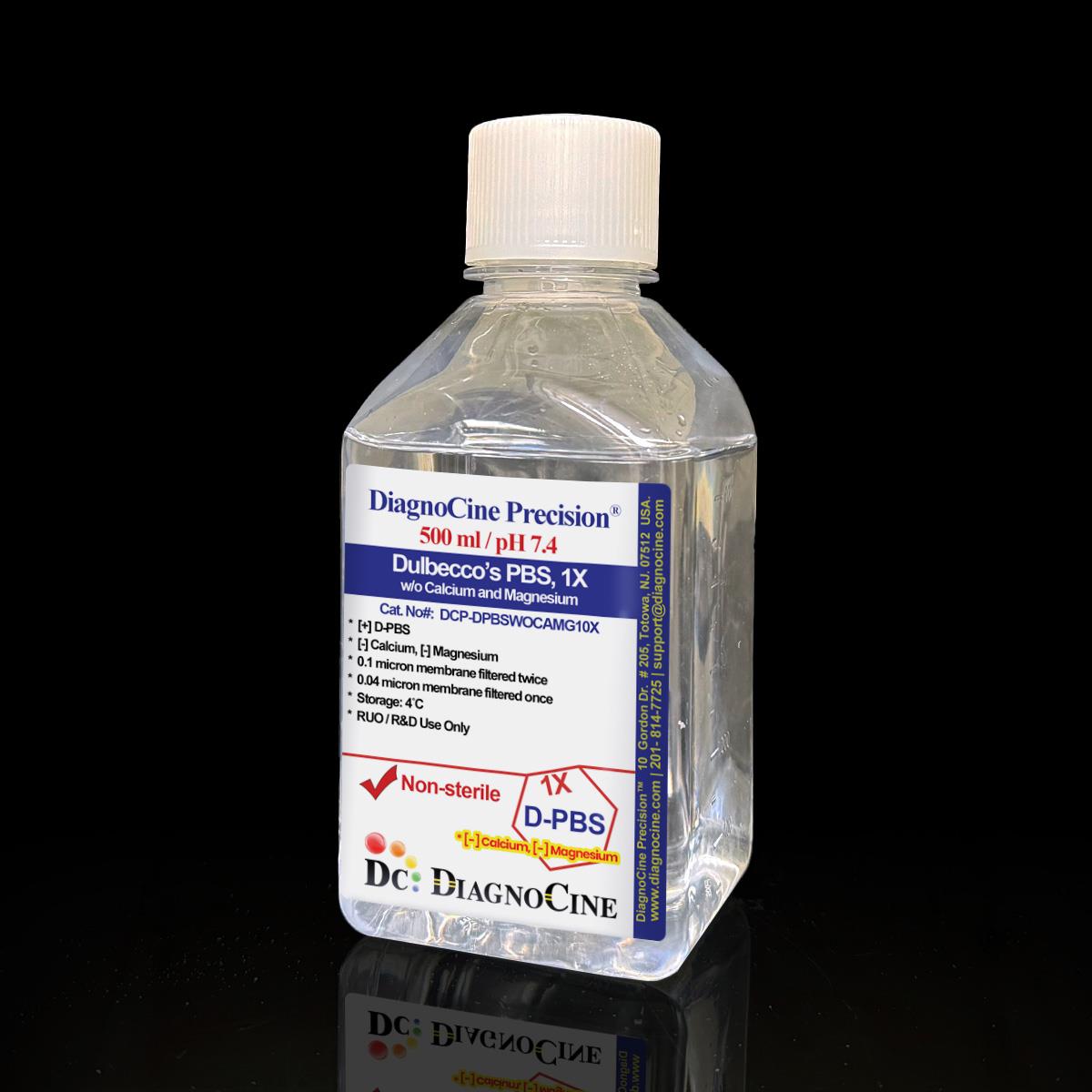
Dulbecco's PBS without Ca2+and Mg2+ (D-PBS), Non-Sterile, 10X
FluxMPS™ Dulbecco's PBS without Ca2+ and Mg2+ (D-PBS), Non-Sterile, 10X
MPS-grade Dulbecco's phosphate-buffered saline concentrate (10X) formulated without calcium or magnesium, intended for organ-on-a-chip, microfluidic, and general cell culture workflows. Each lot is filtered twice through a 0.1 µm membrane in a clean environment and prepared with ASTM Type 1 ultrapure water to support a target pH of 7.4.
- 0.1 µm membrane filtration, performed twice (dual-pass), in a clean environment
- Target pH 7.4; customizable to 2X, 4X, 5X, or 10X concentration on request
- Free of Ca2+, Mg2+, protease, DNase, RNase, and endonuclease
- Prepared with ASTM Type 1 ultrapure water (0.05 µS/cm), deionized
- Non-sterile, Tissue Culture & Molecular Biology grade formulation
- Custom pH, concentration, and additive/detergent/inhibitor/protein formulations available on request
- pH7.4
- Concentration10X (2X, 4X, 5X, 10X available)
- FormulationCa2+(-), Mg2+(-)
- Filtration0.1 µm membrane, dual-pass
- Water QualityASTM Type 1 Ultrapure, 0.05 µS/cm
- AppearanceClear, colorless liquid
- SterilityNon-sterile
- StorageRoom temperature (4°C recommended, long term)
- ShippingRoom temperature
- GradeTissue Culture & Molecular Biology
Engineered where standard buffers fail
Dulbecco's phosphate-buffered saline is a balanced salt solution designed for cell culture applications because of its osmotic balance property, similar to the natural condition of mammalian systems. D-PBS provides the appropriate milieu to briefly sustain the physiological and structural integrity (tonicity/viability) of cells in vitro. Balanced salts support viable conditions for cells only during experimental conditions outside their regular growth environment; when treated with D-PBS, cells maintain osmotic balance and physiological pH, and D-PBS without calcium and magnesium protects cells from acute fluctuations. Conventional 0.22 µm-filtered buffers can carry higher subvisible particulate loads and less consistent pH control, which is a concern for sensitive microchannel and imaging workflows.
Microchannel-safe purity
Filtered twice through a 0.1 µm membrane in a clean environment, which helps reduce particulate load; the smallest known mycoplasma organisms measure approximately 0.2 microns.
Precise, stable pH
Formulated to a target pH of 7.4, with buffering capacity effective at in vivo neutral pH across a range of applications.
Ultrapure-grade water
Formulated with ASTM 0.05 µS/cm Type 1 ultrapure, deionized water.
Low background for imaging & assays
Supplied as a clear, colorless liquid suited to optical and imaging-based workflows.
Defined, traceable composition
Formulated without Ca2+, Mg2+, protease, DNase, RNase, or endonuclease activity.
Customization on demand
pH, concentration (2X, 4X, 5X, 10X), and addition of chemicals, detergents, inhibitors, proteins, or other components available on request.
Single-stage 0.1 µm membrane filtration, applied twice
Each lot of DCP-DPBSWOCAMG10X is processed through 0.1 µm membrane filtration, performed twice (2X) in sequence within a clean environment, prior to fill.
-
1
0.1 µm Membrane Filtration (Dual-Pass)
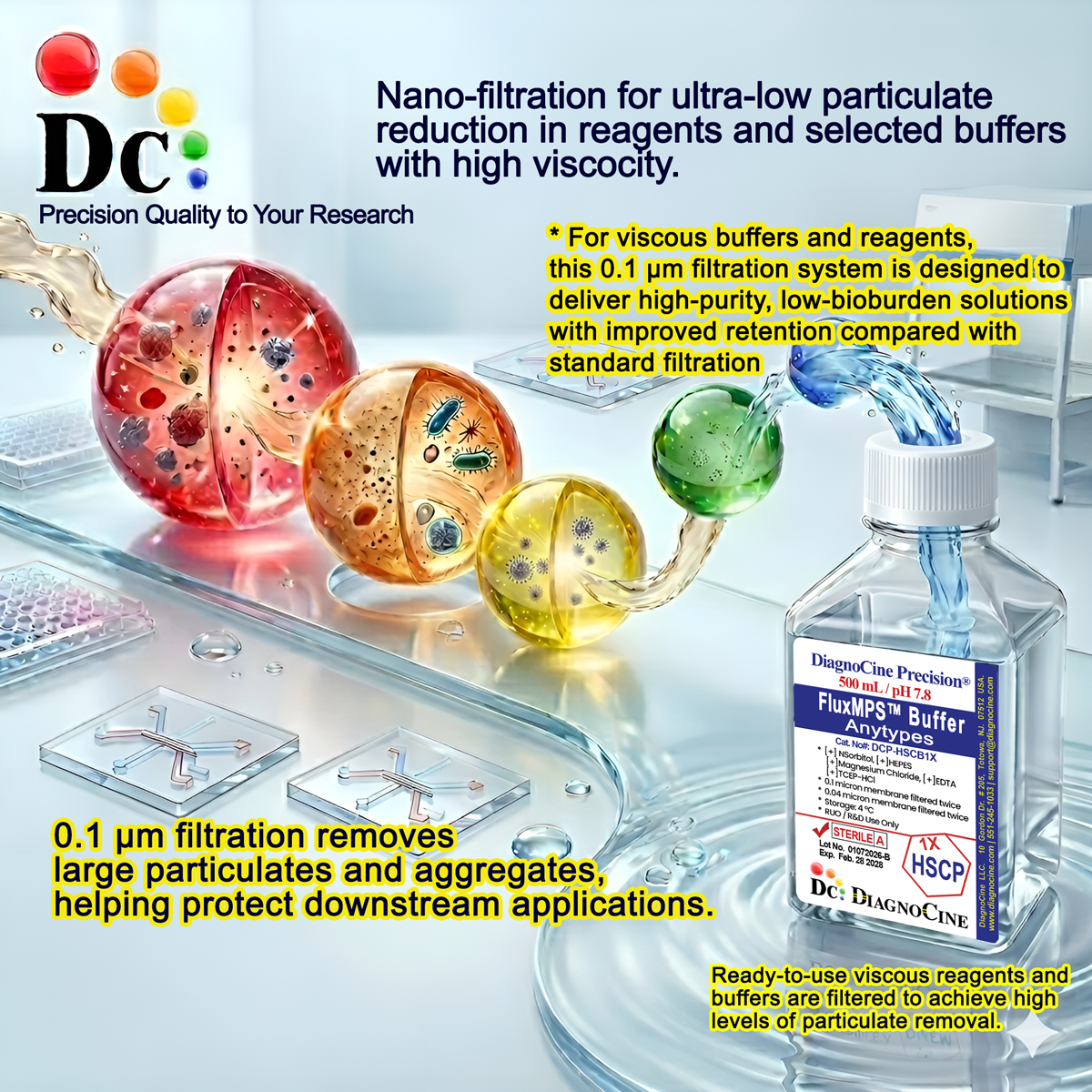
All reagents are filtered twice (2X) through 0.1 micron membrane filters in a clean environment, reducing particulate load and helping to prevent mycoplasma contamination; the smallest known mycoplasma organisms measure approximately 0.2 microns.
Performance vs. conventional buffer
Sequential passage through a 0.1 µm membrane removes finer particulates than a single pass through a standard 0.22 µm filter, supporting cleaner downstream use in sensitive microfluidic and imaging workflows.
© Diagnocine® — DCP-DPBSWOCAMG10X
Where D-PBS without Ca2+/Mg2+ is used
A wide range of uses include general cell culture, washing adhesion cells before dissociation, transporting cells or tissue samples, diluting cells for counting, and preparing reagents that provide inorganic salts essential for basic cell metabolism. D-PBS is widely used because its buffering capacity is effective at in vivo neutral pH across a range of applications. When included with calcium and magnesium, trypsinization/cell dissociation is less effective, but such inclusion is useful for transport media or reagent preparation; D-PBS without calcium and magnesium is generally used as a diluent or as an inorganic base for standard media preparation.
Automated Bioreactors & Robotics
For automated perfusion systems and robotic liquid handling, an optional 0.01 µm (10 nm) ultra-filtered variant is available to further protect sensitive valves, sensors, and microchannels.
- Total Particulate Exclusion — finer retention for closed-loop systems
- Valve & Sensor Protection — reduces particulate-driven fouling risk
- Extended Perfusion Stability — supports longer unattended run times
Inquiry Required: the 0.01 µm ultra-filtered grade is available on request; contact support@diagnocine.com.
Micro Physiological System (MPS) & Chip
Supports buffer exchange and washing in miniaturized tissue and organ models.
Wash, Dilution & Reconstitution
Used for washing adhesion cells before dissociation, diluting cells for counting, and reagent preparation.
iPSC-Derived Model Handling
Ca2+/Mg2+-free formulation supports gentle handling steps for iPSC-derived cell models.
Endothelial & Primary Cell Perfusion
Provides an osmotically balanced rinse and dilution buffer for primary and endothelial cell workflows.
ELISA, Blotting & Blocking
Serves as a wash and dilution base for immunoassay and blotting protocols.
Microscopy & Optical Sensing
Clear, colorless formulation is suited to imaging and optical sensing workflows.
Physical, chemical, and quality parameters
All values below reflect data stated for this specific formulation.
| Parameter | Specification |
|---|---|
| Formulation | 10X Dulbecco's phosphate-buffered saline without Ca2+/Mg2+ |
| Appearance | Clear, colorless liquid |
| pH | 7.4 |
| Concentration | 10X (2X, 4X, 5X, 10X available) |
| Parameter | Specification |
|---|---|
| Sterility | Non-sterile USP <71> |
| Filtration | 0.1 µm membrane, filtered twice |
| Contaminant Screening | Ca2+(-), Mg2+(-), Protease(-), DNase(-), RNase(-), Endonuclease(-) |
| Water Quality | ASTM Type 1 Ultrapure Water, 0.05 µS/cm, deionized |
| Parameter | Specification |
|---|---|
| Storage Temperature | Room temperature; 4°C recommended for long-term storage |
| Shipping Condition | Room temperature |
| Deterioration Signs | Precipitate/particulate matter, cloudy appearance, color change, and/or pH change |
| Parameter | Specification |
|---|---|
| Raw Material Grade | Tissue Culture & Molecular Biology grade |
| Manufacturing QMS | ISO 13485-certified facility ISO 13485:2016 |
| Regulatory Alignment | CE-approved facility (Suppliers of DiagnoCine Precision) |
| Production Method | 0.1 µm membrane filtration, twice, using ASTM Type 1 ultrapure water |
| Intended Use | Research Use Only (RUO); not for human or animal therapeutic use, consumption, or diagnostic use |
| Customization Available | pH, concentration (2X/4X/5X/10X), and additive/detergent/inhibitor/protein customization |
Full composition
Component concentrations are expressed as supplied at 10X strength.
| Component | CAS Number | Concentration |
|---|---|---|
| Potassium Chloride (KCl) | 7447-40-7 | 26.7 mM (2000.00 mg/L) |
| Potassium Phosphate monobasic (KH2PO4) | 7778-77-0 | 14.7 mM (2000 mg/L) |
| Sodium Phosphate Dibasic (Na2HPO4) | 7558-79-4 | 81.0 mM (11500 mg/L) |
| Sodium Chloride (NaCl) | 7647-14-5 | 81 mM (80000 mg/L) |
Manufacturing & compliance
This product is intended for laboratory research use only. It is not intended for any animal or human therapeutic use, any human or animal consumption, or any diagnostic use.
ISO 13485:2016 Certified QMS
Manufactured under ISO 13485-certified and CE-approved facilities (Suppliers of DiagnoCine Precision).
Ultrapure Type 1 Water
Formulated using ASTM 0.05 µS/cm Type 1 ultrapure, deionized water.
Clean-Environment Filtration
Filtered twice through a 0.1 µm membrane within a controlled clean environment prior to fill.
Micro-Batch Precision
Final packaging, quality assurance, and testing are performed at the DiagnoCine R&D and Quality Testing Center; customization and assembly are performed at DiagnoCine Precision in Totowa, New Jersey, USA.
Filtration & Particulate Control
Sterilized by filtering twice (2X) through 0.1 micron membrane filters in a clean environment, which helps largely prevent mycoplasma contamination.
Nuclease/Protease-Free Formulation
Formulated without Ca2+, Mg2+, protease, DNase, RNase, or endonuclease activity.
Documentation & CoA
Final testing is completed at the DiagnoCine R&D and Quality Testing Center; contact support@diagnocine.com for lot-specific documentation.
Custom Formulation Program
pH, concentration (2X/4X/5X/10X), and addition of chemicals/detergents/inhibitors/proteins/other components available upon inquiry.
How DCP-DPBSWOCAMG10X compares
A comparison against conventional 0.22 µm-filtered buffer.
| Parameter | DCP-DPBSWOCAMG10X (FluxMPS™) | Conventional 0.22 µm-Filtered Buffer | Standard Alternative (0.22 µm-Filtered Buffer) |
|---|---|---|---|
| Final filtration pore size | 0.1 µm (dual-pass) | 0.22 µm | 0.22 µm |
| Water quality | ASTM Type 1 Ultrapure, 0.05 µS/cm | Standard purified water | Standard purified water |
| Manufacturing QMS | check_circle ISO 13485-certified, CE-approved | cancel | cancel |
| Microfluidic channel compatibility | check_circle | cancel | cancel |
| Custom pH & concentration formulation | check_circle | cancel | cancel |
| Ca2+/Mg2+, nuclease & protease free | check_circle | cancel | cancel |
| Additive/detergent customization | check_circle | cancel | cancel |
Frequently asked questions
Common questions about DCP-DPBSWOCAMG10X.
Supporting literature
Curated references relevant to phosphate-buffered saline, buffer chemistry, and organ-on-a-chip applications.
- Dulbecco R, Vogt M. Plaque formation and isolation of pure lines with poliomyelitis viruses. J Exp Med. 1954;99(2):167-182. doi:10.1084/jem.99.2.167
- Good NE, et al. Hydrogen ion buffers for biological research. Biochemistry. 1966;5(2):467-477. doi:10.1021/bi00866a011
- Bhatia SN, Ingber DE. Microfluidic organs-on-chips. Nat Biotechnol. 2014;32(8):760-772. doi:10.1038/nbt.2989
- Huh D, et al. Reconstituting organ-level lung functions on a chip. Science. 2010;328(5986):1662-1668. doi:10.1126/science.1188302
- Esch EW, et al. Organs-on-chips at the frontiers of drug discovery. Nat Rev Drug Discov. 2015;14(4):248-260. doi:10.1038/nrd4539
- Zhang B, et al. Organ-on-a-chip devices advance to market. Lab Chip. 2017;17(14):2395-2420. doi:10.1039/C6LC01554A
- Sung JH, et al. Recent advances in body-on-a-chip systems. Anal Chem. 2019;91(1):330-351. doi:10.1021/acs.analchem.8b05293
- Low LA, et al. Organs-on-chips: into the next decade. Nat Rev Drug Discov. 2021;20(5):345-361. doi:10.1038/s41573-020-0079-3
- Ingber DE. Human organs-on-chips for disease modelling, drug development and personalized medicine. Nat Rev Genet. 2022;23(8):467-491. doi:10.1038/s41576-022-00466-9