

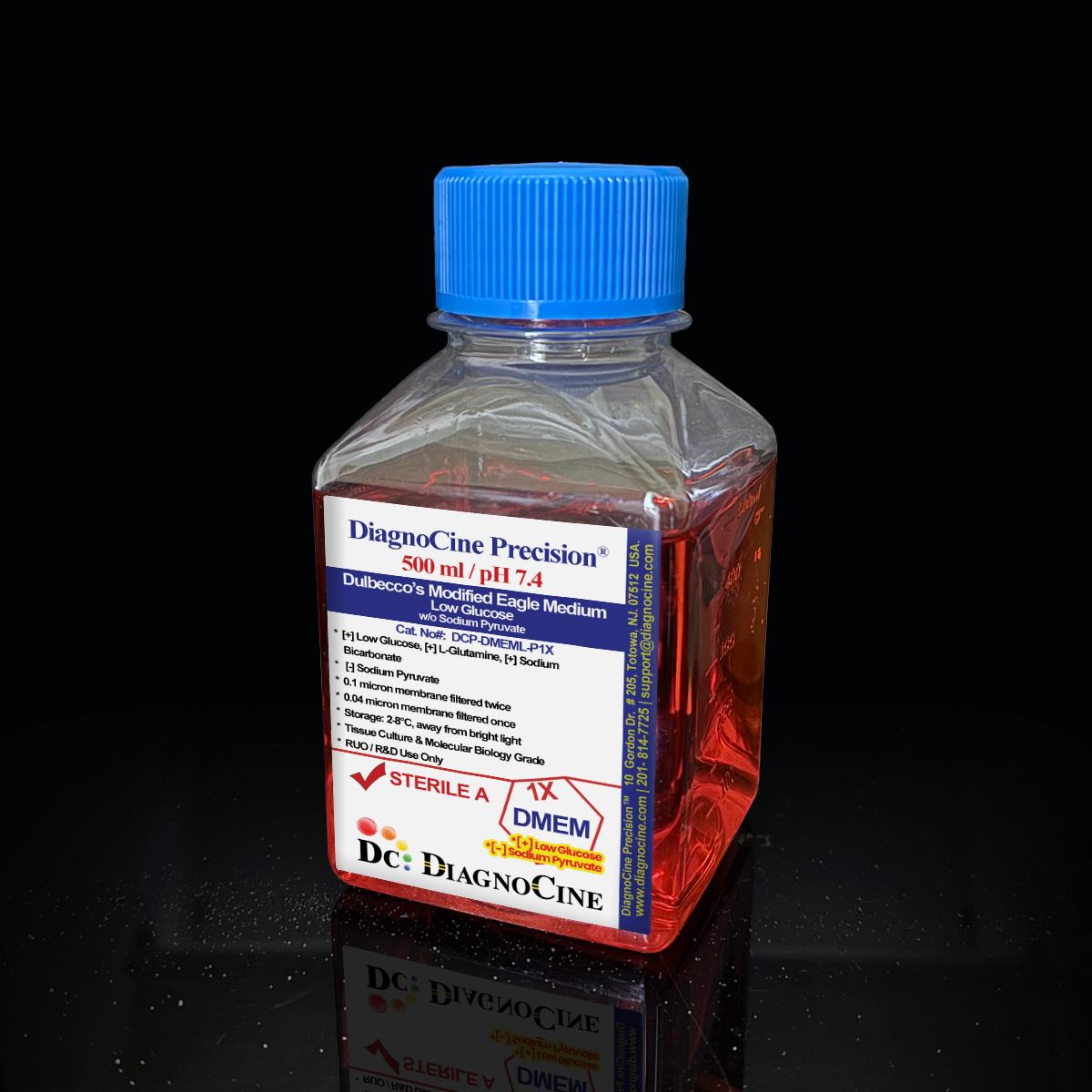
FluxMPS™ Dulbecco's Modified Eagle Medium (DMEM), Low Glucose w/o Sodium Pyruvate: 1X Liquid
FluxMPS™ Dulbecco's Modified Eagle Medium (DMEM), Low Glucose w/o Sodium Pyruvate: 1X Liquid
FluxMPS™ DCP-DMEML-P1X is a Microfluidics Suitable, quadruple-stage ultra-filtered (0.1 µm ×2 + 0.04 µm ×2) Low Glucose DMEM formulated without sodium pyruvate, engineered for microphysiological systems (MPS), organ-on-a-chip (OoC), and microfluidic tissue models. The 0.04 µm final cut-off is five times finer than the 0.22 µm membranes used in conventional sterile filtration, supporting unobstructed flow in microchannel geometries below 100 µm.
- Quadruple-stage filtration train (0.1 µm ×2 + 0.04 µm ×2) reaching a 0.04 µm final cut-off — five times finer than 0.22 µm conventional filtration
- Low Glucose (1.0 g/L) base formulated without sodium pyruvate, allowing precise control of the exogenous carbon source for Warburg-effect and metabolic-flux studies
- Contains L-Glutamine (584 mg/L) and sodium bicarbonate (3700 mg/L); this bicarbonate concentration requires an approximately 10% CO₂ atmosphere to maintain pH 7.4
- Endotoxin release specification < 0.05 EU/mL (LAL, USP <85>), controlled and tested per manufacturing batch
- Prepared with Ultrapure Type 1 water (18.2 MΩ·cm) under trace-metal and organic-carbon controlled conditions
- Manufactured under an ISO 13485:2016 quality management system; final QC and release testing performed at Diagnocine, Totowa, NJ
- Microfluidics Suitable — engineered for MPS, OoC, and microfluidic channel geometries; a separate 0.01 µm MPS Grade line is available on request for automated bioreactors
- Custom pH, glucose concentration, salts, HEPES, and nutrient composition available on request
- Glucose1000 mg/L (1.0 g/L, Low Glucose)
- L-Glutamine584 mg/L
- Sodium PyruvateNot included
- pH (USP <791>)7.4
- Osmolality (USP <785>)310–350 mOsm/kg H₂O
- Endotoxin (USP <85>)< 0.05 EU/mL
- Filtration0.1 µm ×2 + 0.04 µm ×2
- Storage2–8°C, protected from light
- Shelf Life12 months from date of manufacture, unopened
- ShippingCold pack
Engineered where standard media fails
Conventional 0.22 µm–filtered DMEM passes mycoplasma (0.2–0.3 µm diameter), subvisible particulates, and endotoxin fragments that accumulate inside microfluidic channels, clog chip geometries, and corrupt sensor readings and metabolic signals. FluxMPS™ was designed specifically for these failure modes.
Microchannel-safe purity
0.04 µm final filtration removes sub-micron particles that clog channels below 100 µm. USP <788> particulate compliance supports safe perfusion in chip geometries.
Total metabolic control
The Low Glucose (1.0 g/L) base formulated without sodium pyruvate lets researchers define the exogenous carbon source precisely, supporting Warburg-effect and metabolic-flux studies; sodium bicarbonate (3700 mg/L) sets the buffering system for this formulation.
Ultrapure-grade water
Every batch is prepared using Ultrapure Type 1 water (18.2 MΩ·cm) under trace-metal and organic-carbon (TOC) controlled conditions, minimizing feed-water contaminant carryover into the finished medium.
Low background for imaging
Ultra-low particulate count from the quadruple-stage filtration train keeps the particulate baseline low for confocal and biosensor workflows. This formulation contains phenol red (15.9 mg/L); a phenol red–free variant (SKU: DCP-DMEML-PR1X) is available where minimal-autofluorescence imaging is required.
Rich, stable nutrient profile
4× BME amino acid & vitamin concentrations, micro-batch manufacturing, and lot-to-lot QC support reproducible cell growth across multi-day perfusion experiments.
Customization on demand
pH, glucose concentration, salts, HEPES, and nutrient composition are adjustable per your protocol. Contact support@diagnocine.com to specify your formulation.
Quadruple-stage filtration system
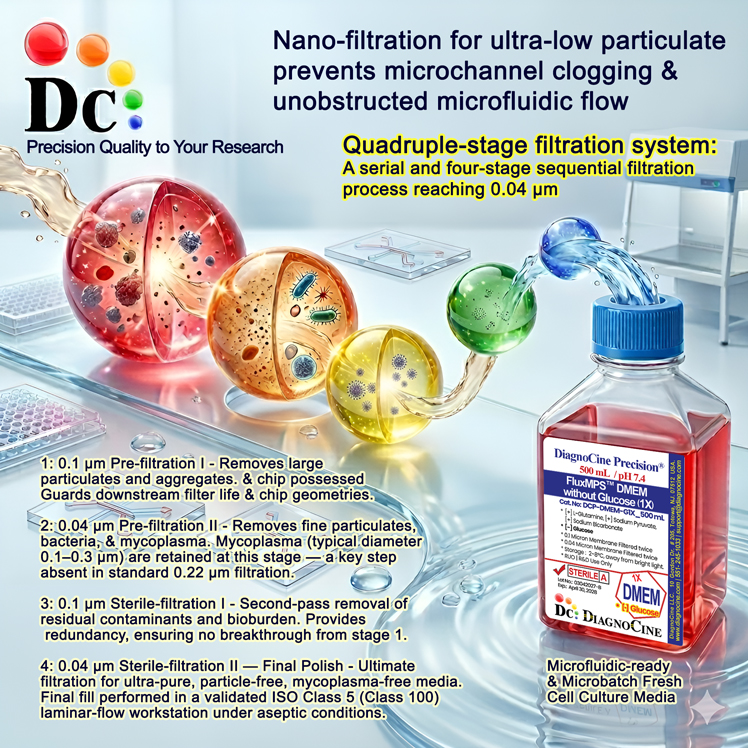
DCP-DMEML-P1X is processed through four serial filtration stages reaching a final 0.04 µm polish under aseptic fill conditions. The train runs as two dedicated prefilter + final-filter pairs, each 0.04 µm final filter protected by its own 0.1 µm prefilter, giving full redundancy across the process.
-
1
0.1 µm Prefiltration I
Removes large aggregates, cell debris, and contaminants. Extends the service life of the downstream 0.04 µm membrane and protects chip geometries from early fouling.
-
2
0.04 µm Final filtration I
Retains fine particulates and sub-micron contaminants, including material in the mycoplasma size range (0.2–0.3 µm) — a step absent from standard 0.22 µm filtration.
-
3
0.1 µm Prefiltration II
A second, dedicated prefilter protecting the second 0.04 µm cartridge and providing process redundancy ahead of the final polish.
-
4
0.04 µm Final filtration II — Polish
Ultimate polishing filter ahead of aseptic fill & finish in a validated ISO Class 5 (Class 100) laminar-flow workstation.
Performance vs. conventional media
DCP-DMEML-P1X is processed through a quadruple-stage filtration train reaching a 0.04 µm final cut-off, addressing microchannel fouling and sub-mycoplasma particulate carryover found in standard 0.22 µm–filtered DMEM.
conventional 0.22 µm–filtered media
(pore-size ratio)
(0.1 µm ×2 + 0.04 µm ×2)
© Diagnocine® — DCP-DMEML-P1X
Designed for next-generation cell models
FluxMPS™ DCP-DMEML-P1X supports demanding cell culture platforms — from single-channel microfluidic chips to multi-organ body-on-a-chip systems — where media purity, metabolic precision, and optical clarity matter.
Automated Bioreactors & Robotics
An optional 0.01 µm (10 nm) ultra nano-filtered MPS Grade variant is available on request for automated bioreactor perfusion systems, robotic liquid handlers, and long-duration closed-loop platforms where even trace particulates cause valve failure or sensor drift.
- Total Particulate Exclusion: 10 nm filtration removes nanoparticulate aggregates not resolved by standard QC methods
- Valve & Sensor Protection: Reduces micro-fouling of solenoid valves, peristaltic pump tubing, and inline optical sensors
- Extended Perfusion Stability: Consistent nutrient delivery over weeks-long culture without filter replacement in the chip circuit
Inquiry Required: The 0.01 µm MPS Grade variant is a custom product. Contact support@diagnocine.com to request it for your automated system.
Micro Physiological System (MPS) & Chip
Microfluidics Suitable, 0.04 µm–filtered media supports laminar flow fidelity in complex multi-organ chip architectures and reduces microchannel clogging risk.
Warburg Effect & Metabolic Research
Low glucose (1.0 g/L) base without sodium pyruvate enables precise control of aerobic glycolysis substrate supply, supporting Warburg phenotype studies.
iPSC-Derived Models
Ultra-low endotoxin (< 0.05 EU/mL, batch-released) and mycoplasma-retentive filtration make this medium suitable for sensitive iPSC-differentiation protocols.
Endothelial & Primary Cells
Particle-controlled, endotoxin-tested DMEM supports HUVEC and primary hepatocyte monolayer integrity, relevant for barrier-function assays and TEER monitoring.
Metabolic Flux Analysis
Defined low-glucose, pyruvate-free formulation provides a controlled metabolic background for ¹³C isotope tracing and extracellular flux measurement. Not compatible with Agilent Seahorse XF assays, which require bicarbonate-free, phenol red–free medium.
Microscopy & Optical Sensing
Ultra-low particulate count supports a clean particulate baseline for confocal and biosensor workflows; a phenol red–free variant (SKU: DCP-DMEML-PR1X) is available for minimal-autofluorescence imaging applications.
Analytical release specifications
Every lot is released against the full specification matrix below. CoA available on request: support@diagnocine.com.
| Parameter | Specification |
|---|---|
| Formulation | [+] Low Glucose, [+] L-Glutamine, [+] Sodium Bicarbonate, [+] Phenol Red, [+] Calcium, [+] Magnesium | [-] Sodium Pyruvate |
| Appearance | Red-colored, clear solution |
| pH USP <791> | 7.4 |
| Osmolality USP <785> | 310–350 mOsm/kg H₂O |
| Glucose | 1000 mg/L (1.0 g/L, Low Glucose) |
| L-Glutamine | 584 mg/L |
| Sodium Pyruvate | Not included |
| Phenol Red | 15.900 mg/L |
| Parameter | Specification |
|---|---|
| Endotoxin USP <85> BET | < 0.05 EU/mL (per batch) |
| Sterility USP <71> | No growth / 14 days |
| Mycoplasma | 0.04 µm mycoplasma-retentive filtration (not tested per lot) |
| Particulate ≥10 µm USP <788> Method 1 | NMT 25/mL |
| Particulate ≥25 µm USP <788> Method 1 | NMT 3/mL |
| Water purity | Ultrapure Type 1, 18.2 MΩ·cm |
| Manufacturing std. | ISO 13485:2016 |
| Fill environment | ISO Class 5 (Class 100) |
| Parameter | Specification |
|---|---|
| Storage temperature | 2–8°C, protected from light |
| Freeze-thaw | Do not freeze |
| Shelf life | 12 months from date of manufacture, unopened |
| Shipping condition | Cold pack |
| CO₂ requirement | Approximately 10% CO₂ (derived from 3700 mg/L sodium bicarbonate buffering, target pH 7.4) |
| Pack sizes | 500 mL, 1000 mL |
| Parameter | Specification |
|---|---|
| Raw material grade | Reagent / cell culture grade |
| Traceability | Full lot traceability per ISO 13485 |
| Manufacturing QMS ISO | ISO 13485:2016 certified |
| UNSPSC | 41116155 — Molecular biology and cell culture growth media (UNv260801) |
| Regulatory alignment | 21 CFR Part 820 (QMSR) aligned |
| Production method | Micro-batch, per-lot QC release |
| Intended use | Research Use Only (RUO) |
Full composition (mg/L)
FluxMPS™ DMEM is a modification of Basal Medium Eagle (BME) containing 4× BME concentrations of amino acids and vitamins, plus glycine, serine, and ferric nitrate. Total ingredients: 32. Every ingredient listed below is present in the released product; CAS numbers provided for traceability.
| Component | CAS Number | mg/L |
|---|---|---|
| INORGANIC SALTS | ||
| Calcium chloride dihydrate | 10035-04-8 | 265.000 |
| Ferric nitrate nonahydrate | 7782-61-8 | 0.100 |
| Magnesium sulfate anhydrous | 7487-88-9 | 97.720 |
| Potassium chloride | 7447-40-7 | 400.000 |
| Sodium bicarbonate | 144-55-8 | 3700.000 |
| Sodium chloride | 7647-14-5 | 6400.000 |
| Sodium dihydrogen phosphate anhydrous | 7558-80-7 | 109.000 |
| Component | CAS Number | mg/L |
|---|---|---|
| AMINO ACIDS | ||
| Glycine | 56-40-6 | 30.000 |
| L-Arginine hydrochloride | 1119-34-2 | 84.000 |
| L-Cystine dihydrochloride | 30925-07-6 | 62.570 |
| L-Glutamine | 56-85-9 | 584.000 |
| L-Histidine hydrochloride monohydrate | 5934-29-2 | 42.000 |
| L-Isoleucine | 73-32-5 | 105.000 |
| L-Leucine | 61-90-5 | 105.000 |
| L-Lysine hydrochloride | 657-27-2 | 146.000 |
| L-Methionine | 63-68-3 | 30.000 |
| L-Phenylalanine | 63-91-2 | 66.000 |
| L-Serine | 56-45-1 | 42.000 |
| L-Threonine | 72-19-5 | 95.000 |
| L-Tryptophan | 73-22-3 | 16.000 |
| L-Tyrosine Disodium Salt dihydrate | 69847-15-0 | 103.790 |
| L-Valine | 72-18-4 | 94.000 |
| Component | CAS Number | mg/L |
|---|---|---|
| VITAMINS | ||
| Choline chloride | 67-48-1 | 4.000 |
| D-Ca-Pantothenate | 137-08-6 | 4.000 |
| Folic acid | 59-30-3 | 4.000 |
| Nicotinamide | 98-92-0 | 4.000 |
| Pyridoxal hydrochloride | 65-22-5 | 4.000 |
| Riboflavin | 83-88-5 | 0.400 |
| Thiamine hydrochloride | 67-03-8 | 4.000 |
| OTHERS | ||
| i-Inositol | 87-89-8 | 7.200 |
| D-Glucose | 50-99-7 | 1000.000 |
| Phenol red sodium salt | 34487-61-1 | 15.900 |
Manufacturing & compliance
Every FluxMPS™ product is manufactured and released under a multi-layer quality system spanning raw materials, in-process controls, and final-product testing.
ISO 13485:2016 Quality Management
Manufactured under ISO 13485:2016–certified facilities. Final packaging, QA, and testing are conducted at the Diagnocine R&D and Quality Testing Center, Totowa, NJ, USA.
Ultrapure Type 1 Water
All formulations use Ultrapure Type 1 water (18.2 MΩ·cm) prepared under trace-metal and organic-carbon (TOC) controlled conditions.
ISO Class 5 Fill & Finish
Final aseptic fill performed in validated ISO Class 5 (Class 100) laminar-flow workstations, supporting container-closure integrity at the point of fill.
Micro-Batch Precision
Small-batch production with full per-lot traceability. Each batch is individually tested and released — no blending of lots, no averaging of QC results. A Certificate of Analysis is issued for every lot.
- Endotoxin — LAL assay, USP <85> Bacterial Endotoxins Test; assay sensitivity 0.005 EU/mL; release specification < 0.05 EU/mL
- pH, osmolality, conductivity, appearance and clarity
- Sterility
Endotoxin — USP <85> BET
Limulus Amebocyte Lysate (LAL) assay. Release specification: < 0.05 EU/mL. Tested on every production batch.
Particulate — USP <788> Method 1
Light obscuration particle count. Release limits: NMT 25/mL (≥10 µm) and NMT 3/mL (≥25 µm).
Osmolality — USP <785>
Freezing-point osmometry. Target range: 310–350 mOsm/kg H₂O.
Documentation & CoA
Full Certificate of Analysis with raw-material traceability, in-process records, and final-release test results available for every lot upon request.
How DCP-DMEML-P1X compares
FluxMPS™ DCP-DMEML-P1X vs. conventional 0.22 µm–filtered DMEM formulations.
| Parameter | DCP-DMEML-P1X (FluxMPS™) | Conventional DMEM (0.22 µm filtered) |
Standard Alt. DMEM (0.22 µm filtered) |
|---|---|---|---|
| Grade | Microfluidics Suitable (0.04 µm) | Conventional (0.22 µm) | Conventional (0.22 µm) |
| No Sodium Pyruvate formulation — for cells sensitive to pyruvate or metabolic-flux studies requiring defined carbon sources | check_circle Yes | cancel No | cancel No |
| Final filtration pore size | 0.04 µm | 0.22 µm | 0.22 µm |
| Number of filtration stages | 4 (Quadruple) | 1 | 1 |
| Mycoplasma-retentive filtration | check_circle Yes (0.04 µm) | cancel No | cancel No |
| Endotoxin (release specification) | < 0.05 EU/mL | Corning classical liquid media — < 0.25 EU/mL Sigma-Aldrich DMEM complete medium — ≤ 2 EU/mL Gibco classical DMEM — Not specified (recorded per lot) |
|
| USP particulate compliance | check_circle USP <788> Method 1 | cancel Not specified | cancel Not specified |
| Water quality | Type 1, 18.2 MΩ·cm | Purified water | Purified water |
| Manufacturing QMS | ISO 13485:2016 | ISO 9001 or none | ISO 9001 or none |
| Microfluidic channel compatibility | check_circle Microfluidics Suitable | cancel Risk of clogging | cancel Risk of clogging |
| Custom formulation | check_circle Available | cancel Fixed formulation | cancel Fixed formulation |
Comparison figures from published supplier specifications, accessed 2026-09-02. Suppliers that publish no numeric endotoxin specification are shown as "Not specified".
Frequently asked questions
Common questions about FluxMPS™ DCP-DMEML-P1X, a Microfluidics Suitable DMEM formulation.
Supporting literature
Key peer-reviewed publications supporting the use of ultra-filtered, Microfluidics Suitable media in organ-on-a-chip, microfluidic, and metabolic research applications.
- Huh D, et al. Reconstituting organ-level lung functions on a chip. Science. 2010;328:1662–1668. doi:10.1126/science.1188302
- Bhatia SN, Ingber DE. Microfluidic organs-on-chips. Nat Biotechnol. 2014;32:760–772. doi:10.1038/nbt.2989
- Warburg O. On the origin of cancer cells. Science. 1956;123:309–314. doi:10.1126/science.123.3191.309
- Novak R, et al. Robotic fluidic coupling and interrogation of multiple vascularized organ chips. Nat Biomed Eng. 2020;4:407–420. doi:10.1038/s41551-019-0497-x
- Katt ME, et al. In vitro tumor models: advantages, disadvantages, variables, and selecting the right platform. Front Bioeng Biotechnol. 2016;4:12. doi:10.3389/fbioe.2016.00012
- Campisi M, et al. 3D self-organized microvascular model of the human blood-brain barrier with endothelial cells, pericytes and astrocytes. Biomaterials. 2018;180:117–129. doi:10.1016/j.biomaterials.2018.07.014
- Jang KJ, et al. Human kidney proximal tubule-on-a-chip for drug transport and nephrotoxicity assessment. Integr Biol. 2013;5:1119–1129. doi:10.1039/c3ib40049b
- Schimek K, et al. Integrating biological vasculature into a multi-organ-chip microsystem. Lab Chip. 2013;13:3588–3598. doi:10.1039/c3lc50217a
- Luni C, et al. High-efficiency cellular reprogramming with microfluidics. Nat Methods. 2016;13:446–452. doi:10.1038/nmeth.3832
- Sung JH, et al. Microfabricated mammalian organ systems and their integration into models of whole animals and humans. Lab Chip. 2013;13:1201–1212. doi:10.1039/c3lc41017j