


Buffered Ethanol Fixative 70%
FluxMPS™ Buffered Ethanol Fixative 70%
A next-generation, non-crosslinking alcohol-based fixative buffered with 0.5M PBS and glycerol for exceptional histomorphologic preservation and unparalleled biomolecular integrity. Quadruple-stage filtered — 0.1 µm membrane twice and 0.04 µm membrane twice — for ultra-clean, mycoplasma-safe reagent quality across histology, molecular pathology, and biobanking workflows.
- Quadruple-stage filtration: 0.1 µm membrane twice and 0.04 µm membrane twice for ultrapure, mycoplasma-safe reagent quality
- Non-crosslinking 70% ethanol formulation buffered with 0.5M PBS and glycerol for minimal tissue shrinkage
- Ready-to-use at pH 6.1 with no precipitation risk
- Preserves high-quality DNA, RNA, and protein for downstream NGS, qPCR, FISH, and mass spectrometry
- Formalin-free — eliminates IARC Class 1 carcinogen exposure risk
- Validated for immunohistochemistry, special stains, flow cytometry, and automated tissue processors
- Manufactured under ISO 13485-certified, CE-approved facilities in Totowa, New Jersey, USA
- Custom concentrations, pH, and additive formulations available on request
- pH6.1
- Ethanol Concentration70%
- Buffer System0.5M PBS
- Glycerol1%
- Glacial Acetic Acid0.5%
- Filtration0.1 µm x2 + 0.04 µm x2
- SterilityFilter-sterilized
- Storage4°C, protect from light
- Shelf Life24 months
- Size500 mL
Engineered where standard fixatives fail
Conventional formalin fixatives crosslink nucleic acids and proteins, degrading downstream molecular results, while unfiltered ethanol-based alternatives can carry particulate and bioburden into sensitive histology and molecular pathology workflows. Buffered Ethanol Fixative 70% is built to solve both problems at once.
Ultra-Clean Filtration
Quadruple-stage filtration — 0.1 µm membrane twice and 0.04 µm membrane twice — supports mycoplasma-safe, ultra-clean reagent quality for every lot.
Precise, Stable pH
Pre-buffered with 0.5M PBS to a ready-to-use pH of 6.1, delivering consistent, reproducible fixation chemistry without precipitation risk.
Ultrapure-Grade Water
Formulated with Ultrapure Type 1 water (18.2 MΩ·cm) under ISO 13485-certified manufacturing controls.
Biomolecular Integrity
Non-crosslinking action delivers 4x higher RNA integrity compared to formalin-fixed samples (PERM >120 vs. 32 for NBF), preserving DNA, RNA, and protein for PCR, sequencing, and mass spectrometry.
Defined, Traceable Composition
A traceable formulation of ethanol, glycerol, glacial acetic acid, and 0.5M PBS buffer, manufactured under ISO 13485 quality systems.
Customization on Demand
Alternate concentrations, pH, and additions of chemicals, compounds, proteins, or supplements are available on request.
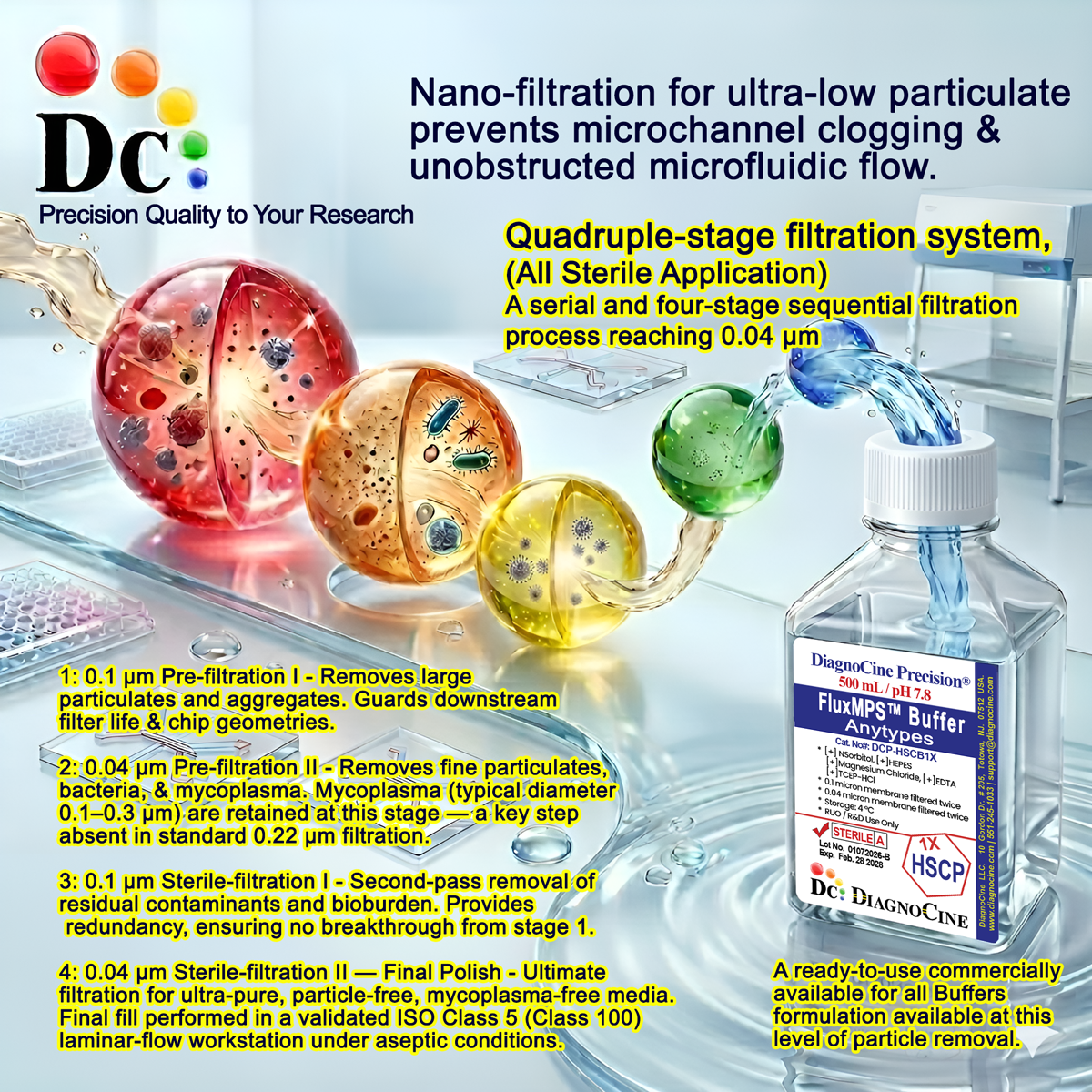
Quadruple-stage filtration system
Every lot of Buffered Ethanol Fixative 70% passes through four sequential membrane filtration stages — 0.1 µm membrane twice and 0.04 µm membrane twice — before aseptic fill, supporting an ultra-clean, mycoplasma-safe reagent for histology, molecular pathology, and biobanking applications.
-
1
0.1 µm Pre-filtration I
Removes large particulates and aggregates, extending the service life of downstream filters.
-
2
0.04 µm Pre-filtration II
Retains fine particulates and bioburden below the smallest known mycoplasma size, generally cited at approximately 0.2 micron.
-
3
0.1 µm Sterile-filtration I
A second independent 0.1 µm pass adds redundancy ahead of final polishing.
-
4
0.04 µm Sterile-filtration II — Final Polish
A final 0.04 µm pass ahead of ISO Class 5 aseptic fill delivers the finished ultra-clean fixative.
Performance vs. conventional buffer
Sequential 0.1 µm and 0.04 µm filtration, applied twice each, removes fine particulates and bioburden beyond what a single conventional membrane pass can achieve, supporting mycoplasma-safe, ultra-clean reagent quality for sensitive histology and molecular workflows.
© Diagnocine® — DCP-BE70X
Where Buffered Ethanol Fixative 70% is used
Designed as a formalin-free bridge between traditional histologic fixation and precision molecular workflows, Buffered Ethanol Fixative 70% is validated across the following application areas.
Automated Bioreactors & Robotics
For laboratories operating automated tissue processors and robotic staining or liquid-handling platforms, an ultra-filtered 0.01 µm (10 nm) grade of this fixative is available on request to further reduce particulate load in automated fluidic pathways.
- Total Particulate Exclusion: finer-graded filtration for automated tissue processors
- Valve & Sensor Protection: reduced particulate load protects fluidic hardware on automated platforms
- Extended Perfusion Stability: supports uninterrupted operation of automated staining and processing lines
Inquiry Required: the 0.01 µm ultra-filtered grade is produced to order — contact support@diagnocine.com to request this configuration.
Routine Histology & Cytology Processing
Formulated for routine histologic and cytologic sample processing with crisp nuclear and cytoplasmic detail.
Biobanking for Genomic & Proteomic Research
Non-crosslinking chemistry preserves nucleic acids and proteins suitable for long-term biorepository storage.
Molecular Pathology Workflows
Supports high-fidelity nucleic acid recovery for next-generation sequencing, qPCR, and fluorescence in situ hybridization.
Immunohistochemistry & Multiplex Staining
Validated for immunohistochemistry (IHC), special stains, and multiplex staining protocols.
Forensic Sample Preservation
Provides reliable fixation for forensic pathology specimens requiring preserved histologic and molecular detail.
Longitudinal Research & Archived Tissue Analysis
Supports long-term studies requiring stable, archivable tissue specimens for retrospective analysis.
Full specification sheet
Every parameter below reflects DCP-BE70X's stated formulation, filtration, and release testing.
| Parameter | Specification |
|---|---|
| Formulation / Composition | 70% ethanol buffered with 0.5M PBS, glycerol, and glacial acetic acid |
| Appearance | Clear solution |
| pH USP <791> | 6.1 |
| Ethanol Concentration | 70% |
| Buffering Component | 0.5M PBS |
| Parameter | Specification |
|---|---|
| Sterility / Filtration | Filtered 0.1 micron membrane twice and 0.04 micron membrane twice |
| DNase Activity | None detected (18 hours, room temperature, plasmid DNA) |
| RNase Activity | None detected (18 hours, room temperature, ribosomal RNA) |
| Water Quality | Ultrapure Type 1 water (18.2 MΩ·cm) |
| Manufacturing Standard ISO 13485 | ISO 13485:2016 certified, CE approved |
| Fill Environment | ISO Class 5 (Class 100) |
| Parameter | Specification |
|---|---|
| Storage Temperature | 4°C, protected from light |
| Shelf Life | 24 months |
| Post-Fixation Wash | 3 x 5 minutes in fixation buffer |
| Fixed Specimen Hold | Up to one week at 4°C before further processing |
| Parameter | Specification |
|---|---|
| Component Sourcing | Ethanol, glycerol, glacial acetic acid, 0.5M PBS buffer system |
| Manufacturing QMS | ISO 13485:2016 certified facility |
| Regulatory Alignment | CE approved |
| Production & Customization Site | DiagnoCine Precision, Totowa, New Jersey, USA |
| Intended Use | Research Use Only (RUO); histology, molecular pathology, biobanking, forensic preservation |
Full composition
Buffered Ethanol Fixative 70% is a defined, lot-traceable formulation released against the composition below.
| Component | CAS Number | Concentration |
|---|---|---|
| Ethanol | 64-17-5 | 70% |
| Glycerol | 56-81-5 | 1% |
| Glacial acetic acid | 64-19-7 | 0.5% |
| 0.5M PBS | 28.5% |
Manufacturing & compliance
Buffered Ethanol Fixative 70% is manufactured, packaged, and released under a controlled quality system.
ISO 13485:2016 QMS
Manufactured under ISO 13485-certified and CE-approved facilities.
Ultrapure Type 1 Water
Formulated with Ultrapure Type 1 water (18.2 MΩ·cm).
ISO Class 5 Fill & Finish
Filled and finished in an ISO Class 5 (Class 100) environment.
Micro-Batch Precision
Final packaging, quality assurance, and customization performed at the DiagnoCine R&D and Quality Testing Center, Totowa, New Jersey, USA.
Sterility & Filtration
Filtered 0.1 micron membrane twice and 0.04 micron membrane twice.
DNase / RNase Testing
None detected after 18 hours incubation at room temperature.
pH Verification USP <791>
Released at pH 6.1.
Documentation / CoA
A Certificate of Analysis is available for every lot.
How DCP-BE70X compares
A side-by-side look at DCP-BE70X against conventional fixation alternatives.
| Parameter | DCP-BE70X (FluxMPS™) | Conventional Formalin-Based Fixative | Standard 0.22 µm-Filtered Ethanol Fixative |
|---|---|---|---|
| Fixation chemistry | Non-crosslinking, ethanol-based | Crosslinking, formaldehyde-based | Non-crosslinking, ethanol-based |
| Final filtration pore size | 0.04 µm | Not typically filtered | 0.22 µm |
| Number of filtration stages | 4 | N/A | 1 |
| Formalin-free | check_circle | cancel | check_circle |
| RNA integrity for molecular workflows | PERM >120 | PERM ~32 (NBF) | Not specified |
| Ready-to-use, precipitation-free | check_circle | cancel | check_circle |
| Manufacturing QMS | ISO 13485:2016, CE approved | Varies by supplier | Varies by supplier |
| Custom formulation available | check_circle | cancel | cancel |
Frequently asked questions
Answers to common questions about DCP-BE70X.
Supporting literature
Curated literature relevant to ethanol-based, non-crosslinking fixation and its downstream molecular applications.
- Vincek V, et al. A tissue fixative that protects macromolecules (DNA, RNA, and protein) and histomorphology in clinical samples. Lab Invest. 2003. doi:10.1097/01.LAB.0000098428.03725.5D
- Ahmed-Nasser T, et al. Alcohol-based fixatives for molecular pathology: a comparison of RNA and DNA yield. J Histochem Cytochem. 2011. doi:10.1369/jhc.2010.957308
- Gillespie JW, et al. Evaluation of non-formalin tissue fixation for molecular profiling studies. Am J Pathol. 2002. doi:10.1016/S0002-9440(10)64361-9
- Ergin B, et al. Effects of fixative type on nucleic acid preservation in archival tissue. Diagn Mol Pathol. 2010. doi:10.1097/PDM.0b013e3181c53e58
- Cox ML, et al. Tissue subsampling and non-formalin fixation for histology and molecular analysis. Toxicol Pathol. 2006. doi:10.1080/01926230600867727
- Bass BP, et al. A review of preanalytical variables for gene expression studies in FFPE tissue. Arch Pathol Lab Med. 2014. doi:10.5858/arpa.2013-0691-RA
- Srinivasan M, et al. Effect of fixatives and tissue processing on the content and integrity of nucleic acids. Am J Pathol. 2002. doi:10.1016/S0002-9440(10)64472-8
- Delfour C, et al. Clinical performance of alcohol-based fixative for molecular diagnostics on biopsy specimens. J Mol Diagn. 2013. doi:10.1016/j.jmoldx.2012.09.004
- Howat WJ, Wilson BA. Tissue fixation and the effect of molecular fixatives on downstream staining procedures. Methods. 2014. doi:10.1016/j.ymeth.2014.01.019