


Bis-Tris Transfer Buffer
FluxMPS™ Bis-Tris Transfer Buffer
FluxMPS™ Bis-Tris Transfer Buffer is a ready-to-use, 1X liquid buffer engineered for Western blot protein transfer from Bis-Tris polyacrylamide gels to nitrocellulose or PVDF membranes. Every lot is sterile-filtered through a quadruple-stage 0.1-micron and 0.04-micron membrane architecture and released at a measured pH of 7.2, giving microfluidic and bench-scale transfer workflows a clean, reproducible buffering platform. The EDTA-chelated, Bicine/Bis-Tris formulation avoids the toxicity of cacodylate and the UV interference of maleic acid, supporting sensitive downstream detection.
- Quadruple-stage filtration: 0.1-micron membrane applied twice and 0.04-micron membrane applied twice
- Ready-to-use 1X Bis-Tris Transfer Buffer for Western blot transfer to nitrocellulose or PVDF membranes
- Formulated with Bicine, Bis-Tris, and EDTA to chelate divalent metal ions and prevent transfer interference
- Measured pH of 7.2 for stable, reproducible protein transfer
- No DNase or RNase activity detected in quality control testing
- Manufactured in ISO 13485-certified, CE-approved facilities
- Customizable concentrations, pH, and additive content available on request
- pH7.2
- AppearanceClear, Colorless Liquid
- CompositionBicine 25 mM, Bis-Tris 25 mM, EDTA 1 mM
- Filtration0.1 µm x2 + 0.04 µm x2
- SterilityFiltered in a sterile environment
- DNase ActivityNone detected
- RNase ActivityNone detected
- Storage4 °C
- Shelf Life1 year
- FormatReady-to-use 1X liquid buffer
Engineered where standard transfer buffers fail
Conventional 0.22 µm-filtered transfer buffer can carry subvisible particulates into narrow transfer sandwiches and microfluidic channels, and unbuffered or unchelated formulations can drift in pH or bind divalent metals that interfere with transfer. FluxMPS™ Bis-Tris Transfer Buffer is built to avoid both.
Microchannel-safe purity
Sequential 0.1-micron and 0.04-micron membrane filtration, applied twice each, removes particulates finer than a single-pass 0.22-micron filter can catch, keeping narrow transfer and microfluidic channels clear.
Precise, stable pH
A Bicine/Bis-Tris zwitterionic formulation is released at a measured pH of 7.2, with Bis-Tris buffering capacity described across the physiological range of approximately 6.8-8.2.[1]
Ultrapure-grade water
Formulated with Ultrapure Type 1 water (18.2 MΩ·cm) as the aqueous base for every lot.
Low background for imaging & assays
EDTA chelates divalent metal ions that would otherwise interfere with transfer, and Bis-Tris's lower UV absorption versus maleic acid keeps spectrophotometric measurements clean.
Defined, traceable composition
Every lot is formulated to a fixed Bicine (25 mM), Bis-Tris (25 mM), and EDTA (1 mM) composition, with no undisclosed additives.
Customization on demand
Alternate concentrations, pH, and additional chemicals, compounds, proteins, or supplements are available on request to support@diagnocine.com.
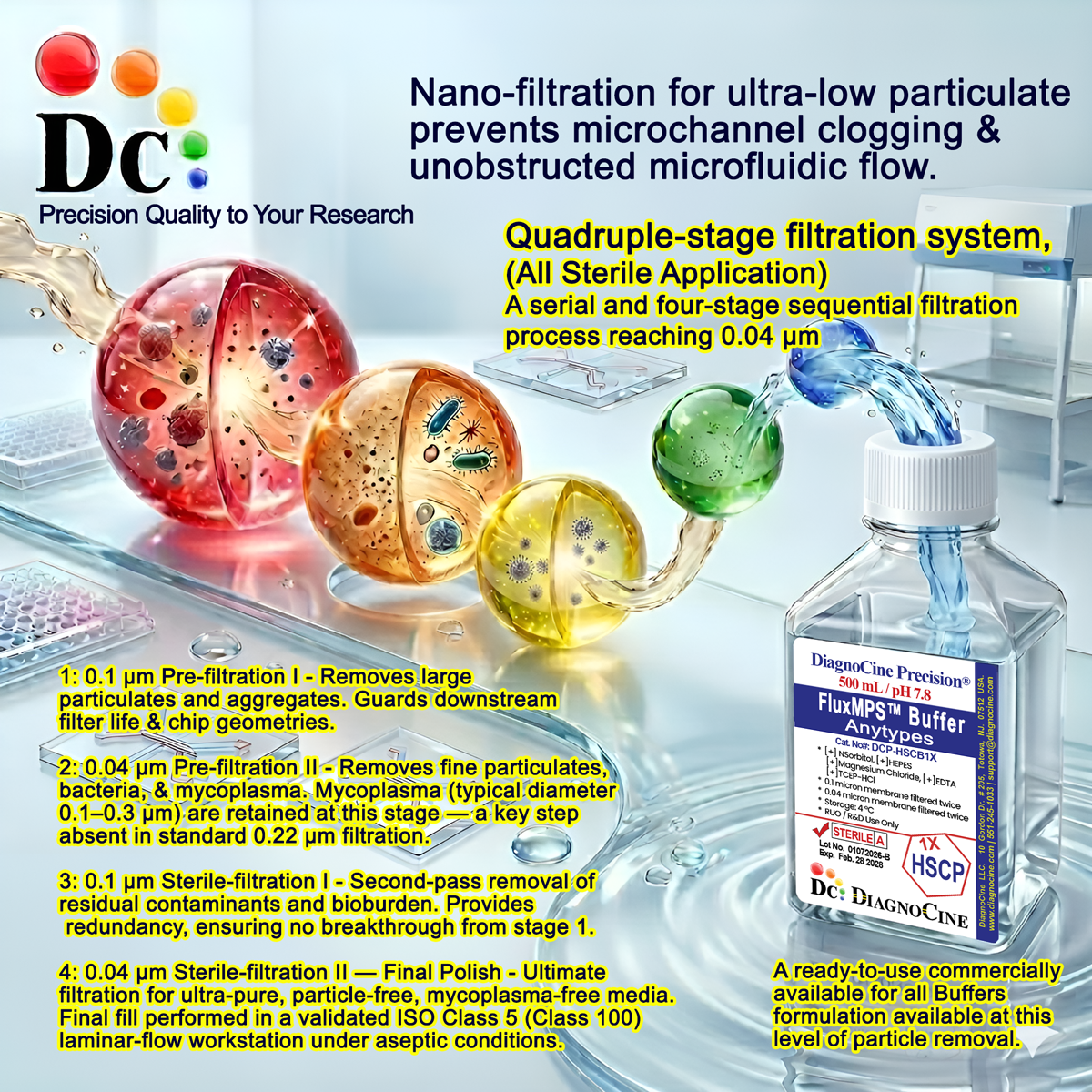
Quadruple-stage filtration system
Each lot of Bis-Tris Transfer Buffer is filtered through 0.1-micron membrane twice and 0.04-micron membrane twice in a sterile environment before release.
-
1
0.1 µm Pre-filtration I
First-pass 0.1-micron membrane filtration removes large particulates and aggregates, protecting the downstream membranes.
-
2
0.04 µm Pre-filtration II
First-pass 0.04-micron membrane filtration retains finer particulates and bioburden ahead of final sterile filtration.
-
3
0.1 µm Sterile-filtration I
A second 0.1-micron membrane pass provides redundant particulate and bioburden reduction in a sterile filling environment.
-
4
0.04 µm Sterile-filtration II — Final Polish
A second 0.04-micron membrane pass gives a final polish in a sterile environment, restricting organisms as small as mycoplasma, whose smallest types are about 0.2 microns.
Performance vs. conventional buffer
Sequential 0.1-micron and 0.04-micron filtration, each applied twice, removes finer particulates than a single 0.22-micron pass typical of conventional transfer buffer, supporting cleaner Western blot transfer and microfluidic protein-analysis workflows.
© Diagnocine® — DCP-BTTB1X
Where Bis-Tris Transfer Buffer performs
Beyond Western blot membrane transfer, this Bicine/Bis-Tris/EDTA buffer supports SDS-PAGE, Native PAGE, and anion exchange chromatography protocols that need a stable, chelated pH environment, including within microfluidic and organ-on-a-chip protein-analysis platforms.[2,3]
Automated Bioreactors & Robotics
An optional 0.01-micron (10 nm) ultra-filtered variant is available on request for automated bioreactor and robotic liquid-handling platforms where valve and sensor protection is critical.
- Total Particulate Exclusion for closed-loop fluid paths
- Valve & Sensor Protection in automated dispensing systems
- Extended Perfusion Stability for long-duration runs
Inquiry Required: Contact support@diagnocine.com to request the 0.01-micron ultra-filtered grade.
Micro Physiological System (MPS) & Chip
Supports on-chip protein transfer and blotting workflows in microfluidic and organ-on-a-chip protein-analysis platforms.
Wash, Dilution & Reconstitution
Ready-to-use 1X format supports dilution and reconstitution steps ahead of protein transfer protocols.
iPSC-Derived Model Handling
Compatible with protein transfer analysis of iPSC-derived neuronal, cardiomyocyte, and hepatocyte lysates.
Endothelial & Primary Cell Perfusion
Suited to Western blot analysis of endothelial and primary cell perfusate proteins.
ELISA, Blotting & Blocking
Formulated for Western blotting protein transfer from Bis-Tris polyacrylamide gels to nitrocellulose or PVDF membranes ahead of antibody-based detection.[4]
Microscopy & Optical Sensing
Low UV-absorbing Bis-Tris chemistry supports clean downstream optical and spectrophotometric measurements.
Measured and manufacturing specifications
Specifications reflect this product's stated formulation and release testing.
| Parameter | Specification |
|---|---|
| Formulation / Composition | Bicine 25 mM, Bis-Tris 25 mM, EDTA 1 mM |
| Appearance | Clear, Colorless Liquid |
| pH | 7.2 |
| Format | Ready-to-use 1X liquid buffer |
| Parameter | Specification |
|---|---|
| Filtration | 0.1 µm membrane twice and 0.04 µm membrane twice |
| Sterility | Filtered in a sterile environment |
| DNase Activity | None detected (18 hr, plasmid DNA, room temperature) |
| RNase Activity | None detected (18 hr, ribosomal RNA, room temperature) |
| Manufacturing Standard ISO 13485 | ISO 13485-certified, CE-approved facilities |
| Parameter | Specification |
|---|---|
| Storage Temperature | 4 °C |
| Shelf Life | 1 year |
| Parameter | Specification |
|---|---|
| Manufacturing QMS | ISO 13485-certified facilities (DiagnoCine Precision suppliers) |
| Regulatory Alignment | CE-approved |
| Production Method | Final packaging, quality assurance, and testing at the DiagnoCine R&D and Quality Testing Center; customization and assembly at DiagnoCine Precision, Totowa, New Jersey, USA |
| Intended Use | Research Use Only (RUO) |
Full composition
Ready-to-use 1X Bicine/Bis-Tris buffer with EDTA chelation, released per lot.
| Component | CAS Number | Concentration |
|---|---|---|
| Bicine | 150-25-4 | 25 mM |
| Bis-Tris | 6976-37-0 | 25 mM |
| EDTA | 60-00-4 | 1 mM |
Manufacturing & compliance
Every lot of Bis-Tris Transfer Buffer is manufactured, filtered, and released under a controlled quality system.
ISO 13485:2016 QMS
Manufactured under ISO 13485-certified and CE-approved facilities (suppliers of DiagnoCine Precision).
Ultrapure Type 1 Water
Formulated with Ultrapure Type 1 water (18.2 MΩ·cm).
Sterile Filtration
Filtered through 0.1-micron (twice) and 0.04-micron (twice) membranes in a sterile environment.
Micro-Batch Precision
Final packaging, quality assurance, and testing performed at the DiagnoCine R&D and Quality Testing Center; customization and assembly at DiagnoCine Precision, Totowa, New Jersey, USA.
DNase Activity
None detected after 18 hr incubation with plasmid DNA at room temperature.
RNase Activity
No RNase activity detected after 18 hr incubation with ribosomal RNA at room temperature.
pH Verification
Measured pH of 7.2; Clear, Colorless Liquid appearance confirmed at release.
Documentation
Certificate of Analysis available on request.
How DCP-BTTB1X compares
A side-by-side look at filtration architecture and QC scope versus conventional transfer buffer.
| Parameter | DCP-BTTB1X (FluxMPS™) | Conventional Transfer Buffer (0.22 µm filtered) | Standard Alternative (0.22 µm filtered) |
|---|---|---|---|
| Buffering system | Bicine/Bis-Tris, EDTA-chelated | Tris-Glycine, unchelated | Varies by supplier |
| Final filtration pore size | 0.04 µm | 0.22 µm | 0.22 µm |
| Number of filtration stages | 4 | 1 | 1 |
| Measured pH | 7.2 | Not typically disclosed | Not typically disclosed |
| DNase/RNase tested | check_circle | cancel | cancel |
| Manufacturing QMS | ISO 13485-certified | Not typically disclosed | Not typically disclosed |
| Custom formulation available | check_circle | cancel | cancel |
Frequently asked questions
Answers to common questions about DCP-BTTB1X Bis-Tris Transfer Buffer.
Supporting literature
Curated literature relevant to Bis-Tris chemistry, Western blot transfer, and microfluidic protein analysis.
- Good, N.E., Winget, G.D., Winter, W., Connolly, T.N., Izawa, S., Singh, R.M.M. Hydrogen ion buffers for biological research. Biochemistry. 1966;5(2):467-477. doi:10.1021/bi00866a011
- Zhang, B., Radisic, M. Organ-on-a-chip devices advance to market. Lab Chip. 2017. doi:10.1039/C6LC01554A
- Huh, D., Matthews, B.D., Mammoto, A., Montoya-Zavala, M., Hsin, H.Y., Ingber, D.E. Reconstituting organ-level lung functions on a chip. Science. 2010;328(5986):1662-1668. doi:10.1126/science.1188302
- Mahmood, T., Yang, P.C. Western blot: technique, theory, and trouble shooting. N Am J Med Sci. 2012;4(9):429-434. doi:10.4103/1947-2714.100998
- Schagger, H. Tricine-SDS-PAGE. Nat Protoc. 2006;1(1):16-22. doi:10.1038/nprot.2006.4
- Kielkopf, C.L., Bauer, W., Urbatsch, I.L. Bis-Tris propane buffer for protein crystallization and biochemistry. Cold Spring Harb Protoc. 2020. doi:10.1101/pdb.top096198
- Wiltfang, J., Arold, N., Neuhoff, V. A new multiphasic buffer system for sodium dodecyl sulfate-polyacrylamide gel electrophoresis. Electrophoresis. 1991;12(5):352-366. doi:10.1002/elps.1150120507
- Bass, J.J., Wilkinson, D.J., Rankin, D., et al. An overview of technical considerations for Western blotting protocols. Scand J Med Sci Sports. 2017. doi:10.1111/sms.12742
- Zhang, B., Korolj, A., Lai, B.F.L., Radisic, M. Advances in organ-on-a-chip engineering. Nat Rev Mater. 2018;3:257-278. doi:10.1038/s41578-018-0034-7