


Anti-Varicella Zoster Virus(VZV) gH, Mouse-Mono(OAKK39)
Product#: FNK-65-363
$303.44
Availability:
Ships in 1-2 Weeks
Anti-Varicella Zoster Virus(VZV) gH, Mouse-Mono(OAKK39)
Cat.No: FNK-65-363Size: 100 μg
Storage: -20℃
Concentration: 1.0 mg/ml
Buffer: PBS- with 50% glycerol
Purity: Purified IgG fraction with protein A from hybridoma cell culture medium.
Immunogen: Varicella-zoster virus Oka strain (vaccine strain)
Isotype: Mouse IgG1k
Reactivity: gH of VZV
Application
1. Western blotting (1/1,000)2. Immunoprecipitation (Assay dependent)
3. Neutralization of infectivity of VZH
Not suitable for western blotting and ELISA
Background
Varicella Zoster Virus (VZV) is one of eight herpesviruses known to infect humans and vertebrates. VZV only affects humans, and commonly causes chickenpox in children, teens and young adults and herpes zoster (shingles) in adults and rarely in children. VZV is known by many names, including chickenpox virus, varicella virus, zoster virus, and human herpesvirus type 3 (HHV-3).VZV infects the nerves and causes a wide variety of symptoms. After the primary infection (chickenpox), the virus goes dormant in the nerves, including the cranial nerve ganglia, dorsal root ganglia, and autonomic ganglia. Many years after the patient has recovered from chickenpox, VZV can reactivate to cause a number of neurologic conditions.
The heterodimer glycoprotein H-glycoprotein L is required for the fusion of viral and plasma membranes leading to virus entry into the host cell. Following initial binding of gD to one of its receptors, membrane fusion is mediated by the fusion machinery composed at least of gB and the heterodimer gH/gL. May also be involved in the fusion between the virion envelope and the outer nuclear membrane during virion morphogenesis gH is consists of 841 amino acids with molecular mass of 94 kDa.
Data Link
UniProtKB P09260 (GH_VZVD)Please note: All products are FOR RESEARCH USE ONLY. NOT FOR USE IN DIAGNOSTIC PROCEDURES. NOT FOR MILITARY USE.
Data Images
65-363 Anti-Varicella Zoster Virus (VZV) gH antibody, mouse monoclonal (OAKK39)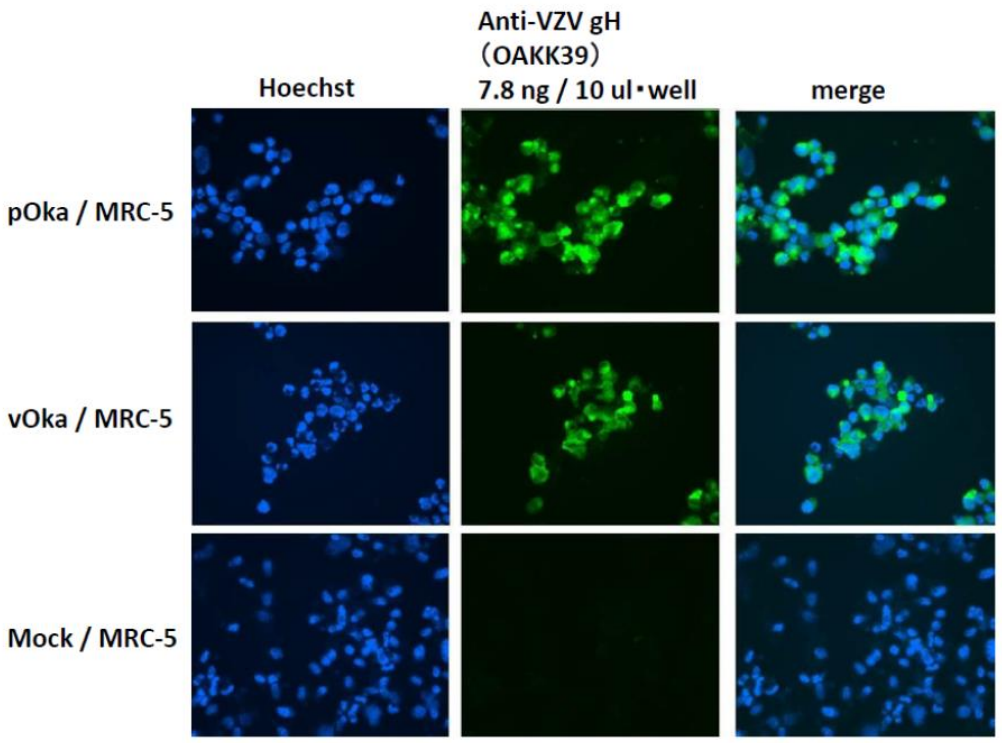
Fig.1 Immunofluorescence staining of VZV glycoprotein H in VZV-infected MRC-5 cells by using anti-VZV gH antibody (clone OAKK39)
MRC-5 was infected with VZV pOka strain, vaccine strain vOka or mock-infected. Anti-VZV gH antibody was used at about 1/1,000 dilution. As second antibody, Alexa Fluor 488 donkey anti-mouse IgG [H+L] (Life Technology No. A21202) was used at 1/200 dilution. Nuclei were stained with Hoechst 33342.
Related Products
| SKU# | Description | Link |
|---|---|---|
| FNK-65-350 | Anti-Varicella Zoster Virus(VZV) IE62, Mouse-Mono (62A) | GO! |
| FNK-65-353 | Anti-Varicella Zoster Virus(VZV) IE62, Mouse-Mono(62B) | GO! |
| FNK-65-358 | Anti-Varicella Zoster Virus(VZV) gE, Mouse-Mono(#9) | GO! |