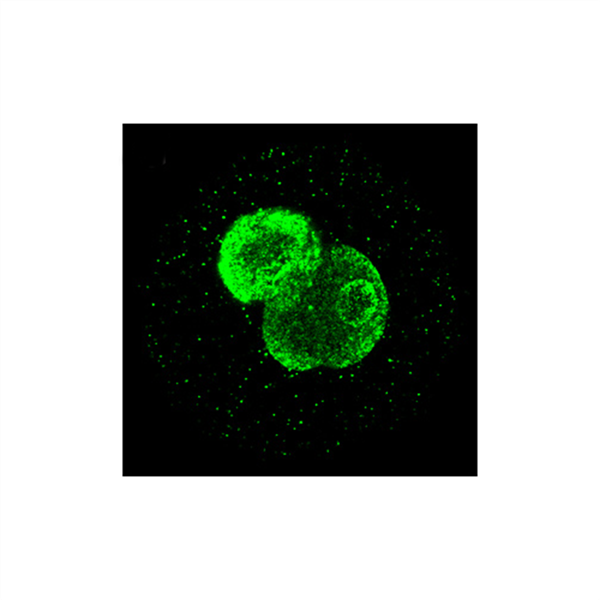

Anti-MdmX (Mdm4)/HdmX p-Ser367 antibody (mouse/human), monoclonal (#15)
Anti-MdmX (Mdm4)/HdmX p-Ser367 antibody (mouse/human), monoclonal (#15)
DiagnoCine offers excellent MdmX | phospho-MdmX (pSer367) Phosphorylated Antibodies for the researchers studying Cell Growth & Survival, Therapeutic Target in Cancers, Cell Cycle, DNA Repair, Lipid Remodelling, Endocrine Pancrease development, Ferrosptosis, and Therapeutic Target in Hepatocellular Carcinoma.
Human diseases include Lung Cancer, Breast cancer, Retinoblastoma, Leukemia, and Psychiatric disorder.
MdmX |MdmX (pSer367) Phosphorylated Antibodies has excellent quality and this highly pure antibody can be adapted for Western Blots, ELISA, Immunohistochemistry, and Immunoprecipitation with optimization.
General Information
| Cat. No. | :FNK-71-141 |
| Size | :50 ug |
| Antigen | :Human |
| Host Species | :Mouse |
| Cross Reactivity | :Human/ Mouse |
| Label | :Unlabeled |
| Clone | :15 |
| Product | :Mouse monoclonal antibody (clone #15) specific to the MdmX protein phosphorylated at Ser367 |
| Immunogen | :A synthetic peptide corresponding to a sequence of human Mdmx protein surrounding phospho-Ser367 |
| Reaction | :Human and mouse MdmX proteins phosphorylated at Ser367 |
| Form | :Purified monoclonal antibody(IgG)1 mg/ml in PBS (-), 50% glycerol |
| Isotype | :Mouse IgG2b (κ) |
| Application | :
|
| Data Link | :UniProtKB/Swiss-Prot O15151 (MDM4_HUMAN) |
Description
MdmX (synonyms: Mdm4, HdmX) inhibits p53-and p73-dependent cell cycle arrest and apoptosis by binding to the transcription activation domains of these proteins. MdmX consists of 490 amino acids with the molecular weight of 54,864 and contains a RIING-finger domain and a nuclear transport signal. It is known that the protein migrates aberrantly in SDS-PAGE at the position of an 80-kDa protein. MdmX is phosphorylated at Ser367 by Chk2 kinase downstream of ATM in response to DNA damage, and as a result, it binds to14-3-3 and is transported into nucleus where it is degraded by Mdm2. This process activates the p53 functions.
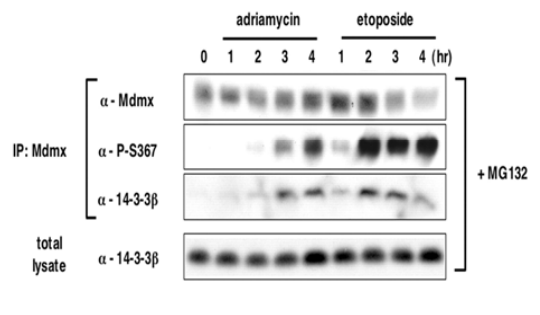
Figure. Induction of S367 phosphorylation after DNA damage is associated with increased binding of 14-3-3 to MdmX and accelerated MdmX degradation.
MCF cells were preincubated with the proteasome inhibitor MG132 (20 uM) and exposed to DNA damaging agent, adriamycin (3 uM) or etoposide (20 uM), for the indicated periods. The cell lysates were used for immunoprecipitation with anti-MdmX antibody (D-19, Santa-Cruz) and The MdmX immunoprecipitates and the total lysate were analyzed by Western blotting using the indicated antibodies including this product (anti P-S367).
Antigen Characterization
- Type: Primary
- Application: Western Blot (WB),Immunoprecipitation (IP),Immunocytochemistry (ICC),Immunohistochemistry (IHC),Flow Cytometry (FC),Chromatin Immunoprecipitation (ChIP)
- Species: Human
- Recombinant: Yes
- Long Term Storage: -20°C or below
- Shipping Condition: Dry ice
Human Diseases
- Cancer
- Overexpression of MdmX has been implicated in various cancers, including gastric cancer, prostate cancer, and breast cancer. It plays a role in tumor progression and metastasis by inhibiting the tumor suppressor p53.
- Genomic Instability
- MdmX promotes genomic instability independent of p53 and Mdm2, contributing to malignant transformations.
- p53 Pathway
- MdmX inhibits p53 activity by binding to its transactivation domain, leading to reduced transcriptional activation of p53 target genes involved in cell cycle arrest and apoptosis.
- 14-3-3 Protein Interaction
- MdmX interacts with 14-3-3 proteins, which are involved in various signaling pathways that regulate cell growth and survival.
- Epithelial-Mesenchymal Transition (EMT)
- Changes in MdmX expression correlate with EMT processes in cancer progression.
Aliases for MDM4 Gene
- MDM4 Regulator Of P53 2 3 5
- MDMX 2 3 4
- Mdm2-Like P53-Binding Protein 3 4
- MDM4, P53 Regulator 2 3
- Protein Mdm4 3 4
- Protein Mdmx 3 4
- HDMX 2 3
- Mdm4, Transformed 3T3 Cell Double Minute 4, P53 Binding Protein (Mouse) 2
- Mouse Double Minute 4, Human Homolog Of; P53-Binding Protein 2
- Double Minute 4, Human Homolog Of; P53-Binding Protein 3
- Mdm4 P53 Binding Protein Homolog (Mouse) 2
- Mdm4 P53 Binding Protein Homolog 3
- P53-Binding Protein Mdm4 4
- Double Minute 4 Protein 4
- MDM4 Protein Variant G 3
- MDM4 Protein Variant Y 3
- MDM4-Related Protein 1 3
- BMFS6 3
- MRP1 3
- MDM4 5
References
- Okamoto K et al “DNA damage-induced phosphorylation of MdmX at serine 367 activates p53 by targeting Mdm2-dependent degradation” Mol Cell Biol 25:9608-9620 (2005) PMID: 16227609
- Chen L et al “ATM and Chk2-dependent phosphorylation of MDMX contribute to p53 activation after DNA damage” EMBO J 24: 3411-3422 (2005) PMID: 16163388
- Pereg Y et al “Differential roles of ATM- and Chk2 mediated phosphorylations of HdmX in response to DNA damage” Mol Cell Biol 26: 6819-6831 (2006) PMID: 16943424