
Anti-ARFGAP1 Rabbit Polyclonal Antibody
Anti-ARFGAP1 Rabbit Polyclonal Antibody
General information
| Cat. No. | :SB-GB113718 |
| Size | :100 uL |
| Protein full name | :ADP-ribosylation factor GTPase-activating protein 1 |
| Synonym | :ARF GAP 1, ARF1 GAP, ARF1GAP, ARFGAP1, HRIHFB2281, ARF1-directed GTPase-activating protein |
| Immunogen | :KLH conjugated Synthetic peptide corresponding to Mouse ARFGAP1 |
| Isotype | :IgG |
| Purity | :Affinity purification |
| Predicted MW. | :45 kDa |
| Observed MW. | :50 kDa |
| Uniprot ID | :Q9EPJ9, Q62848 |
| Storage | :Store at -20 ℃ for one year. Avoid repeated freeze/thaw cycles. |
| Storage Buffer | :PBS with 0.02% sodium azide,100 μg/ml BSA and 50% glycerol. |
Application
| Applications | Species | Dilution | Positive Tissue |
| WB | Mouse, Rat | 1: 500-1: 1000 |
brain |
Description
Protein coats deform flat lipid membranes into buds and capture membrane proteins to form transport vesicles. The assembly-disassembly cycle of the COPI coat on Golgi membranes is coupled to the GTP-GDP cycle of the small G protein ARF1. ARFGAP1 contributes to vesicle budding by increasing the GTPase activity of ARF1, because it promotes hydrolysis of the ARF1-bound GTP and thus, is required for the dissociation of coat proteins from Golgi-derived membranes and vesicles, a prerequisite for vesicle's fusion with target compartment. for ARFGAP1 may has a role in regulating the GTPase activity and neuronal toxicity of LRRK2; reciprocally, LRRK2 phosphorylates ArfGAP1 and is required for ArfGAP1 neuronal toxicity.
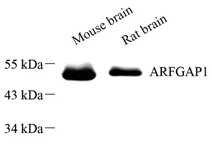 |
Western blot analysis of ARFGAP1 (GB113718) at dilution of 1: 1000 |
Aliases for ARFGAP1 Gene
- GeneCards Symbol: ARFGAP1 2
- ADP Ribosylation Factor GTPase Activating Protein 1 2 3 5
- ARF1GAP 3 4 5
- ADP-Ribosylation Factor GTPase-Activating Protein 1 3 4
- ARF1-Directed GTPase-Activating Protein 3 4
- BA261N11.3 2 5
- FLJ10767 2 5
- ADP-Ribosylation Factor 1 GTPase Activating Protein 2
- ADP-Ribosylation Factor 1 GTPase-Activating Protein 4
- HRIHFB2281 3
- ARF GAP 1 4
- ARF1 GAP 4