Anti-ATPB Rabbit Polyclonal Antibody
Anti-ATPB Rabbit Polyclonal Antibody
General information
| Cat. No. | :SB-GB113540 |
| Size | :100 uL |
| Protein full name | :ATP synthase subunit beta, mitochondrial |
| Synonym | :ATP synthase F1 subunit beta, Atp5f1b, Atp5b, HEL-S-271, ATPMB, ATPSB, Epididymis secretory protein Li 271 |
| Immunogen | :Recombinant protein corresponding to Mouse ATPB |
| Isotype | :IgG |
| Purity | :Affinity purification |
| Predicted MW. | :56 kDa |
| Observed MW. | :56 kDa |
| Uniprot ID | :P06576, P56480, P10719 |
| Storage | :Store at -20 ℃ for one year. Avoid repeated freeze/thaw cycles. |
| Storage Buffer | :PBS with 0.02% sodium azide,100 μg/ml BSA and 50% glycerol. |
Application
| Applications | Species | Dilution | Positive Tissue |
| WB |
Human, Mouse, Rat |
1: 1000-1: 2000 | small intestine, prostate |
Description
Mitochondrial membrane ATP synthase (F1F0 ATP synthase or Complex V) produces ATP from ADP in the presence of a proton gradient across the membrane which is generated by electron transport complexes of the respiratory chain. F-type ATPases consist of two structural domains, F1 - containing the extramembraneous catalytic core, and F0 - containing the membrane proton channel, linked together by a central stalk and a peripheral stalk. During catalysis, ATP synthesis in the catalytic domain of F1 is coupled via a rotary mechanism of the central stalk subunits to proton translocation. Subunits alpha and beta form the catalytic core in F1. Rotation of the central stalk against the surrounding alpha3beta3 subunits leads to hydrolysis of ATP in three separate catalytic sites on the beta subunits.
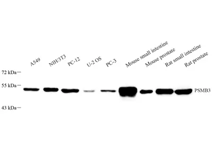 |
Western blot analysis of ATPB (GB113540) at dilution of 1: 2000 |
Aliases for ATPB Gene
- GeneCards Symbol: ATP5F1B 2
- ATP Synthase F1 Subunit Beta 2 3 4 5
- ATP5B 3 4 5
- ATPSB 3 4 5
- ATP Synthase, H+ Transporting, Mitochondrial F1 Complex, Beta Polypeptide 2 3
- ATP Synthase Subunit Beta, Mitochondrial 3 4
- ATPMB 3 4
- Mitochondrial ATP Synthetase, Beta Subunit 3
- Mitochondrial ATP Synthase Beta Subunit 3
- Epididymis Secretory Protein Li 271 3
- EC 3.6.3.14 48
- EC 7.1.2.2 4
- HEL-S-271 3
- EC 3.6.3 48