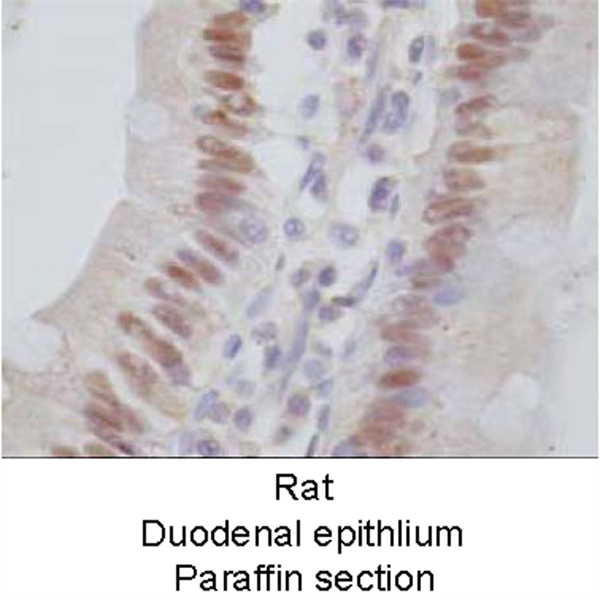
Anti Human MR mouse monoclonal antibody (H3122)
Anti Human MR mouse monoclonal antibody (H3122)
MR: Mineralocorticoid Receptor
DiagnoCine offers excellent Anti-MR | NR3C2 | Mineralocorticoid Receptor Antibody used for studying Prenatal Exposure, Aldosterone, Diffusion, Cardiovascular Disorders, Tumors Biopsy, Tensor Imaging, Diffusion, Myocarditis, Electrophysiology Research.
Human diseases include Cardiovascular Disease, Multiple Cancer types, Asthma, Infections, Stroke, Thyroid Tumor, Chronic Liver disease, Myocarditis, Heart Failure Studies, and Fungal lung disease.
Anti-MR | NR3C2 | Mineralocorticoid Receptor Antibody has excellent quality and this highly pure antibody can be adapted for Western blotting, ELISA, Immunoprecipitation, and Immunohistochemistry research with optimization.
General information
| Cat. No. | :FNK-PP-H3122-00 |
| Size | :100 ul |
| Antigen Species | :Human |
| Host Species | :Mouse |
| Cross Reactivity | :Human/ Rat |
| Purification | :Ammonium sulfate fractionation. |
| Clone No | :H3122 |
| Lot. | :A-2 |
| Concentration | :1 mg/mL |
| Ig Class | :G2a |
| Nomenclature | :NR3C2 |
| Application | :ELISA : 0.2 ug/mL :Western Blot : 1 ug/mL :Immunohistochemistry : 20-40 ug/mL |
| Specificity |
:This antibody specifically recognizes human MR and cross reacts with mouse and rat MR.
|
| Long Term Storage | :- 20 ºC or below |
| Shipping Condition | :Dry Ice |
| Form | :Physiological saline with 0.1% NaN3 as a preservative |
| Genbank | :M16801 |
Description
Mineralcorticoid receptor (MR; NR3C2) is a member of steroid receptor (AR, ER, GR, PR). Aldosterone binds to MR with a high affinity. MR is expressed in kidney, gut, brain, pituitary, hypothalamus and heart. MR plays a critical role in regulating electrolyte and fluid balance in the kidney, as well as having specific roles in the central nervous system. The protein is expressed as a 107 kDa nuclear form. MR and GR can cooperatively form heterodimers.

Origin
Produced in BALB/c mouse ascites after inoculation with hybridoma of mouse myeloma cells (NS-1) and spleen cells derived from a BALB/c mouse immunized with Baculovirus-expressed recombinant human MR (2-99 aa).
Note
Antigen Characterization
- Type: Primary
- Application: ELISA: Used for measuring MR levels in various samples,Western Blot: Employed for detecting MR protein expression in tissues,Immunohistochemistry: Utilized to visualize MR localization in tissue sections.
- Species: Human
- Recombinant: Yes
Human Diseases
- Hypertension: MR activation contributes to increased blood pressure through sodium retention and vascular remodeling.
- Cardiovascular Disease (CVD): Overactivation of MR is linked to cardiovascular fibrosis and hypertrophy, exacerbating conditions like heart failure.
- Chronic Kidney Disease (CKD): MR plays a role in the progression of CKD by promoting inflammation and fibrosis in renal tissues.
- Type 2 Diabetes Mellitus: MR overactivity is associated with increased cardiovascular risk in diabetic patients.
- Heart Failure: MR antagonists are used therapeutically to improve outcomes in heart failure patients
Cellular Signaling Pathways
- Genomic Pathways: MR acts as a transcription factor, regulating gene expression related to sodium transport and blood pressure regulation.
- Non-genomic Pathways: MR also mediates rapid cellular responses independent of transcription, involving signaling molecules such as PKC (Protein Kinase C) and RACK1 (Receptor for Activated C Kinase 1).
- NFκB Pathway: Aldosterone activates NFκB through MR, promoting pro-inflammatory cytokine expression in immune cells, contributing to cardiovascular pathology.
- RAAS (Renin-Angiotensin-Aldosterone System): MR is a critical component of RAAS, influencing fluid balance and vascular tone.
Aliases for NR3C2 Gene
- Nuclear Receptor Subfamily 3 Group C Member 2 2 3 4 5
- MR 2 3 4
- Mineralocorticoid Receptor 3 4
- MCR 3 4
- MLR 3 4
- Nuclear Receptor Subfamily 3, Group C, Member 2 Variant 3 3
- Nuclear Receptor Subfamily 3, Group C, Member 2 2
- Mineralocorticoid Receptor Delta 3
- Mineralocorticoid Receptor 1 3
- Mineralocorticoid Receptor 2 3
- Aldosterone Receptor 3
- NR3C2VIT 3
- NR3C2 5
References
- Jae Mi Suh, et al. Mol Endocrinol, Dec. 2006, 20(12): 3412-3420
- Jun Qin, et al. Developmemtal Dynamics, 2007, 236: 810-820
- Bene, Nicholas C, et al. “Mineralocorticoid Receptors in Immune Cells: Emerging Role in Cardiovascular Disease.” Steroids, U.S. National Library of Medicine, Dec. 2014, www.ncbi.nlm.nih.gov/pmc/articles/PMC4205205/.
- Yang, Jun, and Morag J Young. “The Mineralocorticoid Receptor and Its Coregulators.” Jme, Society for Endocrinology, 1 Aug. 2009, jme.bioscientifica.com/view/journals/jme/43/2/53.xml.
- Gomez-Sanchez, Elise, and Celso E Gomez-Sanchez. “The Multifaceted Mineralocorticoid Receptor.” Comprehensive Physiology, U.S. National Library of Medicine, July 2014, www.ncbi.nlm.nih.gov/pmc/articles/PMC4521600/.
- Savarese, Gianluigi, et al. “Mineralocorticoid Receptor Overactivation: Targeting Systemic Impact with Non-Steroidal Mineralocorticoid Receptor Antagonists - Diabetologia.” SpringerLink, Springer Berlin Heidelberg, 21 Dec. 2023, link.springer.com/article/10.1007/s00125-023-06031-1.