- Home
- Gene Cloning & Editing
- Cloning Vectors
- Alkaline Phosphatase, Shewanella sp. SIB1, Recombinant (PAP)
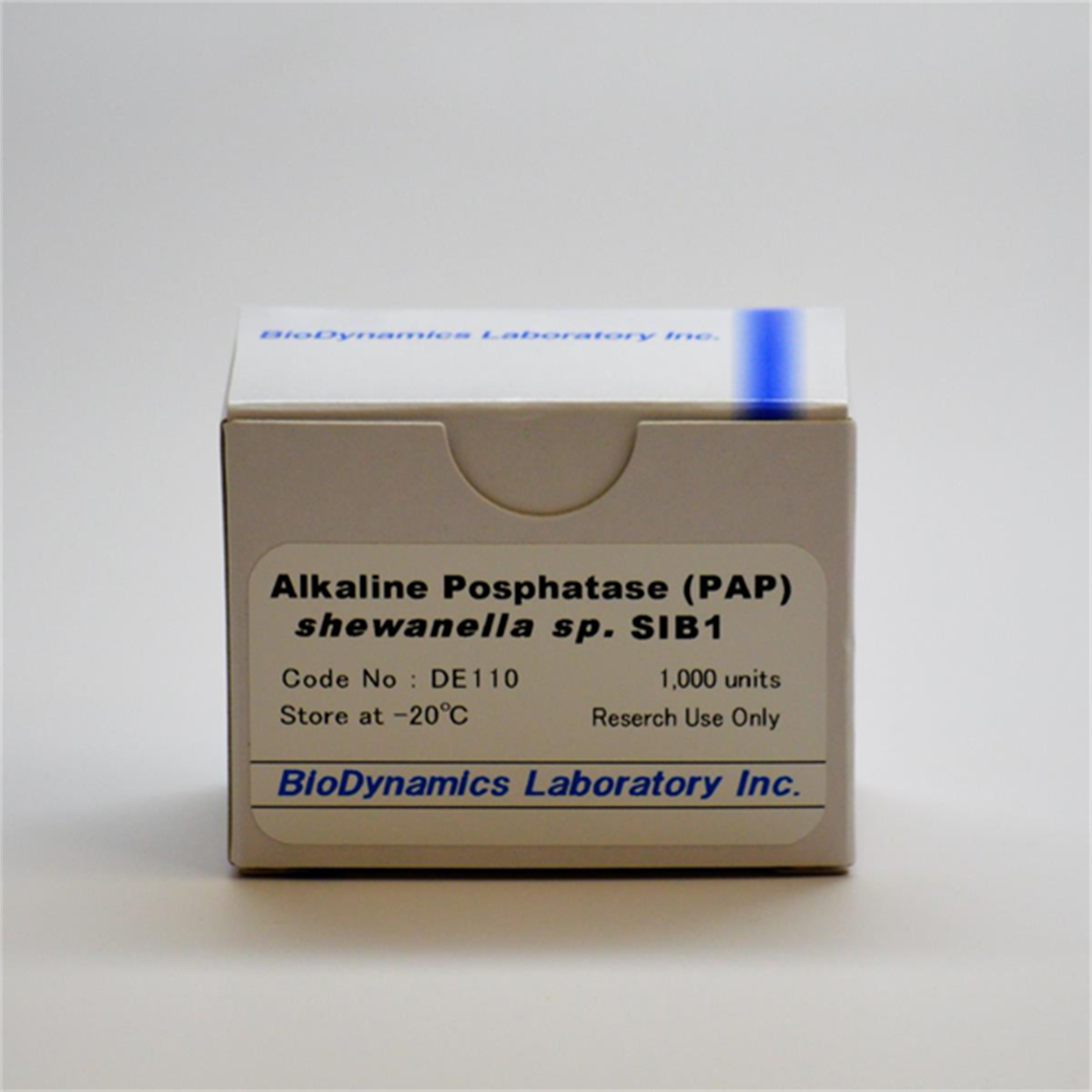
Alkaline Phosphatase, Shewanella sp. SIB1, Recombinant (PAP)
Alkaline Phosphatase, Shewanella sp. SIB1, Recombinant
Cat. No. FNK-DE110
Store at -20℃
Size 1000 Units
Concentration: 5unit/μl
Supplied reagent
- 10×Alkaline Phosphatase Reaction Buffer
- Dilution Buffer
Storage Store at -20℃
Source
E.coli harboring the plasmid encoding the gene of alkaline phosphatase from a psychrotrophic bacterium Shewanella sp. SIB1 (PAP).
Unit Definition
One unit is defined as the amount required to hydrolyzed 1.0 μmole p-nitrophenyl phosphate per 1 minute in glycine-NaOH buffer at pH10.5 and 37℃.
Assay conditions
The reaction mixture (100μl) contains 50mM glycine-NaOH buffer, pH 10.5, 5 mM MgCl2, 0.5 mM ZnCl2, 10 0mM KCl, 5 mM p-nitrophanyl phosphate.
Storage Buffer
10mM Tris-HCl pH7.5
0.025mM ZnCl2
0.25mM MgCl2
50% glycerol
Description
Alkaline phosphatase from the psychrophilic strain Shewanella sp. SIB1 (PAP) has both merits of BAP and CIAP.
|
|
On the other hand, BAP can not be easily inactivated even by phenol extraction. Because activity of the enzyme at 60°C is about four times that at 37°C, the enzyme can easily removes phosphate from not only protruding 3'-end but also blunt end or recessed 5'-end at 60°C for 30min. (On the other hand, SAP and CIAP were rapidly inactivated at 60°C.) |
Contaminants
Rnase: No RNase activity is observed by the use of RnaseAlert assay (Ambion). In this assay the reaction mixture containing the fluorescent-labeled RNA substrate was incubated with 10units of this enzyme for 1 hours at 37℃.
* Licensed Under Japan Patent NO. 2001-172653
Product Information
|
1. 5M |
Tris-HCl, pH7.3 |
|
125mM |
glycine |
|
0. 5% |
TritonX-100 |
|
0.25mM |
ZnCl2 |
|
2.5mM |
MgCl2 |
|
60mM |
NiCl2 |
Dilution Buffer ( 1×Reaction Buffer, Store at –20℃)
|
1. 5M |
Tris-HCl, pH7.3 |
|
12.5mM |
glycine |
|
0. 05% |
TritonX-100 |
|
0.025mM |
ZnCl2 |
|
0.25mM |
MgCl2 |
|
6mM |
NiCl2 |
- Gel Indicator (DM510)
- DynaExpressDNA Ligation Kit ver.2 (DS110)
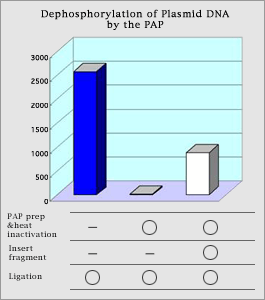
As shown in figure below, PAP treatment produces a larger number of white colonies on plates than BAP treatment after transformation. Because active BAP survives after inactivation treatments, active BAP remove phosphate of insert DNA during the ligation reaction and result in the decrease the ligation efficiency. The experiment shows that PAP is easily inactivated before ligation but not BAP. In order to get sufficient amount of white colony after BAP treatment, insert DNA must be added at high insert: vector ratio into ligaton reaction to overcome surviving BAP or more than two times of phenol extraction must be carried out.

One μg of the EcoRI cleaved pBluescript SK (+) vector was dephosphorylated by 0.5 unit of BAP or 5 unit PAP at 37°C. After dephosphorylation, the reaction mixtures were treated as follow:
- No-treatment: The reaction mixtures were directly used for ligation reaction.
- Phenol: Equal volume of phenol was added to the reaction mixture and it was vortexed for 30 seconds. Then the mixture was extracted by ether, and precipitated by ethanol. The precipitate was dried up and dissolved by dH2O. It was used for ligation reaction.
- Heat: The reaction mixtures were just heat at 95°C for 5 min for PAP or at 100°C for 5 min for BAP. These were directly used for ligation reaction.