


Accutase, 100 ml
Accutase
Product ID and Size
| Product | Accutase | Accutase |
| Cat No. | FNK-AT104-100 | FNK-AT104-500 |
| Size | 100ml | 500ml |
| Link | 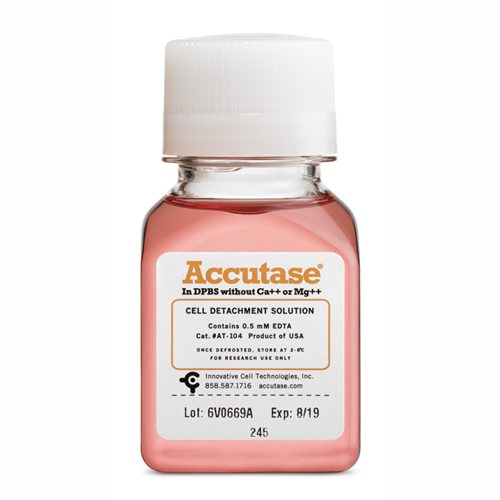 |
|
Description
Accutase®, Cell Detachment Solution, is a ready-to-use cell detachment solution of proteolytic and collagenolytic enzymes. Useful for the routine detachment of cells from standard tissue culture plastic ware and adhesion coated plastic ware, and polymers. Accutase performs exceptionally well in detaching cells for the analysis of cell surface markers, virus growth assay, quiescence assays by serum starvation, transformation assays by oncogene transfection, neural crest cell migration assays, cell proliferation, cell haptotaxis, tumor cell migration assays, routine cell passage, production scale-up (bioreactor), and flow cytometry. Cell lines tested for Accutase application includes fibroblasts, keratinocytes, vascular endothelial cells, hepatocytes, vascular smooth muscle cells, hepatocyte progenitors, primary chick embryo neuronal cells, bone marrow stem cells, adherent CHO and BHK cells, macrophages, 293 cells, L929 cells, immortalized mouse testicular germ cells, MRC5, 3T3, Vero, COS, HeLa, NT2, MG63, M24 and A375 metastatic melanoma, gliomas U251, D54, HT1080 fibrosarcoma cells, Sf9 insect cells, human embryonic stem cells, human mesenchymal stem cells and human neural stem cells. Accutase does not contain mammalian or bacterial derived products.
Intended Use
Accutase is direct replacement for trypsin cell detachment solution. For research use only.
CAUTION: Not intended for human or animal diagnostic or therapeutic uses.
Precautions
Do not store Accumax at room temperature. Accumax is stable when stored at 2 to 8℃ for 2 months. It is recommended to thaw.
Accumax at 4℃ overnight or in a bath of cool water. Do not thaw at 37℃.
Storage & Shelf Life
Store at -20℃ frozen. 2-8℃ defrosted. 24 month shelf life frozen.
Formulation:
1 x ACCUTASE enzymes in Dulbecco's PBS (0.2 g/L KCI, 0.2 g/L KH2PO4, 8 g/L NaCl, and 1.15 g/L Na2HPO4) containing 0.5 mM EDTA?4Na and 3 mg/L Phenol Red.
Use:
Note:
Washing or neutralizing of Accutase is not required in routine cell passaging.
General Dissociation
1. Aspirate the media and wash with 4 mL of DPBS (w/o calcium and magnesium).
2. Add Accutase to flask (10 mL per 75cm2 surface area) using aseptic procedures.
3. Allow cells to detach at room temperature (RT) 5 to 10 minutes up to a maximum of 1 hr. Or cells can be left on ice for several hours.
4. Smack the flask against palm of hand.
5. Take a 20 μL sample of the cell suspension to determine the viable cell density.
6. Resuspend in fresh media and split into new flasks. Incubate at 37℃ in a humidified 5% CO2 incubator.
Dissociation of human ESCs grown in Serum Free Media on hESC-qualified Basement Membrane Extract
1. Aspirate the media from culture dish and wash with 4mL of DPBS (w/o calcium and magnesium).
2. Aspirate DPBS and add 2 mL of Accutase to culture dish.
3. Incubate for 2 to 5 minutes at RT until individual single cells start to round up.
4. Gently rinse to remove cells off of the plate's surface.
5. Transfer cell suspension to 15 mL conical tube. Gently pipette up and down until cells are in a single cell suspension.
6. Add 8 mL of media to rinse any remaining cells off of the dish's surface and transfer to the conical tube from Step 5.
7. Take a 20 μL sample of the cell suspension to determine viable cell density.
8. Centrifuge conical tube containing the cell suspension at 200g for 4 minutes.
9. Aspirate supernatant, resuspend in fresh medium and plate on coated dish(s). Incubate at 37℃ in a humidified 5% CO2 incubator.
Dissociation of adherent human or rat neuronal stem cells grown in Serum Free Media on coated dishes
1. Aspirate the media from the culture dish and wash with 4 mL of DPBS (w/o calcium and magnesium)
2. Aspirate DPBS and add 2 mL of Accutase to culture dish.
3. Incubate for 2 to 5 minutes at RT until individual single cell start to round up.
4. Gently rinse to remove cells off of the plate's surface.
5. Transfer cell suspension to 15 mL conical tube. Gently pipette up and down until cells are in a single cell suspension.
6. Add 8 mL of media to rinse any remaining cells off of the dish's surface and transfer to the conical tube from Step 5.
7. Take a 20 μL sample of the cell suspension to determine the viable cell density.
8. Centrifuge conical tube containing the cell suspension at 200g for 4 minutes.
9. Aspirate supernatant, resuspend in fresh media and plate on coated dish(s). Incubate at 37℃ in a humidified 5% CO2 incubator.
Powerful but gentle cell dissociation solution, Accutase/Accumax
Accutase® is a ready to use non-mam malian, non-bacterial replacement for all applications of trypsin.
Accutase is a natural enzyme mixture with proteolytic and collagenolytic enzyme activity. This means it mimics the action of trypsin and collagenase at the same time. However, because it is more efficient than mammalian trypsin & collagenase, it is formulated at a much lower concentration making it less toxic and gentler, but just as effective.
Advantages of Accutase
- Can be used whenever gentle and efficient detachment of any adherent cell line is needed. Accutase is a direct replacement for trypsin.
- Works extremely well on embryonic and neuronal stem cells; mono layers of stem cells can be grown after passaging with Accutase.
- Preserves most epitopes for subsequent flow cytometry analysis.
- Does not need to be neutralized when passaging adherent cells. The addition of more media after the cells are split dilutes Accutase so it is no longer able to detach cells.
- Does not need to be aliquoted. A bottle is stable in the refrigerator for 2 months.
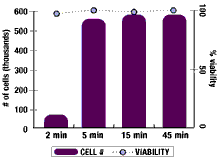
| Cell detachment by Accutase | Viability of human ES cells, treated Accutase, after cryopreservation |
 |
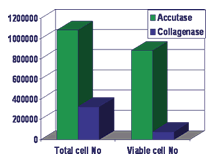 |
| Human MG63 Fibrosarcoma cells cultured in DMEM + 10% FBS were treated with Accutase. Cell viability was measured by each different treated time. Treatment resulted in rapid cell detachment, a single cell suspension, and high viability. Accutase is gentle on cells; viability was 97 ± 3% even after 45 minutes in Accutase. | Human ES cells are treated with Accutase or Collagenase and cryopreserved. After stored in liquid nitrogen for two months and cultured, total cell numbers and live cells numbers are counted after a day. Accutase treated cells (green) has superior cell viability compared to collagenase treated cells. |
Tested Cell Lines of Accumax
|
hESCs |
vascular smooth muscle cells |
primary chick embryo neuronal cells |
HeLa |
NT2 |
|
bone marrow stem cells |
vascular endothelial cells |
immortalized mouse testicular germ cells |
293 |
COS |
|
hepatocyte progenitors |
hepatocytes |
M24 and A375 metastatic melanoma |
MG63 |
Sf9 |
|
fibroblasts |
macrophages |
gliomas U251 and D54 |
3T3 |
Vero |
|
keratinocytes |
HT1080 fibrosarcoma cells |
adherent CHO and BHK cells |
L929 |
Reference
- Nirgude, S., Tichy, E. D., Liu, Z., et al. (2025). Single-nucleus multiomic analysis of Beckwith-Wiedemann syndrome liver reveals PPARA signaling enrichment and metabolic dysfunction. Communications Biology, 8, 495. https://doi.org/10.1038/s42003-025-07961-9

.gif)