

iPSelector Anti-LNFP I, Human, Mouse-Mono(R-17F) (100 µl)
iPSelector <Anti-LNFP I, Human, Mouse-Mono(R-17F)>(100 µl)
Cat. No. FNK-FDV-0014B
Storage -20°C (Avoid repeated freeze-thaw cycles.)
Volume 100 µL (FDV-0014B)
Lot Number see vial label
Host Species and Clonality: Mouse Monoclonal
Clone R-17F
Specificity
This antibody recognizes lacto-N-fucopentaose I (LNFP I: Fucβ1–2Galβ1–3GlcNAcβ1–3Galβ1–4Glc) on a glycolipid / glycoprotein. R-17F epitopes are expressed on undifferentiated human induced pluripotent stem (iPS) / embryonic stem (ES) cells but not on human embryonal carcinoma (EC) cells nor on differentiated human iPS/ES cells.
Isotype and Subclass IgG1
Formulation Phosphate Buffered Saline (PBS) containing 50% Glycerol, contains no preservative.
Purification Protein A Purified
Concentration 1.0 mg/ml
Verified Species Reactivity Human --- Other species not tested.
Immunogen Human iPS cell line, Tic, derived from human fetus lung cells (MRC-5).
Applications
Western Blot (1:2,000), Immunocytochemistry, Flow Cytometry, Functional Application (Optimal working dilutions should be determined experimentally by each laboratory for each application.)
Antigen- Human
Host Animal- Mouse
Cross Reactivity- Human
Application- FCM, Functional Analysis, IC, IF, Western Blot
Unlabeled
Purification- PAPu
Class- IgG
Description
New specific antibody for human iPS/ES cells iPSelector (Anti-Human LNFP I, Mouse Monoclonal)
iPSelector is a mouse monoclonal antibody recognizes for lacto-N-fucopentaose I (LNFP I) raised against human iPS cells.
LNFP I is the sugar chain expressed in undifferentiate state human iPS or ES cells then this antibody can be used as a marker for undiffrentiated human iPS or ES cells.
Therefore this antibody is beneficial for removing undifferentiated human iPS or ES cells.
This antibody has been commercialized under a license from Ritsumeikan University.
Features
- Specific for undifferentiated human iPS or ES cells.
- Uniformly stain cell membrane of human iPS or ES cells.
- Can be used for removing undifferentiated human iPS or ES cells by cytotoxic effect.
- Clone : R-17F
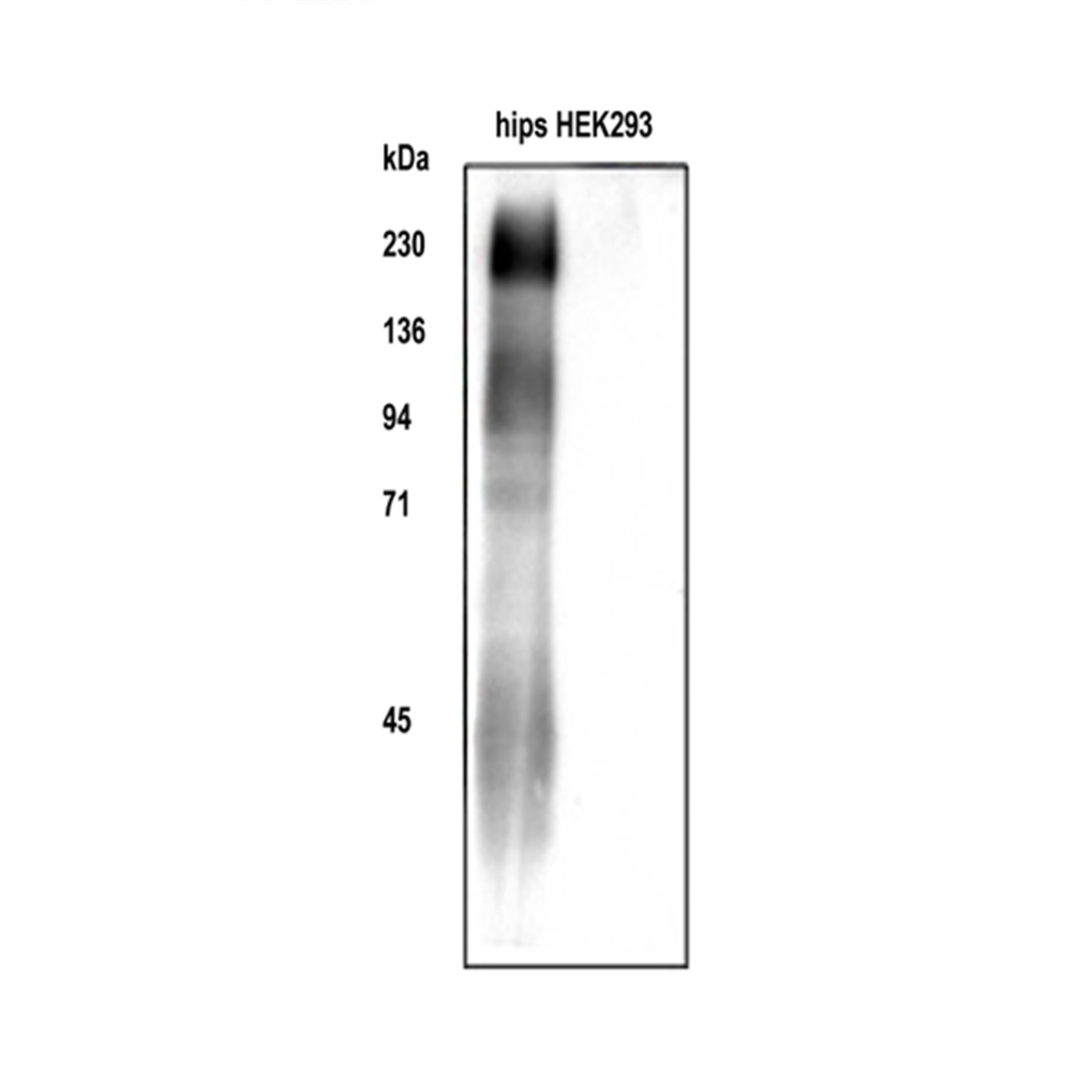
(1) Western Blot
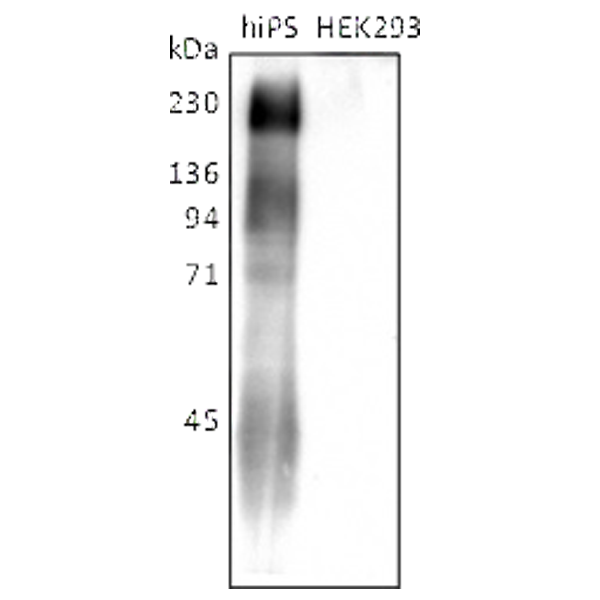 |
One major positive band and several minor bands were specific to human iPS cells, and any positive band were not obtained with HEK293 cells. (Condition) Sample: 5 μg cell lysate in each lane. Left: human iPS cells (LNFP I positive) Right: HEK293 (Negative Control) Dilution: 1:2,000 Secondary antibody: Anti-Mouse IgG, Goat-Poly, HRP (Kirkegaard & Perry Laboratories, #074-1516) Chemiluminescence Substrate: Trident plus Western HRP Substrate (GeneTex International Corporation, #GTX400006) Detection: LuminoGraph I (ATTO) with 1min exposure |
(2) Immunocytochemical Staining
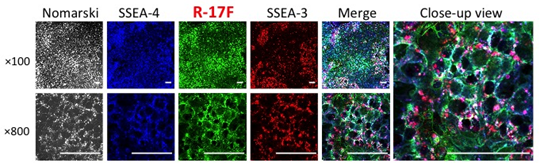
Cultured human iPS cells were stained with R-17F, SSEA-3, and SSEA-4 antibodies. [bars: 100 μm]
R-17F stained the entire surface of the cell membranes equally, while the staining by SSEA-3 and SSEA-4 antibodies are not evenly.
This suggests that R-17F epitope is expressed ubiquitously all over the human iPS cells.
(3) Functional Application (Cytotoxic effects on undifferentiated iPS/ES cells)

R-17F is reported to exhibit potent dose-dependent cytotoxicity when it is added to living human iPS/ES cells.
[Left] After the incubation of iPS cell suspension with R-17F at 4°C for only 45 minutes, the percentage of viable cells decreased concentration-dependently (red triangles).
Blue squares: effects of the isotype (IgG1)-matching control antibody (anti-α-MBP) as Negative Control
[Right] When R-17F-treated iPS cells were incubated with a small amount (0.025-0.1 μg) of the secondary antibody (goat anti-mouse IgG1 antibody), the cytotoxic effect of R-17F was enhanced significantly in a dose-dependent manner (red triangles).
Comparison table : Binding Activity of Antibodies to Cells
| R-17F | TRA-1-60 | TRA-1-81 | SSEA-3 | SSEA-4 | |
|---|---|---|---|---|---|
| Tic (iPS) | ++++ | ++++ | ++++ | ++++ | ++++ |
| KhES-3 (ES) | +++ | ++++ | ++++ | +++ | ++++ |
| H9 (ES) | ++++ | ++++ | ++++ | +++ | ++++ |
| 2102Ep (EC) | +/- | ++++ | ++++ | +++ | +++ |
iPSelector (Clone : R-17F)
Product Background
Clone SSEA-3, SSEA-4, TRA-1-60, and TRA-1-81 antibodies are well-known as human iPS/ES cell-marker antibodies. Since SSEA-3 antibody was originally generated against mouse embryo and the other antibodies were against human EC cells, these antibodies recognize not only human iPS/ES cells but also human EC cells.
R-17F is a novel mouse monoclonal antibody generated by using a human iPS cell line as an immunogen. It is specific to human iPS/ES cells and does not essentially cross-react against human EC cells (Table, ref. 1).
This R-17F antibody also stains entire surface of human iPS/ES cell membranes evenly, while the staining by SSEA-3 and SSEA-4 antibodies are not uniformly (ref. 2).
In addition, R-17F is reported to exhibit potent dose-dependent cytotoxicity when added to living human iPS/ES cells (ref. 2 & 3).
R-17F is a beneficial tool for the selective detection, staining and removal of undifferentiated of human iPS/ES cells in regenerative medicine.
References
- Kawabe, K., et al., Glycobiology, 23, 322, (2013).
- Matsumoto, S., et al., J. Biol. Chem., 290, 20071, (2015).
- Nakao, H., et al., Glycoconj. J., DOI 10.1007/s10719-0169-9710-2
