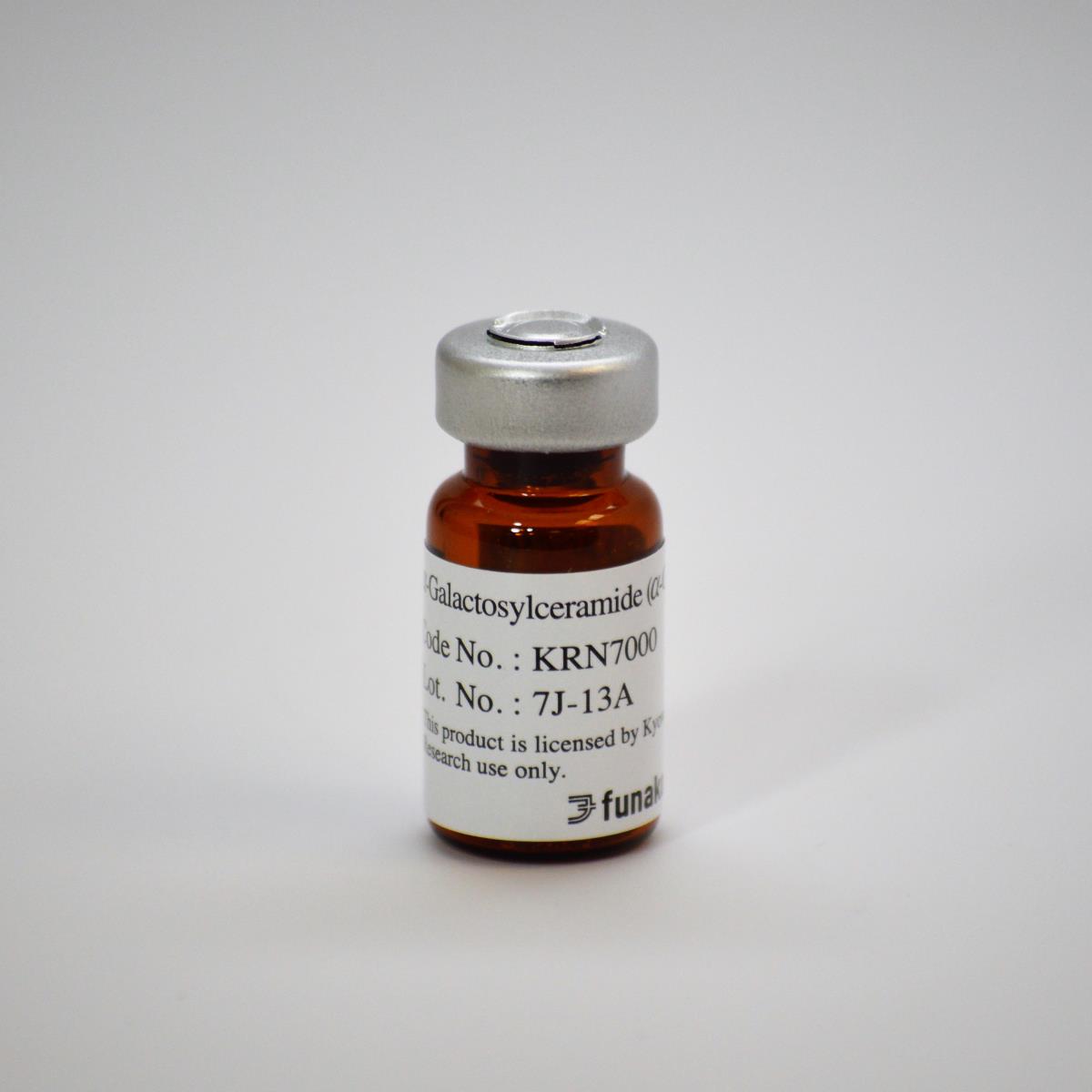
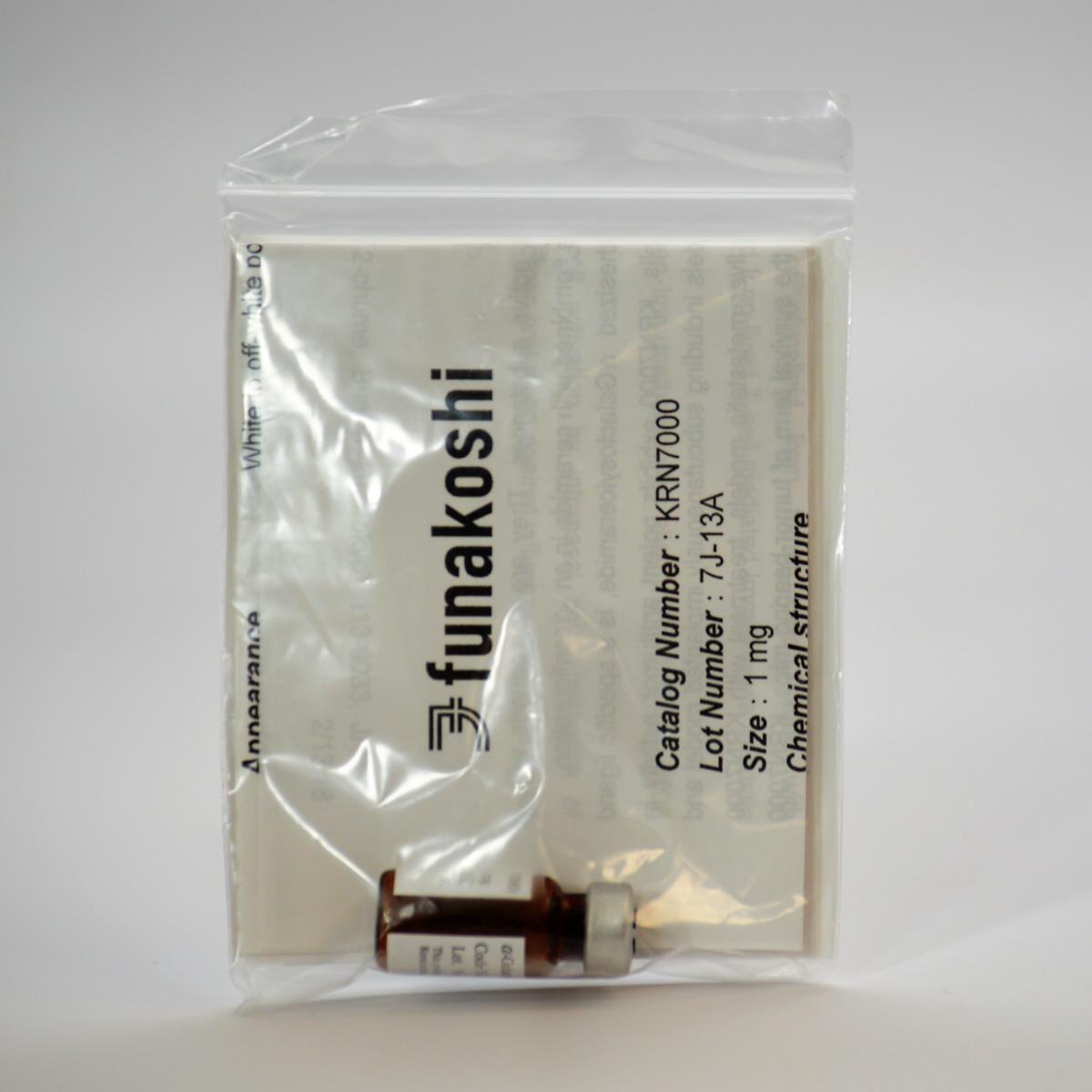
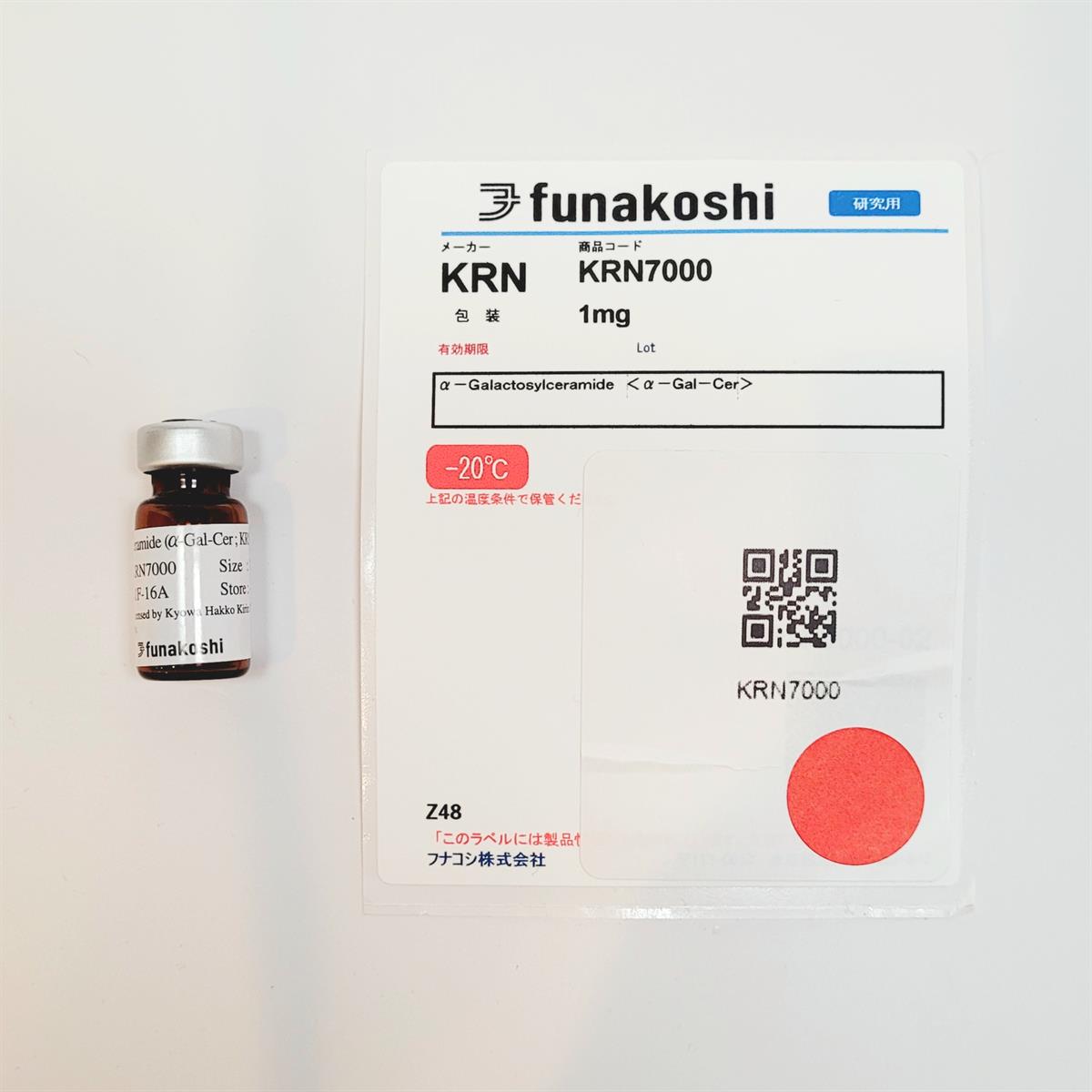
alpha-Galactosylceramide (α-GalCer)
alpha-Galactosylceramide <α-GalCer>
Cat. No. FNK-KRN7000
Size 1 mg
Storage Short term storage +4℃, Long term storage -20℃
Shipping Shipped with Blue ice
Lot Number 5E-12A
Molecular formula C50H99NO9
Molecular weight 858.34
Purity >99% (TLC)
Proton NMR Pass
Biological Activity Pass
Appearance White to off-white powder.
Solubility KRN7000 is practically insoluble in water, methanol or ethanol, very slightly soluble in tetrahydrofuran, slightly soluble in pyridine, and practically insoluble in other organic solvents.
Description
KRN7000, a glycolipid derived from the marine sponge has a novel α-galactosylceramide (α-GalCer) structure and exhibits potent anti-tumor activity by stimulating a strong immune response. Detailed informations on "Alpha-GalCer.net". http://www.alpha-galcer.net/
Common Features of KRN7000 and 7DW8-5
- Immunostimulant
- Potent stimulator of human and mouse natural killer T (NKT) cells.
- Potent antitumor compound.

Alpha-GalCer (KRN7000) exhibits various immunological effects through NKT cell functions including potent antitumor effect.
Features
- Chemical Name : (2S, 3S, 4R)-1-O-(alpha-D-galactosyl)-N-hexacosanoyl-2-amino-1, 3, 4-octadecanetriol
- Mol. Formula : C50H99NO9
- Mol. Weight : 858.34
- Chemically synthesized glycolipid soluble in DMSO
- Activates CD1d mediated invariant NKT cells (iNKT cells)
- Both Th1 and Th2 cytokine are released after activation by KRN7000.
Kyowa Hakko Kirin Company has issued a worldwide license for KRN7000 research to Funakoshi Company.
Example of how to dissolve for biological assay
KRN7000 can be dissolved as follows for various biological examinations:
Such a vehicle consists of 5.6% sucrose, 0.75% L-histidine, and 0.5% Tween 20. After mixing, the solution should be heated at 80℃ until the material becomes completely dissolved and disappeared. This solution can be lyophilized and lyophilized powder can be reconstituted easily by pure water.
In vitro use:
KRN7000 can be dissolved in DMSO at a concentration of 1 mg/mL. The solution
should be heated at 80℃ to get a clear solution.
License This product is licensed by Kyowa Hakko Kirin Co., Ltd.
Warning Research use only. Not for use in humans.
Background
α-Gal-Cer;KRN7000, a chemically synthesized α-Galactosylceramide, is a specific ligand for human and mouse natural killer T (NKT) cells, KRN7000 exhibits potent antitumor activity in various kinds of in vivo murine experimental models including subcutaneously implanted model and metastatic models in the liver and lung. In the liver metastatic models, treatment with KRN7000 suppressed the growth of tumors and prolonged the survival term of tumor-bearing mice. KRN7000 has been reported to show various immunological effects in infectious disease, autoimmune disease, and graft verse host disease in mice.
References
- Natori, T., et al. Agelasphins,Novel Antitumor and Immunostimulatory Cerebrosides from the Marine Sponge Agelasmauritianus,, Tetrahedron Lett., 34, 5591-5592, (1993).
- Akimoto, K., et al. Synthesis and Stereochemistry of Agelasphin-9b, Tetrahedron Lett., 34, 5593-5596, (1993).
- Natori, T., et al. Agelasphins, novel antitumor and immunostimulatory cerebrosides from the marine sponge Agelas mauritianus Tetrahedron, 50, 2771-2784, (1994).
- Motoki, K., et al. Immunostimulatory and Antitumor Activities of Monoglycosylceramides Having Various Sugar Moieties Biol. Pharm. Bull., 18, 1487-1491, (1995).
- Morita, M., et al. Syntheses of α-, β-monoglycosylceramides and four diastereomers of an α-galactosylceramide Bioorganic Med. Chem. Lett., 5, Pages 699-704
- Motoki, K., et al. Antitumor activities of α-, β-monogalactosylceramides and four diastereomers of an α-galactosylceramide Bioorganic Med. Chem. Lett., 5, 705-710, (1995).
- Kawano, T., et al. CD1d-restricted and TCR-mediated activation of valpha14 NKT cells by glycosylceramides. Science, 278, 1626-1629, (1997).
- Kronenberg. M. Toward an understanding of NKT cell biology: progress and paradoxes. Annu Rev Immunol., 23 :877-900 (2005).
- Yamaguchi, Y., et al. Enhancing effects of (2S,3S,4R)- 1-O- (alpha-D-galactopyranosyl) -2-(N-hexacosanoylamino) -1,3,4-octadecanetriol (KRN7000) on antigen-presenting function of antigen-presenting cells and antimetastatic activity of KRN7000-pretreated antigen-presenting cells. Oncology Res., 8, 399-407, (1996).
- Giaccone, et al. A Phase I Study of the Natural Killer T-Cell Ligand α-Galactosylceramide (KRN7000) in Patients with Solid Tumors Clinical Cancer Res. 8:3702–3709, (2002)
- Shimizu, K., et al. Cross-presentation of glycolipid from tumor cells loaded with alpha-galactosylceramide leads to potent and long-lived T cell mediated immunity via dendritic cells.S, J Exp Med., 204 : 2641-2653 (2007)
- Ishii Y., et al. Alpha-galactosylceramide-driven immunotherapy for allergy. Front Biosci. 2008 May 1;13:6214-28.
- Kamijuku H. et al. Mechanism of NKT cell activation by intranasal coadministration of alpha-galactosylceramide, which can induce cross-protection against influenza viruses, Mucosal Immunol. 2008 May;1(3):208-218.
- Gu W. et al., Unaltered influenza disease outcomes in swine prophylactically treated with α-galactosylceramide. Dev Comp Immunol. 2020 114:103843.
- Landoni, E., Woodcock, M. G., Barragan, G., Casirati, G., Cinella, V., Stucchi, S., ... & Dotti, G. (2024). IL-12 reprograms CAR-expressing natural killer T cells to long-lived Th1-polarized cells with potent antitumor activity. Nature Communications, 15(1), 89.
- Kumar, A., Yarosz, E. L., Andren, A., Zhang, L., Lyssiotis, C. A., & Chang, C. H. (2022). NKT cells adopt a glutamine-addicted phenotype to regulate their homeostasis and function. Cell Reports, 41(4), 111516.
- Nelson, A., McMullen, N., Gebremeskel, S., De Antueno, R., Mackenzie, D., Duncan, R., & Johnston, B. (2024). Fusogenic vesicular stomatitis virus combined with natural killer T cell immunotherapy controls metastatic breast cancer. Breast Cancer Research, 26(1), 78.
- Landoni, E., Smith, C. C., Fucá, G., Chen, Y., Sun, C., Vincent, B. G., ... & Savoldo, B. (2020). A High Avidity T-Cell Receptor Redirects Natural Killer T-Cell Specificity and Outcompetes the Endogenous Invariant T-Cell Receptor. Cancer Immunology Research, 8(1), 57–69.
- Kumar, A., Suryadevara, N. C., Wolf, K. J., Wilson, J. T., Di Paolo, R. J., Brien, J. D., & Joyce, S. (2020). Heterotypic immunity against vaccinia virus in an HLA-B*07:02 transgenic mousepox infection model. Scientific Reports, 10(1), 13167.
- Cruz Tleugabulova, M., Zhao, M., Lau, I., Kuypers, M., Wirianto, C., Umaña, J. M., ... & Mallevaey, T. (2019). The protein phosphatase Shp1 regulates invariant Natural Killer T cell effector differentiation independently of TCR and Slam signaling. The Journal of Immunology, 202(8), 2276–2286.
- Enoksson, S. L., Grasset, E. K., Hägglöf, T., Mattsson, N., Kaiser, Y., Gabrielsson, S., ... & Karlsson, M. C. (2011). The inflammatory cytokine IL-18 induces self-reactive innate antibody responses regulated by natural killer T cells. Proceedings of the National Academy of Sciences (PNAS), 108(51), E1399–E1407.
- PyaDorta-Estremera, S., Chin, R. L., Sierra, G., Nicholas, C., Yanamandra, A. V., Nookala, S. M. K., ... & Sastry, K. J. (2018). Mucosal HPV E6/E7 peptide vaccination in combination with immune checkpoint modulation induces regression of HPV+ oral cancers. Cancer Research, 78(18), 5327–5339.ram, K., Kumar, A., Kim, Y. H., Noel, S., Reddy, S. P., Rabb, H., & Chang, C. H. (2019). Keap1-Nrf2 System Plays an Important Role in Invariant Natural Killer T Cell Development and Homeostasis. Cell Reports, 27(3), 699–707.e4.
- Derakhshandeh, R., Zhu, Y., Li, J., Hester, D., Younis, R., Koka, R., ... & Webb, T. J. (2024). Identification of Functional Immune Biomarkers in Breast Cancer Patients. International Journal of Molecular Sciences, 25(22), 12309.
- Artiaga, B. L., Madden, D., Kwon, T., McDowell, C., Keating, C., Balaraman, V., ... & Driver, J. P. (2024). Adjuvant Use of the Invariant-Natural-Killer-T-Cell Agonist α-Galactosylceramide Leads to Vaccine-Associated Enhanced Respiratory Disease in Influenza-Vaccinated Pigs. Vaccines, 12(9), 1068.
- Courtney, A. N., Thapa, P., Singh, S., Wishahy, A. M., Zhou, D., & Sastry, J. (2011). Intranasal but not intravenous delivery of the adjuvant $\alpha$-galactosylceramide permits repeated stimulation of natural killer T cells in the lung. European Journal of Immunology, 41(11), 3312–3322.
- Artiaga, B. L., Morozov, I., Ransburgh, R., Kwon, T., Balaraman, V., Indran, S. V., ... & Driver, J. P. (2022). Evaluating α-galactosylceramide as an adjuvant for live attenuated influenza vaccines in pigs. Animal Diseases, 2(1), 19.
- Lin, Q., Kuypers, M., Liu, Z., Copeland, J. K., Chan, D., Robertson, S. J., ... & Mallevaey, T. (2022). Invariant natural killer T cells minimally influence gut microbiota composition in mice. Gut Microbes, 14(1), 2104087.
- Singh, S., Yang, G., Schluns, K. S., Anthony, S. M., & Sastry, K. J. (2014). Sublingual vaccination induces mucosal and systemic adaptive immunity for protection against lung tumor challenge. PLoS One, 9(3), e90001.
- Singh, S., Nehete, P. N., Yang, G., He, H., Nehete, B., Hanley, P. W., ... & Sastry, K. J. (2014). Enhancement of Mucosal Immunogenicity of Viral Vectored Vaccines by the NKT Cell Agonist Alpha-Galactosylceramide as Adjuvant. Vaccines, 2(4), 686–706.
- Houser, M. C. Q., Mitchell, S. P. C., Sinha, P., Lundin, B., Berezovska, O., & Maesako, M. (2023). Endosome and Lysosome Membrane Properties Functionally Link to γ-Secretase in Live/Intact Cells. Sensors, 23(5), 2651.
- Rout, N., Else, J. G., Yue, S., Connole, M., Exley, M. A., & Kaur, A. (2010). Heterogeneity in phenotype and function of CD8+ and CD4/CD8 double-negative natural killer T cell subsets in sooty mangabeys. Journal of Medical Primatology, 39(4), 224–234.
- Singh, S., Schluns, K. S., Yang, G., Anthony, S. M., Barry, M. A., & Sastry, K. J. (2016). Intranasal Vaccination Affords Localization and Persistence of Antigen-Specific CD8+ T Lymphocytes in the Female Reproductive Tract. Vaccines, 4(1), 7. https://doi.org/10.3390/vaccines4010007
- Sierra, G., Dorta-Estremera, S., Hegde, V. L., Nookala, S. M. K., Yanamandra, A. V., & Sastry, K. J. (2020). Intranasal Therapeutic Peptide Vaccine Promotes Efficient Induction and Trafficking of Cytotoxic T Cell Response for the Clearance of HPV Vaginal Tumors. Vaccines, 8(2), 259. https://doi.org/10.3390/vaccines8020259
- Bartkowiak, T., Singh, S., Yang, G., et al. (2015). Unique potential of 4-1BB agonist antibody to promote durable regression of HPV+ tumors when combined with an E6/E7 peptide vaccine. Proceedings of the National Academy of Sciences (PNAS), 112(38), E5290–E5299. https://doi.org/10.1073/pnas.1514418112
- Nelson, A., Gebremeskel, S., Lichty, B. D., & Johnston, B. (2022). Natural killer T cell immunotherapy combined with IL-15-expressing oncolytic virotherapy and PD-1 blockade mediates pancreatic tumor regression. Journal for Immunotherapy of Cancer, 10(3), e003923. https://doi.org/10.1136/jitc-2021-003923
- Gebremeskel, S., Nelson, A., Walker, B., et al. (2021). Natural killer T cell immunotherapy combined with oncolytic vesicular stomatitis virus or reovirus treatments differentially increases survival in mouse models of ovarian and breast cancer metastasis. Journal for Immunotherapy of Cancer, 9(3), e002096. https://doi.org/10.1136/jitc-2020-002096
- Singh, S., Yang, G., Byrareddy, S. N., Barry, M. A., & Sastry, K. J. (2014). Natural Killer T Cell and TLR9 Agonists as Mucosal Adjuvants for Sublingual Vaccination with Clade C HIV-1 Envelope Protein. Vaccine, 32(51), 6934–6940. https://doi.org/10.1016/j.vaccine.2014.10.051