
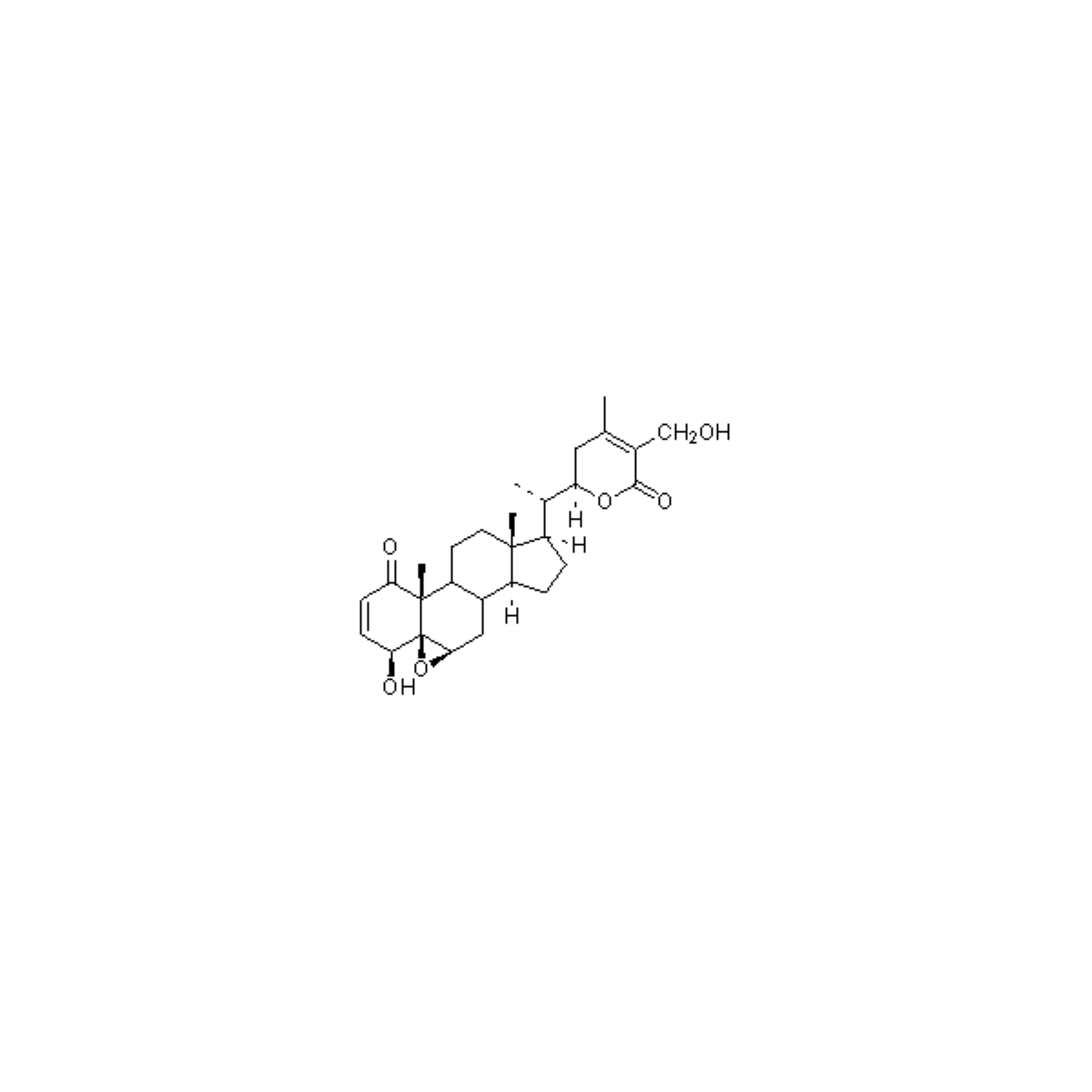
Withaferine A
Product#: FNK-2400236
$419.12
Availability:
Ships in 1-2 Weeks
Withaferine A
- CAT Number : FNK-2400236
- CAS Number : 119-48-2
- Molecular Weight : 470.6
- Molecular Formula : C28H38O6
- Pack size: 5 mg
- Store: Store at 2-10℃ in a dry and dark place.
- Purity: (HPLC) ≥98%
Withaferin A is a steroidal lactone derived from the plant Withania somnifera (Ashwagandha), known for its broad spectrum of biological activities, including anti-inflammatory and anticancer properties.
Properties
- Molecular formula: C28H38O6
- Molecular weight: 470.60 g/mol
- CAS Number: 5119-48-2
- Appearance: White to off-white crystalline powder
- Solubility: Soluble in DMSO, ethanol, and methanol; poorly soluble in water
- Used in scientific research for its potential therapeutic effects
- Exhibits anti-inflammatory, anticancer, and immunomodulatory properties
- Studied for its role in inducing apoptosis and inhibiting angiogenesis in cancer cells
- Investigated for its neuroprotective effects and potential in treating neurodegenerative diseases
- Handle with appropriate safety precautions in a laboratory setting
- Use personal protective equipment such as gloves and safety glasses
- Store in a cool, dry place, away from direct sunlight
Cancer
WA exhibits significant anticancer properties across a variety of cancer types, including breast, lung, colon, brain, cervical, and more. It works by inducing apoptosis, autophagy, and cell cycle arrest while inhibiting cell proliferation and metastasis. WA targets several molecular pathways and proteins involved in cancer progression, such as NF-κB, Hsp90, and p53126. Despite its potential, challenges such as toxicity and poor oral bioavailability need to be addressed for its development as an anti-tumor agent
Cardiovascular Diseases
WA has shown cardioprotective effects by reducing apoptotic cell death and activating pathways that protect against myocardial infarction (MI). It also exhibits antiplatelet and anticoagulant activities, making it a potential therapeutic agent for cardiovascular disorders.
Neurological Disorders
WA acts as a neuroprotectant in conditions like Parkinson's disease, amyotrophic lateral sclerosis (ALS), and other neurodegenerative diseases. It reduces neuroinflammation and promotes the clearance of misfolded proteins, which are common in these disorders.
Diabetes
WA has demonstrated antidiabetic effects by enhancing insulin sensitivity and reducing oxidative stress. It modulates key signaling pathways involved in glucose metabolism, making it beneficial for managing diabetes.
Inflammatory Diseases
The compound has potent anti-inflammatory properties that can be beneficial in treating chronic inflammatory diseases such as rheumatoid arthritis, inflammatory bowel disease, and asthma. WA reduces the production of pro-inflammatory cytokines and suppresses oxidative stress-induced inflammation.
COVID-19
Preliminary studies suggest that WA may inhibit the binding of SARS-CoV-2's spike protein to the host receptor ACE2, potentially preventing COVID-19 infection or reducing its severity. Its anti-inflammatory properties might also help mitigate the cytokine storm associated with severe COVID-19 cases.
Cell Signaling Pathways Affected
ATF4-ATF3-CHOP Axis
WA induces apoptosis and G2/M cell cycle arrest in glioblastoma cells through the ATF4-ATF3-CHOP axis. This pathway is part of the endoplasmic reticulum (ER) stress response, which can lead to cell death when homeostasis cannot be restored.
NF-κB Signaling Pathway
WA inhibits NF-κB signaling, which plays a critical role in inflammatory responses and cancer progression. By suppressing this pathway, WA reduces inflammation and tumor growth.
Smad and TGF-β Signaling
WA regulates epithelial-to-mesenchymal transition (EMT) by inhibiting Smad and TGF-β signaling pathways. This action helps prevent cancer metastasis by maintaining epithelial characteristics and inhibiting mesenchymal traits.
STAT3 Signaling Pathway
WA suppresses STAT3 signaling, which is involved in cell proliferation, survival, and metastasis in various cancers. By inhibiting STAT3, WA reduces tumor growth and cell migration.
PI3K/AKT and MAPK/ERK Pathways
WA affects insulin signaling by modulating PI3K/AKT pathways and also influences MAPK/ERK pathways, which are involved in cell growth and survival3. This modulation helps restore endothelial function and reduce insulin resistance.