Ultrapure Water, Type 1, 500ml, Sterile
FluxMPS™ Ultrapure Water, Type 1, 500 mL, Sterile
DCP-T1UH2O-500S is a sterile, Type 1 ultrapure water manufactured through demineralization, deionization, and endotoxin detoxification, finished with a two-pass 0.1 µm membrane filtration for microchannel-safe purity. Supplied Non-pH Adjusted (pH 4.5-5) or NaOH pH-adjusted (pH 7.4), it is built for HPLC, GC, ICP-MS, cell culture, and MPS/organ-on-a-chip workflows that demand consistently low-conductivity, nuclease-free water.
- Two-pass 0.1 µm membrane filtration for microchannel-safe purity
- Electrolytic conductivity of 0.05 µS/cm (ASTM tested standard)
- Water purity range of 0.015 to 0.005 microSiemens/cm
- Available Non-pH Adjusted (pH 4.5-5) or NaOH pH-adjusted (pH 7.4)
- Sterile and free of DNase, RNase, Protease & Endonucleases
- Produced via demineralization, deionization, and endotoxin detoxification
- Custom 0.04 µm polishing filtration available on request
- pH4.5-5 (Non-Adjusted) or 7.4 (NaOH-Adjusted)
- Molecular FormulaH2O
- CAS Number7732-18-5
- Conductivity (ASTM)0.05 µS/cm
- Water Purity Range0.015 to 0.005 microSiemens/cm
- Filtration0.1 µm membrane, 2X
- SterilitySterile
- Nuclease/ProteaseDNase, RNase, Protease & Endonuclease Free
- Shelf Life24 months
- Size500 mL
Engineered where standard ultrapure water falls short
Conventional single-pass, 0.22 µm-filtered water can carry subvisible particulates, ionic drift, and undocumented endotoxin content into sensitive workflows. DCP-T1UH2O-500S addresses each failure mode with a defined, multi-step purification and filtration process.
Microchannel-safe purity
Two sequential 0.1 µm membrane passes reduce particulate load ahead of use in microfluidic channels and chip ports.
Precise, stable pH options
Choose Non-pH Adjusted (pH 4.5-5) as produced, or NaOH pH-adjusted (pH 7.4) for physiological-pH protocols.
Ultrapure-grade water
Type 1 water with electrolytic conductivity of 0.05 µS/cm (ASTM tested standard) and a purity range of 0.015 to 0.005 microSiemens/cm.
Low background for sensitive assays
Formulated for HPLC, GC, and ICP-MS trace-level work where reagent water itself must not contribute background signal.
Defined, traceable purification
Demineralization, deionization, endotoxin detoxification, and a relay of membrane filtration steps — the same process used across all FluxMPS™ buffers.
Customization on demand
Additional 0.04 µm polishing filtration can be added on request for further purity.
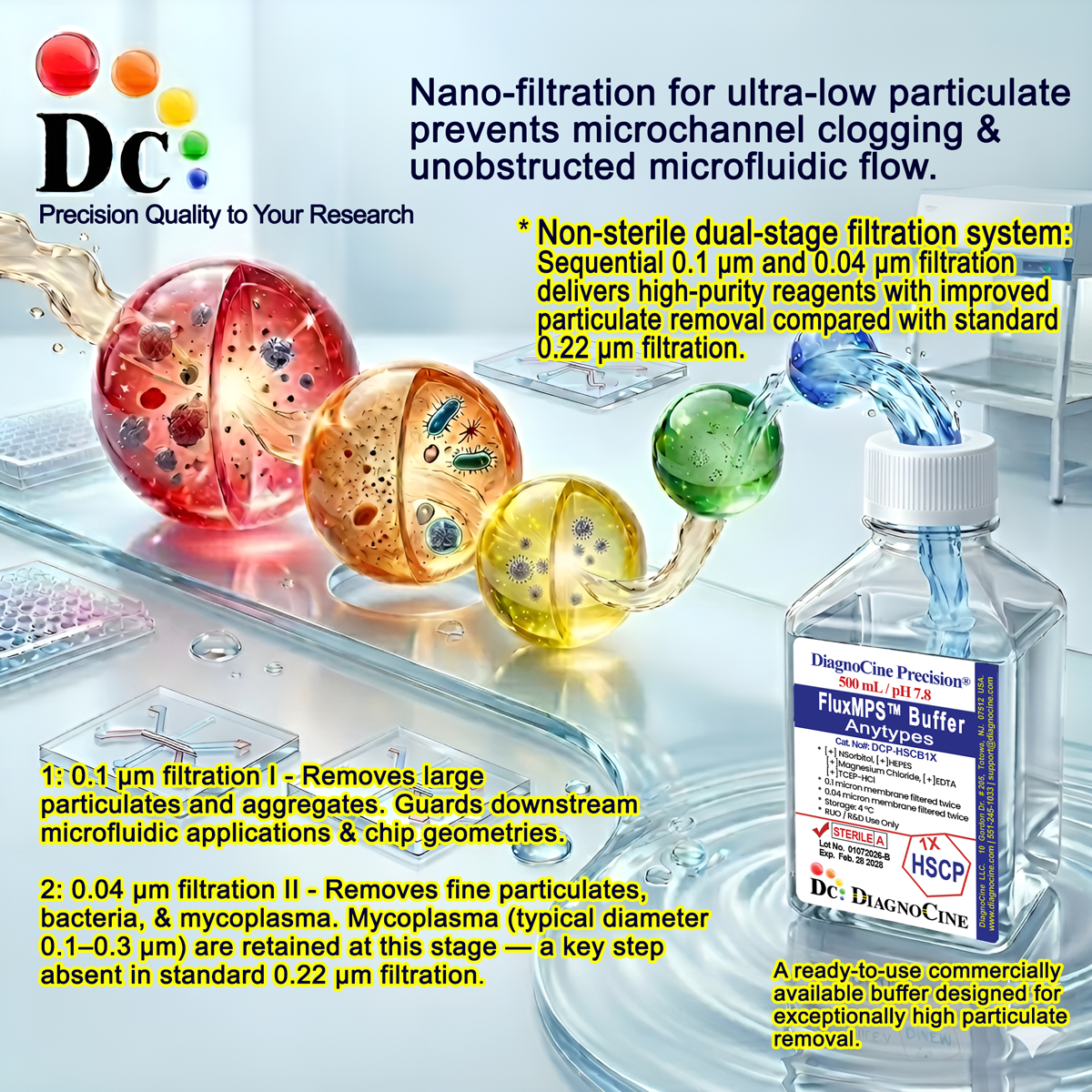
Dual-pass 0.1 µm filtration system
DCP-T1UH2O-500S undergoes two sequential 0.1 µm membrane filtration passes as the final steps of a multi-stage purification process that also includes demineralization, deionization, and endotoxin detoxification, delivering Type 1 ultrapure water suitable for microfluidic and organ-on-a-chip workflows.
-
1
0.1 µm Pre-Filtration
Following demineralization and deionization, the water passes through a 0.1 µm membrane filter to remove particulates ahead of final sterilization.
-
2
0.1 µm Final Sterile Filtration
A second 0.1 µm membrane pass (2X total) completes the sterilization process, reaching a water purity of 0.015 to 0.005 microSiemens/cm.
Performance vs. conventional water
Two sequential 0.1 µm membrane passes, combined with demineralization, deionization, and endotoxin detoxification, achieve electrolytic conductivity of 0.05 µS/cm (ASTM tested standard) and a purity range of 0.015 to 0.005 microSiemens/cm.
© Diagnocine® — DCP-T1UH2O-500S
Where DCP-T1UH2O-500S is used
Type 1 ultrapure water is required wherever trace contaminants would compromise measurement accuracy, cell viability, or instrument integrity.
Automated Bioreactors & Robotics
For automated perfusion and robotic liquid-handling systems, an additional 0.04 µm polishing filtration pass can be added to DCP-T1UH2O-500S on request, further reducing particulate load beyond the standard two-pass 0.1 µm process.
- Further particulate reduction beyond the standard 0.1 µm x2 process
- Supports valve and sensor protection in automated fluidic systems
- Available as a made-to-order polishing filtration step
Inquiry Required: Contact support@diagnocine.com to request the 0.04 µm polished grade.
Micro Physiological System (MPS) & Chip
Reagent-grade water for microfluidic device priming, wash steps, and buffer preparation.
Wash, Dilution & Reconstitution
Low-background water for lysis, dilution, reconstitution, and rinse steps.
iPSC-Derived Model Handling
Water quality suited to cell culture and molecular biology workflows where trace contaminants affect viability.
Endothelial & Primary Cell Perfusion
Reagent water for buffer and media preparation supporting primary and endothelial cell workflows.
ELISA, Blotting & Blocking
Nuclease- and protease-free water for immunoassay buffer and reagent preparation.
HPLC, GC & ICP-MS
Reagent water quality intended for high-performance liquid chromatography, gas chromatography, and ICP-MS trace analysis.
Measured and declared parameters
Specification values are drawn directly from DCP-T1UH2O-500S product documentation.
| Parameter | Specification |
|---|---|
| Formulation / Composition | Ultrapure Water (H2O), CAS 7732-18-5 |
| pH (Non-pH Adjusted) | pH 4.5 ~ pH 5 |
| pH (Adjusted Option) | pH 7.4 |
| Electrolytic Conductivity (ASTM Tested Standard) | 0.05 µS/cm |
| Water Purity (Conductivity Range) | 0.015 to 0.005 microSiemens/cm |
| Parameter | Specification |
|---|---|
| Sterility | Sterile USP <71> |
| Nuclease / Protease Testing | Free of DNase, RNase, Protease & Endonucleases |
| Filtration | 0.1 µm membrane filtration, applied twice (2X) |
| Water Type | Type 1 Ultrapure Water |
| Manufacturing Standard | ISO 13485:2016 |
| Parameter | Specification |
|---|---|
| Shelf Life | 24 months |
| pH Stability in Use | May decrease toward pH 4.5 upon exposure to air as CO2 is absorbed |
| pH Measurement Note | Requires a pH meter designed for low-conductivity ultrapure water |
| Parameter | Specification |
|---|---|
| Raw Material Grade | Type 1 Ultrapure Water (demineralized, deionized, detoxified) |
| Purification Equipment | Top-tier commercial purification bead / filter systems |
| Manufacturing QMS | ISO 13485:2016 aligned |
| Regulatory Alignment | Exceeds USP purified/ultrapure water requirements |
| Production Method | Demineralization, deionization, endotoxin detoxification, 0.1 µm membrane filtration (2X) |
| Intended Use | RUO; general PCR use (DNA-based/gDNA); not for delicate PCR (endpoint/qPCR); not for human, therapeutic, or clinical use |
Full composition
DCP-T1UH2O-500S is a single-component, sterile ultrapure water product.
| Component | CAS Number | Concentration |
|---|---|---|
| Ultrapure Water (H2O) | 7732-18-5 | Sole component (ultrapure water matrix) |
Manufacturing & compliance
DCP-T1UH2O-500S is produced under a defined, multi-step purification and quality process.
ISO 13485:2016 QMS
Manufactured under an ISO 13485:2016-aligned quality management system.
Ultrapure Type 1 Water
All FluxMPS™ buffers and reagents use this same demineralization, deionization, and 0.1 µm filtration process.
Multi-Step Purification
Demineralization, deionization, endotoxin detoxification, and a relay of membrane filtration steps.
Micro-Batch Precision
Precision batch production supports lot-to-lot consistency in conductivity and purity performance.
Endotoxin Detoxification
Detoxification is integrated into the purification process, within a framework aligned to USP <85> Bacterial Endotoxins Test principles.
Particulate Control (USP <788>)
Two-pass 0.1 µm membrane filtration minimizes particulate contamination in line with USP <788> Method 2 principles.
Osmolality (USP <785>)
Not applicable to solvent-grade ultrapure water; USP <785> osmolality testing applies to buffers and reagents formulated using this water.
Documentation / CoA
Certificate of Analysis available on request via support@diagnocine.com.
How DCP-T1UH2O-500S compares
A side-by-side view against generic single-pass 0.22 µm-filtered water products.
| Parameter | DCP-T1UH2O-500S (FluxMPS™) | Conventional Water (0.22 µm filtered) | Standard Alternative (0.22 µm filtered) |
|---|---|---|---|
| Filtration Passes | 2 x 0.1 µm | 1 x 0.22 µm | 1 x 0.22 µm |
| Electrolytic Conductivity (ASTM) | 0.05 µS/cm | Not specified | Not specified |
| Water Purity Range | 0.015-0.005 microSiemens/cm | Not specified | Not specified |
| Sterility | check_circle | cancel | cancel |
| Nuclease/Protease-Free Testing | check_circle | cancel | cancel |
| pH Options | Non-Adjusted (4.5-5) or 7.4 | Not offered | Not offered |
| Manufacturing QMS | ISO 13485:2016 | Not specified | Not specified |
| Endotoxin Detoxification Step | check_circle | cancel | cancel |
| Microfluidic / OoC Compatibility | check_circle | cancel | cancel |
| Custom Filtration (0.04 µm on request) | check_circle | cancel | cancel |
Frequently asked questions
Common questions about DCP-T1UH2O-500S.
Supporting literature
Curated literature on reagent water quality and its role in analytical and cell-based workflows.
- ASTM International. Standard Specification for Reagent Water (ASTM D1193). doi:10.1520/D1193-06R18
- Huang Y, et al. Water quality considerations in trace-metal and ICP-MS analysis. J Anal At Spectrom. doi:10.1039/C9JA00123A
- Meyers RA. Reagent water grades for HPLC and chromatography applications. Encyclopedia of Analytical Chemistry. doi:10.1002/9780470027318.a5608
- Williams DF. Endotoxin control in ultrapure water systems for laboratory use. Biomaterials. doi:10.1016/j.biomaterials.2008.04.023
- Light TS. pH measurement challenges in low-ionic-strength and ultrapure water. Anal Chem. doi:10.1021/ac00203a015
- Freshney RI. Culture of Animal Cells: water quality considerations for cell culture reagents. Wiley. doi:10.1002/9780470649367
- Bhatia SN, Ingber DE. Microfluidic organs-on-chips. Nat Biotechnol. doi:10.1038/nbt.2989
- Halpin ST, Spence DM. Reagent purity requirements in microfluidic device fabrication and operation. Anal Chem. doi:10.1021/ac102313f