



Ultrapure Water, Type 1, 1000ml, Sterile
FluxMPS™ Ultrapure Water, Type 1, 1000 mL, Sterile
MPS-grade Type 1 ultrapure water engineered for organ-on-a-chip, microfluidic, and analytical workflows. Produced through demineralization, deionization, detoxification, and dual-pass 0.1 µm membrane sterilizing filtration, it is supplied non-pH-adjusted (pH 4.5-5) or NaOH pH-adjusted to physiological pH 7.4.
- Sterile Type 1 ultrapure water manufactured via demineralization, deionization, detoxification, and multi-stage membrane filtration
- Dual-pass (2X) 0.1 µm membrane sterile filtration for microchannel-safe purity; additional 0.04 µm polishing filtration available on request
- Tested electrolytic conductivity per ASTM standard, 0.05 µS/cm, with process water purity of 0.015 to 0.005 microSiemens/cm
- Free of DNase, RNase, protease, and endonucleases
- Available non-pH-adjusted (pH 4.5-5) or NaOH pH-adjusted to pH 7.4
- Validated for HPLC, GC, ICP-MS, cell culture, chemistry, and molecular biology workflows
- Suitable for general PCR applications (DNA-based, gDNA, abundant-RNA targets); not recommended for delicate PCR applications such as endpoint or quantitative PCR (qPCR)
- 24-month shelf life; For Research Use Only (RUO)
- pH (Option A)4.5 – 5 (Non-pH Adjusted)
- pH (Option B)7.4 (NaOH pH-Adjusted)
- CAS Number7732-18-5
- Molecular FormulaH2O
- Conductivity (ASTM)0.05 µS/cm
- Process Water Purity0.015 to 0.005 microSiemens/cm
- Filtration0.1 µm membrane, 2X
- SterilitySterile
- Shelf Life24 months
- Size1000 mL
Engineered where standard laboratory water falls short
Conventional 0.22 µm-filtered laboratory water can carry subvisible particulates, nuclease/protease residues, and inconsistent conductivity — all of which accumulate in microchannels, drift pH and ionic readings, and elevate assay background. FluxMPS™ Ultrapure Water, Type 1 is purified and filtered specifically to avoid these failure modes.
Microchannel-safe purity
Dual-pass 0.1 µm membrane sterilizing filtration reduces particulate load ahead of microfluidic and organ-on-a-chip use.
Precise, stable pH options
Choose native non-pH-adjusted water (pH 4.5-5) or NaOH pH-adjusted water at physiological pH 7.4 for downstream buffer and reagent preparation.
Ultrapure-grade water
Type 1 ultrapure water aligned with USP <85> expectations, produced through demineralization, deionization, and detoxification.
Low background for sensitive analysis
Supports HPLC, GC, ICP-MS, and trace-element analysis where background ions and impurities must be minimized.
Defined, traceable composition
Single-component ultrapure water (H2O, CAS 7732-18-5), free of DNase, RNase, protease, and endonucleases.
Customization on demand
pH adjustment and an additional 0.04 µm polishing filtration pass are available on request — contact support@diagnocine.com.
Dual-stage filtration system
Final sterilization is carried out as two successive passes of 0.1 µm membrane filtration, delivering sterile, microchannel-safe water. An additional 0.04 µm polishing filtration pass can be added on request for applications needing further sub-0.1 µm clarity.
-
1
0.1 µm Pre-Filtration Pass
First 0.1 µm membrane pass removes large particulates and bioburden following demineralization, deionization, and detoxification.
-
2
0.1 µm Sterile-Filtration Pass (Final)
Second 0.1 µm membrane pass provides redundant sterilizing-grade filtration. Optional 0.04 µm polishing filtration is available on request for automated bioreactor and robotic microfluidic systems.
Performance vs. conventional deionized water
Sequential 0.1 µm membrane filtration removes finer particulates than a single 0.22 µm pass typical of standard laboratory water, while the multi-step demineralization, deionization, and detoxification process reduces ionic and endotoxin contaminants ahead of final filtration.
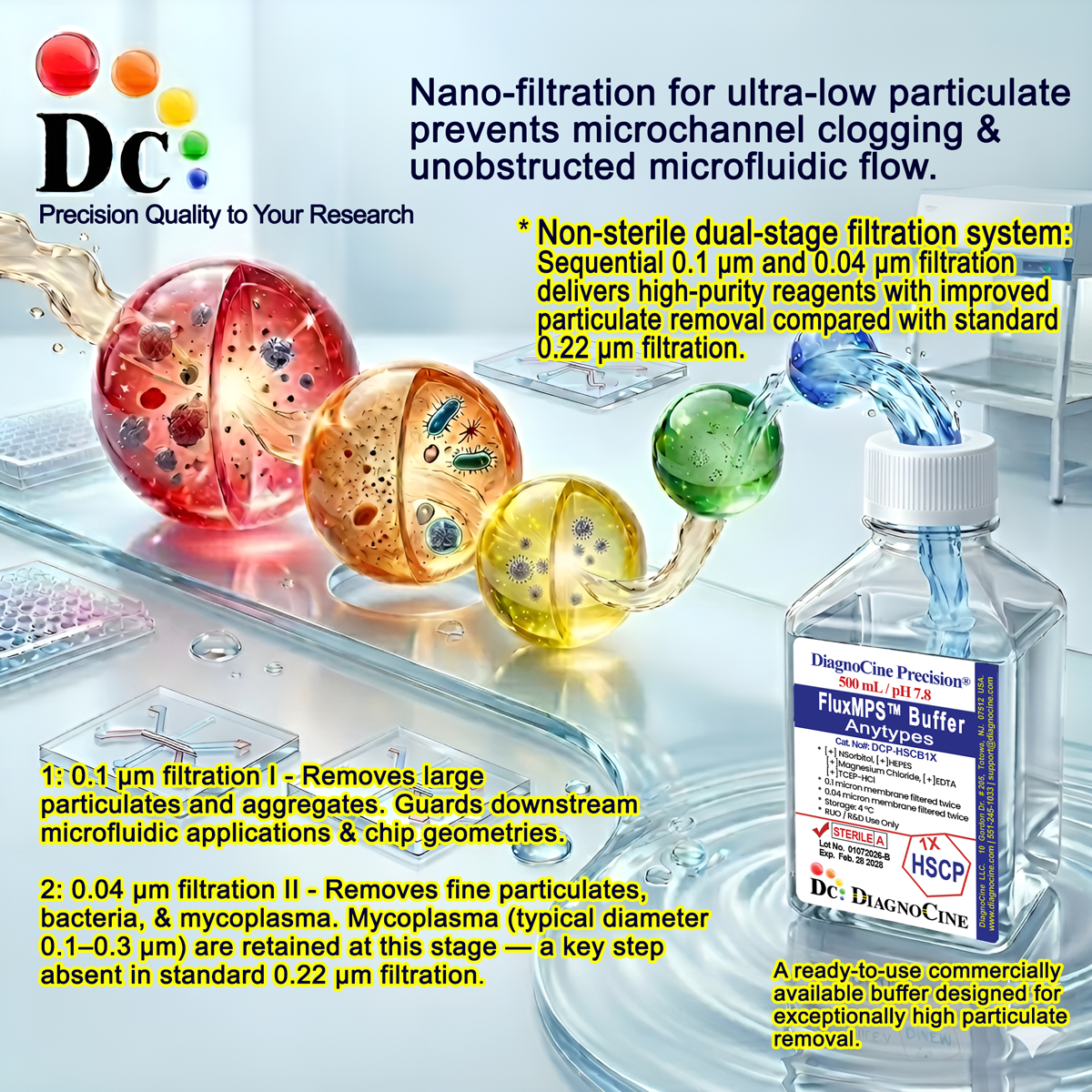
© Diagnocine® — DCP-T1UH2O-1000S
Where Type 1 ultrapure water purity matters
Water quality directly affects the precision, reproducibility, and instrument reliability of sensitive analytical and biological workflows. FluxMPS™ Ultrapure Water, Type 1 supports the applications below.
Automated Bioreactors & Robotics
For automated perfusion bioreactors and robotic liquid-handling systems, an optional 0.01 µm (10 nm) ultra-filtered variant can be requested on top of the standard dual-pass 0.1 µm architecture, further reducing particulate exposure to sensitive valves and sensors.
- Total Particulate Exclusion for long-duration perfusion runs
- Valve & Sensor Protection in automated fluidic systems
- Extended Perfusion Stability for continuous-flow bioreactors
Inquiry Required: the 0.01 µm (10 nm) ultra-filtered grade is available by request — contact support@diagnocine.com.
Micro Physiological System (MPS) & Chip
Low-conductivity, particulate-controlled water for microchannel perfusion and priming.
Wash, Dilution & Reconstitution
Suitable for general PCR reagent preparation (DNA-based, gDNA, abundant-RNA targets); not recommended for delicate PCR applications such as endpoint or quantitative PCR (qPCR).
iPSC-Derived Model Handling
Nuclease- and protease-free water for sensitive stem-cell-derived culture workflows.
Endothelial & Primary Cell Perfusion
Ultrapure base water for perfusion media and buffer preparation in vascular cell models.
ELISA, Blotting & Blocking
Low-background water for wash and dilution steps in immunoassay workflows.
Microscopy & Optical Sensing
Supports HPLC, GC, ICP-MS, and trace-element analysis workflows adjacent to imaging and biosensor studies.
Physical, chemical, and quality parameters
Specifications reflect this product's own stated production and testing parameters.
| Parameter | Specification |
|---|---|
| Formulation / Composition | Ultrapure Water (H2O), CAS 7732-18-5 |
| pH (Non-pH Adjusted) | 4.5 – 5 |
| pH (NaOH pH-Adjusted) | 7.4 |
| Electrolytic Conductivity (ASTM) | 0.05 µS/cm |
| Process Water Purity | 0.015 to 0.005 microSiemens/cm |
| Parameter | Specification |
|---|---|
| Sterility USP <71> | Sterile |
| Nuclease / Protease Status | Free of DNase, RNase, Protease, Endonucleases |
| Endotoxin Reduction | Detoxification step included in purification process |
| Manufacturing Standard ISO 13485 | Exceeds USP requirements |
| Fill Environment | ISO Class 5 (Class 100) |
| Parameter | Specification |
|---|---|
| Shelf Life | 24 months |
| pH Stability Note | Non-pH-adjusted water pH can fall toward 4.5 upon air exposure due to atmospheric CO2 absorption; this does not indicate contamination |
| pH Meter Compatibility | Requires a pH meter specifically designed for low-conductance ultrapure water |
| Parameter | Specification |
|---|---|
| Raw Material Grade | Type 1 Ultrapure Water produced with top-tier purification bead/filter systems |
| Production Method | Demineralization, deionization, detoxification, membrane filtration |
| Regulatory Alignment | Exceeds USP water quality requirements |
| Intended Use | RUO; not for human consumption, therapeutic, or clinical use; general PCR use only, not for delicate/endpoint/qPCR use |
Full composition
A single-component ultrapure water solvent, purified and filtered as described in the specifications above.
| Component | CAS Number | Concentration |
|---|---|---|
| Ultrapure Water (H2O) | 7732-18-5 | Neat (single-component ultrapure water) |
Manufacturing & compliance
Produced under a controlled quality system with purification equipment from leading manufacturers.
ISO 13485:2016 QMS
Manufactured under an ISO 13485:2016-aligned quality management system.
Ultrapure Type 1 Water
Produced via demineralization, deionization, and detoxification using top-tier purification systems.
ISO Class 5 Fill & Finish
Final sterile fill performed in an ISO Class 5 (Class 100) environment.
Micro-Batch Precision
Dual-pass 0.1 µm sterilizing filtration performed on every production batch.
Endotoxin USP <85> BET
Detoxification is included in the purification process; contact support@diagnocine.com for the current Certificate of Analysis.
Particulate USP <788> Method 2
Dual-pass 0.1 µm membrane filtration is applied to reduce particulate load ahead of packaging.
Osmolality USP <785>
Not applicable — single-component ultrapure water solvent with no added osmotic solutes.
Documentation / CoA
A Certificate of Analysis is available upon request — contact support@diagnocine.com.
How DCP-T1UH2O-1000S compares
A qualitative comparison against conventional laboratory water grades.
| Parameter | DCP-T1UH2O-1000S (FluxMPS™) | Conventional Water (0.22 µm filtered) | Standard Alternative (0.22 µm filtered) |
|---|---|---|---|
| Final Filtration Pore Size | 0.1 µm (dual-pass) | 0.22 µm | 0.22 µm |
| Number of Filtration Stages | 2 | 1 | 1 |
| Process Water Purity | 0.015-0.005 µS/cm (ASTM tested) | cancel | cancel |
| Sterile | check_circle | cancel | cancel |
| Nuclease / Protease Free | check_circle | cancel | cancel |
| Manufacturing QMS (ISO 13485:2016) | check_circle | cancel | cancel |
| Microfluidic / OoC Channel Compatibility | check_circle | cancel | cancel |
| pH Options Available | Non-adjusted (4.5-5) or 7.4 adjusted | cancel | cancel |
| Custom Formulation (pH / 0.04 µm Polish) | check_circle | cancel | cancel |
Frequently asked questions
Common questions about FluxMPS™ Ultrapure Water, Type 1.
Supporting literature
Curated literature relevant to ultrapure water quality, purification, and its role in analytical and organ-on-a-chip workflows.
- Bhatia, S.N. & Ingber, D.E. Microfluidic organs-on-chips. Nat Biotechnol. doi:10.1038/nbt.2989
- ASTM International. Standard Test Methods for Electrical Conductivity and Resistivity of Water. doi:10.1520/D1125-19
- United States Pharmacopeia. USP <645> Water Conductivity. USP-NF. doi:10.31003/USPNF_M99290
- Rand, R.N. & Hunt, D.C. Water quality requirements for trace element analysis by ICP-MS. J Anal At Spectrom. doi:10.1039/C5JA00074B
- Snyder, L.R. et al. Water purity effects in HPLC mobile phase preparation. J Chromatogr A. doi:10.1016/j.chroma.2009.09.001
- Light, T.S. Absolute standard for ultrapure water conductivity measurement. Anal Chem. doi:10.1021/ac00043a020
- Reichl, U. et al. Endotoxin control in cell culture media and water systems. Biotechnol Bioeng. doi:10.1002/bit.260420102
- Kamm, R.D. et al. Perspective on microphysiological systems in drug development. Lab Chip. doi:10.1039/C7LC00462A
- Halden, R.U. Trace contaminant considerations in laboratory-grade water. Environ Sci Technol. doi:10.1021/es200779s
- Van Nostrand, W.E. Membrane filtration for sterile water production in the laboratory. J Membr Sci. doi:10.1016/j.memsci.2011.04.023