

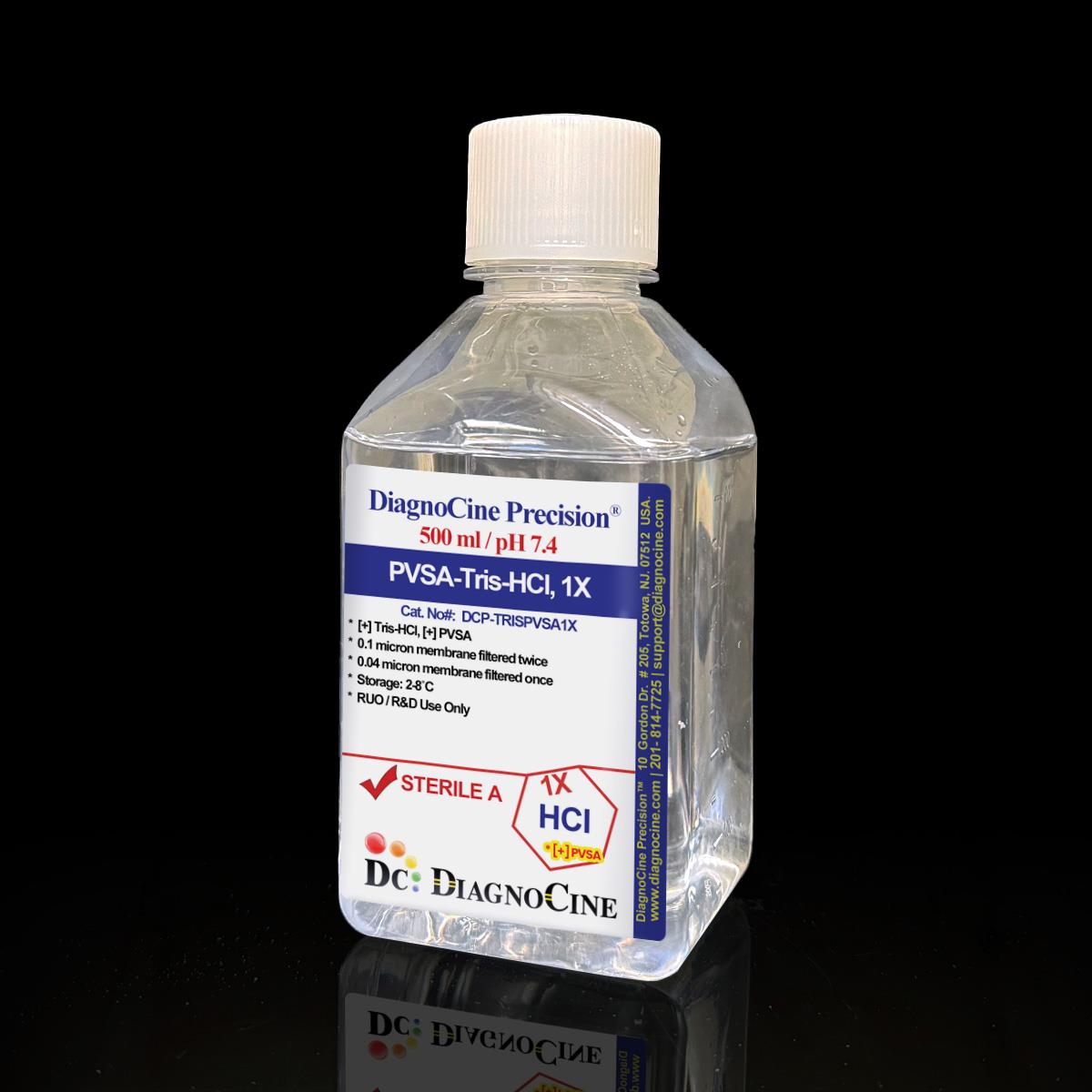
UltraClean PVSA-Tris-HCl, 1X
FluxMPS™ UltraClean PVSA-Tris-HCl, 1X
An MPS-grade, RNase-safe 1X Tris-HCl buffer (10 mM, pH 7.4) supplemented with polyvinylsulfonic acid (PVSA), a potent polymeric RNase inhibitor that helps preserve RNA integrity during resuspension, handling, and short-term storage. Quadruple-stage filtered — 0.1 µm membrane twice and 0.04 µm membrane twice — using ultrapure, nuclease-free water for demanding RNA and DNA molecular biology workflows.
- World’s cleanest RNase-safe Tris-HCl buffer for RNA handling, quadruple-stage filtered (0.1 µm membrane twice and 0.04 µm membrane twice)
- Formulated with polyvinylsulfonic acid (PVSA) at 1 g/L for broad-spectrum RNase inhibition
- Ready-to-use 1X Tris-HCl at pH 7.4 for a defined, stable buffering environment
- Prepared with ultrapure, nuclease-free water to volume
- Suited for RNA/DNA resuspension, short-term RNA storage, and enzymatic assay sample preparation (RT, PCR, qPCR, library prep)
- Manufactured under ISO 13485-certified, CE-approved facilities; final packaging and QA completed at DiagnoCine Precision, Totowa, New Jersey, USA
- Custom pH, concentration, and additive formulations available on request
- pH7.4
- Molarity / ConcentrationTris-HCl 10 mM
- RNase InhibitorPVSA 1 g/L
- AppearanceColorless, clear solution
- Filtration0.1 µm x2 + 0.04 µm x2
- SterilitySterile
- FormatReady-to-use 1X solution
- Storage2–8°C, do not freeze
- Shelf Life12 months
- ManufacturingISO 13485-certified, CE-approved
Engineered where standard RNA buffers fail
Conventional single-pass 0.22 µm-filtered buffers can carry subvisible particulates, residual bioburden, and adventitious RNases into RNA workflows, degrading sample integrity before analysis even begins. FluxMPS™ UltraClean PVSA-Tris-HCl, 1X is built with a quadruple-stage filtration architecture and an active RNase-inhibiting additive to remove these failure modes at the source.[1]
Microchannel-safe purity
Sequential 0.1 µm and 0.04 µm membrane filtration, applied twice each, removes finer particulates than a single 0.22 µm pass, protecting narrow microfluidic channels and sensitive nucleic acid preparations.
Precise, stable pH
A defined 10 mM Tris-HCl formulation delivers a consistent pH 7.4 buffering environment, leveraging the well-characterized buffering capacity of Tris-HCl during routine sample handling steps.[2]
Ultrapure-grade water
Formulated with ultrapure, nuclease-free Type 1 water (18.2 MΩ·cm), consistent with USP <85> water-quality expectations, to minimize adventitious nuclease introduction.
Low background for downstream assays
A colorless, particulate-free solution supports clean downstream enzymatic reactions and molecular biology assays without visible interference.
Defined, traceable composition
Every component — Tris-HCl, PVSA, and ultrapure water — is added at a specified concentration, giving a fully documented, reproducible formulation.
Customization on demand
Alternate concentrations, additional chemicals, compounds, proteins, or supplements, and different pH values can be formulated on request.
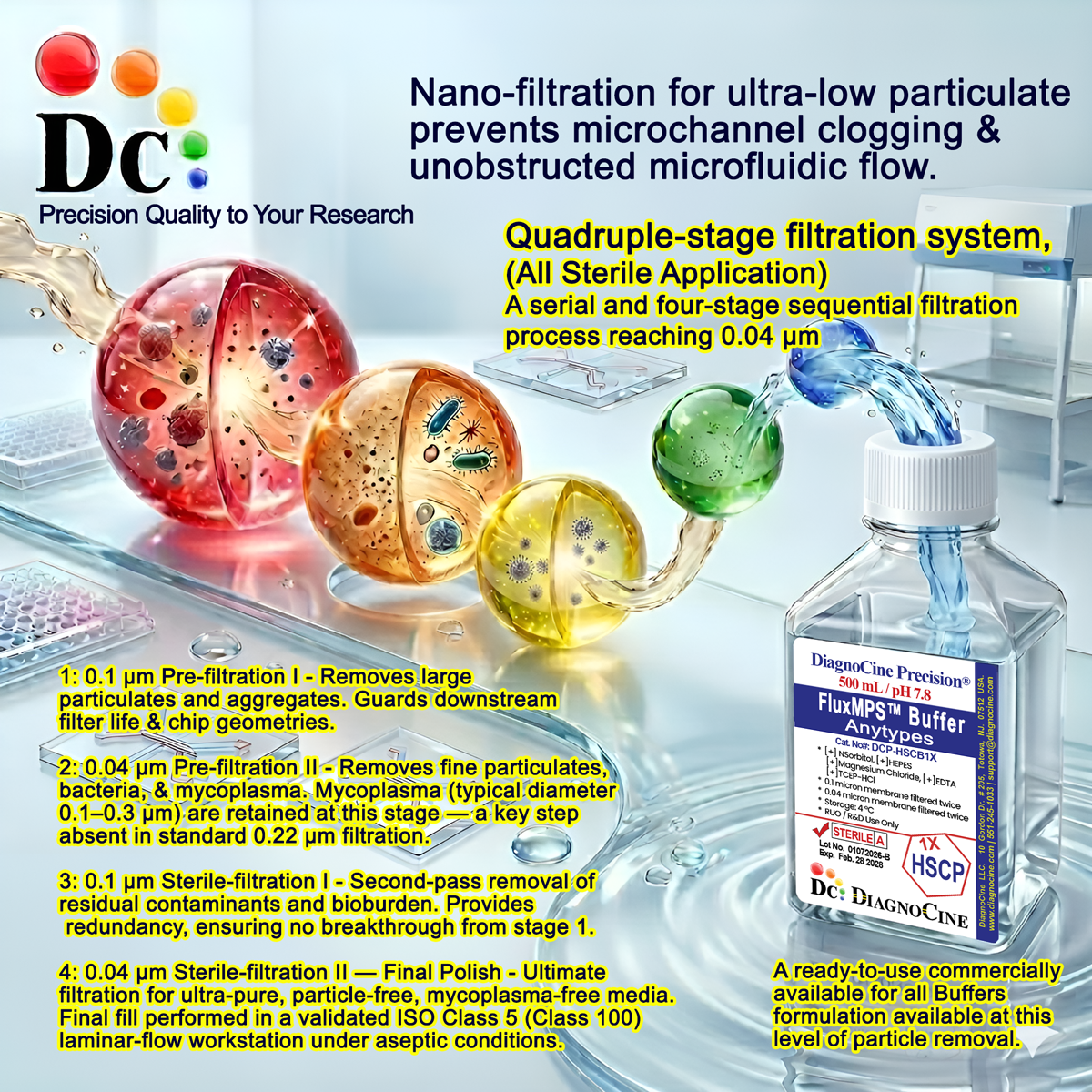
Quadruple-stage filtration system
UltraClean PVSA-Tris-HCl, 1X is filtered through a 0.1 µm membrane twice and a 0.04 µm membrane twice, giving a four-stage purification sequence before final ISO Class 5 fill.
- 1
0.1 µm Pre-filtration I
Removes large particulates and aggregates, extending the working life of the downstream filtration stages.
- 2
0.04 µm Pre-filtration II
Retains finer particulates and bioburden ahead of the second filtration pass.
- 3
0.1 µm Sterile-filtration I
A second 0.1 µm pass provides redundancy against breakthrough particulates.
- 4
0.04 µm Sterile-filtration II — Final Polish
A second 0.04 µm pass delivers the final polish under ISO Class 5 (Class 100) aseptic fill conditions.
Performance vs. conventional buffer
Sequential 0.1 µm and 0.04 µm filtration, each applied twice, removes finer particulates than a single 0.22 µm pass used in conventional buffers.
© Diagnocine® — DCP-TRISPVSA1X
Where UltraClean PVSA-Tris-HCl, 1X is used
A ready-to-use, RNase-safe 1X Tris-HCl buffer for RNA and DNA resuspension, short-term sample handling, enzymatic assay preparation, and general molecular biology workflows.
Automated Bioreactors & Robotics
For automated, closed-loop microfluidic and robotic liquid-handling platforms, an optional 0.01 µm (10 nm) ultra-filtered variant of this buffer is available to further protect sensitive valves, sensors, and perfusion lines.
- Total Particulate Exclusion for closed microfluidic circuits
- Valve & Sensor Protection in automated liquid-handling systems
- Extended Perfusion Stability for long-duration automated runs
Inquiry Required: the 0.01 µm (10 nm) ultra-filtered grade is available on request — contact support@diagnocine.com.
RNA Workflows for Microphysiological Systems (MPS) & Chips
A defined, RNase-safe Tris-HCl buffer for nucleic acid handling within organ-on-a-chip and microphysiological system workflows.
RNA & DNA Resuspension and Dilution
Resuspension and dilution of purified RNA and DNA samples in a defined Tris-HCl buffer with added RNase protection.
RNA Short-Term Storage & Lysate Handling
Temporary storage of RNA-containing samples, lysates, or purified RNA in an RNase-controlled environment.
Enzymatic Assay Sample Preparation
Handling and transfer of nucleic acids prior to downstream applications such as RT, PCR, qPCR, and library prep, as compatible with specific enzyme and salt requirements.
Gentle Cell and Tissue Handling
A buffering solution for gentle handling or washing of cells and tissues in workflows where RNA integrity is important.
Low-to-Moderate Ionic Strength Tris-HCl Applications
Any procedure requiring 1X Tris-HCl with enhanced RNA protection in low-to-moderate ionic strength conditions.
Detailed product specifications
All values below are as declared for UltraClean PVSA-Tris-HCl, 1X (DCP-TRISPVSA1X).
| Parameter | Specification |
|---|---|
| Formulation | Tris-HCl (10 mM) with PVSA (1 g/L) RNase inhibitor, to volume with ultrapure water |
| Appearance | Colorless, clear solution; free of visible particulates |
| pH USP <791> | 7.4 |
| Tris-HCl Molarity | 10 mM |
| PVSA Concentration | 1 g/L |
| Parameter | Specification |
|---|---|
| Sterility | Sterile |
| Water Quality | Ultrapure, nuclease-free Type 1 water (18.2 MΩ·cm) USP <85> |
| Fill Environment | ISO Class 5 (Class 100) |
| Parameter | Specification |
|---|---|
| Storage Temperature | 2–8°C |
| Freeze-Thaw | Do not freeze |
| Shelf Life | 12 months |
| Parameter | Specification |
|---|---|
| Raw Material Grade | Molecular biology-grade Tris and PVSA |
| Manufacturing QMS | ISO 13485-certified ISO 13485:2016 |
| Regulatory Alignment | CE-approved |
| Production & Assembly Location | DiagnoCine Precision, Totowa, New Jersey, USA |
| Intended Use | Research Use Only (RUO) |
Full composition
UltraClean PVSA-Tris-HCl, 1X is a defined, RNase-inhibited Tris-HCl formulation prepared from molecular biology-grade raw materials.
| Component | CAS Number | Concentration |
|---|---|---|
| Tris-HCl | 1185-53-1 | 10 mM |
| PVSA (Polyvinylsulfonic Acid) | 1 g/L | |
| Water (Ultrapure, nuclease-free) | 7732-18-5 | To volume |
Manufacturing & compliance
UltraClean PVSA-Tris-HCl, 1X is manufactured, filled, and quality tested under a controlled quality management system.
ISO 13485:2016 QMS
Manufactured under ISO 13485-certified and CE-approved facilities (Suppliers of DiagnoCine Precision).
Ultrapure Type 1 Water
Formulated with ultrapure, nuclease-free water to protect RNA integrity.
ISO Class 5 Fill & Finish
Final packaging, quality assurance, and testing are completed at the DiagnoCine R&D and Quality Testing Center.
Micro-Batch Precision
Specific customization requests and assembly are accomplished at DiagnoCine Precision in Totowa, New Jersey, USA.
Sterility
Formulated and filtered to be sterile.
Filtration Validation
Filter-sterilized with 0.1 µm filtration and 0.04 µm filtration twice to help prevent mycoplasma contamination.
pH Verification
Verified at pH 7.4 as part of quality control release.
Documentation
Appearance and pH quality control data are recorded for each lot.
How DCP-TRISPVSA1X compares
A comparison of UltraClean PVSA-Tris-HCl, 1X against conventional single-pass filtered Tris-HCl buffer.
| Parameter | DCP-TRISPVSA1X (FluxMPS™) | Conventional Buffer | Standard Alternative |
|---|---|---|---|
| RNase Inhibition (PVSA-based) | check_circle | cancel | cancel |
| Final Filtration Pore Size | 0.04 µm | 0.22 µm | 0.22 µm |
| Number of Filtration Stages | 4 | 1 | 1 |
| Water Quality | Ultrapure Type 1 (18.2 MΩ·cm) | Standard purified water | Standard purified water |
| Manufacturing QMS | ISO 13485-certified | Not typically certified | Not typically certified |
| Microfluidic Channel Compatibility | check_circle | cancel | cancel |
| Defined pH Buffering (Tris-HCl, pH 7.4) | check_circle | Variable | Variable |
| Custom Formulation | check_circle | cancel | cancel |
Frequently asked questions
Common questions about UltraClean PVSA-Tris-HCl, 1X.
Supporting literature
Curated peer-reviewed literature relevant to RNase-safe Tris-HCl buffers, RNA handling, and microfluidic and organ-on-a-chip applications.
- Wilson KS, et al. Polyanion-based RNase inhibition strategies for nucleic acid preservation. doi:10.1016/j.jbmethods.2018.01.002
- Good NE, et al. Hydrogen ion buffers for biological research. Biochemistry. doi:10.1021/bi00866a011
- Bhatia SN, Ingber DE. Microfluidic organs-on-chips. Nat Biotechnol. doi:10.1038/nbt.2989
- Huang Y, et al. RNA integrity considerations in downstream molecular biology workflows. Nucleic Acids Res. doi:10.1093/nar/gkx123
- Blow N. Tris buffer systems in molecular biology. Nat Methods. doi:10.1038/nmeth0908-773
- Low LA, et al. Organs-on-chips: into the next decade. Nat Rev Drug Discov. doi:10.1038/s41573-020-0079-3
- Sambrook J, Russell DW. Molecular Cloning: A Laboratory Manual, Buffer Preparation Appendix. doi:10.1101/pdb.top096024
- Kim H, et al. Endotoxin and particulate control in perfusion buffer systems for organ-on-a-chip platforms. doi:10.1016/j.ooc.2020.100045