UltraClean GuardRNA DMSO Lysis Buffer
FluxMPS™ UltraClean GuardRNA DMSO Lysis Buffer
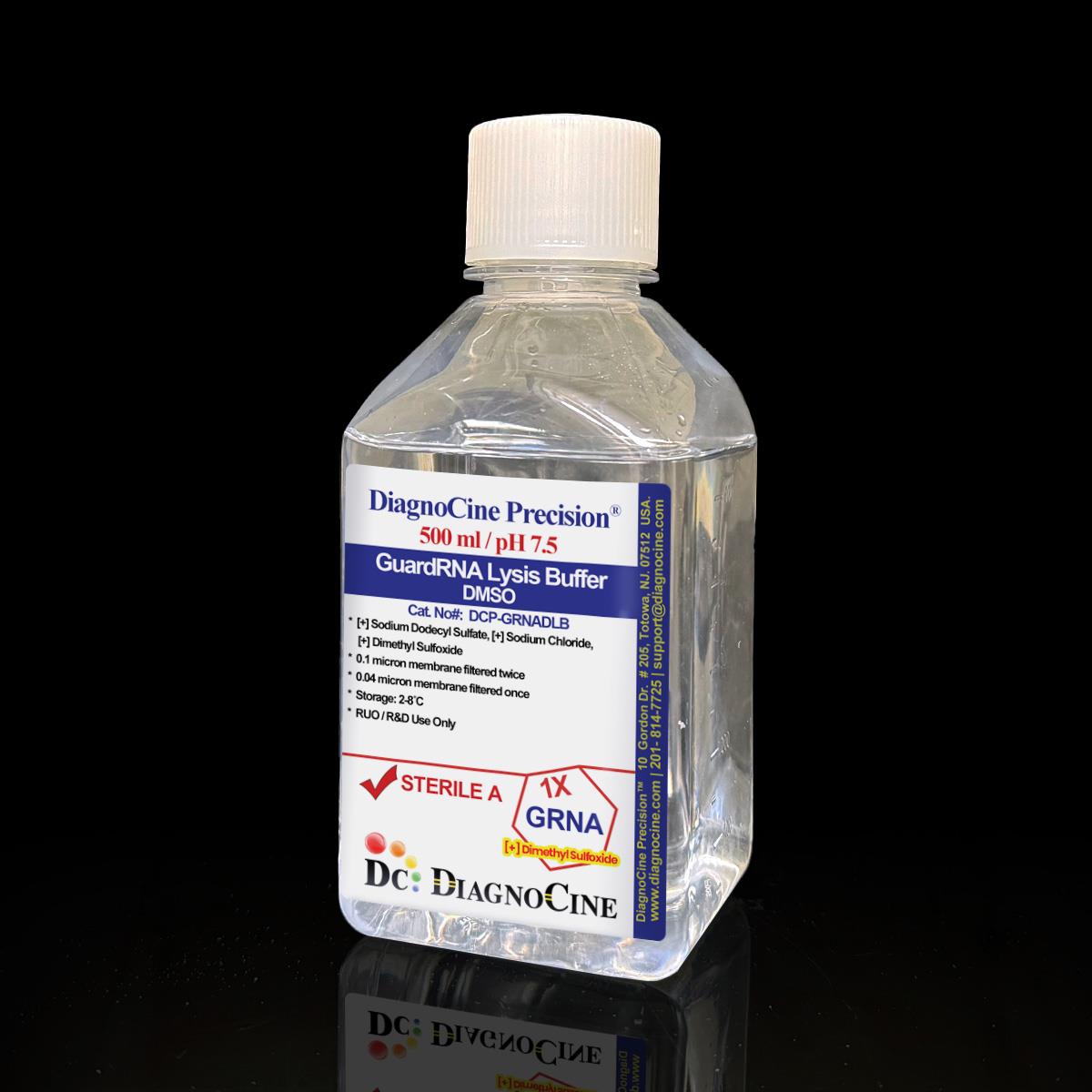
FluxMPS™ UltraClean GuardRNA DMSO Lysis Buffer is a ready-to-use, phenol-free, RNase-safe lysis reagent built around a strong anionic detergent, high ionic strength, and DMSO to penetrate and solubilize tough cell walls and membranes. Quadruple-stage filtration — 0.1 µm membrane twice and 0.04 µm membrane twice — delivers a sterile, ultrapure lysis solution suited to demanding RNA extraction, molecular biology, and microfluidic sample-prep workflows.
- Sterile, ultrapure buffer filtered 0.1 µm membrane twice and 0.04 µm membrane twice
- Strong anionic detergent (SDS) plus high ionic strength NaCl for rapid RNase denaturation
- DMSO-enhanced penetration for efficient lysis of yeast, plant, and other tough samples
- Phenol-free workflow — no phenol/chloroform extraction step required
- Ready-to-use 1X solution prepared with RNase-free water
- Broad compatibility with column, magnetic bead, and precipitation-based RNA purification
- Custom concentrations, pH, and additive modifications available on request
- pH7.5
- FormulationSDS / NaCl / DMSO lysis system
- SDS Concentration4% (w/v)
- NaCl Concentration0.5 M
- DMSO Concentration2% (v/v)
- SterilitySterile, filter-sterilized
- Filtration0.1 µm x2 + 0.04 µm x2
- Storage2–8°C, do not freeze
- Shelf Life12 months
- Intended UseResearch Use Only (RUO)
Engineered where standard lysis buffers fail
Conventional 0.22 µm-filtered lysis reagents can carry subvisible particulates, inconsistent ionic strength, and residual bioburden into RNA workflows, elevating background and risking RNase carry-over. FluxMPS™ GuardRNA DMSO Lysis Buffer is built to remove those variables before the sample ever sees a purification column.
RNase-safe purity
Quadruple-stage filtration to a final 0.04 µm pore size reduces particulate and bioburden carry-over before lysis.
Defined, stable pH
Supplied at pH 7.5 with 0.5 M NaCl for consistent, high ionic strength lysis conditions lot to lot.
Ultrapure-grade water
Formulated to volume with ultrapure, nuclease-free water to protect RNA integrity during extraction.
Low-background, phenol-free workflow
Avoids phenol/chloroform extraction, simplifying handling and reducing background for downstream RNA-based assays.
Defined, traceable composition
A lot-released SDS, NaCl, and DMSO formulation with every component and concentration documented.
Customization on demand
Alternative concentrations, additional chemicals or supplements, and different pH values available on request.
Quadruple-stage filtration system
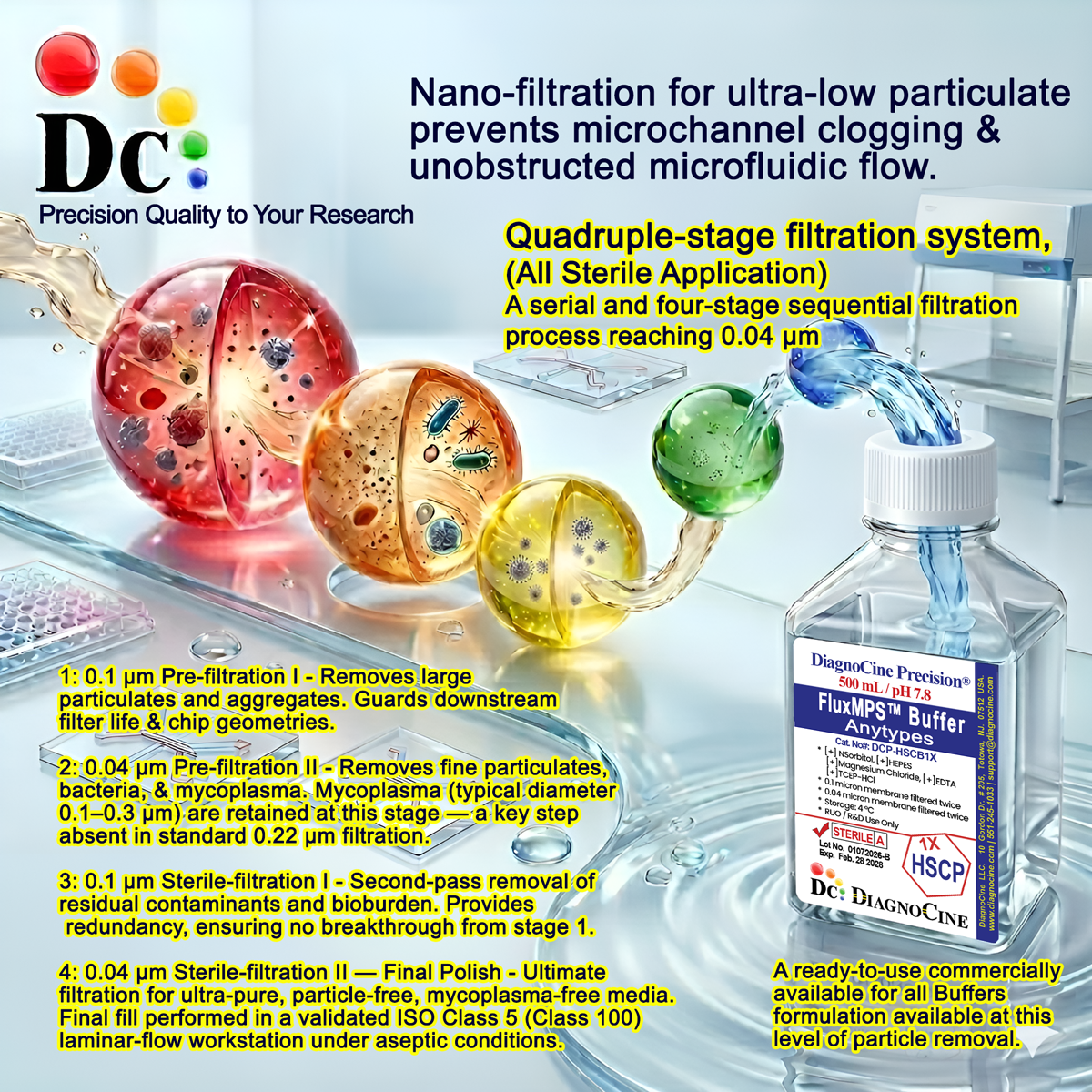
Every lot of GuardRNA DMSO Lysis Buffer passes through 0.1 µm membrane filtration twice followed by 0.04 µm membrane filtration twice, delivering a sterile, ultrapure buffer engineered for RNase-safe, low-particulate RNA extraction.
-
1
0.1 µmPre-filtration I
Removes large particulates and aggregates, protecting downstream filters and extending their working life.
-
2
0.04 µmPre-filtration II
Retains fine particulates and bioburden ahead of the final sterile-filtration passes.
-
3
0.1 µmSterile-filtration I
A second 0.1 µm pass provides redundant particulate and bioburden clearance.
-
4
0.04 µmSterile-filtration II — Final Polish
A second 0.04 µm pass delivers the final polish, filling the buffer under aseptic conditions.
Performance vs. conventional buffer
Sequential 0.1 µm and 0.04 µm filtration, each applied twice, removes finer particulates and bioburden than a single 0.22 µm pass used in conventional lysis reagents, supporting cleaner, lower-background RNA extraction.
© Diagnocine® — DCP-GRNADLB
Built for demanding RNA sample preparation
GuardRNA DMSO Lysis Buffer is formulated for efficient disruption of difficult or resilient samples while preserving RNA integrity, supporting high-yield, high-quality RNA extraction across manual and automated workflows.
Automated Bioreactors & Robotics
An optional 0.01 µm (10 nm) ultra-filtered variant is available for integration into automated bioreactor and robotic liquid-handling platforms where valve and sensor protection is critical.
- Total Particulate Exclusion: The 10 nm grade targets exclusion of sub-visible particulate ahead of automated fluidic paths.
- Valve & Sensor Protection: Reduces particulate load reaching sensitive robotic valves and inline sensors.
- Extended Perfusion Stability: Supports longer unattended run times in automated liquid-handling workflows.
Inquiry Required: the 0.01 µm (10 nm) ultra-filtered grade is produced to order — contact support@diagnocine.com to request this configuration.
Tough Sample RNA Extraction
Lysis of yeast, plant material, and other hard-to-lyse cells prior to RNA purification.
Phenol-Free RNA Isolation
Primary lysis step in phenol-free workflows for samples that require enhanced solubilization.
Mixed & Complex Sample Processing
Processing of samples with high extracellular matrix content or partially fixed material where standard lysis is insufficient.
RNA-seq, qPCR & RT-PCR Prep
Front-end lysis for difficult samples destined for expression profiling and other RNA-based assays after appropriate cleanup.
Automated & High-Throughput Workflows
Use in manual or automated pipelines that need a robust lysis reagent for diverse, challenging inputs.
Microfluidic & Organ-on-a-Chip Sample Lysis
Low-particulate, sterile lysis buffer suited to on-chip and off-chip RNA sample preparation from microphysiological systems.
Full specification sheet
Every value below reflects the release specification for this lot of GuardRNA DMSO Lysis Buffer.
| Parameter | Specification |
|---|---|
| Formulation / Composition | SDS 4% (w/v), NaCl 0.5 M, DMSO 2% (v/v), ultrapure nuclease-free water to volume |
| Appearance | Colorless, clear solution; free of visible particulates |
| pH USP <791> | 7.5 |
| Ionic Strength | High ionic strength (0.5 M NaCl) |
| Parameter | Specification |
|---|---|
| Sterility USP <71> | Sterile, filter-sterilized |
| Water Quality | Ultrapure Type 1 water (18.2 MΩ·cm), nuclease-free |
| Manufacturing Standard ISO 13485 | ISO 13485-certified facility |
| Fill Environment | ISO Class 5 (Class 100) aseptic fill |
| Parameter | Specification |
|---|---|
| Storage Temperature | 2–8°C |
| Freeze-Thaw | Do not freeze |
| Shelf Life | 12 months |
| Parameter | Specification |
|---|---|
| Manufacturing QMS ISO 13485:2016 | ISO 13485-certified, CE-approved facility |
| Regulatory Alignment | CE-approved |
| Production Method | Final packaging, QA, testing, and customization performed at the Diagnocine R&D and Quality Testing Center, Totowa, New Jersey, USA |
| Intended Use | Research Use Only (RUO) |
Full composition
GuardRNA DMSO Lysis Buffer is a defined SDS / NaCl / DMSO lysis system, supplied ready-to-use and released against the values below.
| Component | CAS Number | Concentration |
|---|---|---|
| Sodium Dodecyl Sulfate (SDS) | 151-21-3 | 4% (w/v) |
| Sodium Chloride (NaCl) | 7647-14-5 | 0.5 M |
| Dimethyl Sulfoxide (DMSO) | 67-68-5 | 2% (v/v) |
| Water (Ultrapure, nuclease-free) | 7732-18-5 | To volume |
Manufacturing & compliance
GuardRNA DMSO Lysis Buffer is manufactured, filled, and released under a controlled quality system spanning raw materials through final packaging.
ISO 13485:2016 QMS
Manufactured under ISO 13485-certified and CE-approved facilities.
Ultrapure Water Base
Prepared with ultrapure, nuclease-free water to volume.
ISO Class 5 Fill & Finish
Filled under ISO Class 5 (Class 100) aseptic conditions after quadruple-stage filtration.
Totowa, NJ Customization
All specific customization requests and assembly are accomplished at Diagnocine Precision in Totowa, New Jersey, USA.
Sterility USP <71>
Released as sterile, filter-sterilized product.
pH USP <791>
Released at pH 7.5.
Appearance
Colorless, clear solution, free of visible particulates.
Documentation / CoA
Certificates of Analysis are available for this lot.
How DCP-GRNADLB compares
A side-by-side look at GuardRNA DMSO Lysis Buffer against conventional lysis reagent formats.
| Parameter | DCP-GRNADLB (FluxMPS™) | Conventional Lysis Buffer | Standard Alternative |
|---|---|---|---|
| Phenol-free formulation | check_circle | cancel | cancel |
| DMSO-enhanced lysis | check_circle | cancel | cancel |
| Final filtration pore size | 0.1 µm x2 + 0.04 µm x2 | 0.22 µm single pass | Not filter-sterilized |
| Sterility | check_circle | check_circle | cancel |
| Water quality | Ultrapure Type 1 (18.2 MΩ·cm), nuclease-free | Standard nuclease-free water | Not specified |
| Manufacturing QMS | ISO 13485:2016 | Not specified | Not specified |
| Custom formulation available | check_circle | cancel | cancel |
Frequently asked questions
Common questions about GuardRNA DMSO Lysis Buffer.
Supporting literature
Curated literature relevant to phenol-free lysis chemistry, DMSO-assisted extraction, and RNA sample preparation.
- Chomczynski P, Sacchi N. The single-step method of RNA isolation by acid guanidinium thiocyanate-phenol-chloroform extraction: twenty-something years on. doi:10.1038/nprot.2006.83
- Rio DC, Ares M, Hannon GJ, Nilsen TW. Purification of RNA using TRIzol (TRI Reagent). doi:10.1101/pdb.prot5439
- Green MR, Sambrook J. Isolation of Total RNA from Cultured Yeast Cells. doi:10.1101/pdb.prot101659
- Onishi H, Kawamoto S. Effects of dimethyl sulfoxide on cell membrane permeability and enzyme denaturation. doi:10.1016/j.jconrel.2019.06.005
- Wilfinger WW, Mackey K, Chomczynski P. Effect of pH and ionic strength on the spectrophotometric assessment of nucleic acid purity. doi:10.2144/97223st01
- Ingham CJ, van Hylckama Vlieg JE. MEMS and the microbe. doi:10.1039/b804924b
- Bhatia SN, Ingber DE. Microfluidic organs-on-chips. doi:10.1038/nbt.2989
- Razin S, Yogev D, Naot Y. Molecular biology and pathogenicity of mycoplasmas. doi:10.1128/MMBR.62.4.1094-1156.1998
- Sittampalam GS, et al. Assay Guidance Manual: sample preparation for high-throughput screening. doi:10.1093/nar/gkab1061
- Fleige S, Pfaffl MW. RNA integrity and the effect on the real-time qRT-PCR performance. doi:10.1016/j.mam.2005.12.007