

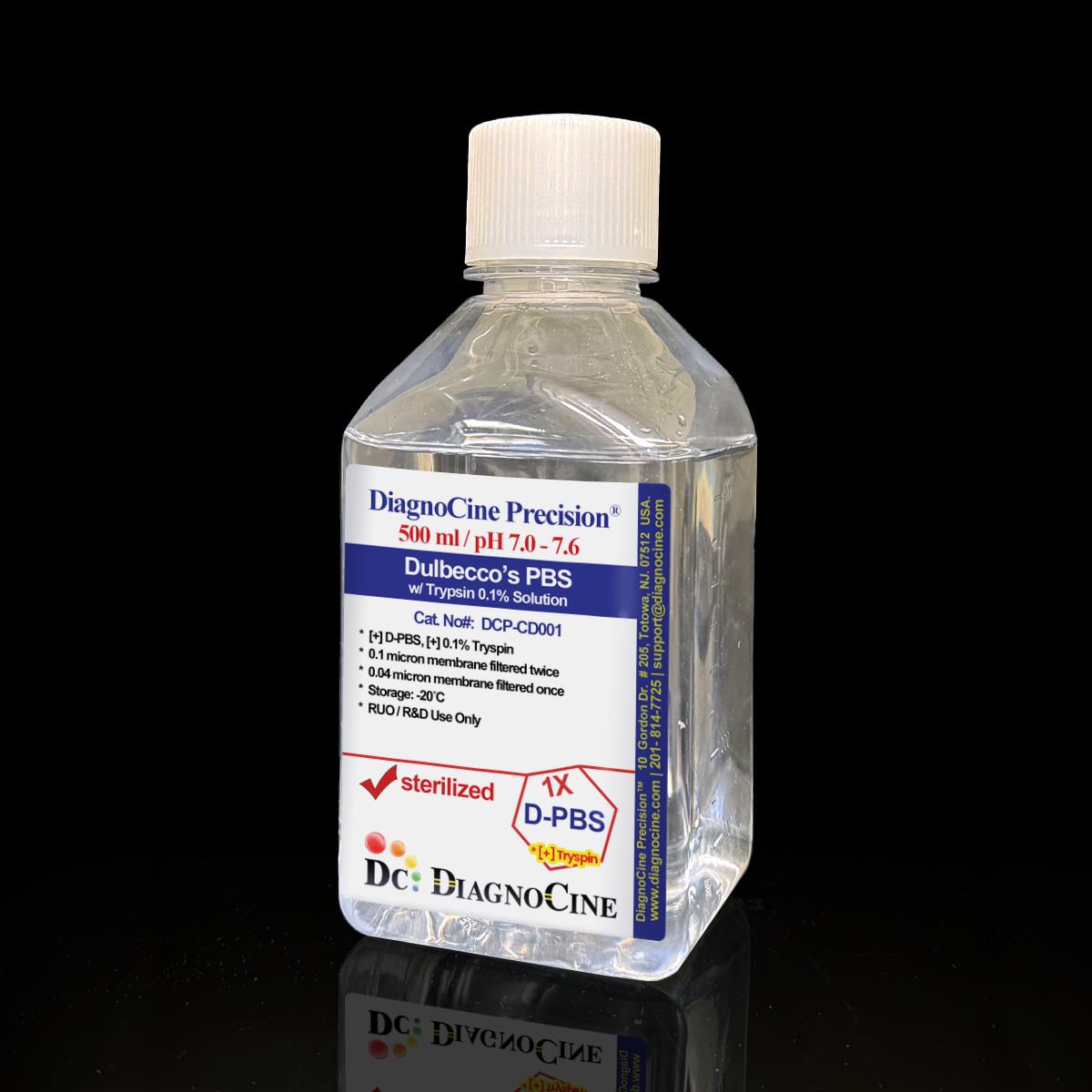
FluxMPS™ Trypsin 0.1% Solution in Dulbecco's Phosphate Buffered Saline (1X)
Microfluidics Suitable, dual-stage ultra-filtered (0.1 µm + 0.04 µm) 0.1% trypsin solution prepared in 1X Dulbecco's Phosphate Buffered Saline, engineered for gentle, reproducible dissociation of adherent cells in microfluidic, organ-on-a-chip (OoC), and standard cell culture workflows.
- Trypsin (CAS 9002-07-7, EC 3.4.21.4), a 223-residue serine protease, supplied as a 0.1% w/v solution in 1X Dulbecco's Phosphate Buffered Saline
- Dual-stage filtration: 0.1 µm prefiltration followed by a 0.04 µm final filter for microchannel-safe clarity
- Colorless, clear solution; pH 7.00 - 7.60; osmolality 275 - 315 mOsm/kg H2O
- Sterility confirmed by 14-day USP <71> incubation with no bacterial or fungal growth observed
- Lot-released against a functional Cell Dissociation Test, not just a compositional spec
- Validated for dissociating adherent cell monolayers, routine passaging, and primary tissue dissociation
- Manufactured under an ISO 13485:2016 quality management system; final packaging, QC, and customization performed at Diagnocine, Totowa, NJ
- Custom pH, concentration, and EDTA-supplemented formulations available on request
- Active EnzymeTrypsin, 0.1% w/v
- Buffer SystemDulbecco's Phosphate Buffered Saline (1X)
- Molecular Weight23.4 kDa
- pH (USP <791>)7.00 - 7.60
- Osmolality (USP <785>)275 - 315 mOsm/kg H2O
- Sterility (USP <71>)No growth, 14-day incubation
- Filtration0.1 µm ×1 + 0.04 µm ×1 (dual-stage)
- Storage-20°C, non-self-defrosting freezer
- Shelf Life24 months from date of manufacture
- ShippingDry ice
Engineered where standard dissociation reagents fall short
Conventional 0.22 µm filtered trypsin solutions leave sub-micron particulates and mycoplasma-scale contaminants in the reagent, which can accumulate in microfluidic channels, foul sensors, and confound downstream imaging. FluxMPS™ addresses each failure mode directly.
Microchannel-safe purity
A 0.1 µm prefilter followed by a 0.04 µm final filter removes particulate well below the size that clogs microfluidic channels and valves.
Consistent, lot-qualified activity
Every lot is released against a functional Cell Dissociation Test, not a compositional assay alone, so dissociation performance is verified before shipment.
Defined buffer system
Prepared in 1X Dulbecco's Phosphate Buffered Saline at a controlled pH (7.00 - 7.60) and osmolality (275 - 315 mOsm/kg H2O) for predictable, reproducible dissociation.
Low background for imaging
Reduced particulate carryover supports cleaner downstream flow cytometry and live-cell microscopy after cell recovery.
Validated for sensitive cell types
Suitable for primary tissue dissociation and routine passaging of established and stem-cell-derived lines where dissociation gentleness matters.
Customization on demand
Concentration, pH, and EDTA supplementation can be tailored to specific cell lines and protocols — contact support@diagnocine.com.
Dual-stage filtration system
This trypsin solution is processed through a validated two-pass filtration train reaching a 0.04 µm final pore size, engineered as a dedicated prefilter and final-filter pair rather than a simple descending cascade.
- 0.1 µm
Prefiltration
Removes large particulate and protein aggregates, protecting the downstream 0.04 µm final filter cartridge.
- 0.04 µm
Final filtration — Polish
Retains sub-micron particulates and microaggregates that pass through a conventional 0.22 µm filter.
Filtration facts
Two dedicated filtration passes reach a final cut-off well below the industry-standard 0.22 µm, without altering enzymatic activity.
Where this dissociation reagent is used
From routine passaging to seeding microphysiological systems, gentle and reproducible cell recovery is a prerequisite for downstream assay quality.
Automated Bioreactors & Robotics
For automated cell-harvesting platforms and robotic liquid handlers, an optional 0.01 µm (10 nm) ultra-filtered MPS Grade variant of this reagent is available, minimizing particulate load on valves, sensors, and microfluidic manifolds during continuous operation.
- Total Particulate Exclusion — supports long-run automated harvesting cycles
- Valve & Sensor Protection — reduces fouling in robotic dispensing systems
- Extended Perfusion Stability — consistent reagent quality across large batch runs
Inquiry Required: The 0.01 µm MPS Grade variant is produced on request — contact support@diagnocine.com to discuss automated system requirements.
Cell Harvesting for Microphysiological Systems (MPS) & Chip Seeding
Low-particulate dissociation for seeding cells into microfluidic devices without channel or valve fouling.
Passaging of Cancer Cell Lines
Gentle, reproducible dissociation for maintaining and subculturing adherent cancer cell lines.
iPSC & Primary Cell Harvesting
Supports dissociation protocols for iPSC-derived and primary cell models requiring gentle handling.
Endothelial & Primary Cell Dissociation
Used for detachment and passaging of endothelial and primary hepatic cell cultures.
Cell Harvesting for Metabolic Flux Assays
Used to recover cells prior to seeding into metabolic flux and tracer-based assay platforms.
Cell Recovery for Microscopy & Flow Cytometry
Low-particulate reagent supports cleaner downstream flow cytometry and live-cell imaging after harvesting.
- Aspirate spent medium from the culture vessel.
- Wash the monolayer with a calcium- and magnesium-free balanced salt solution, rocking the flask 1-2 minutes; discard the wash.
- Add sufficient Trypsin solution to cover the monolayer.
- Rock the flask to ensure even coverage of the cell sheet.
- Incubate at 37°C for 2-3 minutes, monitoring under an inverted microscope until cells round up and detach; gentle tapping may assist difficult-to-remove lines.
- Add serum-containing complete medium to inhibit tryptic activity.
- Disperse cells into a single-cell suspension by repeated pipetting.
- Count and subculture the cells.
Concentration and exposure time should be optimized empirically for each cell line; dissociation time depends on cell type, density, trypsin potency, serum concentration, and time since last subculture.
Full parameter set
All parameters below are release specifications verified prior to shipment.
| Parameter | Specification |
|---|---|
| Formulation | Trypsin, 0.1% w/v in 1X Dulbecco's Phosphate Buffered Saline |
| Appearance | Colorless, clear solution |
| pH USP <791> | 7.00 - 7.60 |
| Osmolality USP <785> | 275 - 315 mOsm/kg H2O |
| Active Enzyme | Trypsin, 0.1% w/v (1,000 mg/L) |
| Molecular Weight | 23.4 kDa |
| EC Number | 3.4.21.4 |
| Parameter | Specification |
|---|---|
| Sterility USP <71> | No bacterial or fungal growth, 14-day incubation |
| Mycoplasma | 0.1 µm mycoplasma-retentive filtration (not tested per lot) |
| Cultural Response | Cell Dissociation Test |
| Manufacturing Std. | ISO 13485:2016 |
| Parameter | Specification |
|---|---|
| Storage Temperature | -20°C, non-self-defrosting freezer |
| After Thawing | Stable ~2 weeks at 2-8°C; avoid repeated freeze-thaw |
| Shelf Life | 24 months from date of manufacture; use before label expiry |
| Shipping Condition | Dry ice |
| Available Pack Sizes | 100 mL, 500 mL |
| Parameter | Specification |
|---|---|
| CAS Number | 9002-07-7 |
| Manufacturing QMS | ISO 13485:2016 |
| UNSPSC | 41116155 — Molecular biology and cell culture growth media (UNv260801) |
| Regulatory Alignment | ISO 13485:2016 certified manufacturing |
| Production Method | Custom formulation, final QC and packaging at Diagnocine, Totowa, NJ |
| Intended Use | Research Use Only (RUO) |
Product composition
Component identity, concentration, and quality attributes for this dissociation reagent, released per lot.
| Component | CAS / EC Number | Concentration |
|---|---|---|
| Trypsin | CAS 9002-07-7 / EC 3.4.21.4 | 1,000 mg/L (0.1% w/v) |
| Component | CAS Number | Concentration |
|---|---|---|
| Dulbecco's Phosphate Buffered Saline (1X) | — | Formulated to pH 7.00 - 7.60, 275 - 315 mOsm/kg H2O |
| Attribute | Method | Result / Specification |
|---|---|---|
| Appearance | Visual | Colorless, clear solution |
| pH | USP <791> | 7.00 - 7.60 |
| Osmolality | USP <785> | 275 - 315 mOsm/kg H2O |
| Sterility | USP <71> | No growth, 14-day incubation |
| Cultural Response | Functional assay | Cell Dissociation Test |
| Molecular Weight | — | 23.4 kDa |
Manufacturing & compliance
This product is manufactured under ISO 13485-certified facilities (Suppliers of Diagnocine Precision). All final packaging, quality assurance, and testing are performed at the Diagnocine R&D and Quality Testing Center. All specific customization requests and assembly are performed at Diagnocine Precision in Totowa, New Jersey, USA.
ISO 13485:2016 QMS
Manufactured under a certified quality management system throughout production and release.
Dual-stage filtration
0.1 µm prefiltration + 0.04 µm final filtration for microchannel-safe clarity.
Lot-released Cell Dissociation Testing
Each lot is functionally verified for dissociation performance before release.
Finished in Totowa, NJ
Final QC, packaging, and customization performed at Diagnocine Precision, Totowa, New Jersey, USA.
Sterility USP <71>
No bacterial or fungal growth observed after 14 days of incubation.
Mycoplasma Control
0.1 µm mycoplasma-retentive filtration applied during processing (not tested per lot).
pH & Osmolality USP <791> / <785>
pH 7.00 - 7.60; osmolality 275 - 315 mOsm/kg H2O, verified per lot.
Documentation / CoA
Certificate of Analysis available for every lot, including QC results and expiry.
How DCP-CD001 compares
A parameter-by-parameter comparison against conventional 0.22 µm filtered trypsin reagents.
| Parameter | DCP-CD001 (FluxMPS™) | Conventional Trypsin Solution | Standard Alternative |
|---|---|---|---|
| Grade | Microfluidics Suitable (0.04 µm final filtration) | Standard grade (0.22 µm filtered) | Standard grade (0.22 µm filtered) |
| Formulation | 0.1% trypsin in 1X DPBS, lot-released Cell Dissociation Test | 0.1%-0.25% trypsin, variable QC | Formulation varies by supplier |
| Final filtration pore size | 0.04 µm | 0.22 µm | 0.22 µm |
| Number of filtration stages | 2 (0.1 µm + 0.04 µm) | 1 (0.22 µm) | 1 (0.22 µm) |
| Mycoplasma barrier filtration | check_circle 0.1 µm mycoplasma-retentive | cancel Not specified | cancel Not specified |
| Endotoxin (release specification) | Not specified | Corning classical liquid media — < 0.25 EU/mL Sigma-Aldrich DMEM complete medium — ≤ 2 EU/mL Gibco classical DMEM — Not specified (recorded per lot) |
|
| Manufacturing QMS | check_circle ISO 13485:2016 | Varies by supplier | Varies by supplier |
| Microfluidic channel compatibility | check_circle Validated for microchannel use | Not specified | Not specified |
| Custom formulation available | check_circle pH, concentration, EDTA on request | cancel Standard formulations only | cancel Standard formulations only |
Comparison figures from published supplier specifications, accessed 2026-09-02. Suppliers that publish no numeric endotoxin specification are shown as "Not specified".
Frequently asked questions
Common questions about using this trypsin solution in microfluidic and standard cell culture workflows.
Supporting literature
Curated references on trypsin dissociation, microfluidic cell handling, and mycoplasma control relevant to this reagent.
- Bard J, et al. Trypsinization and cell dissociation methods for adherent cell culture. doi:10.1002/9780470147407
- Huh D, Hamilton GA, Ingber DE. From 3D cell culture to organs-on-chips. Trends Cell Biol. doi:10.1016/j.tcb.2011.09.005
- Bhatia SN, Ingber DE. Microfluidic organs-on-chips. Nat Biotechnol. doi:10.1038/nbt.2989
- Rudnicki MA, et al. Enzymatic dissociation methods for primary tissue. Methods Mol Biol. doi:10.1007/978-1-4939-6472-7
- Rappaport C. Trypsin and cell dissociation. In Vitro. doi:10.1007/BF02618366
- Freshney RI. Culture of Animal Cells: A Manual of Basic Technique. doi:10.1002/9780470649367
- Uhrig M, et al. Cell harvesting methods for iPSC-derived models. Stem Cell Reports. doi:10.1016/j.stemcr.2016.01.001
- Rottem S, Barile MF. Beware of mycoplasmas. Trends Biotechnol. doi:10.1016/0167-7799(93)90113-6
- van Meer BJ, et al. Small molecule absorption by PDMS in the context of drug response bioassays. Biochem Biophys Res Commun. doi:10.1016/j.bbrc.2016.11.062