Tris-HCl with SDS Buffer
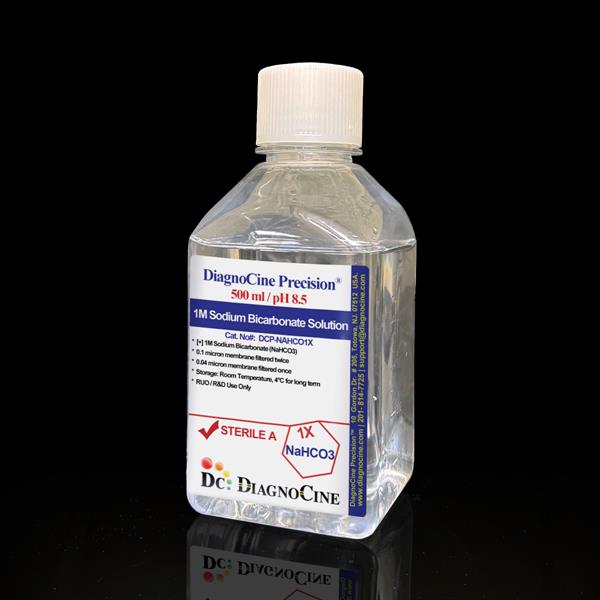
FluxMPS™ Tris-HCl with SDS Buffer
An MPS-grade, quadruple-stage filtered Tris-HCl/SDS buffer formulated at pH 8.45 with 3 M Tris-HCl and 0.3% SDS, purpose-built for casting gels in the Tricine-SDS-PAGE system. Ultrapure Type 1 water and a 0.1 micron / 0.04 micron sequential filtration architecture keep particulate and bioburden out of small-protein and peptide separation workflows.
- Quadruple-stage filtration: 0.1-micron membrane twice and 0.04-micron membrane twice
- 3 M Tris-HCl, 0.3% SDS, pH 8.45 — optimized for the Tricine-SDS-PAGE system
- Manufactured with ultrapure Type 1 water (18.2 MΩ·cm)
- ISO Class 5 (Class 100) aseptic fill environment
- Tested DNase- and RNase-free for sensitive downstream molecular biology use
- Low-particulate formulation suited to microfluidic and lab-on-a-chip electrophoretic platforms
- Customizable concentration, pH, tracking dyes, and additives on request
- pH8.45
- Tris-HCl Concentration3 M
- SDS Concentration0.3%
- Filtration0.1 µm x2 + 0.04 µm x2
- SterilityFiltered, sterile environment
- DNase ActivityNone detected
- RNase ActivityNone detected
- AppearanceClear
- Storage4°C
- Shelf Life1 year
Engineered where standard gel-casting buffers fall short
Conventional 0.22 µm-filtered Tris-SDS buffers can carry subvisible particulate and inconsistent ionic conditions into a gel cast, showing up later as band smearing, elevated background, or run-to-run variability. FluxMPS™ Tris-HCl with SDS Buffer is filtered through a sequential 0.1 µm / 0.04 µm membrane architecture and prepared with ultrapure water to keep the chemistry defined and the particulate load low.
Microchannel-safe purity
Quadruple-stage filtration (0.1 µm twice, 0.04 µm twice) reduces particulate load beyond a single 0.22 µm pass.
Precise, stable pH
Formulated at pH 8.45 with 3 M Tris-HCl, the exact conditions used in the Tricine-SDS-PAGE system.
Ultrapure-grade water
Manufactured with ultrapure Type 1 water (18.2 MΩ·cm) for a clean chemical background.
Low background for resolution
SDS at 0.3% denatures and uniformly charges proteins, minimizing SDS-micelle interference for sharper bands.
Defined, traceable composition
Two-component formulation (Tris-HCl, SDS) with lot-controlled concentrations and documented QC testing.
Customization on demand
Alternate concentrations, pH, tracking dyes, and additives available on inquiry.
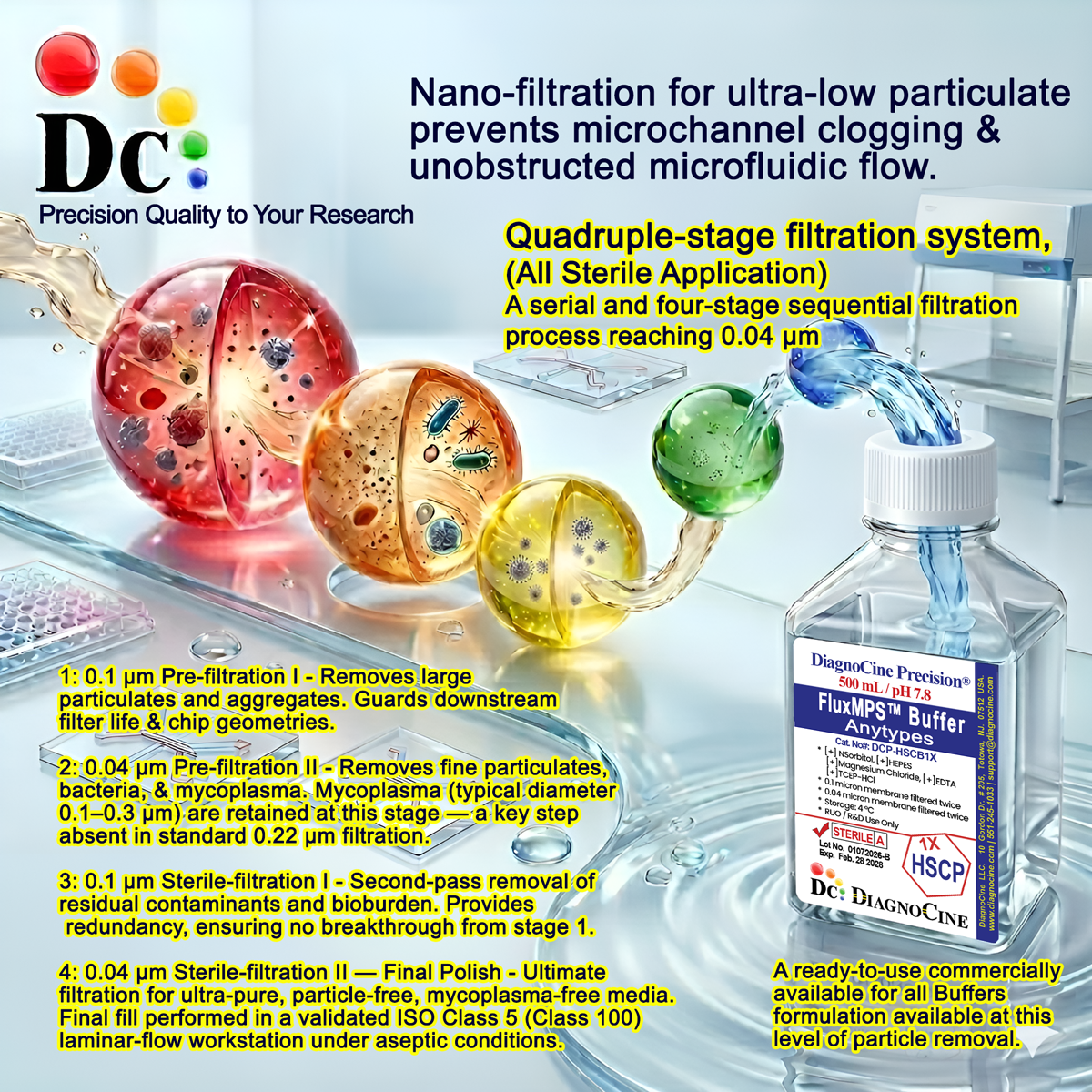
Quadruple-stage filtration system
This buffer is filtered with a 0.1-micron membrane twice and a 0.04-micron membrane twice, in a sterile environment, before final packaging.
- 1
0.1 µm Pre-filtration I
First 0.1-micron membrane pass removes large particulate and aggregates ahead of downstream stages.
- 2
0.04 µm Pre-filtration II
First 0.04-micron membrane pass retains finer particulates and bioburden, including organisms at the mycoplasma size scale of about 0.2 microns.
- 3
0.1 µm Sterile-filtration I
Second 0.1-micron membrane pass provides redundant particulate reduction in the sterile fill environment.
- 4
0.04 µm Sterile-filtration II — Final Polish
Second 0.04-micron membrane pass is the final polish, completed in a sterile environment ahead of packaging.
Performance vs. conventional buffer
Sequential 0.1 µm and 0.04 µm filtration, applied across four passes, retains finer particulates than a single 0.22 µm pass used in conventional gel-casting buffers.
© Diagnocine® — DCP-THSDS3X
Built for Tricine-SDS-PAGE gel casting and small-protein resolution
This buffer is used to cast gels for the Tricine-SDS-PAGE system, which resolves proteins and peptides from about 1-100 kDa, with optimal resolution for proteins as small as 2 kDa and exceptional resolution below 30 kDa. It lacks glycerol or tracking dyes and carries a much higher Tris concentration than typical loading or running buffers, operating at a lower pH than Tris-Glycine systems to help minimize protein modification.
Automated Bioreactors & Robotics
For automated liquid-handling and bioreactor platforms with heightened sensitivity to particulate, an optional 0.01 µm (10 nm) ultra-filtered variant of this buffer chemistry is available.
- Total Particulate Exclusion for automated fluidic paths
- Valve & Sensor Protection in robotic liquid handlers
- Extended Perfusion Stability in automated platforms
Inquiry Required: contact support@diagnocine.com to request the 0.01 µm ultra-filtered grade.
Micro Physiological System (MPS) & Chip
Low-particulate formulation supports lab-on-a-chip electrophoretic and chip-based protein separation workflows.
Gel Casting & Buffer Preparation
Used specifically for preparing gels in the Tricine-SDS-PAGE system, distinct from standard loading or running buffers.
Small Protein & Peptide Separation
Optimal for separating proteins in the 1-100 kDa range, with exceptional resolution for proteins smaller than 30 kDa.
Tricine-SDS-PAGE Systems
High Tris-HCl concentration (3 M) and pH 8.45 create the conditions this electrophoresis technique requires.
Western Blotting of Hydrophobic Proteins
Facilitates easier transfer of hydrophobic proteins during Western blotting due to lower acrylamide concentrations used with this system.
Nuclease-Free Workflows
Tested DNase- and RNase-free, suiting workflows sensitive to nucleic acid contamination.
Full specification sheet
All values below are as documented for this lot and formulation; parameters not tested for this product are not listed.
| Parameter | Specification |
|---|---|
| Formulation / Composition | Tris-HCl (3 M), SDS (0.3%) |
| Appearance | Clear |
| pH | 8.45 |
| Tris-HCl Concentration | 3 M |
| SDS Concentration | 0.3% |
| Parameter | Specification |
|---|---|
| Sterility Filtered | 0.1 µm x2 + 0.04 µm x2 in a sterile environment |
| DNase Activity | None detected (plasmid DNA, 18 hours, room temperature) |
| RNase Activity | None detected (ribosomal RNA, 18 hours, room temperature) |
| Water Purity | Ultrapure Type 1 water (18.2 MΩ·cm) |
| Manufacturing Standard ISO | ISO 13485-certified, CE-approved facility |
| Fill Environment | ISO Class 5 (Class 100) |
| Parameter | Specification |
|---|---|
| Storage Temperature | 4°C |
| Shelf Life | 1 year |
| Parameter | Specification |
|---|---|
| Raw Material Grade | Manufactured under ISO 13485-certified, CE-approved supplier facilities |
| Manufacturing QMS | ISO 13485:2016 |
| Regulatory Alignment | CE-approved |
| Production Method | Filtered-sterilized, 0.1 µm x2 + 0.04 µm x2 |
| Traceability | Final packaging, QA, and customization assembled at DiagnoCine Precision, Totowa, New Jersey, USA |
| Intended Use | Research Use Only (RUO) |
Full composition
Two-component Tris-HCl / SDS system formulated at pH 8.45 for the Tricine-SDS-PAGE gel-casting system.
| Component | CAS Number | Concentration |
|---|---|---|
| Tris-HCl | 1185-53-1 | 3 M |
| SDS (Sodium Dodecyl Sulfate) | 151-21-3 | 0.3% |
Manufacturing & compliance
Manufactured under ISO 13485-certified and CE-approved facilities, with final packaging, quality assurance, testing, and customization completed at the DiagnoCine R&D and Quality Testing Center and DiagnoCine Precision in Totowa, New Jersey, USA.
ISO 13485:2016 QMS
Manufactured under an ISO 13485-certified, CE-approved quality management system.
Ultrapure Type 1 Water
Prepared with ultrapure Type 1 water (18.2 MΩ·cm).
ISO Class 5 Fill & Finish
Final filtration and fill completed in an ISO Class 5 (Class 100) environment.
Micro-Batch Precision
Customization requests and final assembly completed at DiagnoCine Precision, Totowa, NJ.
Nuclease Testing
None detected for DNase (plasmid DNA, 18 hours, room temperature) or RNase (ribosomal RNA, 18 hours, room temperature).
Sterility
Filtered with a 0.1-micron membrane twice and a 0.04-micron membrane twice in a sterile environment.
Appearance & pH
Clear appearance; pH 8.45.
Documentation
Certificate of Analysis available upon request.
How DCP-THSDS3X compares
A comparison of this Tris-HCl with SDS buffer against conventional gel-casting buffer chemistries.
| Parameter | DCP-THSDS3X (FluxMPS™) | Conventional Buffer | Standard Alternative |
|---|---|---|---|
| Filtration Architecture | 0.1 µm x2 + 0.04 µm x2 | Single 0.22 µm pass | Single 0.22 µm pass |
| Final Filtration Pore Size | 0.04 µm | 0.22 µm | 0.22 µm |
| Number of Filtration Stages | 4 | 1 | 1 |
| Sterility Testing | check_circle | cancel | cancel |
| DNase / RNase Tested | check_circle | cancel | cancel |
| Manufacturing QMS | ISO 13485:2016 | Not specified | Not specified |
| Water Quality | Ultrapure Type 1 (18.2 MΩ·cm) | Not specified | Not specified |
| Microfluidic / Chip Compatibility | check_circle | cancel | cancel |
| Custom Formulation | check_circle | cancel | cancel |
Frequently asked questions
Common questions about DCP-THSDS3X Tris-HCl with SDS Buffer.
Supporting literature
Curated literature relevant to Tricine-SDS-PAGE, gel-casting buffer chemistry, and low-particulate microfluidic reagent handling.
- Schagger, H. Tricine-SDS-PAGE. Nature Protocols, 2006. doi:10.1038/nprot.2006.4
- Schagger, H.; von Jagow, G. Tricine-sodium dodecyl sulfate-polyacrylamide gel electrophoresis for the separation of proteins in the range from 1 to 100 kDa. Analytical Biochemistry, 1987. doi:10.1016/0003-2697(87)90587-2
- Laemmli, U.K. Cleavage of structural proteins during the assembly of the head of bacteriophage T4. Nature, 1970. doi:10.1038/227680a0
- Mahmood, T.; Yang, P.C. Western blot: technique, theory, and trouble shooting. North American Journal of Medical Sciences, 2012. doi:10.4103/1947-2714.100998
- Bass, J.J. et al. An overview of technical considerations for Western blotting applications to physiological research. Scandinavian Journal of Medicine & Science in Sports, 2017. doi:10.1111/sms.12702
- Reisner, A.H. et al. The use of Coomassie Brilliant Blue G250 perchloric acid solution for staining in electrophoresis and isoelectric focusing on polyacrylamide gels. Analytical Biochemistry, 1975. doi:10.1016/0003-2697(75)90265-8
- Zhang, S. et al. Organ-on-a-chip devices for research on the reproductive system. Micromachines, 2019. doi:10.3390/mi10100685
- Bhatia, S.N.; Ingber, D.E. Microfluidic organs-on-chips. Nature Biotechnology, 2014. doi:10.1038/nbt.2989