Tris-HCl Buffer, Sterile [1.5X]
FluxMPS™ Tris-HCl Buffer, Sterile [1.5X]
An ultra-filtered, 1.5 M Tris-HCl resolving gel buffer formulated to pH 8.8 for sharp, reproducible protein separation in SDS-PAGE, native PAGE, and 2D gel electrophoresis. Manufactured under ISO 13485-certified, CE-approved processes with quadruple-stage 0.1 µm and 0.04 µm membrane filtration, this clear, colorless, DNase- and RNase-free buffer is built for demanding molecular biology and microfluidic-compatible protein workflows.
- Quadruple-stage filtration: 0.1-micron membrane filtered twice and 0.04-micron membrane filtered twice in a sterile environment
- Defined pH of 8.8 for optimal resolving gel protein separation
- 1.5 M Tris base, HCl-adjusted — ready-to-use, no weighing or titration required
- No DNase activity detected; no RNase activity detected[1]
- Clear, colorless liquid manufactured under ISO 13485-certified, CE-approved facilities
- Compatible with SDS-PAGE, native PAGE, and Tris-glycine discontinuous buffer systems
- Custom pH, concentration, and additive formulations available on request
- pH8.8
- Concentration1.5 M Tris base
- AppearanceClear, Colorless Liquid
- Filtration0.1 µm x2 + 0.04 µm x2
- DNase ActivityNone Detected
- RNase ActivityNone Detected
- SterilitySterile-Filtered
- Storage4°C
- Shelf Life2 Years
- Size1000 mL
Engineered where standard gel buffers fall short
Conventional 0.22 µm-filtered gel buffers can carry subvisible particulates, inconsistent pH, and undetected nuclease or mycoplasma contamination that compromise band resolution and downstream assay reliability. FluxMPS™ Tris-HCl Buffer is built to remove those variables at the source.
Microchannel-safe purity
Quadruple-stage 0.1 µm and 0.04 µm membrane filtration removes fine particulates beyond a single 0.22 µm pass.
Precise, stable pH
Formulated and verified to pH 8.8, the alkaline environment resolving gels require for sharp SDS-PAGE and native PAGE bands.
Ultrapure-grade water
Manufactured with Ultrapure Type 1 water (18.2 MΩ·cm) to minimize background contaminants in downstream protein work.
Low background for downstream assays
DNase- and RNase-free formulation[1] keeps nucleic acid and protein workflows free of enzymatic interference.
Defined, traceable composition
A simple, lot-released 1.5 M Tris base formulation, HCl-adjusted to a defined pH of 8.8.
Customization on demand
Alternate concentrations, pH values, and chemical, protein, or supplement additions are available on inquiry.
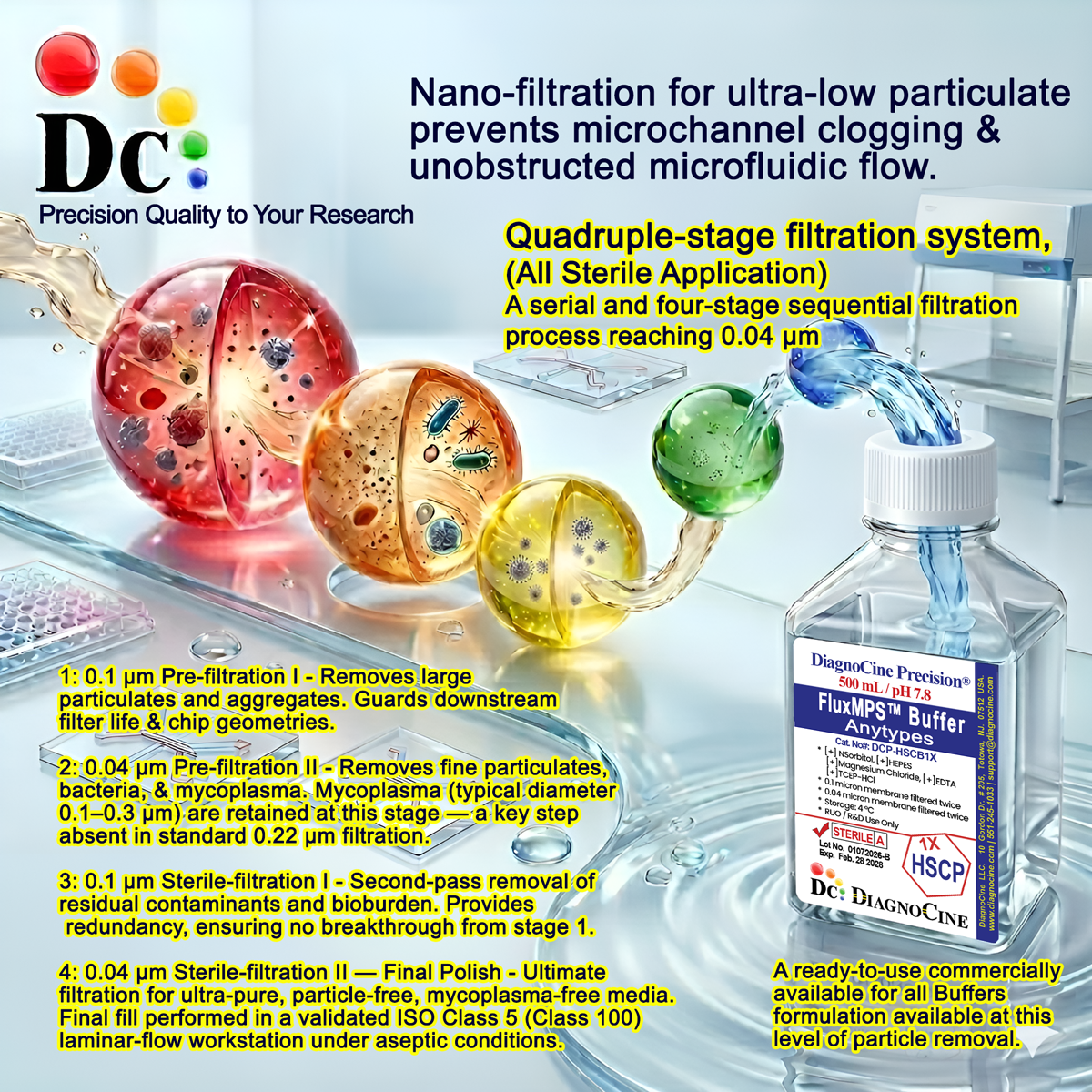
Quadruple-stage filtration system
Every lot of DCP-THB1.5X is sterile-filtered through a 0.1-micron membrane twice and a 0.04-micron membrane twice, in a controlled sterile environment, before final fill.
-
1
0.1 µm Pre-filtration I
First-pass 0.1-micron membrane filtration removes large particulates and aggregates, protecting downstream filters.
-
2
0.04 µm Pre-filtration II
A 0.04-micron membrane pass retains finer particulates and reduces bioburden ahead of final sterilizing filtration.
-
3
0.1 µm Sterile-filtration I
A second 0.1-micron pass provides redundant sterilizing filtration ahead of the final polish.
-
4
0.04 µm Sterile-filtration II — Final Polish
A second 0.04-micron pass in a sterile environment provides the final polish and prevents mycoplasma contamination; the smallest known mycoplasma species measure about 0.2 micron.[4]
Performance vs. conventional buffer
Sequential double-pass 0.1-micron and double-pass 0.04-micron filtration removes finer particulates than a single 0.22-micron pass, and is performed in a controlled sterile environment to guard against mycoplasma and microbial contamination.
Where DCP-THB1.5X is used
As a resolving gel buffer, DCP-THB1.5X provides the alkaline ionic environment required for reproducible protein separation across denaturing and non-denaturing electrophoresis workflows.[1,2]
Automated Bioreactors & Robotics
For automated liquid-handling and robotics-integrated workflows, an optional 0.01-micron (10 nm) ultra-filtered variant of this buffer is available on request for applications requiring the lowest possible particulate load.
- Total Particulate Exclusion: 10 nm filtration targets particulates below the range addressed by standard membrane filtration.
- Valve & Sensor Protection: reduces particulate load reaching automated dispensing valves and inline sensors.
- Extended Perfusion Stability: supports longer unattended run times in automated systems.
Inquiry Required: the 0.01-micron (10 nm) grade is produced to order — contact support@diagnocine.com to request this configuration.
Resolving Gel Buffer for SDS-PAGE
Used to prepare resolving gels for denaturing protein electrophoresis.
Native PAGE Protein Separation
Supports non-denaturing protein separation protocols when SDS is omitted.
Protein Molecular Weight Determination
Forms a gel matrix suited to separating proteins by molecular weight.
Tris-Glycine Protein Complex Separation
Effective in Tris-glycine systems for separating a broad range of protein molecular weights.
Protein Analysis QC Workflows
Used across research and industrial protein analysis quality control applications.
Protein Isolation & 2D Gel Electrophoresis
Supports isolation of specific proteins from complex mixtures and the second dimension of 2D gel electrophoresis.
Product specifications
Every parameter below reflects DCP-THB1.5X as manufactured and tested.
| Parameter | Specification |
|---|---|
| Formulation | 1.5 M Tris base, HCl-adjusted |
| Appearance | Clear, Colorless Liquid |
| pH | 8.8 |
| Molarity | 1.5 M Tris base |
| Parameter | Specification |
|---|---|
| Sterility USP <71> | Filtered 0.1-micron membrane twice and 0.04-micron membrane twice in a sterile environment |
| DNase Activity | None detected after incubation of plasmid DNA and this product for 18 hr at room temperature |
| RNase Activity | No RNase activity detected after incubation of ribosomal RNA and this product for 18 hr at room temperature |
| Parameter | Specification |
|---|---|
| Storage Temperature | 4°C |
| Shelf Life | 2 years |
| Parameter | Specification |
|---|---|
| Manufacturing QMS ISO 13485 | ISO 13485-certified facilities |
| Regulatory Alignment | CE-approved facilities |
| Production Method | Final packaging, quality assurance, and testing performed at the Diagnocine R&D and Quality Testing Center; customization and assembly performed at Diagnocine Precision, Totowa, New Jersey, USA |
| Intended Use | For Research Use Only (RUO) |
Full composition
DCP-THB1.5X is a two-component Tris-HCl buffer system: Tris base at 1.5 M concentration, adjusted with hydrochloric acid to a final pH of 8.8.
| Component | CAS Number | Concentration |
|---|---|---|
| Tris base (tris(hydroxymethyl)aminomethane) | 77-86-1 | 1.5 M |
| Hydrochloric Acid | 7647-01-0 | Added to adjust pH to 8.8 |
Manufacturing & compliance
DCP-THB1.5X is manufactured under ISO 13485-certified and CE-approved facilities, with final packaging, quality assurance, and testing completed at the Diagnocine R&D and Quality Testing Center in Totowa, New Jersey, USA.
ISO 13485:2016 QMS
Produced under an ISO 13485-certified quality management system.
Ultrapure Type 1 Water
Formulated using Ultrapure Type 1 water (18.2 MΩ·cm).
Sterile Fill & Finish
Filtered and filled in a controlled sterile environment.
Micro-Batch Precision
Assembly and customization performed at Diagnocine Precision, Totowa, New Jersey, USA.
DNase Activity Testing
None detected after incubation of plasmid DNA and this product for 18 hr at room temperature.
RNase Activity Testing
No RNase activity detected after incubation of ribosomal RNA and this product for 18 hr at room temperature.
Sterility
Filtered 0.1-micron membrane twice and 0.04-micron membrane twice in a sterile environment.
Documentation / CoA
Lot-specific Certificates of Analysis are available on request.
How DCP-THB1.5X compares
A side-by-side look at filtration architecture and quality controls versus conventional resolving gel buffer.
| Parameter | DCP-THB1.5X (FluxMPS™) | Conventional Buffer | Standard Alternative |
|---|---|---|---|
| Final filtration pore size | 0.04 µm | 0.22 µm | 0.22 µm |
| Number of filtration stages | 4 | 1 | 1 |
| DNase / RNase tested | check_circle | cancel | cancel |
| Filtered in sterile environment | check_circle | cancel | cancel |
| Defined pH (8.8) | check_circle | cancel | cancel |
| ISO 13485 manufacturing | check_circle | cancel | cancel |
| Custom formulation available | check_circle | cancel | cancel |
Frequently asked questions
Common questions about DCP-THB1.5X Tris-HCl Buffer, Sterile [1.5X].
Supporting literature
Selected literature relevant to Tris-HCl buffer chemistry, protein gel electrophoresis, and sterile filtration.
- Laemmli UK. Cleavage of structural proteins during the assembly of the head of bacteriophage T4. Nature. 1970;227:680-685. doi:10.1038/227680a0
- Good NE, Winget GD, Winter W, Connolly TN, Izawa S, Singh RM. Hydrogen ion buffers for biological research. Biochemistry. 1966;5:467-477. doi:10.1021/bi00866a011
- Ornstein L. Disc electrophoresis - I: Background and theory. Ann N Y Acad Sci. 1964;121:321-349. doi:10.1111/j.1749-6632.1964.tb14207.x
- Razin S, Yogev D, Naot Y. Molecular biology and pathogenicity of mycoplasmas. Microbiol Mol Biol Rev. 1998;62:1094-1156. doi:10.1128/MMBR.62.4.1094-1156.1998
- Gallagher SR. SDS-polyacrylamide gel electrophoresis (SDS-PAGE). Curr Protoc Protein Sci. 2012;68:10.4.1-10.4.16. doi:10.1002/0471140864.ps1004s68
- Garfin DE. One-dimensional gel electrophoresis. Methods Enzymol. 2009;463:497-513. doi:10.1016/S0076-6879(09)63029-6
- Bass JJ, Wilkinson DJ, Rankin D, et al. An overview of technical considerations for Western blotting applications to physiological research. Scand J Med Sci Sports. 2017;27:4-25. doi:10.1111/sms.12852
- Uphoff CC, Drexler HG. Detection of mycoplasma contamination in cell cultures. Curr Protoc Mol Biol. 2014;106:24.4.1-24.4.14. doi:10.1002/0471142727.mb2404s106