

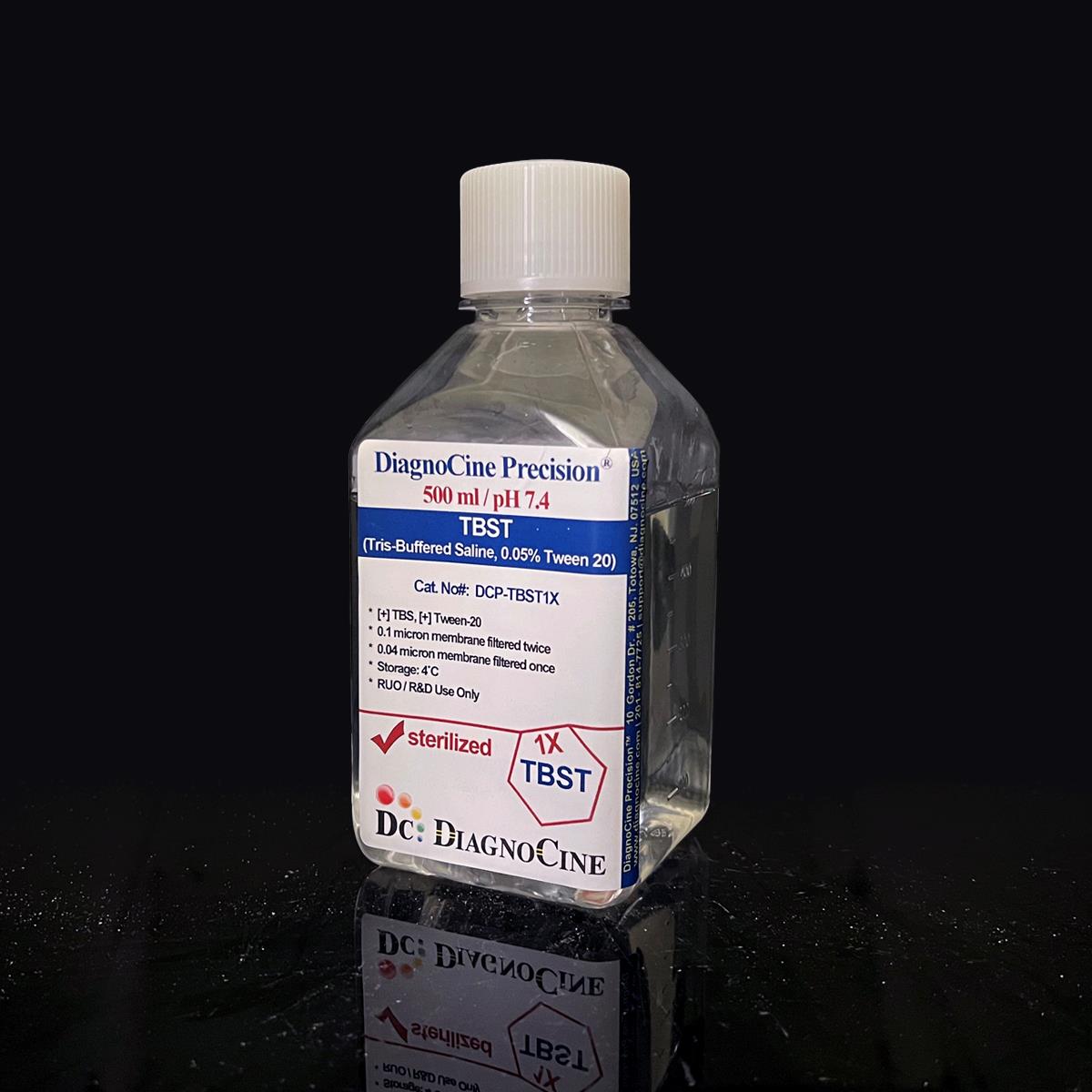
Tris-Buffered Saline (TBS) with (0.05%) Tween-20 Buffer [1X]
FluxMPS™ Tris-Buffered Saline (TBS) with (0.05%) Tween-20 Buffer [1X]
A sterile, ultrapure 1X Tris-Buffered Saline with 0.05% Tween-20 (TBS-T), formulated at a stable pH of 7.4 with defined 20mM Tris-base and 150 mM NaCl. Quadruple-stage sterile filtration (0.1 µm membrane twice, 0.04 µm membrane twice) delivers microchannel-safe purity for ELISA, Western blot, immunohistochemistry, and immunofluorescence workflows.
- Quadruple-stage filtration: 0.1 µm membrane filtration twice and 0.04 µm membrane filtration twice in a sterile environment
- Sterile, ultrapure Tris-buffered saline formulated at pH 7.4
- Defined composition: 20mM Tris-base, 150 mM NaCl, 0.05% Tween-20
- DNase and RNase activity: none detected after 18 hr incubation at room temperature
- Microchannel-safe purity supporting ELISA, Western blot, immunohistochemistry, and immunofluorescence protocols
- Manufactured under ISO 13485-certified, CE-approved facilities (DiagnoCine Precision, Totowa, NJ, USA)
- Customizable pH, concentration, and additive content available on request
- Formulation
- Tris-base, NaCl, Tween-20
- pH
- 7.4
- Appearance
- Clear, colorless liquid
- Filtration
- 0.1 µm x2 + 0.04 µm x2
- Sterility
- Sterile, ultrapure
- DNase Activity
- None detected
- RNase Activity
- None detected
- Storage
- Room temperature
- Shelf Life
- 2 years
- Customization
- Available on request
Engineered where standard buffers fail
Conventional 0.22 µm-filtered TBS-T can carry subvisible particulates, drift in pH, and leave background signal in sensitive immunoassays. FluxMPS™ TBS-T is built to remove those failure points before they reach the well plate, membrane, or microchannel.
Microchannel-safe purity
Final 0.04 µm membrane polish limits particulate carryover for microfluidic and imaging-sensitive workflows.
Precise, stable pH
Formulated at pH 7.4 with defined 20mM Tris-base and 150 mM NaCl for consistent antigen-antibody binding.
Ultrapure-grade water
Prepared with Ultrapure Type 1 water (18.2 MΩ·cm) to minimize trace contaminants in every batch.
Low background for imaging & assays
Tween-20 minimizes non-specific binding, improving signal-to-noise in colorimetric, chemiluminescent, and fluorescent detection.
Defined, traceable composition
Tris-base, NaCl, and Tween-20 concentrations are fixed and lot-consistent, supporting reproducible washing and dilution steps.
Customization on demand
Alternate pH, concentrations, or added chemicals, compounds, proteins, and supplements available on inquiry.
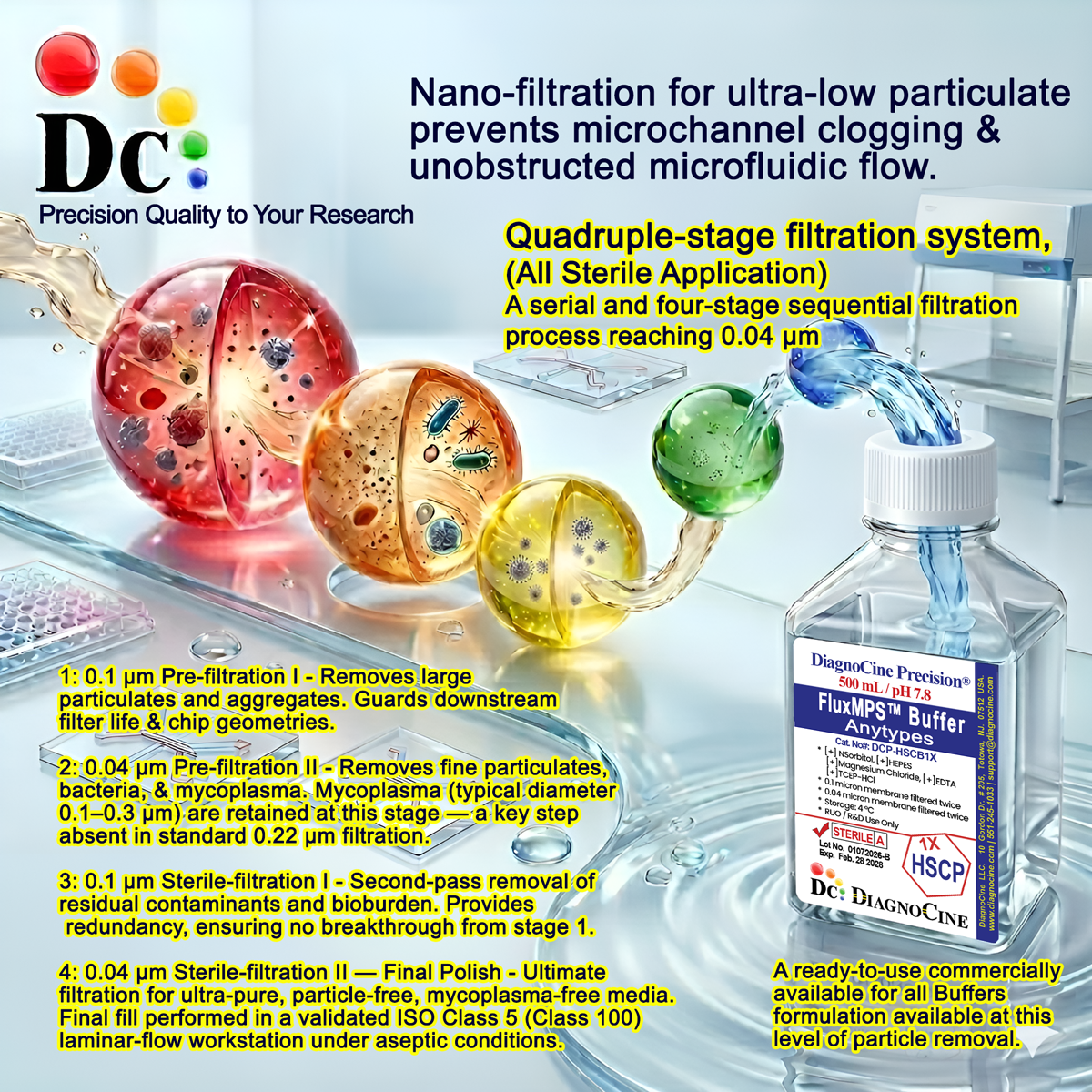
Quadruple-stage filtration system
Every batch of DCP-TBST1X is sterile-filtered through a 0.1 µm membrane twice and a 0.04 µm membrane twice inside a sterile environment, giving a final polish well below standard single-pass filtration.
-
1
0.1 µm Pre-filtration I
First-pass 0.1 µm membrane filtration removes large particulates and aggregates, extending downstream filter life.
-
2
0.04 µm Pre-filtration II
First-pass 0.04 µm membrane filtration retains fine particulates and bioburden, including organisms in the size range of mycoplasma, reported as small as about 0.2 micron.
-
3
0.1 µm Sterile-filtration I
Second 0.1 µm membrane pass provides redundancy ahead of final polish filtration.
-
4
0.04 µm Sterile-filtration II — Final Polish
Second 0.04 µm membrane pass completes the sterile fill, designed to prevent mycoplasma contamination.
Performance vs. conventional buffer
Sequential 0.1 µm and 0.04 µm filtration, applied twice each, removes finer particulates and bioburden than a single-pass 0.22 µm filtered buffer, supporting mycoplasma-safe, low-background use in ELISA, Western blot, and microfluidic wash steps.
© Diagnocine® — DCP-TBST1X
Where DCP-TBST1X is used
TBS-T is a widely used washing and dilution buffer across immunoassay and microfluidic workflows, combining stable pH with mild-detergent action to reduce non-specific binding.
Automated Bioreactors & Robotics
For fully automated bioreactor and robotic liquid-handling systems, an optional 0.01 µm (10 nm) ultra-filtered variant of this buffer can be produced on request to further protect valves, sensors, and perfusion lines.
- Total Particulate Exclusion: 10 nm ultra-filtration for automated systems sensitive to fine particulates
- Valve & Sensor Protection: reduces particulate load on precision robotic and perfusion hardware
- Extended Perfusion Stability: supports longer unattended run times in closed-loop systems
Inquiry Required: the 0.01 µm (10 nm) ultra-filtered variant is produced to order — contact support@diagnocine.com for availability and lead information.
Micro Physiological System (MPS) & Chip
Sterile, ultrapure wash and dilution buffer for chip-based culture and assay platforms.
Wash, Dilution & Reconstitution
Used for washing membranes, diluting antibodies, and rinsing sample preparations.
iPSC-Derived Model Handling
Gentle, low-background buffer for wash steps in iPSC-derived model workflows.
Endothelial & Primary Cell Perfusion
Compatible with wash and dilution steps for endothelial and primary cell perfusion protocols.
ELISA, Blotting & Blocking
Widely used as a washing buffer in ELISA and Western blotting, and as a dilution buffer for antibodies.
Microscopy & Optical Sensing
Low-background formulation supports colorimetric, chemiluminescent, and fluorescent detection methods.
Specifications at a glance
All values below reflect DCP-TBST1X as manufactured and released by DiagnoCine Precision.
| Parameter | Specification |
|---|---|
| Tris-base concentration | 20mM |
| NaCl concentration | 150 mM |
| Tween-20 concentration | 0.05% |
| Appearance | Clear, colorless liquid |
| pH | 7.4 |
| Parameter | Specification |
|---|---|
| Sterility USP <71>-aligned | Sterile, ultrapure |
| Filtration system | 0.1 µm membrane twice, 0.04 µm membrane twice |
| DNase activity | None detected (18 hr, plasmid DNA, room temperature) |
| RNase activity | None detected (18 hr, ribosomal RNA, room temperature) |
| Parameter | Specification |
|---|---|
| Storage temperature | Room temperature |
| Shelf life | 2 years |
| Parameter | Specification |
|---|---|
| Manufacturing standard ISO 13485 | ISO 13485-certified, CE-approved facilities (DiagnoCine Precision suppliers) |
| Production & QA site | Final packaging, QA, and testing at DiagnoCine R&D and Quality Testing Center |
| Custom assembly site | DiagnoCine Precision, Totowa, New Jersey, USA |
| Intended use | Research Use Only (RUO) |
Full composition
Tris-Buffered Saline with Tween-20 formulated with fixed, lot-consistent component concentrations.
| Component | CAS Number | Concentration |
|---|---|---|
| Tris-base | 77-86-1 | 20mM |
| Sodium Chloride (NaCl) | 7647-14-5 | 150 mM |
| Tween-20 | 9005-64-5 | 0.05% |
Manufacturing & compliance
DCP-TBST1X is produced under a documented quality management system with dedicated QC testing.
ISO 13485:2016 QMS
Manufactured under ISO 13485-certified and CE-approved facilities (Suppliers of DiagnoCine Precision).
Ultrapure Type 1 Water
Formulated using Ultrapure Type 1 water (18.2 MΩ·cm) to minimize trace contaminants.
Quadruple-Stage Sterile Filtration
0.1 µm membrane filtration twice and 0.04 µm membrane filtration twice in a sterile environment.
Micro-Batch Precision
Final packaging, QA, and testing performed at the DiagnoCine R&D and Quality Testing Center; custom assembly completed at DiagnoCine Precision, Totowa, New Jersey, USA.
DNase Activity Testing
None detected after incubating plasmid DNA and this product for 18 hr at room temperature.
RNase Activity Testing
None detected after incubating ribosomal RNA and this product for 18 hr at room temperature.
Facility Certification
ISO 13485-certified, CE-approved manufacturing and Totowa, New Jersey, USA finishing site.
Documentation / CoA
Certificate of Analysis available on request.
How DCP-TBST1X compares
A side-by-side look at filtration architecture and quality controls versus conventional TBS-T buffer.
| Parameter | DCP-TBST1X (FluxMPS™) | Conventional TBS-T (0.22 µm filtered) | Standard alternative (0.22 µm filtered) |
|---|---|---|---|
| Defined Tris/NaCl/Tween-20 concentrations | check_circle | cancel | cancel |
| Final filtration pore size | 0.04 µm | 0.22 µm | 0.22 µm |
| Number of filtration stages | 4 | 1 | 1 |
| DNase / RNase activity tested | check_circle | cancel | cancel |
| Ultrapure Type 1 water (18.2 MΩ·cm) | check_circle | cancel | cancel |
| ISO 13485-certified manufacturing | check_circle | cancel | cancel |
| Microfluidic channel compatibility | check_circle | cancel | cancel |
| Custom formulation available | check_circle | cancel | cancel |
Frequently asked questions
Common questions about DCP-TBST1X TBS-T buffer.
Supporting literature
Curated references on TBS-T buffer chemistry, immunoassay washing, and microfluidic buffer purity.
- Mahmood, T. & Yang, P. Western blot: technique, theory, and trouble shooting. N. Am. J. Med. Sci. doi:10.4103/1947-2714.100998
- Kurien, B. T. & Scofield, R. H. Western blotting. Methods doi:10.1016/j.ymeth.2005.07.018
- Hnasko, T. S. & Hnasko, R. M. The Western blot. Methods Mol. Biol. doi:10.1007/978-1-4939-2742-5_31
- Lin, J. S. & Lai, E. M. Protein-protein interactions: co-immunoprecipitation. Methods Mol. Biol. doi:10.1007/978-1-4939-7033-9_18
- Bystry, R. S. et al. Blocking and washing buffers for immunoassays. J. Immunol. Methods doi:10.1016/S0022-1759(97)00107-8
- Good, N. E. et al. Hydrogen ion buffers for biological research. Biochemistry doi:10.1021/bi00866a011
- Bhattacharjee, Y. & Bhattacharjee, S. Buffer selection for immunoassay development. Anal. Biochem. doi:10.1016/j.ab.2018.02.019
- Bhatia, S. N. & Ingber, D. E. Microfluidic organs-on-chips. Nat. Biotechnol. doi:10.1038/nbt.2989
- Sackmann, E. K. et al. The present and future role of microfluidics in biomedical research. Nature doi:10.1038/nature13118
- Rios de la Rosa, J. M. et al. Endotoxin and particulate control in cell culture and perfusion reagents. Biotechnol. Prog. doi:10.1002/btpr.2951