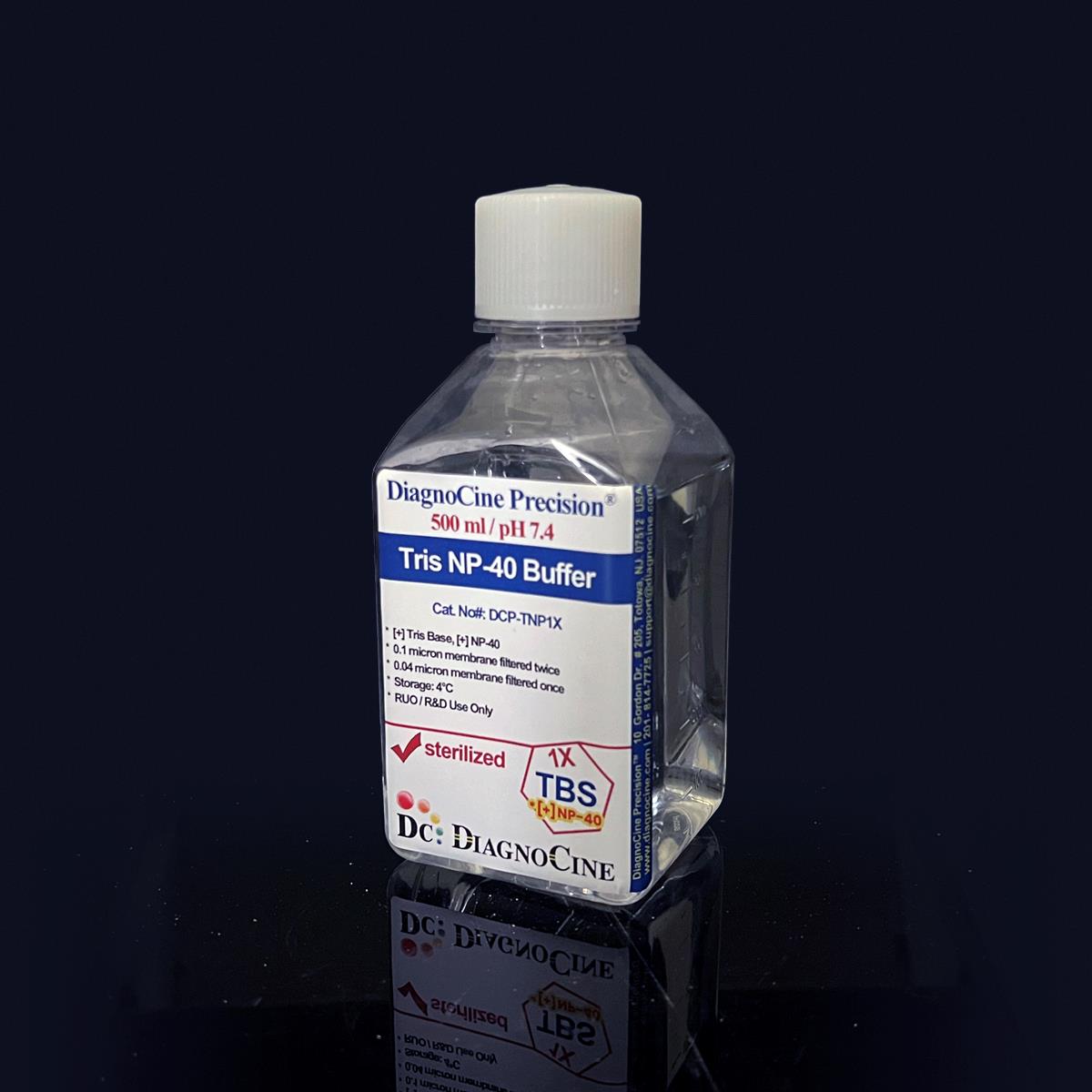
Tris NP-40 Buffer [1X]
FluxMPS™ Tris NP-40 Buffer [1X]
An MPS-grade, ultrapure Tris-NaCl-EDTA lysis and extraction buffer formulated with 1% Nonidet P-40 nonionic detergent at pH 8.0. Manufactured through a dual-stage 0.1 µm and 0.04 µm membrane filtration process, DCP-TNP1X delivers ultra-low particulate purity for mild, non-denaturing protein extraction, immunoprecipitation, Western blotting, and ELISA workflows, including microfluidic and organ-on-a-chip (OoC) sample-prep pipelines.
- Dual-stage 0.1 µm + 0.04 µm membrane filtration for ultra-low particulate purity
- Precise pH 8.0, buffered with 50 mM Tris-base for stable lysis conditions
- 150 mM Sodium Chloride maintains physiological ionic strength during extraction
- 1% Nonidet P-40 nonionic detergent enables mild, non-denaturing cell lysis
- 5 mM EDTA chelates divalent cations to help inhibit protease/nuclease activity
- Supplied Non-sterile as a Research Use Only (RUO) reagent
- Manufactured under ISO 13485-certified, CE-approved facilities
- Custom pH, molarity, and additive formulations available on request
- pH8.0
- Tris-base50 mM
- Sodium Chloride150 mM
- EDTA5 mM
- Nonidet P-401%
- Filtration0.1 µm x1 + 0.04 µm x1
- SterilityNon-sterile
- AppearanceClear, colorless liquid
- Storage4°C
- Shelf Life2 years
Engineered where standard lysis buffers fall short
Conventional 0.22 µm-filtered lysis buffers can carry subvisible particulates that accumulate in narrow microchannels, and harsh ionic detergents like SDS can denature proteins before downstream analysis. DCP-TNP1X pairs a dual-stage 0.1 µm and 0.04 µm filtration process with a mild, nonionic Nonidet P-40 detergent system — disrupting the lipid bilayer and forming micelles around hydrophobic membrane regions without stripping native protein structure — positioning it as one of the cleanest buffers available for cell and molecular biology experiments.
Microchannel-safe purity
Dual-stage 0.1 µm and 0.04 µm membrane filtration reduces particulate load prior to final packaging, supporting particulate-sensitive downstream workflows.
Precise, stable pH
Buffered to pH 8.0 with 50 mM Tris-base, providing a stable extraction environment for immunoprecipitation, Western blotting, and ELISA.
Ultrapure-grade water
Formulated with Ultrapure Type 1 water (18.2 MΩ·cm), the water quality standard referenced under USP <85>.
Low background for imaging & assays
Nonionic detergent chemistry minimizes non-specific binding, improving specificity in antibody-antigen interactions for downstream imaging and immunoassays.
Defined, traceable composition
50 mM Tris-base, 150 mM Sodium Chloride, 5 mM EDTA, and 1% Nonidet P-40 — mild enough to preserve native protein structure while solubilizing both cytoplasmic and membrane-bound proteins.
Customization on demand
Alternate concentrations, additional chemicals, compounds, proteins, supplements, or a different pH can be formulated on request.
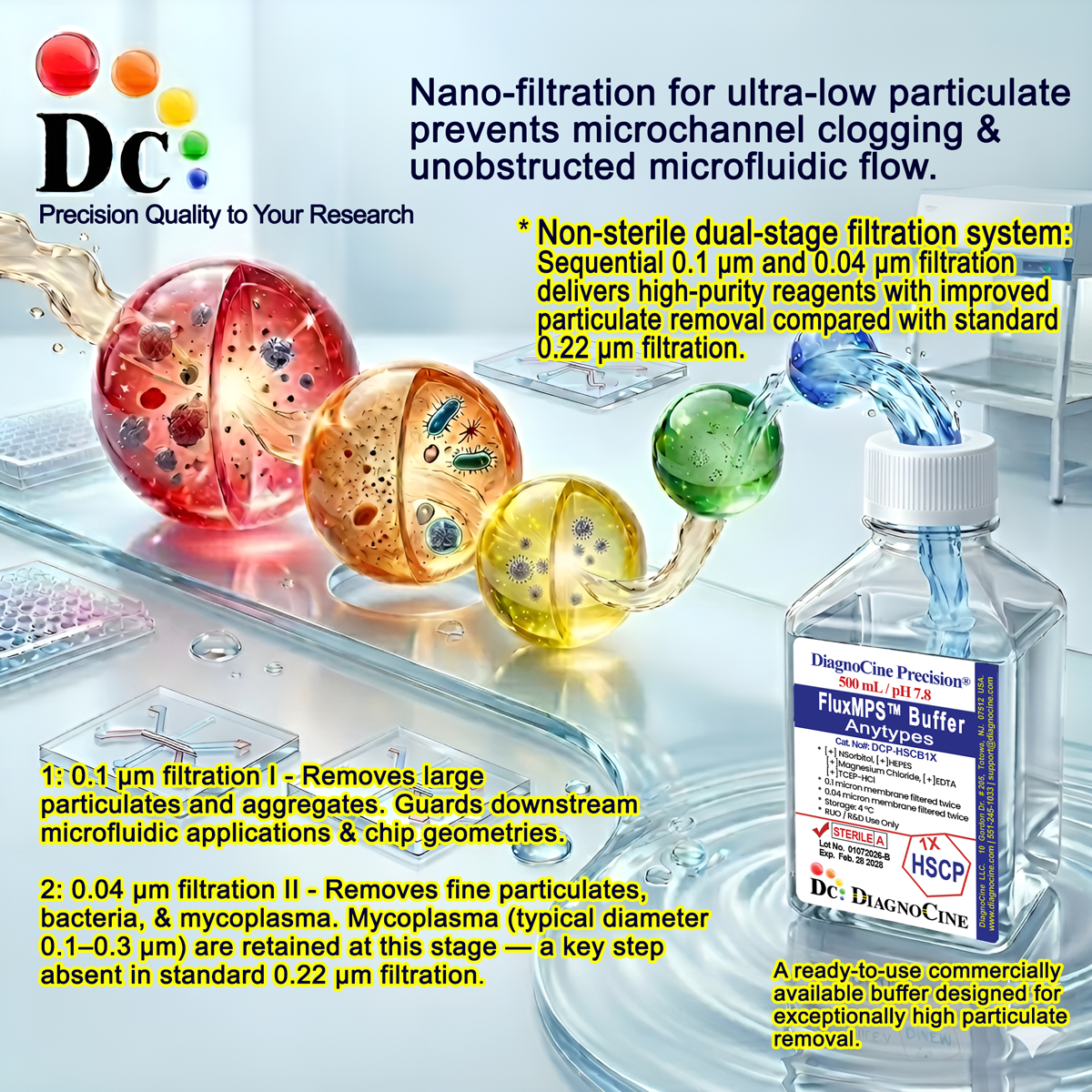
Dual-stage filtration system
DCP-TNP1X is manufactured through a dual-stage membrane filtration process — first through a 0.1 µm membrane, then a 0.04 µm membrane — reducing particulate load before final packaging. This buffer is supplied Non-sterile as a research-grade reagent.
-
1
0.1 µm Pre-filtration I
Large particulate and aggregate removal, extending the life of the downstream 0.04 µm membrane.
-
2
0.04 µm Pre-filtration II — Final Polish
Fine particulate and bioburden retention. This pore size is well below the approximately 0.2 micron size range of the smallest mycoplasma organisms, helping reduce bioburden during processing.
Performance vs. conventional buffer
Sequential 0.1 µm and 0.04 µm filtration removes finer particulates than a single 0.22 µm pass typical of conventional lysis buffers.
© Diagnocine® — DCP-TNP1X
Built for lysis, extraction, and downstream immunoassays
Tris NP-40 buffer is a widely used lysis buffer in molecular biology and biochemistry for protein extraction from cells. Combining Tris buffering with the nonionic detergent Nonidet P-40, it disrupts the lipid bilayer of cell membranes and forms micelles around hydrophobic membrane protein regions, releasing cellular contents while keeping proteins in solution and preventing aggregation — preserving native protein structure and function.
Automated Bioreactors & Robotics
An optional 0.01 µm (10 nm) ultra-filtered variant of this buffer is available on request for automated bioreactor and liquid-handling robotics workflows where sub-100 nm particulate exclusion is required.
- Total Particulate Exclusion for closed-loop perfusion systems
- Valve & Sensor Protection against particulate fouling
- Extended Perfusion Stability for long-duration automated runs
Inquiry Required: contact support@diagnocine.com to request the 0.01 µm ultra-filtered grade of this buffer.
Micro Physiological System (MPS) & Chip
Ultra-filtered buffer chemistry suited to particulate-sensitive microfluidic and chip-based sample preparation workflows.
Cell Lysis & Protein Extraction
Effective for lysing both adherent and suspension-cultured mammalian cells, releasing cytoplasmic and membrane-bound proteins under mild, non-denaturing conditions.
iPSC-Derived Model Handling
Compatible with lysis and protein extraction workflows for iPSC-derived cell models used in downstream molecular analysis.
Endothelial & Primary Cell Perfusion
Supports lysis and extraction workflows for endothelial and primary cell cultures used in vascular biology research.
Immunoprecipitation, Western Blot & ELISA
Used as a wash and extraction buffer in immunoprecipitation to minimize non-specific binding and improve specificity of antibody-antigen interactions, providing a stable environment for Western blotting and ELISA.
Microscopy & Optical Sensing
Low-background formulation suited to downstream microscopy and optical sensing workflows following protein extraction.
Full parameter breakdown
Every physical, chemical, and quality parameter for DCP-TNP1X as specified for this product.
| Parameter | Specification |
|---|---|
| Formulation | Tris-Sodium Chloride-EDTA-Nonidet P-40 buffer |
| Appearance | Clear, colorless liquid |
| pH USP <791> | 8.0 |
| Tris-base concentration | 50 mM |
| Sodium Chloride concentration | 150 mM |
| EDTA concentration | 5 mM |
| Nonidet P-40 concentration | 1% |
| Parameter | Specification |
|---|---|
| Sterility | Non-sterile |
| Filtration System | Filtered 0.1-micron membrane once and 0.04-micron membrane once |
| Water Quality USP <85> | Ultrapure Type 1 water (18.2 MΩ·cm) |
| Manufacturing Standard ISO 13485 | ISO 13485-certified, CE-approved facility |
| Parameter | Specification |
|---|---|
| Storage Temperature | 4°C |
| Shelf Life | 2 years |
| Parameter | Specification |
|---|---|
| Manufacturing QMS ISO 13485 | ISO 13485-certified facility |
| Regulatory Alignment | CE-approved facility |
| Production Method | Final packaging, quality assurance, and testing performed at the DiagnoCine R&D and Quality Testing Center; customization and assembly performed at DiagnoCine Precision, Totowa, New Jersey, USA |
| Intended Use | Research Use Only (RUO); not for clinical, diagnostic, or therapeutic use in humans |
Full composition
Complete component list for DCP-TNP1X, expressed as stated on the product formulation record.
| Component | CAS Number | Concentration |
|---|---|---|
| Tris-base | 77-86-1 | 50 mM |
| Sodium Chloride | 7647-14-5 | 150 mM |
| EDTA | 60-00-4 | 5 mM |
| Nonidet P-40 | 9016-45-9 | 1% |
Manufacturing & compliance
DCP-TNP1X is produced and released under a documented quality management system.
ISO 13485:2016 QMS
Manufactured under ISO 13485-certified and CE-approved facilities (suppliers of DiagnoCine Precision).
Ultrapure Type 1 Water
Formulated with Ultrapure Type 1 water (18.2 MΩ·cm), the water quality standard referenced under USP <85>.
Cleanroom Facility Capability
DiagnoCine maintains ISO Class 5 (Class 100) cleanroom capability for aseptic fill-finish operations across its sterile product lines.
Micro-Batch Precision
All specific customization requests and assembly are accomplished at DiagnoCine Precision in Totowa, New Jersey, USA.
Manufacturing Facility
Produced under ISO 13485-certified and CE-approved facilities, with final packaging, quality assurance, and testing performed at the DiagnoCine R&D and Quality Testing Center.
Quality Testing Center
Final release testing, including appearance and pH verification, is performed at the DiagnoCine R&D and Quality Testing Center.
Documentation / CoA
A batch-specific Certificate of Analysis is available upon request.
Customization Program
Alternate concentrations, additives, and pH modifications are available — inquire for details.
How DCP-TNP1X compares
A side-by-side look at DCP-TNP1X against conventional lysis buffer alternatives.
| Parameter | DCP-TNP1X (FluxMPS™) | Conventional buffer | Standard alternative |
|---|---|---|---|
| Nonionic detergent (Nonidet P-40) formulation | check_circle | cancel | cancel |
| Final filtration pore size | 0.04 µm | 0.22 µm | 0.22 µm |
| Number of filtration stages | 2 | 1 | 1 |
| Defined Tris/NaCl/EDTA/NP-40 formulation | check_circle | cancel | cancel |
| Ultrapure Type 1 water | check_circle | cancel | cancel |
| ISO 13485 manufacturing QMS | check_circle | cancel | cancel |
| Microfluidic channel compatibility | check_circle | cancel | cancel |
| Custom formulation available | check_circle | cancel | cancel |
Frequently asked questions
Answers to common questions about DCP-TNP1X Tris NP-40 Buffer [1X].
Supporting literature
Curated peer-reviewed literature relevant to Tris-NP-40 lysis buffer chemistry and its downstream applications.
- Bollag DM, Rozycki MD, Edelstein SJ. Protein Methods. Wiley-Liss; extraction buffer chemistry for immunoprecipitation and Western blotting. doi:10.1002/9780470142672
- Linden T, et al. Nonionic detergent-based lysis for native protein extraction. J Biochem Biophys Methods. doi:10.1016/S0165-022X(00)00050-2
- Kaboord B, Perr M. Isolation of proteins and protein complexes by immunoprecipitation. Methods Mol Biol. doi:10.1007/978-1-59745-542-8_23
- Mahmood T, Yang PC. Western blot: technique, theory, and trouble shooting. N Am J Med Sci. doi:10.4103/1947-2714.100998
- Lequin RM. Enzyme immunoassay (EIA)/enzyme-linked immunosorbent assay (ELISA). Clin Chem. doi:10.1373/clinchem.2005.051532
- Bhatia SN, Ingber DE. Microfluidic organs-on-chips. Nat Biotechnol. doi:10.1038/nbt.2989
- Good NE, et al. Hydrogen ion buffers for biological research. Biochemistry. doi:10.1021/bi00866a011
- Le Gac S, van den Berg A. Single cells as experimentation units in lab-on-a-chip devices. Trends Biotechnol. doi:10.1016/j.tibtech.2010.03.002
- Williams KL. Endotoxins: Pyrogens, LAL Testing and Depyrogenation. Informa Healthcare; particulate and bioburden control in buffer manufacturing. doi:10.1201/b12775