


Tris Acetate EDTA Buffer [10X]
FluxMPS™ Tris Acetate EDTA Buffer [10X]
An MPS-grade Tris Acetate EDTA (TAE) running buffer concentrate formulated with defined Tris base, EDTA, and acetic acid molarity at pH 8.0 (10X concentration). Quadruple-stage 0.1 micron and 0.04 micron membrane filtration delivers a clear, colorless, ultra-clean buffer suitable for DNA electrophoresis, molecular biology workflows, and microchannel-safe microfluidic applications.
- Quadruple-stage filtration: 0.1-micron membrane filtered twice and 0.04-micron membrane filtered twice
- Defined 10X formulation: 400 mM Tris base, 10 mM EDTA, 200 mM glacial acetic acid
- Precise, stable pH 8.0 at 10X concentration
- Filtered and packaged in a sterile environment
- Clear, colorless liquid free of visible particulate
- Does not interfere with cloning enzyme activity
- Manufactured under ISO 13485-certified, CE-approved facilities
- Customizable concentration, pH, and additive chemistry on request
- Format10X Concentrate
- pH (10X)8.0
- Tris base400 mM
- EDTA10 mM
- Glacial Acetic Acid200 mM
- AppearanceClear, Colorless Liquid
- Filtration0.1 µm x2 + 0.04 µm x2
- SterilityFiltered, sterile environment
- StorageRoom Temperature, Cool & Dry
- Shelf Life24 Months
Engineered where standard buffers fail
Conventional single-pass 0.22 µm-filtered buffers can carry subvisible particulates and bioburden into agarose gels, microchannels, and downstream cloning steps. FluxMPS™ TAE Buffer is built for workflows that cannot tolerate that variability.
Microchannel-safe purity
Sequential 0.1 µm and 0.04 µm membrane filtration, each stage applied twice, retains fine particulates that a single 0.22 µm pass allows through.
Precise, defined pH
pH 8.0 at 10X concentration with 400 mM Tris base buffering capacity for reproducible electrophoretic migration.
Ultrapure-grade water
Formulated with Ultrapure Type 1 water (18.2 MΩ·cm) under ISO 13485-certified, CE-approved manufacturing.
Clean for downstream enzymology
Clear, colorless formulation that does not interfere with the activity of enzymes used in cloning procedures.
Defined, traceable composition
Tris base, EDTA, and glacial acetic acid at fixed, lot-released concentrations for consistent buffering capacity.
Customization on demand
Alternate concentrations, pH, components, and chemical/detergent/inhibitor/protein additions available on request.
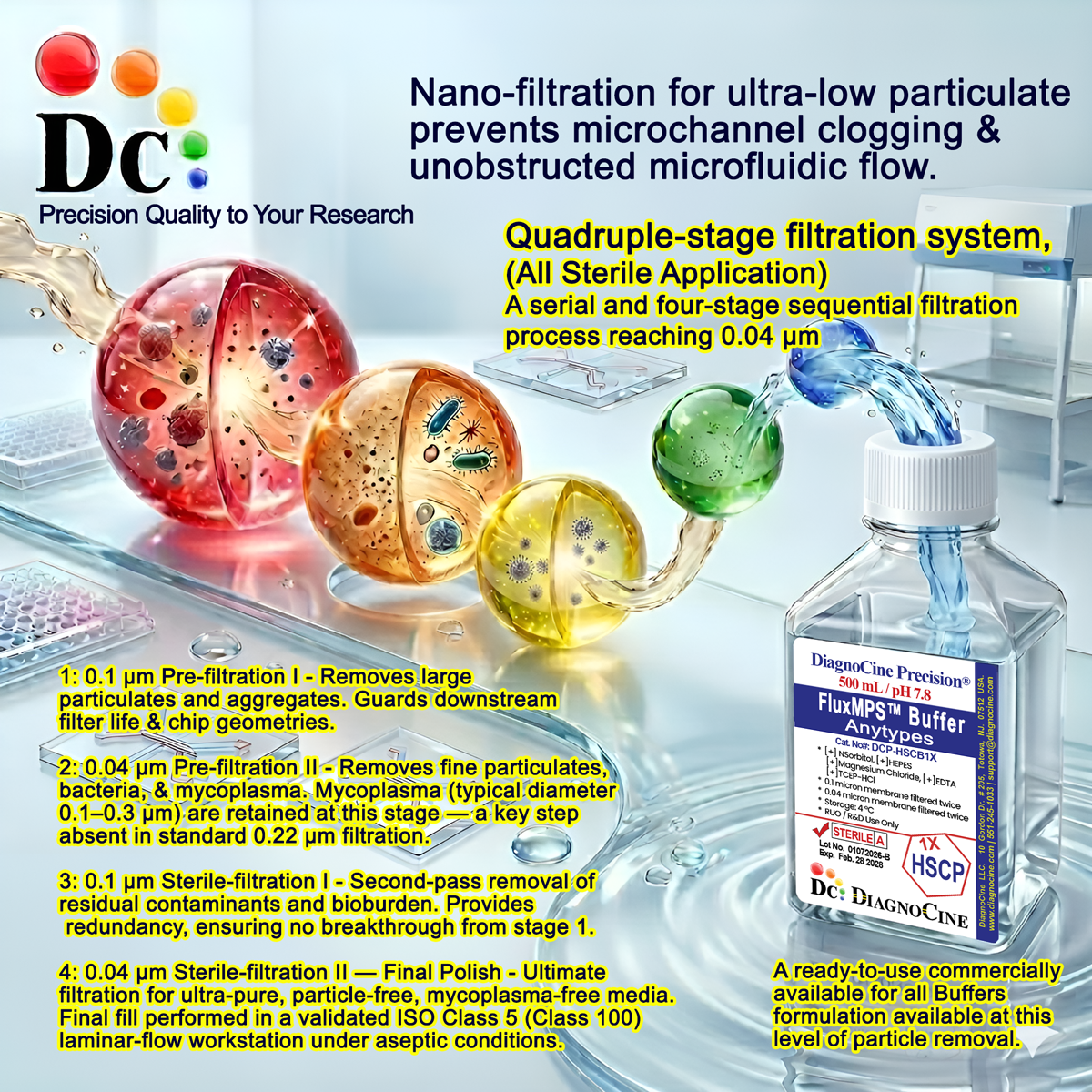
Quadruple-stage filtration system
DCP-TAE10X is processed through four sequential filtration passes — a 0.1-micron membrane filtered twice followed by a 0.04-micron membrane filtered twice — in a sterile environment to minimize particulate carryover into gels and downstream molecular biology workflows.
-
1
0.1 µmPre-filtration I
First 0.1-micron membrane pass removes large particulate and aggregates from the TAE concentrate.
-
2
0.04 µmPre-filtration II
First 0.04-micron (40 nanometer) membrane pass retains fine particulates and bioburden; DiagnoCine Precision sterile filtration at this pore size is designed to address mycoplasma contamination, since the smallest mycoplasma species can be about 0.2 microns.
-
3
0.1 µmSterile-filtration I
Second 0.1-micron membrane pass provides redundant particulate reduction ahead of final polish.
-
4
0.04 µmSterile-filtration II — Final Polish
Second 0.04-micron membrane pass completes the sterile-filtered fill in a controlled environment.
Performance vs. conventional buffer
Sequential 0.1 µm and 0.04 µm filtration, applied twice each, removes finer particulates than a single 0.22 µm pass used in conventional TAE buffer preparations.
© Diagnocine® — DCP-TAE10X
Where DCP-TAE10X performs
Formulated as the world's cleanest buffer for cell and molecular biology experiments, DCP-TAE10X supports DNA electrophoresis and a broad range of downstream molecular and microfluidic workflows.
Automated Bioreactors & Robotics
An optional 0.01 µm (10 nm) ultra-filtered variant is available for automated liquid handling, bioreactor, and robotics platforms where valve and sensor protection is critical.
- Total Particulate Exclusion for automated fluidic pathways
- Valve & Sensor Protection in closed-loop dispensing systems
- Extended Perfusion Stability for long-duration automated runs
Inquiry Required: contact support@diagnocine.com to request the 0.01 µm ultra-filtered grade.
Micro Physiological System (MPS) & Chip
Ultra-clean TAE buffer suitable for microfluidic sample handling on chip-based platforms.
Wash, Dilution & Reconstitution
Prepares agarose gel running buffer at working concentration for nucleic acid workflows.
iPSC-Derived Model Handling
Low-particulate buffer chemistry compatible with sensitive molecular biology sample workflows.
Endothelial & Primary Cell Perfusion
Sterile-filtered buffer chemistry supports downstream primary cell and endothelial sample prep.
ELISA, Blotting & Blocking
Compatible dilution and wash chemistry for nucleic acid and protein-adjacent workflows.
Microscopy & Optical Sensing
Clear, colorless liquid does not interfere with imaging or downstream enzyme-based assays.
DCP-TAE10X specification sheet
Measured and declared values for DCP-TAE10X as manufactured by DiagnoCine Precision.
| Parameter | Specification |
|---|---|
| Formulation | Tris Acetate EDTA (TAE) Buffer, 10X concentrate |
| Appearance | Clear, Colorless Liquid |
| pH (at 10X concentration) | 8.0 |
| Tris base concentration | 400 mM |
| EDTA concentration | 10 mM |
| Glacial acetic acid concentration | 200 mM |
| Parameter | Specification |
|---|---|
| Sterility | Filtered in a sterile environment |
| Filtration USP <788> | 0.1-micron membrane filtered twice; 0.04-micron membrane filtered twice |
| Manufacturing standard ISO 13485 | ISO 13485-certified, CE-approved facility |
| Parameter | Specification |
|---|---|
| Storage temperature | Room Temperature, Cool and Dry Room |
| Shelf life | 24 months |
| Expiry | Use before the expiry date on the product label |
| Parameter | Specification |
|---|---|
| Manufacturing facility | ISO 13485-certified, CE-approved (Suppliers of DiagnoCine Precision) |
| Final packaging & QA | DiagnoCine R&D and Quality Testing Center |
| Customization & assembly site | DiagnoCine Precision, Totowa, New Jersey, USA |
| Intended use | For Research Use Only (RUO) |
Full composition
Tris Acetate EDTA buffering system, 10X concentrate, per lot release.
| Component | CAS Number | Concentration |
|---|---|---|
| Tris base | 77-86-1 | 400 mM |
| EDTA | 60-00-4 | 10 mM |
| Glacial acetic acid | 64-19-5 | 200 mM |
Manufacturing & compliance
DCP-TAE10X is manufactured, filtered, and packaged under controlled, certified conditions.
ISO 13485:2016 QMS
Manufactured under ISO 13485-certified and CE-approved facilities (Suppliers of DiagnoCine Precision).
Ultrapure Type 1 Water
Formulated with Ultrapure Type 1 water (18.2 MΩ·cm).
ISO Class 5 Fill & Finish
Filtered and filled in a controlled sterile environment.
Final QA at DiagnoCine
Final packaging, quality assurance, and testing performed at the DiagnoCine R&D and Quality Testing Center.
Sterility
Filtered in a sterile environment; quadruple-stage 0.1 µm / 0.04 µm membrane filtration.
Particulate Control USP <788>
Sequential membrane filtration architecture aligned with USP <788> particulate testing methodology.
Custom Assembly
Specific customization requests and assembly completed at DiagnoCine Precision, Totowa, New Jersey, USA.
Documentation / CoA
Lot-specific Certificate of Analysis available upon request.
How DCP-TAE10X compares
A side-by-side look at filtration architecture and manufacturing controls.
| Parameter | DCP-TAE10X (FluxMPS™) | Conventional Buffer | Standard Alternative |
|---|---|---|---|
| Final filtration pore size | 0.04 µm | 0.22 µm | 0.22 µm |
| Number of filtration stages | 4 | 1 | 1 |
| Filtered in sterile environment | check_circle | cancel | cancel |
| Defined pH at 10X | check_circle | check_circle | cancel |
| Manufacturing QMS | ISO 13485:2016 | Not specified | Not specified |
| Custom formulation | check_circle | cancel | cancel |
Frequently asked questions
Common questions about DCP-TAE10X Tris Acetate EDTA Buffer.
Supporting literature
Curated literature relevant to TAE buffer chemistry, DNA electrophoresis, and microfluidic sample handling.
- Lee, P.J. et al. Microfluidic application-specific integrated device for monitoring direct cell-cell communication. doi:10.1063/1.2000343
- Sambrook, J., Russell, D.W. Molecular Cloning: A Laboratory Manual, Gel Electrophoresis of DNA. Cold Spring Harbor Laboratory Press. doi:10.1101/pdb.top96
- Brody, J.R., Kern, S.E. History and principles of conductive media for standard DNA electrophoresis. Anal Biochem. doi:10.1016/j.ab.2004.02.021
- Huang, Y. et al. Effects of buffer composition on DNA migration in agarose gel electrophoresis. Electrophoresis. doi:10.1002/elps.200900010
- Bustin, S.A. et al. Chelating agents and nucleic acid stability: the role of EDTA. Biotechniques. doi:10.2144/000112598
- Huh, D. et al. Reconstituting organ-level lung functions on a chip. Science. doi:10.1126/science.1188302
- Bhatia, S.N., Ingber, D.E. Microfluidic organs-on-chips. Nat Biotechnol. doi:10.1038/nbt.2989
- Williams, K.P. et al. Sterile filtration and mycoplasma control in cell culture reagent manufacturing. In Vitro Cell Dev Biol Anim. doi:10.1007/s11626-010-9337-5