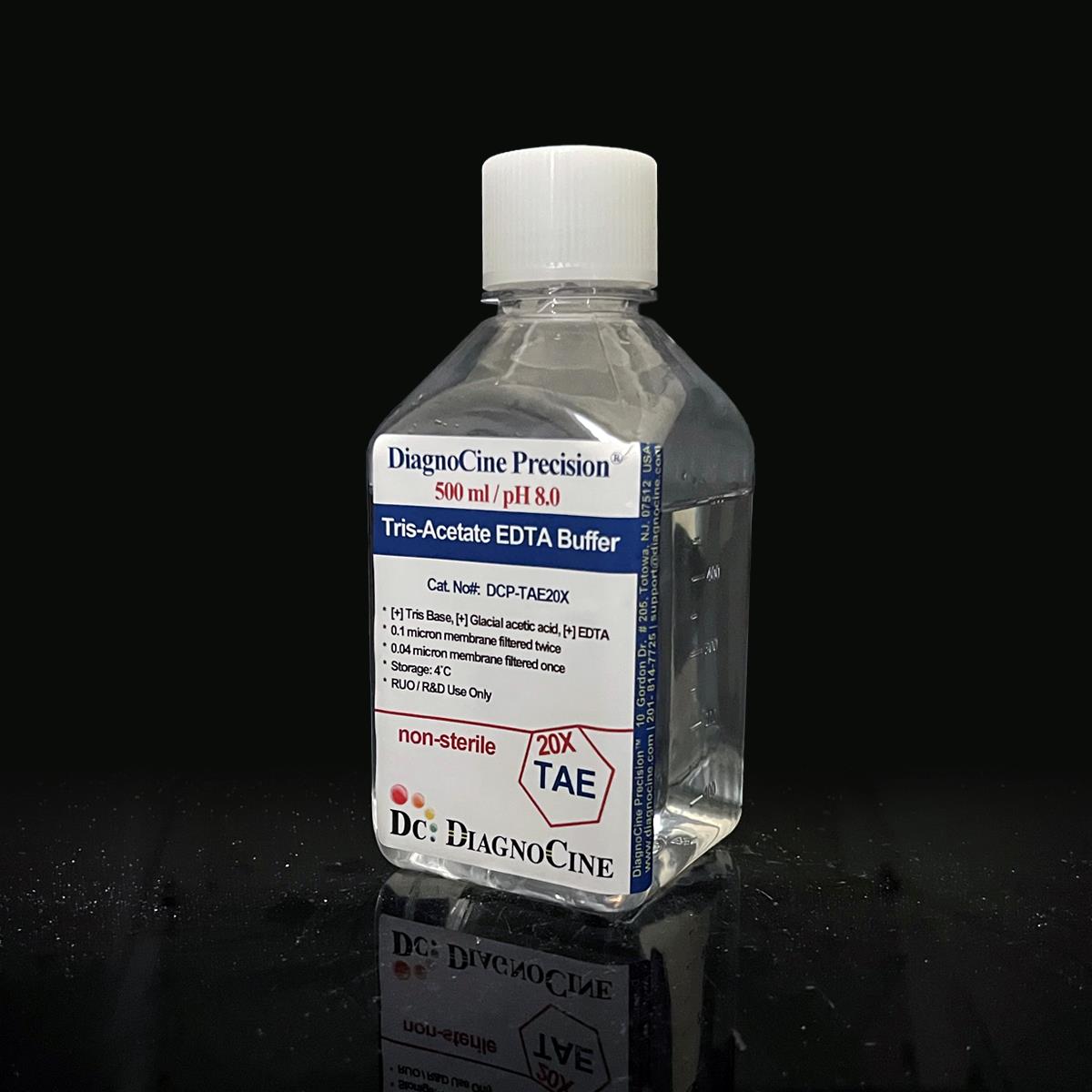
Tris Acetate EDTA Buffer [20X]
FluxMPS™ Tris Acetate EDTA Buffer [20X]
An MPS-grade, quadruple-stage ultra-filtered 20X TAE running buffer formulated at pH 8.0 with defined Tris base, glacial acetic acid, and EDTA molarity for reproducible agarose and polyacrylamide gel electrophoresis. Filtered 0.1 µm membrane twice and 0.04 µm membrane twice to minimize particulate and nuclease carry-over into downstream molecular biology and microfluidic electrophoresis workflows.
- Quadruple-stage ultra-filtration: 0.1 µm membrane filtered twice and 0.04 µm membrane filtered twice
- Defined 20X molarity: 800 mM Tris base, 400 mM glacial acetic acid, 20 mM EDTA
- pH 8.0 formulation supports consistent, negatively-charged DNA migration during electrophoresis
- Formulated with Ultrapure Type 1 water (18.2 MΩ·cm)
- No detectable DNase or RNase activity after 18-hour incubation testing
- Microchannel-safe purity suited to Lab-on-a-Chip (LoC) electrophoresis systems
- Non-sterile, research-grade formulation manufactured under ISO 13485-certified, CE-approved facilities
- Concentration, pH, and additive customization available on request
- FormulationTris-Acetate-EDTA (TAE), 20X
- pH8.0
- Tris base800 mM
- Glacial acetic acid400 mM
- EDTA20 mM
- AppearanceClear, colorless liquid
- SterilityNon-sterile
- Filtration0.1 µm x2 + 0.04 µm x2
- Storage4°C
- Shelf Life2 years
Engineered where standard TAE buffers fail
Conventional 0.22 µm-filtered TAE buffer can carry subvisible particulates, residual nuclease activity, and inconsistent pH into gel electrophoresis and microfluidic nucleic acid workflows. FluxMPS™ addresses each failure mode directly.
Microchannel-safe purity
Quadruple-stage filtration down to a 0.04 µm final pore size reduces particulate load beyond a single 0.22 µm pass.
Precise, stable pH
Formulated to pH 8.0 to keep DNA phosphate groups deprotonated for consistent electrophoretic migration.
Ultrapure-grade water
Base water is Ultrapure Type 1 (18.2 MΩ·cm) to reduce background contamination.
Low background for downstream assays
No detectable DNase or RNase activity after 18-hour incubation, protecting sample integrity.
Defined, traceable composition
800 mM Tris base, 400 mM glacial acetic acid, and 20 mM EDTA at 20X, lot-tested for nuclease contamination.
Customization on demand
Alternate concentrations, pH, and chemical/protein additions available on request.
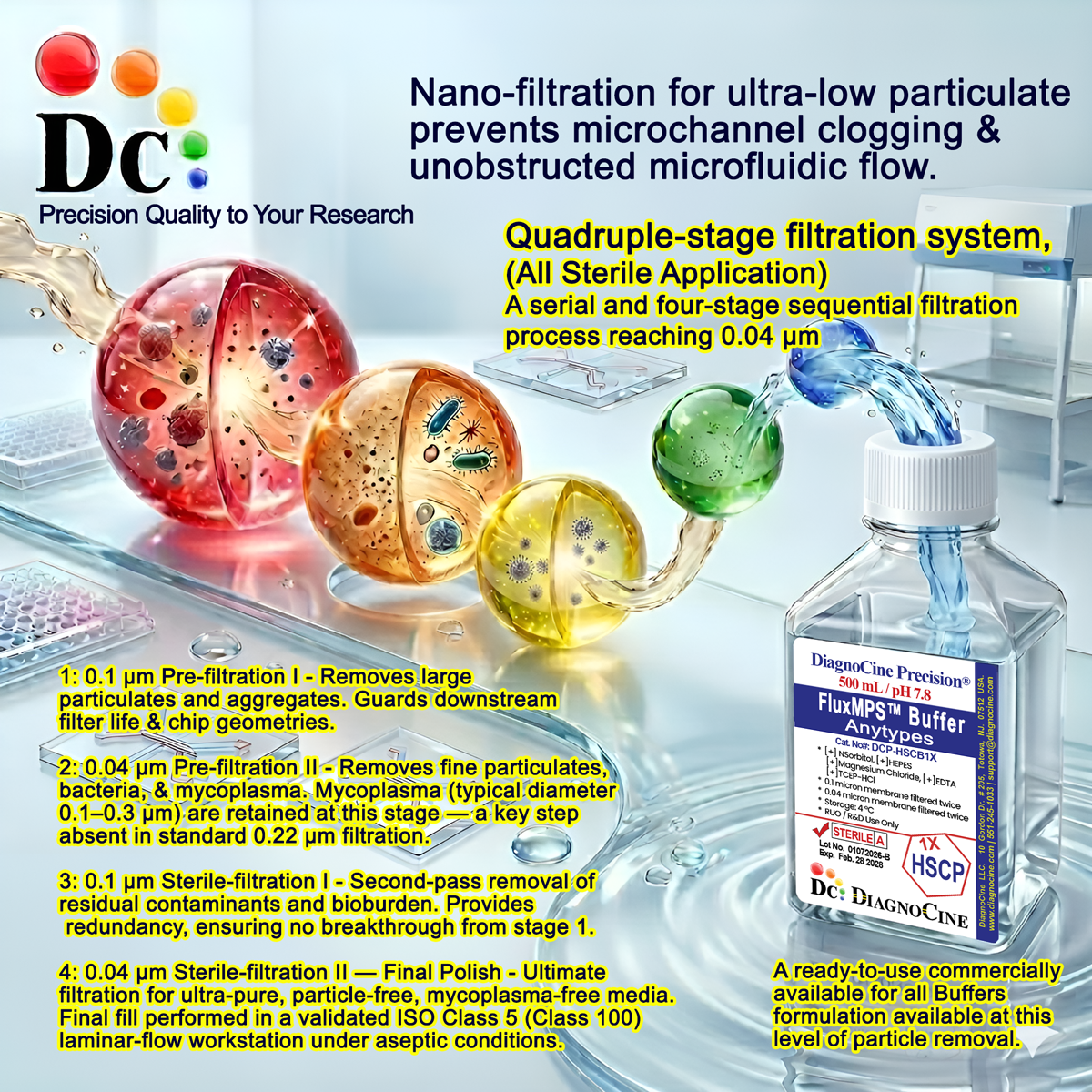
Quadruple-stage filtration system
DCP-TAE20X is filtered 0.1 µm membrane twice and 0.04 µm membrane twice, reducing particulate carry-over relative to a single 0.22 µm filtration pass while remaining a non-sterile, research-grade reagent.
-
1
0.1 µmPre-filtration I
Removes large particulates and aggregates, extending the life of downstream filters.
-
2
0.04 µmPre-filtration II
Retains fine particulates ahead of the second filtration pass.
-
3
0.1 µmSecond-pass Filtration I
A repeat 0.1 µm pass provides redundant particulate removal.
-
4
0.04 µmFinal Filtration Polish
A second 0.04 µm pass provides a final polish; the smallest mycoplasma types are about 0.2 microns, so this fine filtration step helps prevent mycoplasma contamination during manufacturing.
Performance vs. conventional buffer
Sequential 0.1 µm and 0.04 µm filtration, each applied twice, removes finer particulates than a single-pass 0.22 µm filtered buffer used in conventional TAE preparations.
© Diagnocine® — DCP-TAE20X
Where FluxMPS™ TAE Buffer is used
Tris Acetate EDTA Buffer [20X] is a running buffer for agarose and polyacrylamide gel electrophoresis, keeping DNA molecules deprotonated and negatively charged for migration toward the positive electrode, while acetate ions maintain buffering capacity and conductivity during the run.
Automated Bioreactors & Robotics
For automated liquid-handling and robotic microfluidic electrophoresis systems, an optional 0.01 µm (10 nm) ultra-filtered variant of this buffer is available to further reduce particulate ingress into valves, channels, and sensors.
- Total Particulate Exclusion — finer filtration for automated pipetting and gel-loading systems
- Valve & Sensor Protection — reduced particulate load protects microfluidic hardware
- Extended Perfusion Stability — consistent buffer performance during long automated runs
Inquiry Required: the 0.01 µm (10 nm) ultra-filtered grade is available by request — contact support@diagnocine.com.
Lab-on-a-Chip (LoC) Electrophoresis
Ultra-filtered TAE buffer suited to microfluidic and chip-based nucleic acid electrophoresis systems.
DNA Extraction from Agarose Gels
TAE buffer supports efficient DNA extraction from agarose gels following electrophoresis.
Genotyping of iPSC-Derived Models
Supports gel-based genotyping and mutation confirmation across iPSC-derived research models.
Genotyping in Vascular Cell Research
Used for nucleic acid analysis supporting endothelial and primary vascular cell research workflows.
Denaturing Gradient Gel Electrophoresis
Applied in DGGE workflows for mutation analysis and DNA mobility studies with or without added salts such as NaCl.
Cloning Workflow Compatibility
Does not interfere with the activity of enzymes used in downstream cloning procedures.
Full specification data
All values below are as measured or declared for DCP-TAE20X.
| Parameter | Specification |
|---|---|
| Formulation | Tris Acetate EDTA (TAE) Buffer, 20X concentrate |
| Appearance | Clear, colorless liquid |
| pH | 8.0 |
| Tris base concentration | 800 mM |
| Glacial acetic acid concentration | 400 mM |
| EDTA concentration | 20 mM |
| Parameter | Specification |
|---|---|
| Sterility | Non-sterile |
| Filtration environment | Non-sterile environment |
| DNase activity | None detected (18 hr, room temperature, plasmid DNA) |
| RNase activity | None detected (18 hr, room temperature, ribosomal RNA) |
| Water quality USP <85> | Ultrapure Type 1 water (18.2 MΩ·cm) |
| Manufacturing standard ISO 13485 | ISO 13485-certified, CE-approved facility |
| Parameter | Specification |
|---|---|
| Storage temperature | 4°C |
| Shelf life | 2 years |
| Parameter | Specification |
|---|---|
| Manufacturing facility | ISO 13485-certified, CE-approved supplier facility (Diagnocine Precision) |
| Traceability | Final packaging, QA, and testing performed at Diagnocine R&D and Quality Testing Center |
| Regulatory alignment | CE-approved |
| Production location | Diagnocine Precision, Totowa, New Jersey, USA |
| Intended use | Research Use Only (RUO) |
Full composition
Component concentrations for the 20X Tris Acetate EDTA Buffer concentrate.
| Component | CAS Number | Concentration |
|---|---|---|
| Tris base | 77-86-1 | 800 mM |
| EDTA | 60-00-4 | 20 mM |
| Glacial acetic acid | 64-19-4 | 400 mM |
Manufacturing & compliance
DCP-TAE20X is manufactured under ISO 13485-certified, CE-approved supplier facilities, with final packaging, QA, and testing performed at the Diagnocine R&D and Quality Testing Center.
ISO 13485:2016 QMS
Manufactured under ISO 13485-certified, CE-approved supplier facilities (Diagnocine Precision).
Ultrapure Type 1 Water
Formulated using Ultrapure Type 1 water (18.2 MΩ·cm).
Controlled Filtration Environment
Filtered 0.1 µm membrane twice and 0.04 µm membrane twice under controlled, non-sterile processing conditions.
Micro-Batch Precision
Final packaging, quality assurance, and customization assembly completed at Diagnocine Precision in Totowa, New Jersey, USA.
DNase Activity Testing
None detected after incubation of plasmid DNA and this product for 18 hr at room temperature.
RNase Activity Testing
No RNase activity detected after incubation of ribosomal RNA and this product for 18 hr at room temperature.
Non-Sterile Formulation Disclosure
Product is filtered for particulate and nuclease control but is not sterile-filled; intended for Research Use Only.
Documentation / CoA
Certificate of Analysis available detailing appearance, pH, filtration, and DNase/RNase test results.
How DCP-TAE20X compares
A comparison of purity and manufacturing attributes against conventional TAE buffer options.
| Parameter | DCP-TAE20X (FluxMPS™) | Conventional TAE Buffer (0.22 µm filtered) | Standard Alternative (lab-prepared TAE) |
|---|---|---|---|
| Defined pH | check_circle pH 8.0 | check_circle | cancel |
| Final filtration pore size | 0.04 µm | 0.22 µm | Not filtered |
| Number of filtration stages | 4 | 1 | 0 |
| DNase activity tested | check_circle | cancel | cancel |
| RNase activity tested | check_circle | cancel | cancel |
| Water quality | Ultrapure Type 1 (18.2 MΩ·cm) | Standard purified water | Tap/DI water |
| Manufacturing QMS | ISO 13485-certified | cancel | cancel |
| Microfluidic / LoC compatibility | check_circle | cancel | cancel |
| Custom formulation available | check_circle | cancel | cancel |
Frequently asked questions
Common questions about DCP-TAE20X Tris Acetate EDTA Buffer [20X].
Supporting literature
Curated literature relevant to TAE buffer chemistry and gel electrophoresis applications.
- Lee PY, et al. Agarose gel electrophoresis for the separation of DNA fragments. J Vis Exp. 2012. doi:10.3791/3923
- Sambrook J, Russell DW. Molecular Cloning: A Laboratory Manual. Gel electrophoresis buffer systems. Cold Spring Harb Protoc. 2006. doi:10.1101/pdb.top88
- Brody JR, Kern SE. History and principles of conductive media for standard DNA electrophoresis. Anal Biochem. 2004;333(1):1-13. doi:10.1016/j.ab.2004.05.054
- Myers RM, Fischer SG, Lerman LS, Maniatis T. Nearly all single base substitutions in DNA fragments joined to a GC-clamp can be detected by denaturing gradient gel electrophoresis. Nucleic Acids Res. 1985;13(9):3131-3145. doi:10.1093/nar/13.9.3131
- Stellwagen NC. Electrophoresis of DNA in agarose gels, polyacrylamide gels and in free solution. Electrophoresis. 2009;30(S1):S188-S195. doi:10.1002/elps.200900052
- Bustin SA, Nolan T. Pitfalls of quantitative real-time reverse-transcription polymerase chain reaction. J Biomol Tech. 2004;15(3):155-166.
- Huang Y, et al. Microfluidic capillary and chip electrophoresis for nucleic acid analysis. Anal Bioanal Chem. 2019;411:4407-4419. doi:10.1007/s00216-019-01669-6
- Bushnell TP, et al. Endotoxin and contamination control strategies in laboratory perfusion and buffer systems. Lab Chip. 2015;15:3618-3638. doi:10.1039/C5LC00568J
- Razin S, Yogev D, Naot Y. Molecular biology and pathogenicity of mycoplasmas. Microbiol Mol Biol Rev. 1998;62(4):1094-1156. doi:10.1128/MMBR.62.4.1094-1156.1998
- Ewing B, et al. Buffer capacity and ionic strength effects on nucleic acid electrophoretic mobility. Electrophoresis. 2011;32:3122-3130. doi:10.1002/elps.201100189