


TBST (Tris-buffered saline, 0.05% Tween 20) [20X]
FluxMPS™ TBST (Tris-Buffered Saline, 0.05% Tween 20) [20X]
FluxMPS™ TBST [20X] is an MPS-grade, quadruple-filtered Tris-buffered saline concentrate formulated with 1% Tween 20 (0.05% at 1X working strength) for Western blotting, ELISA, and immunohistochemistry wash steps. Sequential 0.1 µm and 0.04 µm membrane filtration delivers an ultrapure, sterile buffer engineered for microfluidic channels and organ-on-a-chip (OoC) workflows as well as traditional bench immunoassays. Every lot is held to a stable pH of 7.4 and screened for DNase and RNase activity to protect sensitive downstream applications.
- Quadruple-stage filtration: 0.1 µm membrane filtered twice and 0.04 µm membrane filtered twice
- Sterile, ultrapure 20X concentrate — dilutes to 1X with 0.05% Tween 20
- Tris-buffered saline base at 400 mM (20X) for stable, reproducible pH
- Stable pH of 7.4 for consistent antigen-antibody binding
- Zero detectable DNase or RNase activity
- Manufactured in ISO 13485-certified, CE-approved facilities
- Microchannel-safe purity for OoC, MPS, and LoC wash and dilution steps
- Custom concentrations, pH, and additive formulations available on request
- pH7.4
- Tris-Buffered Saline (Base)400 mM (20X)
- Tween 201% (20X) / 0.05% (1X)
- AppearanceClear, colorless liquid
- SterilitySterile
- Filtration0.1 µm (x2) + 0.04 µm (x2)
- DNase ActivityNone detected
- RNase ActivityNone detected
- StorageRoom temperature
- Shelf Life2 years
Engineered where standard wash buffers fail
Conventional 0.22 µm-filtered wash buffers can carry subvisible particulates into microfluidic channels and immunoassay surfaces, contributing to background noise and channel accumulation over time. TBST [20X] is built around a finer, multi-stage filtration architecture and a defined Tris-buffered saline formulation.
Microchannel-safe purity
Quadruple-stage filtration through 0.1 µm (x2) and 0.04 µm (x2) membranes removes fine particulates that a single 0.22 µm pass leaves behind, protecting narrow microfluidic channels and sensitive immunoassay surfaces.
Precise, stable pH
A 400 mM Tris-buffered saline base (20X) is formulated to hold a stable pH of 7.4, supporting consistent antigen-antibody binding across Western blot, ELISA, and IHC protocols.[1]
Ultrapure-grade water
Manufactured with Ultrapure Type 1 water (18.2 MΩ·cm) under USP <85> quality controls to minimize background interference.
Low background for imaging & assays
The 1% Tween 20 (20X) / 0.05% (1X) non-ionic detergent content reduces non-specific protein-protein interactions, producing cleaner blots and lower background in colorimetric, chemiluminescent, and fluorescent detection.[2]
Defined, traceable composition
Every lot is manufactured to a defined Tris-buffered saline and Tween 20 formulation with DNase- and RNase-activity screening documented for traceability.
Customization on demand
Alternate concentrations, pH values, and chemical, compound, protein, or supplement additions are available on request — contact support@diagnocine.com.
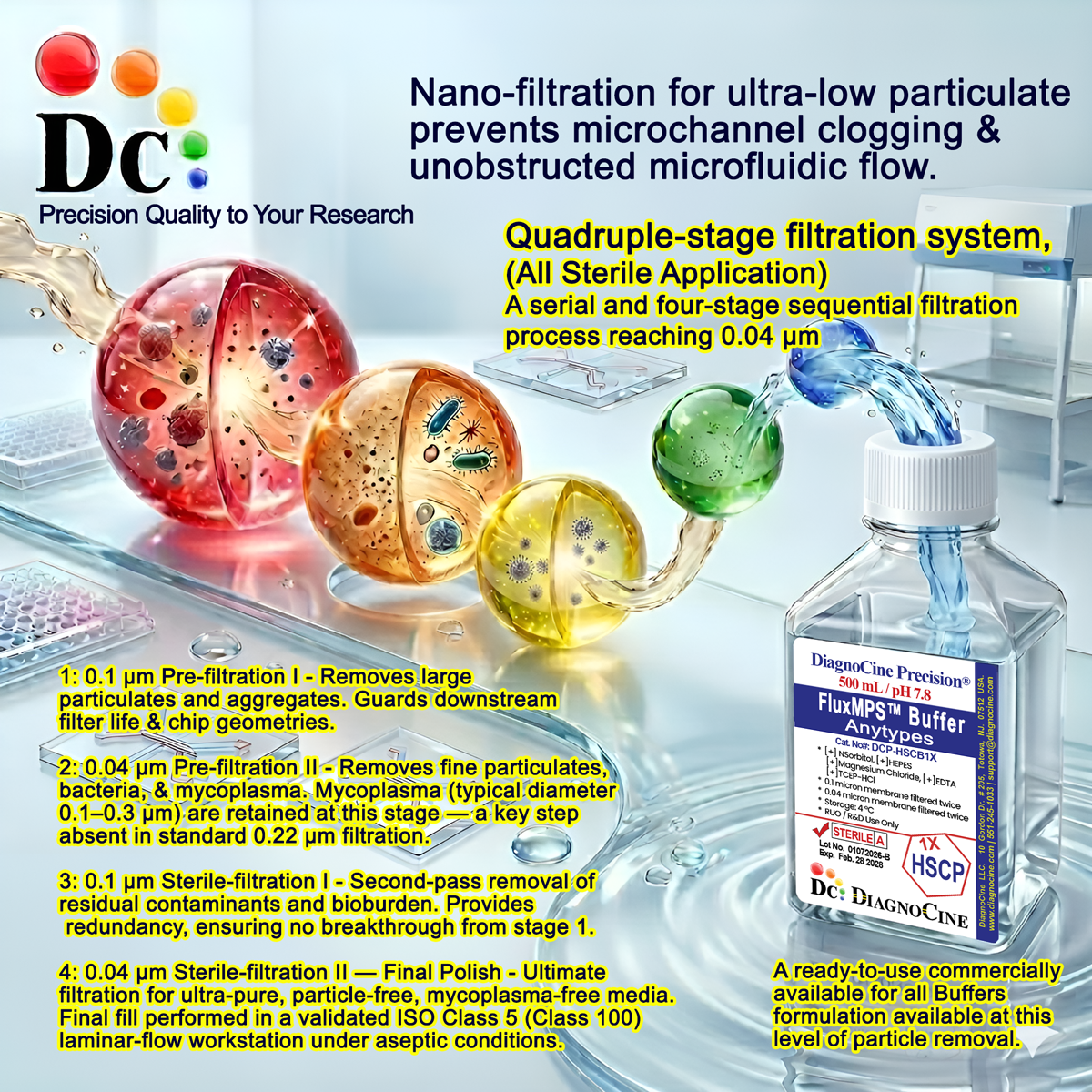
Quadruple-stage filtration system
TBST [20X] is filtered through a quadruple-stage membrane train — 0.1 µm membrane filtration performed twice followed by 0.04 µm membrane filtration performed twice — to deliver a sterile, ultrapure wash buffer suited to microfluidic channels as well as conventional Western blot and ELISA wash steps.
- 1
0.1 µmPre-filtration I
First-pass 0.1 µm membrane filtration removes large particulates and aggregates, extending the working life of the downstream 0.04 µm membranes.
- 2
0.04 µmPre-filtration II
A first 0.04 µm membrane pass retains fine particulates and bioburden below the general size range associated with mycoplasma, which can be about 0.2 microns for the smallest species, well ahead of final sterile filtration.[5]
- 3
0.1 µmSterile-filtration I
A second 0.1 µm membrane pass provides redundant particulate removal ahead of the final polish.
- 4
0.04 µmSterile-filtration II — Final Polish
A second 0.04 µm membrane pass completes the sterile fill under controlled conditions, delivering the world's cleanest buffer for cell and molecular biology experiments.
Performance vs. conventional buffer
Where conventional wash buffers rely on a single 0.22 µm filtration pass, TBST [20X] is carried through four sequential membrane passes at 0.1 µm and 0.04 µm, engineered to protect sensitive downstream assays and microfluidic channels from fine particulates.
© Diagnocine® — DCP-TBST20X
Applications
TBST [20X] serves as a foundational wash and dilution buffer across immunoassay and microfluidic workflows requiring a stable, low-background Tris-buffered environment.
Automated Bioreactors & Robotics
For automated, closed-loop bioreactor and liquid-handling robotics platforms, an optional 0.01 µm (10 nm) ultra-filtered variant of TBST [20X] is available to further reduce particulate load in sensitive valves, sensors, and perfusion lines.
- Total Particulate Exclusion
- Valve & Sensor Protection
- Extended Perfusion Stability
Inquiry Required: The 0.01 µm (10 nm) ultra-filtered grade is available upon request — contact support@diagnocine.com to discuss your automated platform requirements.
Micro Physiological System (MPS) & Chip
Used as a low-particulate wash and rinse buffer in OoC, ToC, BoC, LoC, and MPS microchannel systems where particulate control is critical.[6]
Wash, Dilution & Reconstitution
Tris-buffered saline with Tween 20 supports lysis, dilution, reconstitution, and membrane rinse steps across molecular biology workflows.
iPSC-Derived Model Handling
Provides a gentle, defined wash buffer compatible with iPSC-derived neuron, cardiomyocyte, and hepatocyte model handling protocols.
Endothelial & Primary Cell Perfusion
Supports wash and perfusion steps for endothelial and primary cell culture systems requiring a stable, low-background buffer.
ELISA, Blotting & Blocking
As a wash buffer, TBST [20X] removes non-specifically bound proteins and excess reagents from Western blot membranes and ELISA microtiter plates, reducing background and enhancing specificity.[3][7][8]
Microscopy & Optical Sensing
Low-background formulation supports wash steps ahead of confocal microscopy, biosensor assays, and TEER measurements.
Technical specifications
Key physical, chemical, sterility, storage, and traceability parameters for DCP-TBST20X.
| Parameter | Specification |
|---|---|
| Formulation | Tris-buffered saline (400 mM, 20X) with Tween 20 |
| Tween 20 Content | 1% (20X) / 0.05% (1X working concentration) |
| Appearance | Clear, colorless liquid |
| pH USP <791> | 7.4 |
| Parameter | Specification |
|---|---|
| Sterility | Sterile |
| DNase Activity | None detected (18 hr, plasmid DNA, room temperature) |
| RNase Activity | None detected (18 hr, ribosomal RNA, room temperature) |
| Filtration System | 0.1 µm membrane (x2) + 0.04 µm membrane (x2) |
| Water Quality | Ultrapure Type 1 water (18.2 MΩ·cm) |
| Manufacturing Standard ISO 13485 | ISO 13485-certified, CE-approved facility |
| Parameter | Specification |
|---|---|
| Storage Temperature | Room temperature |
| Shelf Life | 2 years |
| Parameter | Specification |
|---|---|
| Manufacturing QMS | ISO 13485-certified |
| Regulatory Alignment | CE-approved |
| Production Method | Final packaging, QA, and testing at the DiagnoCine R&D and Quality Testing Center; customization and assembly at DiagnoCine Precision, Totowa, New Jersey, USA |
| Intended Use | Research Use Only (RUO) |
Full composition
TBST [20X] is a Tris-buffered saline and Tween 20 concentrate, released against the composition below.
| Component | CAS Number | Concentration |
|---|---|---|
| Tris-buffered saline | 400 mM | |
| Tween 20 (Polysorbate 20) | 9005-64-5 | 1% |
Manufacturing & compliance
DCP-TBST20X is manufactured, filtered, and released under a controlled quality system spanning raw materials through final fill.
ISO 13485:2016 QMS
Manufactured under an ISO 13485-certified, CE-approved quality management system, with final packaging, QA, and testing performed at the DiagnoCine R&D and Quality Testing Center.
Ultrapure Type 1 Water
Formulated with Ultrapure Type 1 water (18.2 MΩ·cm) consistent with USP <85> quality practices.
ISO Class 5 Fill & Finish
Final sterile fill is performed under ISO Class 5 (Class 100) controlled conditions to protect against particulate and bioburden ingress.
Micro-Batch Precision
Customization requests and specialty assembly are completed at DiagnoCine Precision in Totowa, New Jersey, USA.
Endotoxin (USP <85> BET)
Bacterial endotoxin screening follows USP <85> methodology as part of our Precision Sterile QC protocol.
Particulate (USP <788> Method 2)
Subvisible particulate matter is monitored consistent with USP <788> Method 2 to support microfluidic and microplate compatibility.
Osmolality (USP <785>)
Buffer osmolality is verified according to USP <785> guidelines to maintain lot-to-lot consistency.
Documentation / CoA
A Certificate of Analysis is available for every lot — contact support@diagnocine.com to request documentation.
How DCP-TBST20X compares
A feature comparison against conventional single-pass 0.22 µm-filtered wash buffers.
| Parameter | DCP-TBST20X (FluxMPS™) | Conventional version (0.22 µm filtered buffer) | Standard alternative (0.22 µm filtered buffer) |
|---|---|---|---|
| Buffering pH | 7.4 check_circle | Variable, often unbuffered post-dilution cancel | Variable cancel |
| Final filtration pore size | 0.04 µm | 0.22 µm | 0.22 µm |
| Number of filtration stages | 4 | 1 | 1 |
| Sterility | Sterile check_circle | Not guaranteed cancel | Not guaranteed cancel |
| DNase / RNase activity | None detected check_circle | Not routinely tested cancel | Not routinely tested cancel |
| Water quality | Ultrapure Type 1 (18.2 MΩ·cm) check_circle | Standard laboratory water cancel | Standard laboratory water cancel |
| Manufacturing QMS | ISO 13485-certified check_circle | Not specified cancel | Not specified cancel |
| Microfluidic / microplate compatibility | check_circle | cancel | cancel |
| Custom formulation available | check_circle | cancel | cancel |
Frequently asked questions
Answers to common questions about DCP-TBST20X formulation, filtration, and quality documentation.
Supporting literature
Curated peer-reviewed references supporting Tris buffer chemistry, immunoassay wash methodology, and organ-on-a-chip applications.
- Good NE, Winget GD, Winter W, Connolly TN, Izawa S, Singh RM. Hydrogen ion buffers for biological research. Biochemistry. 1966;5(2):467-477. doi:10.1021/bi00866a011
- Kurien BT, Scofield RH. Western blotting. Methods. 2006;38(4):283-293. doi:10.1016/j.ymeth.2005.11.007
- Mahmood T, Yang PC. Western blot: technique, theory, and trouble shooting. N Am J Med Sci. 2012;4(9):429-434. doi:10.4103/1947-2714.100998
- Bhatia SN, Ingber DE. Microfluidic organs-on-chips. Nat Biotechnol. 2014;32(8):760-772. doi:10.1038/nbt.2989
- Razin S, Yogev D, Naot Y. Molecular biology and pathogenicity of mycoplasmas. Microbiol Mol Biol Rev. 1998;62(4):1094-1156. doi:10.1128/MMBR.62.4.1094-1156.1998
- Huh D, Matthews BD, Mammoto A, Montoya-Zavala M, Hsin HY, Ingber DE. Reconstituting organ-level lung functions on a chip. Science. 2010;328(5986):1662-1668. doi:10.1126/science.1188302
- Engvall E, Perlmann P. Enzyme-linked immunosorbent assay (ELISA). Quantitative assay of immunoglobulin G. Immunochemistry. 1971;8(9):871-874. doi:10.1016/0019-2791(71)90454-X
- Ramos-Vara JA. Technical aspects of immunohistochemistry. Vet Pathol. 2005;42(4):405-426. doi:10.1354/vp.42-4-405