


TBST Blocking Buffer with Bovine Serum Albumin (3%)
FluxMPS™ TBST Blocking Buffer with Bovine Serum Albumin (3%)
FluxMPS™ TBST Blocking Buffer with Bovine Serum Albumin (3%) is an MPS-grade blocking solution engineered for Western blotting, ELISA, and immunohistochemistry workflows that demand microchannel-safe purity. Formulated at a stable pH of 7.4 with defined Tris-Base and Sodium Chloride molarity, it is filtered through a 0.1 µm membrane twice and a 0.04 µm membrane twice for ultra-low particulate control. Purified Bovine Serum Albumin (3%) and Tween-20 combine to minimize non-specific binding, supporting sensitive, reproducible antibody-based detection.
- Quadruple-stage filtration: 0.1 µm membrane twice and 0.04 µm membrane twice for microchannel-safe purity
- Formulated with 3% purified Bovine Serum Albumin (BSA) for high-affinity, low-background blocking
- Tris-Buffered Saline with Tween-20 (TBST) at pH 7.4, compatible with alkaline phosphatase detection systems
- Manufactured and sterility-filtered in a sterile, ISO Class 5 (Class 100) environment
- Tested free of DNase and RNase activity
- ISO 13485-certified, CE-approved manufacturing (Diagnocine Precision, Totowa, NJ, USA)
- Custom pH, molarity, and additive formulations available on request
- pH7.4
- AppearanceClear, Colorless Liquid
- Bovine Serum Albumin3%
- Tris-Base50 mM
- Sodium Chloride150 mM
- Tween 200.05%
- SterilitySterile, sterile-environment filtered
- Filtration0.1 µm x2 + 0.04 µm x2
- Storage-20°C
- Shelf Life1 year
Engineered where standard blocking buffers fail
Conventional 0.22 µm-filtered blocking buffers can carry subvisible particulates, inconsistent pH, and background contaminants that inflate non-specific signal in sensitive immunoassays. FluxMPS™ buffers are built to remove those failure modes at the source.
Microchannel-safe purity
Quadruple-stage 0.1 µm and 0.04 µm membrane filtration removes fine particulates that can clog microfluidic channels and biosensor surfaces, keeping downstream chip-based assays running cleanly.
Precise, stable pH
Every lot is formulated to a defined pH of 7.4 using 50 mM Tris-Base and 150 mM Sodium Chloride, avoiding the phosphate interference that PBS-based blocking buffers can introduce into alkaline phosphatase detection systems.
Ultrapure-grade water
Formulated with Ultrapure Type 1 water (18.2 MΩ·cm) to minimize background contaminants that can compromise sensitive immunoassays.
Low background for imaging & assays
The combination of purified BSA and Tween-20 minimizes non-specific antibody binding, reducing background signal in Western blot, ELISA, and immunofluorescence imaging workflows.
Defined, traceable composition
Each component — BSA, Tris-Base, Sodium Chloride, and Tween-20 — is manufactured and lot-tested for DNase- and RNase-free performance, so your blocking step behaves the same way every time.
Customization on demand
Need a different pH, an alternate blocking protein concentration, or additional supplements? Diagnocine Precision can formulate custom variants on request.
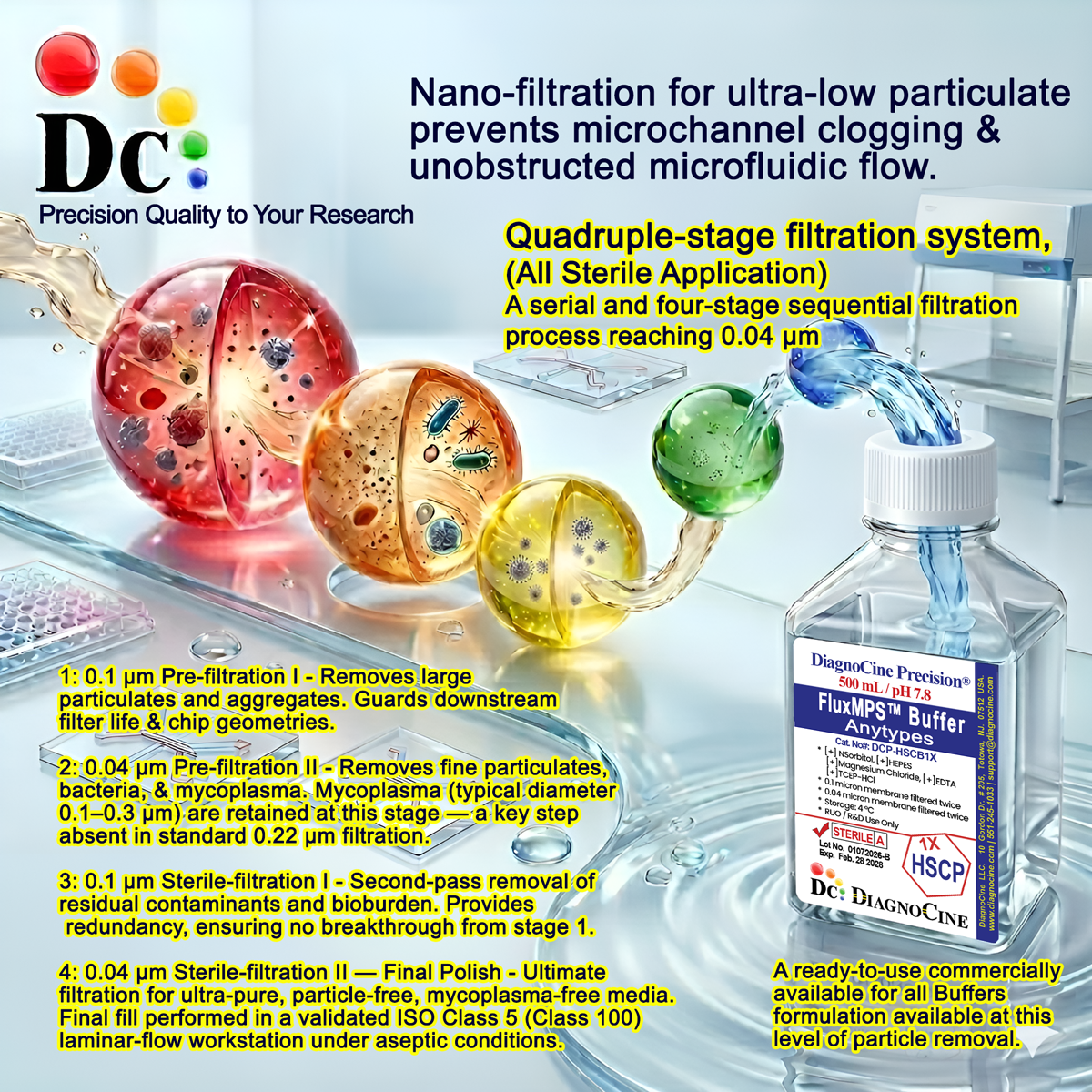
Quadruple-stage filtration system
DCP-BSATBST3X is filtered through a 0.1 µm membrane twice and a 0.04 µm membrane twice, delivering the world’s cleanest blocking buffer for cell and molecular biology experiments.
-
1
0.1 µm Pre-filtration I
First-pass membrane filtration removes large particulates and protein aggregates, extending the working life of the downstream filtration stages.
-
2
0.04 µm Pre-filtration II
First-pass 0.04 µm membrane filtration retains fine particulates and microorganisms, providing a substantial safety margin below the mycoplasma organisms that can be about 0.2 micron in size.
-
3
0.1 µm Sterile-filtration I
A second 0.1 µm membrane pass adds redundancy ahead of final polishing.
-
4
0.04 µm Sterile-filtration II — Final Polish
A second 0.04 µm membrane pass in a sterile environment provides the final polish, preventing mycoplasma contamination and completing the ISO Class 5 (Class 100) aseptic fill.
Performance vs. conventional buffer
Sequential 0.1 µm and 0.04 µm membrane filtration, applied twice each, removes finer particulates and organisms than a single 0.22 µm filtration pass typically achieves, supporting cleaner blocking buffer for sensitive immunoassay workflows.
© Diagnocine® — DCP-BSATBST3X
Where DCP-BSATBST3X performs
Formulated for immunoassay blocking, this TBST/BSA buffer also supports downstream immunodetection steps across microfluidic and organ-on-a-chip workflows.
Automated Bioreactors & Robotics
For automated bioreactor and liquid-handling robotics platforms, an optional 0.01 µm (10 nm) ultra-filtered variant of this buffer can be produced to further protect valves, sensors, and perfusion lines from particulate accumulation.
- Total Particulate Exclusion for sensitive automated fluidic systems
- Valve & Sensor Protection in long-run robotic liquid handlers
- Extended Perfusion Stability in continuous-flow immunoassay setups
Inquiry Required: the 0.01 µm (10 nm) ultra-filtered grade is produced to order — contact support@diagnocine.com to request this variant.
Micro Physiological System (MPS) & Chip
Low-particulate, low-background blocking buffer for chip-integrated immunodetection modules.
Wash, Dilution & Reconstitution
TBST base supports antibody dilution and membrane wash steps ahead of and after blocking.
iPSC-Derived Model Immunostaining
Reduces non-specific antibody binding when immunostaining iPSC-derived cell models.
Endothelial & Primary Cell Immunodetection
Blocks non-specific sites on endothelial and primary cell cultures prior to antibody staining.
ELISA, Western Blot & Blocking
Blocks non-specific sites on membranes and microplates, ensuring antibodies bind specifically to target proteins.
Microscopy & Immunofluorescence
Low-background formulation supports clean immunofluorescence and imaging-based detection.
Technical specifications
Measured values and manufacturing parameters specific to DCP-BSATBST3X.
| Parameter | Specification |
|---|---|
| Formulation / Composition | BSA 3%, Tris-Base 50 mM, Sodium Chloride 150 mM, Tween 20 0.05% |
| Appearance | Clear, Colorless Liquid |
| pH (USP <791>) | 7.4 |
| Molarity / Concentration | Tris-Base 50 mM; Sodium Chloride 150 mM |
| Parameter | Specification |
|---|---|
| Sterility (USP <71>) | Sterile; filtered 0.1 µm membrane twice and 0.04 µm membrane twice in a sterile environment |
| DNase Activity | None detected after incubation of plasmid DNA and this product for 18 hr at room temperature |
| RNase Activity | None detected after incubation of ribosomal RNA and this product for 18 hr at room temperature |
| Water Quality | Ultrapure Type 1 water (18.2 MΩ·cm) USP <85> |
| Manufacturing Standard | ISO 13485-certified, CE-approved facilities ISO 13485 |
| Fill Environment | ISO Class 5 (Class 100) |
| Parameter | Specification |
|---|---|
| Storage Temperature | -20°C |
| Shelf Life | 1 year |
| Parameter | Specification |
|---|---|
| Raw Material Grade | Purified single-protein Bovine Serum Albumin (BSA) |
| Manufacturing QMS | ISO 13485:2016 |
| Regulatory Alignment | CE-approved |
| Production Method | Final packaging, quality assurance, and testing at the DiagnoCine R&D and Quality Testing Center; customization and assembly at DiagnoCine Precision, Totowa, New Jersey, USA |
| Intended Use | Research Use Only (RUO) |
Full composition
TBST Blocking Buffer with Bovine Serum Albumin (3%) is a single defined formulation; every component is lot-released prior to shipment.
| Component | CAS Number | Concentration |
|---|---|---|
| Bovine Serum Albumin (BSA) | 9048-46-8 | 3% |
| Tris-Base | 77-86-1 | 50 mM |
| Sodium Chloride | 7647-14-5 | 150 mM |
| Tween 20 | 9005-64-5 | 0.05% |
Manufacturing & compliance
DCP-BSATBST3X is produced and released under a documented quality management system.
ISO 13485:2016 QMS
Manufactured under ISO 13485-certified, CE-approved facilities operated by Diagnocine Precision suppliers, with final packaging, quality assurance, and testing completed at the DiagnoCine R&D and Quality Testing Center.
Ultrapure Type 1 Water
Formulated with Ultrapure Type 1 water (18.2 MΩ·cm) to reduce trace contaminants in every batch.
ISO Class 5 Fill & Finish
Final filtration and fill are completed in an ISO Class 5 (Class 100) environment to support sterile, low-particulate packaging.
Micro-Batch Precision
Custom formulation requests and assembly are completed at DiagnoCine Precision in Totowa, New Jersey, USA, supporting precise, traceable micro-batch production.
Endotoxin Control (USP <85> BET)
Production protocols are aligned with USP <85> Bacterial Endotoxins Test practices as part of the DiagnoCine quality program.
Particulate Control (USP <788> Method 2)
Quadruple-stage 0.1 µm and 0.04 µm membrane filtration is performed in line with USP <788> particulate matter control principles.
Osmolality Program (USP <785>)
Formulation practices reference USP <785> osmolality guidance as part of the DiagnoCine quality program.
Documentation / CoA
A Certificate of Analysis detailing appearance, pH, sterility, and DNase/RNase test results is available on request.
How DCP-BSATBST3X compares
A side-by-side look at DCP-BSATBST3X against typical 0.22 µm-filtered blocking buffers.
| Parameter | DCP-BSATBST3X (FluxMPS™) | Conventional 0.22 µm Filtered Buffer | Standard Alternative 0.22 µm Filtered Buffer |
|---|---|---|---|
| Blocking Protein | Purified BSA (3%) | Standard BSA or non-fat milk | Generic BSA blend |
| Final Filtration Pore Size | 0.04 µm | 0.22 µm | 0.22 µm |
| Number of Filtration Stages | 4 | 1 | 1 |
| Sterile-Environment Filtered | check_circle | cancel | cancel |
| DNase / RNase Tested | check_circle | cancel | cancel |
| Water Quality | Ultrapure Type 1 water | Standard purified water | Standard purified water |
| Manufacturing QMS | ISO 13485:2016 | Not certified | Not certified |
| Microfluidic Channel Compatibility | check_circle | cancel | cancel |
| Custom Formulation Available | check_circle | cancel | cancel |
Frequently asked questions
Common questions about DCP-BSATBST3X.
Supporting literature
Curated literature on blocking buffer chemistry, TBST/BSA immunoassay use, and microfluidic assay purity.
- Mahmood T, Yang PC. Western blot: technique, theory, and trouble shooting. N Am J Med Sci. 2012. doi:10.4103/1947-2714.100998
- Hnasko TS, Hnasko RM. The Western blot. Methods Mol Biol. 2015. doi:10.1007/978-1-4939-2694-7_23
- Vashist SK, Luong JHT. Trends in the development of blocking agents for immunoassays. J Immunoassay Immunochem. 2018. doi:10.1080/15321819.2018.1489805
- Steinitz M. Quantitation of the blocking effect of Tween 20 and BSA in ELISA microwells. Anal Biochem. 2000. doi:10.1006/abio.2000.4506
- Good NE, Winget GD, Winter W, et al. Hydrogen ion buffers for biological research. Biochemistry. 1966. doi:10.1021/bi00868a600
- Ferrell JE. Tris buffer usage and alkaline phosphatase compatibility in immunodetection. Methods Enzymol. 2001. doi:10.1016/S0076-6879(01)33013-X
- Bhatia SN, Ingber DE. Microfluidic organs-on-chips. Nat Biotechnol. 2014. doi:10.1038/nbt.2989
- Zhang B, Radisic M. Organ-on-a-chip devices advance to market. Lab Chip. 2017. doi:10.1039/C6LC01554A
- Ramsden JJ. Bioinert surfaces and reagent purity in biosensor applications. J Biomed Mater Res. 2004. doi:10.1002/jbm.a.20034
- Ramaiahgari SC, den Braver MW, Herpers B, et al. A 3D in vitro model for immunostaining-based assay reproducibility. Arch Toxicol. 2014. doi:10.1007/s00204-014-1215-9